


Erhalten Sie Zugang zu diesem und mehr als 300000 Büchern ab EUR 5,99 monatlich.
- Herausgeber: THP Ireland
- Kategorie: Ratgeber
- Sprache: Englisch
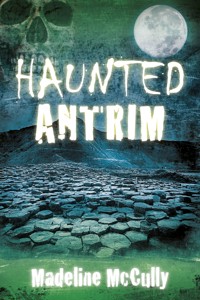
Discover the darker side of Antrim with this collection of spine-chilling tales from across the county. This spooky selection of stories includes the phantom coach of Dundermot Mound, Devil Worship at Crebilly, the witch of Glentow and the Grey Lady of the Dark Hedges as well as tales from such well-known locations as Antrim Castle, the ABC Theatre and the Giant's Causeway. Drawing on historical and contemporary sources and including many first-hand experiences and previously unpublished tales, Haunted Antrim will enthrall anyone interested in the unexplained.
Sie lesen das E-Book in den Legimi-Apps auf:
Seitenzahl: 184
Veröffentlichungsjahr: 2017
Das E-Book (TTS) können Sie hören im Abo „Legimi Premium” in Legimi-Apps auf:
Ähnliche

















HAUNTED
ANTRIM
HAUNTED
ANTRIM
Madeline McCully
I dedicate this book to my children
First published 2017
The History Press Ireland
50 City Quay
Dublin 2
Ireland
www.thehistorypress.ie
© Madeline McCully, 2017
The right of Madeline McCully to be identified as the Author of this work has been asserted in accordance with the Copyright, Designs and Patents Act 1988.
All rights reserved. No part of this book may be reprinted or reproduced or utilised in any form or by any electronic, mechanical or other means, now known or hereafter invented, including photocopying and recording, or in any information storage or retrieval system, without the permission in writing from the Publishers.
British Library Cataloguing in Publication Data.
A catalogue record for this book is available from the British Library.
ISBN 978 0 7509 8631 1
Typesetting and origination by The History Press
Printed and bound by CPI Group
eBook converted by Geethik Technologies
CONTENTS
Foreword
Acknowledgements
Introduction
one Eerie Castles
two Dark Hedges and Frightening Places
three Ill-fated Lovers
four Sinister Places and Malign Manifestations
five Ominous Signs
six Personal Stories
Bibliography
FOREWORD
I was delighted to be asked to write the foreword for Haunted Antrim, since that is my home county.
I was born in Ballymena, the ‘middle town’ of County Antrim, and in my early years there was no television so there was a lot of talking in our house. I listened to stories around the kitchen table and many of these tales concerned ghostly apparitions and haunted places. Sure, didn’t my own eldest brother, Bill, see and hear a wailing banshee the night before a death? He believed that till the day he died.
Wide-eyed and open-mouthed, I heard the stories about Galgorm Castle, located not a mile from my home. Even as a young child, I knew all about the locked room where Dr Colville reputedly sold his soul to the devil. Is it any wonder then that I grew up to be a storyteller with a liking for spooky tales?
In this collection, storyteller Madeline McCully has gathered together some of my favourite ghost stories from places that I know very well. Apart from my own background knowledge, people who live near particular locations have corroborated many of the tales.
For example, a classroom assistant in north Belfast once told me about hearing the hoof-beats of Galloper Thompson’s horse as he clattered around streets near her home. An old man in Randalstown told me all about the banshee of the O’Neills. Go to Rathlin Island and folk there can still recount the story of the dreadful massacre when many women and children were butchered by troops led by the Earl of Essex, under the orders of Sir Francis Drake and other English noblemen. It is said that from the mainland near Ballycastle, Sorley Boy McDonnell was seen ‘to run mad with sorrow’ as he watched the women and children he had sent to the sanctuary of the island being brutally butchered. They say their cries can still be heard on Rathlin and there was talk of retribution when HMS Drake was sunk just off the island in Church Bay by a German U-boat in 1917.
In these pages you will find characters such as Squire O’Hara, who rides out on Christmas Eve at Crebilly outside Ballymena, the White Lady, who haunts Antrim Castle, and the poor demented Lady Isabella, gazing out to sea from her tower at Ballygally Castle.
County Antrim has many places where every stone could tell a story. It would take a brave person to explore Dundermot Mound near Glarryford, one of two ‘Gateways to Hell’, a ghostly portal to the other world. Or indeed to tread on the stone steps at Bonamargy Friary outside Ballycastle, under which lies the body of the Black Nun, Julia McQuillan, who was famed for her predictions.
In her collection, Madeline provides intriguing titbits to lure readers into further investigation. She whets the appetite and shares intriguing evidence. Readers and listeners have an enduring thirst for this type of tale and the easy style of the writing will lead them to further explore this popular genre.
The telling of ghost stories is still flourishing in County Antrim, which now boasts its own Ghosts in the Glens Storytelling Festival every October. At the festival, listeners can learn more about frightening apparitions such as the Witch of Glentow or the Wraith of Rathlin, whom they meet here in these pages.
Sceptics may doubt the veracity of some of the stories, but I can vouchsafe that when I am out telling ghost stories, I always come home with more stories than I tell as listeners queue up to share their own experiences with me.
Reading Madeline McCully’s Haunted Antrim will give readers the chance to become better acquainted with some of the special places in my native county. I leave it up to the reader to decide what is true and what is not.
All I know is that when a sceptic asks me why I believe in the existence of such things as fairies or ghosts, I simply reply ‘because they exist’.
Liz WeirStoryteller, writer and listener2017
ACKNOWLEDGEMENTS
I have thoroughly enjoyed researching and writing the stories in this book. The Antrim coast is a favourite place of mine and over the years we have brought many visitors to the area to admire its majestic scenery and to share with them the myths and legends of this part of Ulster.
My husband Thomas has kept me focused throughout. He seemed to know instinctively when to bring cups of tea and put meals on the table during the writing process. He has driven me around and made each journey memorable and reminded of the importance of laughter.
In researching I have discovered more haunted places than I can include in this book. I must acknowledge the people who have shared their stories with me, in particular Jim McNeill, Thomas Robinson and Heather Barkley.
Ken McCormack’s help was invaluable. Ken is a collector, broadcaster, writer and a great storyteller in his own right. I thank him for his total availability when I needed help or clarification. Nothing was too much trouble for him including proofreading the final manuscript and I am extremely grateful. He was encouraging and supportive all the way.
Libraries N.I were unbelievably helpful – especially Linda Ming and Maura Craig of Derry Central Library who were always on hand to help with the research. The library is almost my second home.
I am grateful to the staff of Belfast Central Library who found suitable books for me and the Linen Hall Library who welcomed me, supplied information and books and a relaxed space in which to read them. Noreen Mullan of the Braid and Mid-Antrim Museum was most helpful and kind.
A very big thank you to Jim McCallion who gave me much needed help in preparing the photographs for the book. It is difficult to access photographs of times gone by but he was patient and always helpful when I asked for help.
I want to acknowledge information received from Joe Baker of the Glenravel History Project and Joe Grahame of Rushlight magazine.
I owe a debt of gratitude to Liz Weir, one of the world’s greatest storytellers. She runs various storytelling and musical events in her Ballyeamon barn. Thank you, Liz, for your encouragement and practical help in bringing this book to the public.
Over the years the Arts Council Northern Ireland have been generous in their awards for gathering and researching folklore. Without their help I couldn’t have continued to preserve these stories.
Finally, I would like to acknowledge The History Press’s editors, Beth Amphlett and Andrew Latimer, for their help in preparing the manuscript.
Many of those who contributed information wished to remain anonymous and I respect that. Therefore I will thank all of you at once for taking the time to tell me the stories and allowing me to use them. I hope that I have done them justice.
The long canal, Antrim Castle. (Photo L.Shepperd)
INTRODUCTION
For the olden memories fast are flying from us;
Oh, that some kind hand would come and bind them in a garland
Ere the present hardens and the past grows cold and dumb.
Sam Henry, Songs of the People
WHEN I hear a ghost story I am right back in my great-aunt’s little cottage in Donegal, with my ear pressed against the door of the lower bedroom, listening to the murmur of voices in the kitchen. How I would have loved to be among the men and women listening to their stories. But maybe the fact that we children were sent off to bed made me want to hear more and learn more about the ghosts and fairies who seemed to haunt the lonely roads and dark hills.
The cottage was without running water and electricity and two candles on saucers lit the bedroom. In their meagre light ghostly shadows flickered on the walls and the coats hanging on hooks looked like ghosts ready to emerge out of the gloom. When the thrill of being frightened became too much it was time to dive into the big iron bed and snuggle under the bedclothes, say my prayers and sink into sleep thinking of ghosts and goblins.
After the holidays back at home some of my friends had televisions in their houses but until I was 12 we didn’t. It was probably the best thing that could have happened because at night before we went to bed we took our supper in the firelight and my mother would often tell us stories that might not otherwise have been told.
My mother was born in Donegal and the cottage and the hills were our playground when the holidays came around. We heard stories that had been handed down from her parents and grandparents and it was as if the people and places she spoke of were still around.
In hindsight, I wish that I had asked more questions and listened more. But that early experience made me curious enough to gather stories and record them because although technology is wonderful we are in danger of losing the magic of storytelling.
I meet very interesting people as I travel around, and I’ve discovered that everyone has a story to tell. For the purposes of this book, however, I have had to confine myself to the haunted stories of County Antrim and the part of Belfast City which is in that county.
Many of the stories are based on tragedies of bygone times but I have included modern ones because the time for ghosts is not yet past. One story I heard several years ago when visiting the Glens of Antrim was the story of the ABC Theatre in Belfast. The story stuck in my mind and when I decided to include it I discovered that Jim MacNeill lived in Canada. He kindly talked to me several times on the phone and his words were so powerful I thought what better than to let him tell it himself.
When I hear about the presence of a ghost I want to research what is behind the story. I want to know the what, when, where, how and why. Often people would say that the appearance of a ghost goes back to a tragic event, or a warning of imminent danger or perhaps the person has left some unfinished business on earth, as in the old woman in the cow-herder’s story. Sometimes it is the appearance of a ‘wraith’ warning of a death as in the Rathlin story. The Banshee is one of the common apparitions of Celtic culture, a female creature who portends a death to come but that also serves to remind us of the dead by her recurring appearances.
The list of apparitions goes on, as do the mysteries – perhaps that is why ghost stories are such a source of endless fascination, particularly if we know the place where they take place and the history behind them.
Drawing on a mix of historical and contemporary sources, I hope this book will fascinate anyone with an appetite for the unexplained.
Antrim Castle.
1
EERIE CASTLES
The Ghosts ofAntrim Castle
Fear came upon me, and trembling, which made all my bones to shake. Then a spirit passed before my face; the hair of my flesh stood up.
The Book of Job 4:14-15
A ghostly presence is said to stalk the grounds of Antrim Castle. The unhappy apparition is believed to be the ghost of a young local girl called Ethel Gilligan, a servant girl working for the family at the castle at the time of an arson attack. Locals saw the blazing building and one man ran with a ladder and climbed to the window of the servants’ quarters to rescue Ethel. Although she wasn’t burnt, she later died of smoke inhalation. It seems that her spirit wanders close to the place where she was laid on the ground after her rescue and where she took her last breath. The locals refer to her ghost as the ‘White Lady’.
Antrim Castle had an eventful history during its 309 years. Sir Hugh Clotworthy, an Englishman of the planter class, was raised to the peerage by patent under Charles II and given the title of Baron of Lough Neagh and Viscount of Massereene. He oversaw the building of the castle in 1613 on the beautiful banks of the Six Mile Water River beside the lough. When his son, Sir John Clotworthy, inherited the title of Viscount Massereene, he set about extending the castle in 1662 or thereabouts.
The Stone Wolfhound and companion.
The Jacobite general Richard Hamilton raided the castle in the 1680s and gave his men the freedom to take whatever they wished as payment for their services to the king. They ran wildly through its corridors and rooms and looted the castle’s treasures of silver plate and furniture worth more than £3,000. Not content with that, they damaged much of what could not be removed.
Antrim Castle was rebuilt in 1813 as a three-storey Georgian-Gothic castellated mansion, designed by Dublin architect John Bowden. The seventeenth-century formal garden added at that time was a showpiece in Ulster, featuring a long canal with another canal at right angles to it. To complete the design, a moat reminiscent of that of a Norman castle was added.
The Massereene family took up residence again and Lord and Lady Massereene were hosting a grand ball in the castle on 28 October 1922 when an IRA gang allegedly set fire to it – apparently on information received from a servant who was thought to be a republican sympathiser.
The daughter of the Archbishop of Armagh, the Most Rev. Charles D’Arcy, who was staying there for the ball, was persuaded by a mysterious white-robed figure of a woman to jump out of a window to save herself.
The ghost of the ‘White Lady’ was seen walking in the gardens and amidst the ruins of the castle before its demolition in 1970. But this has not been the only paranormal activity on the grounds. Apparently, in former times a coach pulled by six black horses galloped towards the castle, but when it reached a deep pond, it sank, causing the death of all of those on board. On that anniversary each May the fearful whinnies of the animals accompanied by the screams of the drowning travellers disturb the night.
Yet another ghost story concerns Lady Marian Langford, daughter of Sir Roger Langford of Muckamore, who was engaged to Sir Hugh Clotworthy. Lady Marian was taking a stroll along the water’s edge when she was startled by a deep growl behind her. Upon turning round, she was faced with the horrifying sight of a wolf baring its teeth and ready to pounce. Lady Marian fell in a dead faint and when she came to she saw the bloodied body of the dead wolf and felt her hand being licked. Lying beside her was a wounded wolfhound, which in defending her had suffered injury. Lady Marian took him to Antrim Castle and tended his wounds but shortly afterwards the wolfhound mysteriously disappeared.
It is believed, though, that some years later the deep baying of a wolfhound was heard above the storm and this warned of an imminent attack by the enemy. A single cannon shot from ‘Roaring Tatty’, as the gun was called, was enough to repel the attack and at dawn a stone wolfhound was seen by the gateway.
It is said that this stone wolfhound will safeguard the Clotworthy family name so long as it is not removed. Legend also has it that this was once the flesh-and-blood animal that saved Lady Marian.
Spookily enough, those who walk through the gardens are often mystified by the sound of heavy breathing, not unlike that of a dog panting.
The Haunting ofGlenarm Castle
Glenarm Castle, built in 1636, stands ‘like the enchanted keep of a fairy tale … It became the residence of the McDonnells – Earls of Antrim – after the accident of Dunluce Castle compelled a removal to some safer spot.’ (Hall’s Ireland).
It is situated in a beautiful area of parkland and forest within sight and sound of the sea and it is the last place one would expect to find a haunted castle. But haunted it is, and the background story lies in its violent history.
After the Ulster Land War of the 1770s, Lord Antrim was governor of the county. He ruthlessly evicted his tenants from his demesne, leaving bitterness in the hearts of the people and, as one would expect, a desire for revenge. Lord Antrim feared for his life and travelled to Dublin to beg the lord lieutenant for a company of soldiers to accompany him to Glenarm.
On his return in the first week of February, he sat down to supper and for some unknown reason he first placed an unframed portrait of his mother-in-law, the late Lady Meredyth, on the sideboard. A shot, likely intended for him, was fired through the window and struck the portrait of the woman on the shoulder.
It must be said that another attempt was made, but that the assassin mistook young Lieutenant Walsh for Lord Antrim and shot him as he returned to Ballymena after visiting Glenarm Castle. The assassin probably saw the escort of two soldiers and assumed that it was the earl. Lord Antrim escaped further attacks on his life and died of natural causes in 1721.
About the year 1853, a later Lord Antrim was reminiscing with a friend about the shot portrait. The friend (referred to only as ‘LLA’) asked to see it and Lady Antrim, who was also present, point-blank refused to accompany him to the room where the old portrait had been left. She bade her husband to stay with her and directed the friend upstairs.
‘Turn right to a short passage and go into the third door,’ said she.
Glenarm Castle.
The room was small with little or no furniture and the only light came from a tiny window without a curtain. The visitor saw the portrait and wasn’t impressed. He described it later as ‘a mere daub of a very commonplace woman with a blue dress, a pearl necklace and a gold comb.’
The man crossed to the window to look out and when he faced the room again he was astounded to see a woman standing in the doorway. At first he thought that it was his imagination because daylight was fading fast, but to his alarm she stared fixedly at him with dark deep-set eyes. She was tall and in the short time that he looked he could see that she was wearing a petticoat of blue and brown homespun material and added, ‘Her arm was extended holding the string of a cap with frills such as Irishwomen used to wear’.
The visitor assumed she was one of the maids who had followed him upstairs to check what he was doing in the upper rooms. He passed her in the doorway and returned downstairs to Lord and Lady Antrim and thought no more about the incident. In June 1855, the aforementioned LLA and his father entertained a Captain Orlebar, a naval friend, who had spent a night in Glenarm Castle as the guest of Lord Antrim. During the conversation, he spoke of the earl’s failing health and mentioned what he called ‘a serious personal incident in his night there’.
‘I was awakened very early by the birds singing in the trees close to the window,’ he said. ‘It was bright daylight and I turned on my elbow to reach for my watch from a small table where my candle stood, and there, right in the doorway, was a woman, evidently a servant. By her dress she had just risen for she wore a mobcap and was holding the strings out in a dazed manner with bare arms.
Portrait of Lady Meredyth.
‘“Well,” I cried sharply and she vanished. I did not say anything about this at breakfast but by Jove, I thought it was perhaps some sort of funny Irish way of seeing if their guests were still alive.’
Soon after Captain Orlebar’s visit, LLA went to see the MacDonnell in Glenarriff who at this time was very old and feeble but still retained a clear memory of the past. The old man enjoyed sharing stories, especially those of local legends and ‘auld warl cracks’.
‘Tell me,’ said LLA, ‘were there ever any ghosts in Glenarm Castle?’
‘Oh aye, plenty, you may be sure,’ was his answer. ‘Why, Ann Bisset walks there to this day and strange to say, it is only to strangers she ever appears, for she would never ask a favour of us, for we McDonnells are her sworn enemies.’




