


11,49 €
Mehr erfahren.
- Herausgeber: Atlantic Books
- Kategorie: Fachliteratur
- Sprache: Englisch
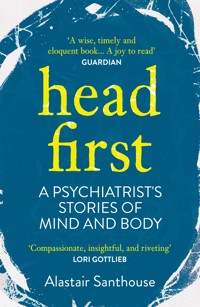
'Wise, timely and eloquent... A joy to read.' Guardian What does it mean to be well? Is it something in our body? Or, is it rather something subjective - something of the mind? In this profound collection of clinical stories, eminent psychiatrist Dr Alastair Santhouse draws on his experience of treating thousands of hospital patients to show how our emotions are inextricably linked to our physical wellbeing. Our minds shape the way we understand and react to symptoms that we develop, dictate the treatments we receive, and influence whether they work. They even influence whether we develop symptoms at all. Written with brutal honesty, deep compassion, and a wry sense of humour, HeadFirst examines difficult cases that illuminate some of our most puzzling and controversial medical issues-from the tragedy of suicide, to the stigma surrounding obesity, to the ongoing misery of chronic fatigue. Ultimately he finds that our medical model has failed us by promoting specialization and overlooking perhaps the single most important component of our health: our state of mind.
Das E-Book können Sie in Legimi-Apps oder einer beliebigen App lesen, die das folgende Format unterstützen:
Veröffentlichungsjahr: 2021
Ähnliche


















Alastair Santhouse is a consultant psychiatrist at both Guy’s Hospital and the Maudsley Hospital in London. He was Vice Chair of the Royal College of Psychiatrists’ Faculty of Liaison Psychiatry between 2013 and 2017, and in 2016 served as President of the Psychiatry Section of the Royal Society of Medicine. His clinical work focusses on the intersection of physical and mental health.
First published in hardback in Great Britain in 2021 by Atlantic Books, an imprint of Atlantic Books Ltd.
This paperback edition published in 2022.
Copyright © Alastair Santhouse, 2021
The moral right of Alastair Santhouse to be identified as the author of this work has been asserted by him in accordance with the Copyright, Designs and Patents Act of 1988.
All rights reserved. No part of this publication may be reproduced, stored in a retrieval system, or transmitted in any form or by any means, electronic, mechanical, photocopying, recording, or otherwise, without the prior permission of both the copyright owner and the above publisher of this book.
Neither the publisher nor the author is engaged in rendering professional advice or services to the individual reader. The ideas, procedures, and suggestions contained in this book are not intended as a substitute for consulting with your physician. All matters regarding your health require medical supervision. Neither the author nor the publisher shall be liable or responsible for any loss or damage allegedly arising from any information or suggestion in this book.
The stories chronicled in this book are based on many years of practice. However, maintaining patient confidentiality is of utmost importance and so the author has taken great care to remove any identifying clinical or personal information. Some of the case studies are an amalgam of several patients.
10 9 8 7 6 5 4 3 2 1
A CIP catalogue record for this book is available from the British Library.
Paperback ISBN: 978 1 83895 034 7
E-book ISBN: 978 1 83895 033 0
Printed in Great Britain
Atlantic Books
An imprint of Atlantic Books Ltd
Ormond House
26–27 Boswell Street
London
WC1N 3JZ
www.atlantic-books.co.uk
To Sara and the boys
CONTENTS
Journey
Stigma
Culture
Melancholia
Altruism
Exhaustion
Suicide
Weight
Belief
Medical Mysteries
Meaning
Acceptance
Pain
Wishing for the End
The Price of a Troubled Mind
Agency
Final Days
COVID-19
Epilogue
Acknowledgements
Endnotes
Index
‘Ask not what disease the person has,but rather what person the disease has.’
Sir William Osler, 1849–1919
JOURNEY
I remember Roland well, although I only met him twice. In fact, I heard him before I saw him; I was startled by an alarming noise, somewhere between a cough and a snort, as I approached the waiting room on my return from lunch to start an afternoon clinic.
I sat down with him in my consulting room and he told me his story. He was aged thirty-three, unmarried and had come to the UK from Gabon three years earlier. Since his arrival he had experienced increasing discomfort with his throat, resulting in frequent, explosive exhalations.
Roland had found life in the UK difficult. He had struggled to find work, had no family here and was unable to see his daughter who lived with his ex-partner in Gabon. His symptoms had begun several years before and were now worse than ever. As he snorted and spluttered, I found myself distracted by a persistent urge to clean my desk with an antiseptic wipe. It was with some difficulty that I listened to his story. He had been encouraged by friends to see his doctor who, reading between the lines, hadn’t initially worried about his symptoms, but had subsequently referred him to the hospital for more opinions.
It was clear to me that the cumulative stress and disappointment in Roland’s life had exacerbated a nervous tic, which was now so deeply engrained in his motor system as to be automatic. I had seen symptoms like this before, in which unusual movements and behaviours, rehearsed often enough, become ‘hardwired’. For example, I have seen people present with a strange gait that makes walking unnatural and effortful, seemingly without any deliberate simulation, even when there is nothing wrong with their muscles or nerves. Sometimes patients experience persistent pain or dizziness, or can only speak in a whisper, without there being any identifiable physiological cause, even after months or years of medical investigations. The number of ways in which patients present is as numerous as the number of symptoms.
When I treat such patients, I acknowledge that these illnesses, even if they have no clear-cut physical cause, are not made up or simulated; they are as real as any other illness, even if their cause is believed to be psychological.
It is difficult to know why an individual will have a particular symptom, for instance paralysis rather than dizziness or speaking in a whisper. Back in the early 1900s, some psychiatrists believed that an individual’s symptoms carried a symbolic significance – for example, someone who witnessed an appalling event might develop blindness. Although this sort of belief is still occasionally mentioned in psychiatry textbooks, not many people believe it.
In Roland’s case, his symptoms began with a cough and a sore throat, but his persistent focus on his breathing developed into a preoccupation. His cousin had told him that he must have been cursed, an idea that Roland felt was being fulfilled in the shape of serious illness. This worry served only to perpetuate his symptoms, until coughing and exhaling noisily through his nose was as natural to him as breathing. Such presentations are often known as ‘conversion disorders’, referring to the theory that psychological stresses are ‘converted’ into physical symptoms, although it should be acknowledged that there is little consensus on what to call them. Our disorganized classification system is a reflection of the different ways in which people have understood these symptoms over the years. Some diagnoses, such as ‘conversion disorder’, stem from the theory of Freudian psychoanalysis, while other diagnoses, such as ‘persistent physical symptoms’, are descriptive, yet both might be talking about the same thing. The term ‘functional disorder’ is commonly used to indicate that while the structures of the body – the nerves, muscles and organs – are all intact, their function is impaired. Sometimes the terms used are pejorative or insulting (a ‘heartsink patient’, referring to the effect they have on a doctor’s morale; a ‘fat folder’ to describe the thickness of a patient’s notes) and yet others such as ‘supratentorial’ (pointing to a region of the brain), while respectful and medical-sounding, suggest that the cause lies in the brain and are a wink to fellow professionals that the doctor thinks it is all psychiatric.
As I dictated my letter to Roland’s GP, I picked up his file and two letters fell out. The first was from an ear, nose and throat (ENT) specialist, who had diagnosed a problem with his vocal cords. The second was from a neurologist, who had diagnosed a disorder of the nervous system. I began to worry; had I completely misread the situation? I wondered whether to even commit my diagnosis to the notes, my confidence in it steadily waning. I knew the ENT and neurology consultants to be sharp and capable doctors, and not the sort who are casual about diagnoses. My diagnosis seemed even less sound when Roland came back to see me some weeks later, smiling and relieved that his symptoms had all but gone. It turned out that, lacking any confidence in his trio of physicians, he had laid out all his cares to a sympathetic priest who agreed with him that he must have been cursed and administered holy water, thereby effecting this miraculous cure.
I felt chastened. Roland had seen four ‘healers’, and each of us had reached a conclusion based on our understanding of the human body or mind. We had all seen what we wanted to see; the ENT specialist found a problem with the vocal cords, the neurologist found a problem with his nerves, the psychiatrist found a problem with his mind, and the priest with his soul. I found this unsettling; I had always believed that the way I saw things was the way that they were.
Medicine is narrow like that; we tend not to question our beliefs. In all medical textbooks there is a formula for presenting an illness. It starts with epidemiology (how common the illness is), then the aetiology (its cause) and presentation (how the illness looks to the doctor), through to the course (the natural history of the illness, if it is left untreated) and prognosis (outcome). Treatments that alter the natural prognosis are discussed, and Man triumphs over Nature.
I have taught medical students in teaching hospitals throughout my career; they believe that all symptoms are the product of a disease, which should be investigated and a cure offered. This process becomes second nature during their training and therefore goes unchallenged. There is an implicit belief that anything else is not real medicine. When I try to teach them a different way of thinking, they at first look slightly sceptical, and then unsettled. I explain to them that symptoms are part of life and that, most of the time, tiredness, pain, dizziness or backache don’t indicate any disease at all. Good doctors realize this, and a significant part of their role is to judge which symptoms to investigate and which to ignore. But mainstream medical and public opinion disagrees; symptoms are seen as indicative of illness, based on the prevalent ‘infectious disease model’ of medicine that is practised in the West.
In this model, an infectious agent is identified, an antibiotic or other cure is developed to attack the infectious agent, and a cure is effected. Treatment of infectious disease was the first major success of modern medicine, as dogma and superstition began to be replaced by a more evidence-based approach. That purely scientific model has had great success in many areas of medicine; it has helped in the understanding and treatments of cancers, heart disease and kidney disease, to name just a few. It is for this reason that it has become the only game in town for the past several decades.
Yet to focus solely on the scientific and neglect the social aspects of illness is a mistake that we continue to make. After all, this approach will not tell us which patients will ignore their symptoms or neglect their treatment, who will change their lives to improve their outcome, whose family will support them, which patients will develop depression and long for the end, and who will find a resilience they did not know they had. In other words, understanding the science of an illness often tells you little about how successful the treatment of an individual will be.
It gets worse. This scientific approach to the practice of medicine leads to countless unnecessary investigations and, eventually, when they don’t reveal much, the patient’s symptoms are dismissed as imaginary. Sometimes, a dreaded ‘incidental finding’ that has nothing to do with the symptoms you were investigating shows up on a blood test or scan, and opens up a whole new front in over-investigation and overtreatment. For patients like Roland, the problem is not that their symptoms are not real – they are – but that they were not caused by the sorts of pathology that you read about in medical textbooks.
We usually don’t think much about what health actually is, but rather instinctively judge whether or not we are in good health. When we do think about it, it is generally in ‘biological’ terms – whether our organs are doing what they ought to. Yet good health, rather than simply meaning that your organs are all functioning correctly, is a subjective feeling of well-being that is influenced by a huge number of factors. The idea that closer scrutiny of our bodies will improve our longevity or general health is a fallacy; in fact, quite the opposite is true. As Benjamin Franklin astutely observed in the eighteenth century, ‘Nothing is more fatal to health than an over care of it.’ We have yet to learn this lesson, and are encouraged into an increasing number of screening programmes, wellness checks and initiatives to raise awareness, all of which have made us more worried about our health than ever, although we have never been so healthy. As Marcel Proust observed more than a century after Franklin, ‘For one disorder that doctors cure with drugs (as I am told they occasionally do succeed in doing), they produce a dozen others in healthy subjects by inoculating them with that pathogenic agent a thousand times more virulent than all the microbes in the world, the idea that one is ill.’
When medical historians evaluate this period of our history, they will see it as the age of the self. Wearable devices measure how much sleep we get, our heart rate and the number of steps we take each day, yet there is little evidence that such analysis improves our long-term health outcomes.1 It does, however, lead to hypochondriacal concerns in the vulnerable, whose good health is eroded by health anxieties, which are triggered by scrutiny of their health data.
It is not just the vulnerable, though, who suffer from our preoccupation with health and well-being. Despite the falling mortality rates and improved treatments for disease in the West, we just don’t seem to feel as healthy as previous generations did. One study that examined health trends over the second half of the twentieth century in the USA showed that for both short- and long-term medical conditions, people were sicker and more disabled than their forebears.2 Another study, again in the USA, observed that with a 10 per cent increase in the population, the number of people permanently limited by disability increased by 37 per cent.3 How can this be? How can there be such a sharp increase in the number of people disabled by illness? At least part of the explanation lies in our expectations of how we perceive and think about our health.
Consider back pain, a leading cause of disability. In the USA, low back pain is estimated to cost the healthcare system over $100 billion per year.4 Studies in Western countries have shown increasing rates of low back pain, an increase that is not easily explained by any increased incidence of back disease.56 The most likely explanation came from a German study, which compared the rates of back pain between East and West Germany before reunification in 1990, with a decade after East and West Germany were reunified. East Germany, formerly a communist country, had a rate of back pain at least 10 per cent lower than West Germany before 1990. Over the course of the next ten years, East Germany had ‘caught up’ and, by the end of the study, had the same high rates of back pain as West Germany. The authors of the study seemed in little doubt. It was the transmission of beliefs and attitudes towards back pain, rather than the transmission of any actual disease, that had moved from West to East and were likely to have resulted in the greatly increased rates of low back pain.7
How then should we think about health? Why did East and West Germany have such different expectations about back pain, so that the poorer East German population felt healthier than their wealthier neighbours in the West? Nothing changed to their backs over the next decade, yet they began to feel that they were more painful, with all the overprescription, disability and economic disadvantage that back pain brings. This is not illness as most people see it or how I imagined health problems when I was studying at medical school.
Health is not just the absence of disease, but something less concrete, more ethereal. It is a subjective feeling, not always easy to measure, and subject to the vagaries of our mood and expectations. All of this is frustratingly unscientific, messy, a hinterland somewhere between medicine and mind. It is an area that many doctors would rather not go to, preferring instead the crisp certainties of a scan result, an X-ray or a surgical procedure.
As our scientific understanding of the body has deepened, there has been a fragmentation of medicine. It has split off into many different subspecialties, because there’s simply too much for one person to know. The advantage is that there is a great level of expertise in each organ system in the body, and patients with disease in that part of their body get a high level of care. The downside is that many doctors don’t know too much outside of their specialist area. This narrowed perspective has led to a loss of wisdom. It means that the delivery of healthcare is focussed, technical and less likely to take into account other factors like patient personality or mental health, which significantly influence the presentation of symptoms. Here, the application of a technical approach to medicine is a disaster. Patients with symptoms that have nothing to do with disease end up having multiple investigations in a fruitless attempt to find the cause. It’s like trying to open a door lock with the wrong key. Rattling the key around and trying harder and harder to turn it in the lock is an act of futility. It will never come to any good, and usually will end up doing some damage. So it is with medicine.
For many patients we end up doing them no good at all, and harming quite a few more through unnecessary medical procedures. We make patients of normal people who don’t need to be in the healthcare system. That people do not respond to our disease-focussed approach is seen as a failure of medicine and our solution is usually to apply more of it. It is a failure of medicine, but not because we lack the technical abilities to understand the human body. It is a failure to understand people – why they develop symptoms, why they come to see a doctor – and often a failure to understand what they want from their interaction with healthcare.
One of the studies that I often think about in relation to the disconnect between health as it is experienced and measured involved people who were recovering from a heart attack.8 After a heart attack, the heart works less efficiently because some of its muscle has died; this is expressed as an ejection fraction, which refers to the amount of blood expelled from a heart’s pumping chamber. A normal ejection fraction is over 55 per cent, but after a heart attack this figure will fall, dependent on the amount of damage. The researchers found the level of disability after a heart attack does not always relate directly to the ejection fraction, but surprisingly to patient beliefs about their illness. If someone believes that their illness will have serious consequences, their lives start to shrink, they stop exercising and having sex, and they live a much more sedentary life. By contrast, if people believe their illness can be controlled, they are more likely to attend rehabilitation programmes, get on with their lives and resume the work and activities they had previously enjoyed. It was their beliefs that determined outcome and activity. Physical activity after a heart attack is protective.9 This remains true even when the damage caused by the heart attack is more significant – you can have an ejection fraction of 45 per cent and be crippled by it, or an ejection fraction of 35 per cent and lead a fulfilling life.
We know plenty about the body – its anatomy, the physiology, the pathology. The problem is that we – doctors and patients alike – pay surprisingly little attention to the ways in which our emotions influence how we perceive our bodies and experience our health.
My own journey into psychiatry was a meandering one. I never planned to study medicine at university, but after years of parental pressure, I was eventually persuaded to apply. Although I had been born and raised in Britain, my parents had something of a second-generation immigrant’s view of progress, and thought that becoming a doctor would mean that I had finally ‘arrived’.
Medical school interviews are a strange process. It is widely considered to be the kiss of death to say, when asked why you are applying, that you ‘want to help people’. This was seen as a trite and superficial answer, whether it was true or not, and I knew to avoid saying it. I can recall only one boy in my year saying it at his interview, and he was met with the terse reply, ‘Well, why don’t you study nursing, then?’ I’m glad I was never asked the question, as I know that ‘my parents made me apply’ wouldn’t have been a great answer, either.
If I were asked now why I am interested in medicine, my answer would be ‘because I am interested in people’, though it would never have occurred to me during my time at medical school that this was relevant. Back then, the emphasis was on medicine as a science. We learned the anatomy of humans, dissecting corpses of people who had donated their bodies to ‘medical science’. The smell of formaldehyde still transports me back to the old anatomy room, with its rows of dead bodies lying on the dissecting tables. By the start of my third term, when the anatomy demonstrator told a class of students to ‘go and get yourselves a leg to dissect’, I was so desensitized to it that I didn’t think twice about ambling over to a large bucket at the back of the room and fishing out a human leg, taking care not to accidentally hit somebody with it on the way back to my desk.
But what do teenagers really understand about life and death, or the other important questions regarding our existence? I’m sure that’s why far more students of psychiatry start their training as postgraduates. Medical school teaches a dispassionate and clinical analysis of disease on the human body. We learned about anatomy (where things are in the body), physiology (how the normal body operates), biochemistry (how cells work), neuroanatomy (dissecting human brains), neurophysiology (how a normal brain works), pathology (the study of illness and disease) and histopathology (looking at diseased bodies under a microscope), without once discussing the numerous ways in which changing the interaction with a patient can affect a health outcome.
Psychiatrists are all doctors, and have received the same training at medical school as cardiologists, neurosurgeons and general practitioners (or GPs). We understand how the body works, what happens in disease and how drugs both affect and are processed by the human body. But we also have something extra – an understanding of human nature, the product of an interest in people’s lives, which is stimulated by seeing the myriad ways in which people’s personalities, intelligence, genetics and misfortune can lead to different health outcomes and illnesses.
After I qualified as a doctor, the pressure of work was intense and the level of support was minimal; as a result, the more you came to see patients as clinical problems to be solved, rather than people with hopes, fears and feelings, the easier life was. It was not uncommon for me to say to a colleague something like, ‘I’ll go and see the gall bladder in cubicle 1, you see the haemorrhoids in cubicle 4, then we can review the overdose in intensive care.’ Nobody thought it odd that the patients’ names often weren’t used. As the years passed, my humanity and curiosity about the anguish that might have led to such overdoses was slowly ebbing away. I became impatient and irritable, and started to resent patients both for the trouble they were causing me and the sleep I was being denied. I never seemed to leave the hospital, and I grew deeply unhappy. I was single, which I blamed on being at work all the time, and increasingly cranky. I gained almost fifteen pounds over six months, undoubtedly a result of my diet of microwave meals and bags of crisps eaten between shifts, supplemented by snacking on chocolates at the nurses’ station.
One particular night on call made me realize how bad things had become. It was 3 a.m. and I had just dozed off, having been at work since 8 a.m. the previous morning, when my bleep sounded. I was disorientated and initially thought it was morning, but when I picked up the bleep I saw that it was from the hospital switchboard, which meant a caller from outside the hospital, which meant a GP, which meant an admission to Accident and Emergency in the next hour or so, which meant no sleep. With a busy day to follow, the prospect of another sleepless night made my shoulders sag. I answered the bleep, and the GP asked if I could accept a seventy-six-year-old woman with a suspected heart attack. It was not a request I could refuse, but I was graceless and cross.
After I put the phone down I dozed fitfully, knowing I would soon be woken by the patient’s arrival in casualty, alert to the sounds of the clanging hospital doors that drifted through the paper-thin walls. I must have dozed off again, because when my bleep sounded for a second time, I felt the same sense of bewilderment before I realized what was going on. The number on my bleep was not from casualty to tell me that my patient had arrived; it was another outside call, which meant another patient. I dialled the number with a heavy heart, before realizing that I was actually speaking to the original GP who told me that the patient had died in the ambulance and would not be coming to casualty after all. Suddenly a night’s sleep – or at least half a night – was back on. Euphoric, I turned off the light and sank back into the sagging, hospital-issue mattress, but sleep would not come. I began to feel troubled by the realization that a human being whom I might have been able to help had died that night. I wondered whether she had had a family, retirement plans, responsibilities. My sense of contentment soon turned to shame; this was not who I was, nor who I wanted to be. I felt like I had lost my humanity, the most important quality a doctor can possess.
It took me several more years to get to psychiatry. The problem was that I found hospital medicine easy to manage – I had by then been elected as a member of the Royal College of Physicians and had risen to the grade below consultant – and it seemed somehow easier to keep going. But I was bored; after a few years, one heart attack looks pretty much like another, as do the chest infections, kidney failures, arthritis and many other problems I saw.
Overdoses were a different story. I would listen, transfixed, to the human dramas unfolding, appalled by the betrayals, sympathetic to the human failings and astonished by the frequent banality behind tragic decisions. I remember one woman who was unhappy with her boyfriend’s infidelities and her boring job, but it was only when she was in the bathroom at home and knocked her head on the underside of the sink having stooped down to pick up her hairbrush, that she decided to take an impulsive overdose. It seemed extraordinary that bumping your head on the porcelain sink might be the final straw. These stories drew me in and showed me a different side of life, and how fundamental failings and weaknesses exist in us all.
Since changing careers to become a psychiatrist over twenty-five years ago, I have been able to do what I always really wanted; to listen to and understand ordinary people like you and me. I have heard the deepest fears and unrealized dreams of thousands of people, as well as their reactions to physical illness and their anguish at mental illness. I have come to understand that our similarities are much greater than our differences; I see and hear the same human reactions to love, loss, redemption, stress and the development of mental illness. We are all scared, vulnerable and uncertain. It is hard for us to admit this, even to ourselves. We like to exhibit our strength and confidence in all sorts of ways, as a means of asserting our success. We do it by the cars we drive, the holidays we take, the houses we live in, the clothes we wear and our worked-out bodies, all of which are aimed at demonstrating our perfection and importance. But we do it because we are needy, uncertain and under-confident. We crave the approval of others as a validation of our own lives, though deep down we want what everyone wants – to still the inner voice of criticism, to believe that we are good enough and to know that our lives are worth something.
It is our personalities, attitudes and beliefs that affect our lives at every stage. We all remember a classmate who could get away with anything at school, while less charming students could do no right. Some children progress effortlessly, while others struggle to make friends. People of average intelligence and talent can have great careers through hard work, persistence and an occasional inflated sense of ability, while highly intelligent people can see their career stall, not realizing that they might sound argumentative or that their shyness may be seen as brusque. The myriad ways in which we interact with the world, whether verbally or non-verbally, all direct our path in life.
Similarly, our personality directly affects how we interact with our health. Do we ignore our symptoms or worry about every last physical sensation and visit the doctor repeatedly? Are we able to trust people, including doctors, or do we believe that ‘big pharma’ is behind their decisions and choose to ignore their advice? Perhaps we think the doctor has got it wrong or prefer to heed the advice we read on the Internet or the story of a friend who did the opposite of what they were advised. Perhaps you are so personable and persistent that the doctor wants to spend longer with you than with other patients, researching new treatments or even lobbying a pharmaceutical company for a particular drug. Religious or cultural beliefs may lead someone to think that their illness is a punishment. Depression can make someone feel that their treatment is pointless, to the extent that they don’t seek treatment, and I have seen manic patients who believe that they are doctors making decisions regarding their treatment, with tragic consequences. Our beliefs, eloquence, expectations, charm, persistence and mental health all significantly influence health outcomes, yet they are considered far less often than their importance would suggest.
The psychiatry I specialize in is at the intersection between mind and body. It draws on my early career working as a physician in internal medicine, as well as later in psychiatry, working in the community and inpatient psychiatry wards. For almost twenty years now I have been employed by a mental health trust to work in a general hospital. It is the sort of hospital most people have been in dozens of times, with the usual round of medical and surgical outpatients, inpatient wards and operating lists. People attend for their physical health problems, expecting the consultation to conclude with a diagnosis, a prescription, perhaps even being listed for an operation. Very few people attending hospital believe that the outcome of their hospital appointment will be a visit to a psychiatrist, but for many of them it transforms their care.
Health is complex. It takes an understanding of human nature, as well as an understanding of the body, to deliver effective care. There are difficult judgements to be made and uncertainties to acknowledge. One must be flexible and able to tolerate uncertainty. The human body can fail in a limited number of ways, but there are endless ways in which people’s lives, experiences, personalities and mental health can interact with their health and present to a doctor. This is an area to which I have always been drawn.
Exploring how personality and mental health dictate our experience of well-being is the subject of this book. It might seem hard to believe that our minds exert such influence over our bodies, but it is true – they dictate all that we are, as well as all that we will become. Our minds shape the way we understand and react to symptoms that we develop, dictate the treatments we receive and even influence whether they work.
What follows is a look at many of the problems that have brought patients to my clinics over the years. It will perhaps give you some understanding of what psychiatrists in a general hospital do, and I write in the hope that you might learn to think in a new way about your mind, your body and your health.
STIGMA
In the 1980s and 1990s, mental illness was very rarely discussed and admitting to having one was regarded as shameful. It was one of those topics that was just never spoken about, similar to how much you earn or whether you’re having an affair. Someone with mental illness would be spoken about in scandalized tones over the garden fence. It’s difficult to remember, now that everyone including the British royal family openly discusses mental illness, that we were once so uncomfortable with the subject.
I have long considered to what extent this new-found openness is a good thing. Having discussions about mental illness (usually referred to in the press as mental health) certainly helps to reduce the shame and stigma; for most of history, mental illness has been feared and sufferers have been victimized. There is evidence that those who are unable to talk about their emotional problems, and particularly people who are socially isolated and lonely, are at higher risk of suicide.1 They are unable to unburden themselves of their problems and receive the help and support they need. The more commonly and openly mental illness is discussed, the more normal it becomes. In particular, we need to lose the notion that masculinity is about being strong and silent, or that mental illness is a sign of weakness.
On the other hand, the mental illnesses that are talked about are usually those that are relatively minor and sufficiently sanitized for public consumption. For example, while royalty may admit to experiencing sadness as a result of bereavement, I suspect that no member of the royal family would be encouraged to talk about their schizophrenia, hallucinations or paranoia; this rather perpetuates the idea that some illnesses are still too stigmatized to talk about and that much of what is publicly discussed relates to more minor problems that straddle the boundary of normal human experience.
I think it might have been the Americanization of culture in the UK that allowed us to talk about emotions more openly. Who can forget (no matter how hard you try) the Jerry Springer-style television chat shows of the 1990s, with their noisy and personal revelations? Situations that would have been a cause of deep shame in any other generation were now talked about openly, and even with some amount of pride.
I remember getting into a lift at the hospital with a mother and her grown-up daughter during that period. They had been arguing as I approached the elevator bank; I didn’t gather the reason, but it seemed to be a fairly standard, something and nothing kind of row. The doors opened and the three of us got in, but their argument simply carried on, without it occurring to either of them that I might feel awkward at having to listen to it, or they might feel a measure of shame for such a carry-on. It seemed from the covert glances they both gave me that they might even be taking a kind of pride in the argument. It felt to me like a demonstration of a change in social behaviour and the adoption of new norms.
The TV show Big Brother and other reality television programmes that followed have furthered such self-revelation, which has in some ways led to a more open and destigmatized society. We have replaced the traditional British and American value of tolerance with an insistent demand for acceptance, and have thus come to accept both behaviours and people who are different from the conventional. Where this includes mental illness, it can only be a good thing.
This shift in attitudes was encouraged by Dr Mike Shooter, President of the Royal College of Psychiatrists between 2002 and 2005. I remember listening, spellbound, as he gave a speech about the onset of his depression at a conference in 2002. He described how it had begun while he was a medical student, and explained how it had affected him. Speaking without notes, he created an intimate atmosphere and painted a vivid picture of the black veil of depression. I felt privileged to have been present at such a confessional moment.
Around this time it also became fashionable for former psychiatric patients, known as ‘service users’, to sit on interview panels for the appointment of consultant psychiatrists. This led to a situation at my first consultant interview that was slightly uncomfortable. The interview began with one such service user asking why I thought I’d make a good consultant psychiatrist – standard interview fare, a lightly lobbed ball to be smashed to the boundary. It was the next question that caught me off guard, although perhaps I should have been expecting it. ‘Do you have any personal experience of mental illness?’ I felt like I should help the interview process and a curt ‘no’ didn’t seem appropriate, but the question itself felt intrusive. After all, a cardiologist would not be asked in a job interview whether they had ever had a heart attack. I wondered if our confessional climate had gone too far.
The question of whether I had any personal experience of mental illness reminded me of my childhood in Manchester. All my family lived there; the city had been the final destination for my great grandparents after their flight from the pogroms and persecutions that had been inflicted upon the Jews in Europe. Among those relatives, I had two great aunts, Pearl and Sadie, who lived together in a detached house in Prestwich, North Manchester. They had spent all their adult lives in the house and had barely touched it since moving in, some time during the 1940s. We would visit them every Saturday afternoon, walking to get there through streets crowded with bearded men in black coats and hats, going to or from synagogue in the heart of suburban Jewish Manchester.
Sadie had last left the house in 1962, when she had attended my parents’ wedding. When she was out of the house in her teens one day, she became faint and dizzy. She was overwhelmed with anxiety, and the dizziness only went away when she returned to the safety of home. From then on, each time she left the house the dizziness and breathlessness returned, until she went out less and less, and her life gradually shrunk. She made one final effort – to attend my parents’ wedding – before deciding that it would be easier if she didn’t leave the house at all.
Sadie found things to do at home. She was a talented cook, so each Saturday afternoon my family would sit in the little oak-panelled snug, and Sadie would pass fried fish, herring, pickles and a variety of homemade cakes through the serving hatch that led to the kitchen. My siblings and I would sit drinking fizzy pop and eating cake, occasionally catching each other’s eye as we removed long hairs from the middle of the slices. After tea, while the adults continued to chat, we would move to the living room and fight over who would get to sit on the burgundy velour Parker Knoll reclining chair with built-in footrest. We’d then settle down to watch the wrestling on World of Sport, followed by Doctor Who. The carpet in the living room, patterned with cocktail glasses, wouldn’t have looked out of place on a 1940s cruise ship. The difficulty came when one of us needed to use the toilet; we got so worked up about the quiet, creepy feel of the upstairs of the house, that we were too frightened to go alone. The three of us had a deal that we would always go in pairs, with one of us standing guard outside the toilet door while the other quickly had a pee.
As Great Aunt Sadie never left the house, she had a dog to keep her company, though because she never left the house, neither did the dog. Brandy was a mongrel with a clump of hair that dangled over his backside. The only time he would become animated was when the doorbell rang or when someone attempted to cut this terrifically ugly clump of hair with a pair of scissors. For years, he ambled around, the matted hair swinging from side to side over his rump like a pendulum. Sadie adored Brandy and could not do enough for him, but although the dog was fed the choicest cuts of meat, his was a gilded cage. The extent of his world was where he could get to on the end of a length of washing line tied to his collar – he could amble around the front garden, but no further.
In time, deprived of other canine company, Brandy became withdrawn and slightly unhinged. When he finally died, he was replaced by a poodle called Mij (named after its original owner Jim, but spelt backwards), a frisky little thing that would try to hump your leg when you sat down. I fear that the confinement also made Mij mentally unbalanced; as a teenager, I began to wonder if dogs could get mental illness in the same way that humans do, and whether that may account for a docile pet becoming moody and, unable to articulate its distress in any other way, biting the postman.




