


Erhalten Sie Zugang zu diesem und mehr als 300000 Büchern ab EUR 5,99 monatlich.
- Herausgeber: Birlinn
- Kategorie: Lebensstil
- Sprache: Englisch
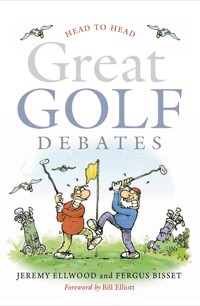
Golf clubs, the length and breadth of the UK, are hotbeds for debate. Go into any clubhouse on a Saturday afternoon and you'll find people arguing the virtues of links golf over parkland or Stableford over medal play. Every time a golf magazine produces a top 100 courses list, golfers throughout Britain begin quarrelling about its inclusions and omissions. In Great Golf Debates, Jeremy Ellwood and Fergus Bisset look at forty of golf's most disputed issues from the serious to the more light-hearted, examining them from opposing viewpoints in an entertaining yet informed manner.From 'Tiger Woods vs Jack Nicklaus' to 'Pull carts vs Carry bags' they provide convincing arguments to give supporters of both camps some added ammunition, appealing directly to every British golfer's argumentative nature. Writers for "Golf Monthly", Ellwood and Bisset's 'head-to-head' style debate features regularly in the magazine and has been a fabulous success in generating considerable interest both in letters to the magazine and debate on the Golf Monthly website where a poll is conducted. The section's popularity gives clear indication there are many issues that split opinion between Britain's golfers and that this book seeks to address a selection of the most contentious.
Sie lesen das E-Book in den Legimi-Apps auf:
Seitenzahl: 258
Veröffentlichungsjahr: 2013
Das E-Book (TTS) können Sie hören im Abo „Legimi Premium” in Legimi-Apps auf:
Ähnliche



















Head to Head
GREAT GOLF DEBATES
Jeremy Ellwood and Fergus Bisset are single-figure handicappers with a passion, nay, obsession for the game.
Jeremy is Golf Monthly’s associate editor, contributing to a wide range of the magazine’s editorial content from travel and course reviews, to in-depth features and player profiles. He has also written for The Independent, The Mail on Sunday’s Live magazine and even the mighty ebay! His game is based very much on ‘how many’ rather than ‘how’, and the autobiographical slant to the ‘scrambling’ argument in the ‘consistency vs scrambling’ debate within these pages will be instantly obvious to anyone who’s ever played with him.
Fergus is Golf Monthly’s contributing editor. A freelance writer, he’s been working with the magazine for almost four years. He has also written for Total Golf, The Mail on Sunday’s Live magazine, Sky magazine and Square Mile magazine. Hailing from Aberdeenshire in Scotland and having attended University in St Andrews, golf runs freely through his veins. Fergus has little time for anything other than serious medal play off the back tees and is widely regarded as one of the unluckiest golfers to have ever wielded a club in anger.
Head to Head
GREAT GOLF DEBATES
JEREMY ELLWOOD and FERGUS BISSET
Illustrated by RUPERT BESLEY
This eBook edition published in 2011 by Birlinn Limited West Newington House 10 Newington Road Edinburgh EH9 1QS
www.birlinn.co.uk
First published in 2009 by
Copyright © Jeremy Ellwood and Fergus Bisset 2009 Drawings copyright © Rupert Besley 2009 Foreword copyright © Bill Elliott 2009 Introduction copyright © Jeremy Ellwood and Fergus Bisset 2009
The moral right of Fergus Bisset and Jeremy Ellwood to be identified as the authors of this work has been asserted by them in accordance with the Copyright, Designs and Patents Act 1988.
All rights reserved. No part of this publication may be reproduced, stored or transmitted in any form without the express written permission of the publisher.
eBook ISBN: 978-0-85790-108-8
British Library Cataloguing-in-Publication Data A catalogue record for this book is available from the British Library
CONTENTS
Foreword
Introduction
1. Tiger Woods vs Jack Nicklaus
2. Links vs parkland courses
3. Shank vs air shot
4. Medal vs Stableford
5. Very slow play vs very fast play
6. Mental game vs physical game
7. Club membership vs pay and play
8. Blades vs cavity backs
9. Golf abroad vs golf at home
10. Pro shop vs high street store
11. Watching on TV vs watching live
12. Par 3s vs par 5s
13. European Tour vs PGA Tour
14. Fade vs draw
15. Stroke play vs match play
16. Driving vs putting
17. 50-yard bunker shot vs flop shot off a bare lie
18. Wind vs calm on a links
19. Crazy golf vs pitch and putt
20. Carrying vs trolleying
21. Leather vs all-weather gloves
22. Accuracy vs distance
23. Putters: blade vs mallet
24. Winter golf vs hanging up the clubs
25. 18-holers vs 9-holers
26. Playing for pride vs playing for cash
27. Relaxed vs strict dress code
28. Metal spikes vs soft spikes
29. Scottish links vs Irish links
30. Short putts: dead weight vs rap ’em in
31. Off the back pegs vs off the yellows
32. Clubhouse pre-round or post-round
33. Tradition vs technology
34. Four-ball vs foursomes
35. Jack Nicklaus vs James Braid
36. The Masters vs The Open
37. Consistency vs scrambling
38. Seniors’ tours vs women’s tours
39. Medal round vs bounce game
40. Elite amateur vs journeyman professional
41. Long iron vs utility club
42. Very slow greens vs very fast greens
43. Driving range vs club practice ground
44. Chip and run vs lob shot
45. Faldo vs Seve
FOREWORD
Debate, argument, rant or ruck; call it what you will, but here, I believe, we have the very fuel of an interesting life. Throw in romance, love, family, at least two loyal pals and a decent Petit Chablis and we may actually be on to something slightly important.
‘Jezza’ (Jeremy is his formal name only) and Fergus (if he has an informal name then it is probably ‘Too Good At Golf’, an old Sioux/Scottish moniker I understand) have called this book GREAT GOLF DEBATES but in truth it is nothing of the sort. Neither should it be. Debating stuff is all very well if you need some light relief after spending a hard day contemplating something heavy and vaguely academic at Oxford or Cambridge but for the rest of us a good, old fashioned, screaming disagreement is what releases the calming stuff inside our fevered bodies. This Messrs Ellwood and Bisset have achieved.
Personally I find this book irritating but the only reason it’s irritating is that it is so enjoyable and that I didn’t think of doing it myself. Quite why I didn’t come up with the idea is beyond me. I often lose my arguments with myself although my psychiatrist, somewhat encouragingly, says this is something I should grow out of. Either that or I will fall off my perch raging against the dying of the light. At least this should please Dylan Thomas, if no-one else.
Whatever, reading the enclosed chapters made me think of what my own opinion was on each of the subjects the chaps have chosen to lock horns over. As each obviously takes an opposing view on topics that range from the bleeding obvious (Woods or Nicklaus) through the esoteric (carrying versus trolleying) and on to the, frankly, bizarre (50-yard bunker shot versus flop shot off a bare lie (as if)) I found myself constantly in agreement with one of them and therefore reinforced in my ongoing belief that I always know best.
What is also true is that golf, more than most games, does throw up these moments of high disagreement. Everyone has a favourite course or player or clubhouse bar, everyone is passionate about these things as well as many others and it is also my experience that the average golfer holds more entrenched opinions than a career politician confronted by an expenses form.
The authors display this admirable quality superbly well. Reassuringly, there is no give or take and each often seems to make a compelling case for his opinion only to lose out – at least in my opinion – to the opponent’s take on things. This is how it should be. Life isn’t fair and debating shouldn’t be either. Not a bad idea for a debate in itself. As a book, this tome not only makes a brilliant doorstop, it actually encourages the reader to think for him/herself. Yes, that’s correct, I am not going to debate feminism here.
The following words will happily fill in those tedious hours between disconsolately finishing an especially poor round and starting the next disappointment. Jezza and Fergus tell me they think they have written a really, really good book. Just this once, I am not prepared to argue with them.
Bill Elliott June 2009
INTRODUCTION
Former US Ryder Cup player Gardner Dickinson was once heard to remark: ‘They say golf is like life, but don’t believe them. Golf is more complicated than that.’ Any golf enthusiast reading this will now have a wry smile on their face, as Dickinson really hit the nail on the head there.
Golf is all consuming. There’s a seemingly bottomless pool of information to absorb on the sport, everything from the rules to the technical specifications of the latest equipment. Then there are the innumerable dilemmas the game throws up – where to play, how to play, who to play with, what to play with . . . The options are endless and decision-making causes all golfers to be pretty opinionated when it comes to ‘their’ game and how they like to enjoy it. This is why golf is the greatest game. Everyone can enjoy it at their own level and strive to get exactly what they want from it. Some will aim to play to par, others to break 100. Some will aim to take less than three hours to get round, others to take less than three air shots during their round. Some will be looking forward to the post-round debrief in the clubhouse, others will be heading straight for the driving range to iron out the kinks in their game before another battle against the links the following day.
The point is, there’s often no right or wrong way in golf – though most will be able to provide convincing arguments to support their methods and opinions. Go into clubhouses the length and breadth of this country and you’ll find debates raging on everything from the best destination for a golfing break in Wales to whether the club pairs championship should be contested using a fourball or foursomes format.
Almost all sportspeople are argumentative; it goes hand in hand with competition. How often do you hear footballers shouting, ‘He was clearly offside, ref!’, or tennis players crying out, ‘That ball was on the line. I saw chalk dust!’ But, as the rules of golf are so definitive, competitors can’t really dispute decisions on the course. The ball is either out of bounds or it’s not; the putt either ended up in the bottom of the cup or it didn’t. So to satisfy our quarrelsome streaks we must direct our squabbles elsewhere. Should the greens be a touch faster? Are bladed irons superior to cavity backs? Is it preferable to hit a fade or a draw? There’s a good deal to get your teeth into.
In this book we’ve picked 45 potentially contentious issues – some serious, some distinctly light-hearted – and tried to approach each in an impartial way. We haven’t necessarily done this from our personal standpoints; we’ve just thought about the pros and cons to each side of each argument and put them down on paper.
It’s by no means an instructional manual, though there are a few chapters that might provide some guidance during those traumatic moments on the links when the debate raging in your brain shifts into top gear and sensible decision making becomes a rather unlikely prospect.
You’ll probably agree with some of what’s said over the next 200 pages, and possibly disagree with a lot of it too. But, whether you read a chapter nodding in appreciation or find yourself yelling, ‘What the hell are these idiots talking about?’, you’ll hopefully have some extra ammunition to shoot from the hip with next time clubhouse chat strays onto one of the debates covered here.
Jeremy Ellwood Fergus Bisset August 2009
1
TIGER WOODS vs JACK NICKLAUS
Who is golf’s greatest-ever player? Most authorities on the game now have it narrowed down to these two names. Both have struck fear into the hearts of opponents and dominated world golf during long tenures at the pinnacle of the game. But which man sits at the top of the pile?
TIGER WOODS
The contention has to end. Tiger Woods is the greatest golfer of all time. He has totally dominated the sport since turning professional in 1996. He has the rest of today’s top players trailing deferentially in his wake. His ball striking is unmatched and his short game would rival Seve’s in his prime. He keeps himself in peak physical condition and possesses an incredible ability to win even when playing poorly. His aggressive style has influenced a new generation of golfers and his mental approach is the benchmark to which all other pros aspire. This golfing demigod eclipses any player, even Jack Nicklaus.
Some stats: Tiger Woods won six US amateur titles (three junior, three senior), Jack Nicklaus won two. Between the ages of 20 and 29 Tiger won 46 PGA Tour events, Nicklaus took just 30. Woods had ten majors before reaching the age of 30, Nicklaus had seven. Those who argue Jack is still the greatest rely resolutely and obstinately on a single statistic: his 18 majors compared to Tiger’s 14. Well, Tiger is only 33 years old. The Golden Bear won his last major aged 46 – the 1986 Masters. If Tiger continues at his present rate, he’ll have 30 by then. So it’s Jack – one stat (soon to be overtaken) – vs Tiger – every other stat going.
As an important aside, the number of majors won should not be the sole barometer for deciding golfing ability. If it were, then we’d have to say that Todd Hamilton, with one major title, is a superior golfer to Colin Montgomerie with none; or that supremely talented Sergio Garcia cannot be considered a finer player than 1953 US PGA Champion Walter Burkemo. It’s preposterous. The main point is that nobody has ever played golf as well as Tiger Woods. Put the Tiger of 2009 against the Jack Nicklaus of 1972 and Woods would win.
Professional golf has never had more strength in depth than at present. There are hundreds of exceptionally talented players across the globe. Places on the main tours are contested with increasing ferocity and only the best of the best will be able to compete as regulars on either the European or PGA tours. Each week anybody in the field has a realistic chance of lifting the trophy come Sunday afternoon. The fact that Tiger can consistently stand above the crowd is testament to his superiority as a golfer. Yes, Nicklaus had rivals in Palmer, Player, Miller and Watson, but he didn’t have to contend against hordes of top-class challengers like those Tiger fends off week after week.
Woods is abnormally consistent. He’s only missed the cut five times in his entire career. He’s only missed two cuts in majors and one of them came at the 2006 US Open after six weeks off following the death of his father. Jack Nicklaus had missed the cut in six majors by the time he was 30, and had missed 30 major cuts by the end of his career.
The weight of evidence is overwhelming. It’s Woods by a five-shot margin.
JACK NICKLAUS
Woods or Nicklaus, Nicklaus or Woods? Since Tiger’s 2006 USPGA victory hoisted him ahead of Walter Hagen into outright second place on the all-time major victories list, the debate as to who is the greatest golfer to have graced the world’s fairways has really hotted up. He now trails Jack 18–14 with regard to golf’s four major championships, with apparently many years in hand to eclipse the Golden Bear’s seemingly impregnable record. If he maintains his major strike rate, he’ll be there in next to no time.
But whether he gets there sooner, later or never, for many Nicklaus will always remain the greatest. Golfing greatness extends beyond just major success – and indeed playing records of any kind – though if you want to add substantial weight to Jack’s playing claims, just ponder this: on top of those 18 major victories he also finished second 19 times, in the top three 46 times, the top five 56 times and the top ten 73 times in golf’s big four events. Then there’s the small matter of 111 professional victories worldwide to consider. And of course those 18 major victories are already in the bag while Tiger still has work to do.
But what else sets the Golden Bear apart from the Tiger in golf’s greatness stakes? Firstly, Tiger was being groomed for golfing excellence by an enthusiastic father from the age of just two; Jack didn’t start playing till he was ten, giving him perhaps a slightly more rounded early childhood. Then, after one particular youthful club-throwing tantrum, Jack was told by his father that if he hurled just one more club in anger it would be the last time he played golf. He never threw a club again. Tiger is still prone to the occasional club toss – and they come back down to earth with a slightly distasteful clang from the lofty perch of undisputed world number one and an influential role model to golfing youngsters everywhere.
Jack, as far as we’re aware, never spat on the golf course; Tiger does, and it’s a habit that’s totally unnecessary in a non-aerobic sport. And finally, Jack’s celebrations – save for nearly decapitating the orange-clad Doug Sanders with his putter at St Andrews in 1970 – were always appropriately under control; Tiger’s post-shot celebrations sometimes verge on the overly aggressive.
Some of this may sound like nit-picking, and much of the way Tiger conducts himself is perhaps symptomatic of our modern times as much as anything. In many ways he does extraordinarily well considering the 24/7 ‘goldfish bowl’ world he inhabits. He can’t even pick his nose without someone wanting to get a picture or write about it.
Tiger may well get there on the major front, although the ferocity with which he has been swinging the club from a tender age may herald further physical problems as he gets older to add to the knee that required surgery again in 2008. But even if he does make it, for many he will never be as great an all-round package as Jack. It’s certainly hard to imagine Tiger as a past-his-prime, slightly potbellied 46-year-old in a pair of bad trousers notching up one final fairy-tale major success, as Nicklaus did in the 1986 Masters.
2
LINKS vs PARKLAND COURSES
Links courses are a little like Marmite – you either love them or loathe them. And manicured parkland courses, a source of inspiration to some, just leave others cold. But who is the real winner in the battle between Windswept-on-Sea Golf Links and Towering Oaks Golf and Country Club?
LINKS
The smell of salt and gorse lingers on the ever-present breeze, the real world seems distant as the call of songbirds rings through the crisp seaside air and the rushes rustle atop the towering sand dunes. The sun glints off your ball as you prepare to launch it down the firm narrow fairway stretching away in front of you. This is golf as it should be. Our great game originated by the sea and the links remains the place where the sport can be enjoyed in its purest form.
Britain is famous across the world for its golf courses. We are blessed with over 2,500 of them and people travel from the four corners to sample the golfing delights our country has to offer. But the majority of these tourists skirt the perimeter of Great Britain, seldom venturing inland. Why? It’s because tedious and repetitive parkland courses can be found all over the world, but true links are confined to Britain. They are historic, captivating, testing and unique. From Nairn in the north to Rye in the south, from Brancaster in the east to Saunton in the west, ask anybody with knowledge and understanding of golf and they’ll tell you Britain’s best courses are to be found by the sea.
The UK’s grand old links still represent the pinnacle of course design. Many modern architects strive to emulate their bunkering, plateau greens, raised tees and natural contours. These coastal tracks provide a true test of the golfer’s ability. An impressive arsenal of shots and a vivid imagination are required to return a good score. The links golfer will be master of the knocked-down iron into the wind, the chip and run, the punched 3-wood and the long putt from off the green.
Striking a ball cleanly and crisply from firm seaside turf is one of the most difficult golfing skills to master. When it’s executed correctly the feeling is hard to beat. Chopping around a muddy field somewhere in middle England simply does not compare. The parkland golfer will play a high ball from the tee to the green. He’ll play lofted pitches aiming to stop the ball by the pin and his technique will hardly vary.
One of the great things about links courses is they’re playable all year round. In mid January when the average parkland course is totally waterlogged and play is confined to winter tees and temporary greens, the links are still playing their full length to firm, well-running putting surfaces. On days when there’s a hard frost inland, the seaside can often be ice-free.
Consider this. Where would you rather be holing out to win a golf tournament? On the windswept 18th at Royal Birkdale after winning a ferocious battle against the elements, the firm ground, the treacherous bunkers and the uncompromising rough? Or the last at Forest of Arden after playing every hole in the same monotonous fashion and plodding home uneventfully? There’s no contest: the links wins on all counts.
PARKLAND COURSES
Show me a golfer who claims to have had fun stepping off a links course on a brutal day, having been buffeted to within an inch of his golfing life and bearing a scorecard that’s been ripped to shreds both physically and metaphorically, and I’ll show you a highly accomplished liar and potentially brilliant spin doctor.
Britain is famed for being a ‘green and pleasant’ land, is it not? Lines of neat hedgerows separating field after field of lush vegetation. But you certainly wouldn’t get that impression setting foot on one of our coastline’s bleak and barren links, where the very idea of greenness is frowned upon and the whole emphasis seems to be on making you, the golfer, look as silly as possible.
On the links you’ll encounter almost unplayably firm, tight fairways and greens, undulations and humps designed to test your patience to the limit by kicking your ball unfairly into the often punishing rough, and bunkers so devilishly deep they’re even capable of inflicting humiliating suffering on the world’s best, just like the old Hamlet ads. Happiness is definitely not hitting two decent shots into a green, watching your ball sweep away viciously into a cavernous greenside bunker, taking six hacks to finally extricate yourself and then three-putting with ease on a crisp roller-coaster putting surface.
Add in the kind of wind that makes your ball dance around like a hyperactive Michael Flatley and it’s easy to see why many golfers prefer to seek shelter inland far from the crashing waves and howling breeze.
Holes bordered by beautiful flowering shrubs wending their way through lines of mature trees with, perhaps, the occasional well-placed pond to negotiate – these are the ones that really set the golfing pulse racing. And unlike the unpredictable firmness of the links, parkland greens are usually willing to receive a well-struck ball, so you can even take luck out of the equation on your approach play. Good shots will be rewarded.
Parkland courses will make you a better player too, for a couple of reasons. Firstly, you’re not constantly tinkering with your swing and set-up to counter the effects of the wind, or forever trying punch shots that you don’t really have in your armoury. A tough day on a links can destroy your rhythm for many a round to come. Then, although there is undoubtedly trouble away from the short grass on a links, the visual frame of reference from the tee is often not intimidatingly claustrophobic. Stand on the tee of a tight, pine-lined dog-leg at a Wentworth-style track, however, and you’ll soon discover how straight you really hit the ball and how well your game stands up under the most severe visual pressure.
Through a long-standing association with The Open Championship, links courses may at first glance appear to form the backbone of Britain’s golfing heritage. But is it not the lush beauty of our parkland layouts that fits in more comfortably with our nation’s reputation for greenness and pleasantness?
3
SHANK vs AIR SHOT
The primary objective of golf is to move a ball into a distant hole in as few strokes as possible. With this in mind the air shot would appear to be the worst thing a golfer can do – a stroke gone but no progress made. There is, however, a contender for worst effort. It comes in the shape of the dreaded shank.
AIR SHOT
If ever one of these debates represented Hobson’s choice then this is it. For who in their right mind would ever want to hit – or not hit in the case of the air shot – either of these two horror strokes? And is it really possible to argue against the shank – that most alarming of efforts when the ball comes into contact with the neck of the club, sending it scurrying away at near right angles to the intended target?
In terms of your scorecard, perhaps not, as the air shot will at least leave you facing the same shot again from exactly the same place, while the shank could see you stymied in the deep dark forest, apologising profusely for nearly taking the captain’s head off on an adjacent green, or quite possibly lying out of bounds.
But we need to see the wider picture here. To clarify a little, an air shot is only that one where you make a full-blooded swing only to miss the little dimpled sphere completely, with club typically passing either above or to the player’s side of it. An air shot is not that one when the ball is sitting up so much in the rough that, in trying to be too cute, you slide your club right underneath it and miss it altogether on the low side. That is something else – a grass shot or whatever you want to call it. An air shot is simply what it says – one where the only thing your club head strikes is the invisible mix of nitrogen, oxygen and carbon dioxide that envelops us.
The air shot is a black-and-white admission that your swing cannot yet guarantee contact of at least some kind. It is, if you like, a non-golfer’s worst shot. The shank, on the other hand – sometimes rather fancifully described as the closest bad shot to a perfect one – is very much a golfer’s miss, with the club coming back into the ball just fractionally outside the ideal line.
It is a shot played by a real golfer whose set-up or swing plane has got just a fraction out of sync, and is usually only a passing affliction – albeit a highly damaging one for both scorecard and morale. You will never see a professional or good amateur hit a true air shot; you will sometimes see them hit the odd ‘Sherman’, ‘J. Arthur’ or ‘Lucy Locket’ – self-preserving terms adopted by golfers desperate to avoid using the actual word.
The reality is that after a shank you should be able to look yourself in the mirror and say, ‘I’ve just hit a horror shot, but it’s only a temporary blip – I am a real golfer.’ A similarly honest analysis of an air shot would have to be, ‘Oh well, I’ve still got a bit of work to do to crack this swing thing – it seems I’m not yet a real golfer.’ Hobson’s choice it may be, but wouldn’t you prefer the former?
SHANK
In the same way actors never mention Macbeth (they call it ‘the Scottish play’), golfers should never utter the dreaded word ‘shank’. From here on it’ll be referred to by one of its many euphemisms.
No shot strikes such fear into the heart of golfers and nothing is more debilitating than contracting a bout of the terrifying ‘J. Arthurs’. Every iron shot could spell complete disaster. Like a ninja assassin under cover of darkness, the ‘Tom Hank’ appears from nowhere and could attack at any time. A ‘Scottish shot’ is just millimetres away from being a reasonable strike but, when the hosel gets involved, all hell breaks loose. You could be just 70 yards short of the green then hit a ‘Lucy Locket’ out of bounds or into a pond. You’ve then got to drop one and the chances are you’ll do the same again. A good score can turn into a no-return frighteningly quickly.
Accepted, an air shot will cause embarrassment. But the red face will quickly disappear when you fire the next one 200 yards down the fairway, get on the green with your third, then sink the putt for par. The problem with the ‘Sherman’ is that it seldom comes as a singleton. You’re generally afflicted by a dose of them and you’ll be shouting ‘Fore right’ before you’ve even stood up to the ball. Alternatively, you’ll start hitting massive pulls in a desperate attempt to avoid the hosel – these can be equally destructive. The psychological damage inflicted by a severe case of the ‘Gordon Banks’ can be permanent. People have quit the game because of acute cases.
An air shot happens when you come up on the ball. It’s fairly easily avoided: just make a slow and solid swing, keeping your eye on the ball, and you’ll make contact with it. Apparently there are 13 separate ways to hit a ‘Shabba Rank’, so they’re notoriously difficult to fix. A ‘touch of Scottish’ can affect players of all abilities, even the top pros. Ian Poulter suffered a minor affliction a couple of years ago and Darren Clarke has been caught on camera producing a ‘socket rocket’.
This is what makes the ‘Davy Crockett’ so scary. No matter how good you get at the game you’re not immune. For a reasonable golfer the air shot will be a complete freak occurrence, something playing partners will laugh at and recount with mirth in the clubhouse. Hit a shank and your playing partners will look to the ground. They won’t discuss it to your face, but will mutter behind your back, ‘He’s got the J. Arthurs.’ You’ll be a condemned man.
Here’s the choice. Take an air shot, laugh riotously with your playing partners, then blast the next one towards the green. Or hit an ‘unmentionable’, thereby planting the seed of doubt in your mind, leave the course psychologically crippled and lose your game completely for five years. It’s a fairly easy decision.
4
MEDAL vs STABLEFORD
Next time you sign up for a competition, what format are you hoping it will be – medal, where every shot counts and there’s no margin for significant error if your sights are set on the prize table, or Stableford, where a slightly more lenient format allows for the odd hiccup along the way without completely dashing your hopes?
MEDAL
The medal round is golf’s purest challenge. You’ll find ‘record a great medal score’ high on the must-achieve list of the majority of true golf lovers. With every shot counting it’s this format that separates the wheat from the chaff. Medal play identifies the best golfers from club level right up to the professional game.




