


Erhalten Sie Zugang zu diesem und mehr als 300000 Büchern ab EUR 5,99 monatlich.
- Herausgeber: Arete Verlag
- Kategorie: Lebensstil
- Sprache: Deutsch
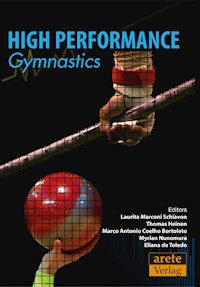
The book "High Performance Gymnastics" is a state-of-the-art documentation of sport science research in artistic and rhythmic gymnastics, coming from a collaboration between Brazil and Germany, and referring to the III. SIGARC congress, hosted 2012 in Sao Paulo (Brazil). International renowned authors provide in-detail discussions in the fields of artistic and rhythmic gymnastics. Psychological topics, such as the role of the coach in gymnastics or athletes' perceptions towards gymnastics are discussed, as well as topics from biomechanics, training science, or history. The edited book "High Performance Gymnastics" may be an important source for all people who are engaged in gymnastics (i.e., researchers, coaches, judges, gymnasts).
Sie lesen das E-Book in den Legimi-Apps auf:
Seitenzahl: 305
Veröffentlichungsjahr: 2015
Das E-Book (TTS) können Sie hören im Abo „Legimi Premium” in Legimi-Apps auf:
Ähnliche



















High Performance Gymnastics
EDITED BY
Laurita Marconi Schiavon, PhD
State University of São Paulo
Biosciences Institute Rio Claro, BRAZIL
Thomas Heinen, PhD
University of Hildesheim
Institute of Sport Science
Hildesheim, GERMANY
Marco Antonio Coelho Bortoleto, PhD
University of Campinas
Physical Education Faculty
Campinas, BRAZIL
Myrian Nunomura, PhD
University of São Paulo
School of Physical Education and Sport
Ribeirão Preto Campus, BRAZIL
Eliana de Toledo, PhD
University of Campinas
College of Applied Sciences
Limeira, BRAZIL
Bibliografische Information der Deutschen Nationalbibliothek
Die Deutsche Bibliothek verzeichnet diese Publikation in der Deutschen Nationalbibliografie; detaillierte bibliografische Daten sind im Internet über http://dnb.ddb.de abrufbar.
© 2014 Arete Verlag Christian Becker, Hildesheim.
www.arete-verlag.de
Das Werk und seine Teile sind urheberrechtlich geschützt. Jede Nutzung in anderen als den gesetzlich zugelassenen Fällen bedarf der vorherigen schriftlichen Einwilligung des Verlages. Dies gilt auch und insbesondere für Vervielfältigungen, Übersetzungen, Verfilmungen und die Einspeicherung sowie Datenvorhaltung in elektronischen und digitalen Systemen.
1. digitale Auflage: Zeilenwert GmbH 2015
ISBN 978-3-942468-57-2
Acknowledgment:
This book is dedicated to all those who have contributed and who still contribute to the development of competitive gymnastics. A special credit is given to the coaches, who, with a lot of effort, study and bravery, face numerous challenges, and do their best to advance gymnastics.
Cover design: Marco Fontanetti.
Last but not least, we thank the former Brazilian gymnast Luisa Parente for providing photos from a travelling exhibition on her life.
Contens
Cover
Titel
Impressum
Foreword by Ivan Čuk
Foreword by Hardy Fink
Preface
1 Gymnastics challenges – a view from 50 years of coaching and teaching - Keith Russell
2 The group in rhythmic gymnastics - Márcia Regina Aversani Lourenço & Ieda Parra Barbosa Rinaldi
3 Profile, motivations, and the challenges of artistic gymnastics coaches in Brazil - Myrian Nunomura & Mauricio Santos Oliveira
4 Contributions of sport psychology to competitive gymnastics - Thomas Heinen, Pia M. Vinken & Konstantinos Velentzas
5 The content of rhythmic gymnastics routines - Lurdes Ávila-Carvalho, Catarina Leandro & Eunice Lebre
6 Qualitative video analysis as a pedagogical tool in artistic gymnastics - Marco Antonio Coelho Bortoleto & César Jose Duarte Peixoto
7 Gymnastics: a game of rules - Jean-François Robin
8 Portraits of high performance rhythmic gymnastics in Brazil - analysis and proposals - Eliana de Toledo & Kizzy Fernandes Antualpa
9 Gymnastics coaching and science: biomechanics perspectives - Gareth Irwin, Geneviève K. R. Williams & David G. Kerwin
10 Reflections on planning and control of sport training in rhythmic gymnastics. - Mélix I. Avilés, Yolaini Govea Díaz & Nelly Ochoa Borrás
11 Psychological aspects in the sport preparation of brazilian female gymnasts participating in the Olympic Games: the gymnasts’ view - Laurita Marconi Schiavon
Author’s biographies (in alphabetical order)
Fußnoten
Foreword by Ivan Čuk
Editor-in-Chief of Science of Gymnastics Journal
SIGARC symposium in Brazil was up to now hold three times. For 2012, experts from all over the world were invited who prepared scientific presentations as well as book chapters from the field of their expertise. In this book there are eleven chapters of excellent readings for coaches, gymnasts, judges, physical education teachers, students, and even parents of gymnasts, and of course, scientists, who will continue to improve and extend gymnastics knowledge. Whether authors are dealing with artistic or rhythmic gymnastics, from my point of view, both sides are interesting since they are focusing on general aspects, which are always of high interests for all gymnastics disciplines.
The first chapter was prepared by the FIG’s scientific commission president Keith Russell, dealing with a mostly philosophical overview of half a century development of gymnastics. The most important medical conclusion was that gymnastics does not hamper gymnast’s growth, which is something that envy sport researchers and medicine people claimed for decades and thus made a lot of negative propaganda against gymnastics. Márcia Regina Aversani Lourenço and Ieda Parra Barbosa Rinaldi prepared the second chapter, covering their expertise on group exercises in rhythmic gymnastics, where the most important topics are different changes of formations (collaboration and communication between gymnasts), without losing individual object manipulation technique mastery. Myrian Nunomura and Mauricio Santos Oliveira were exploring profiles and the motivation of artistic gymnastics coaches in Brazil. Their most valuable conclusion is that universities can be of great support for coaches, thus making the coaching process in gymnastics friendly, injury safe and with high achievements. Thomas Heinen, Pia Vinken and Konstantinos Velentzas discuss the contribution of sport psychology to competitive gymnastics. They stated that experienced gymnasts are far from being ‘machines’ that produce the same pattern of movement in every trial. It was concluded, that in order to make every trial as stable as possible, psychologists can assist them. Lurdes Ávila-Carvalho, Catarina Leandro and Eunice Lebre were researching the content of competition routines in rhythmic gymnastics. According to their analysis of articles they suggest new studies in the area of execution, and some changes in the Code of Points. Marco Antonio Coelho Bortoleto and César Jose Peixoto Duarte made a review of qualitative video analysis as a pedagogical tool in artistic gymnastics. The important conclusion thereby is that operating video hardware and software should also be a part of the knowledge offered in coaches’ education programs, perhaps as a first step prior to discussing biomechanical studies. Jean-François Robin made a philosophical approach towards gymnastics whilst defining gymnastics as a game of rules. Among these rules are “difficulty” and “execution”, like Jing and Jang, which generate basic strategies how to win at competition. Eliana de Toledo and Kizzy Fernandes Antualpa present an in-detail overview of high performance rhythmic gymnastics in Brazil, thereby discussing aspects such as Brazilian participation in the Olympic Games, and also highlighting potential aspects that could help to develop rhythmic gymnastics in the future. Gareth Irwin, Geneviève Williams, and David Kerwin refer to gymnastics coaches and biomechanics perspectives, where highly complex skills demand extra knowledge from coaches in order to prepare proper conditioning, proper skill development, and learning. Mélix Ilisástigui Avilés, Yolaini Govea Díaz, and Nelly Ochoa Borrás deal with planning of sport training in rhythmic gymnastics. The authors discuss some interesting limits when the training was efficient according to coaches plans. The last chapter was written by Laurita Marconi Schiavon on psychological aspects in the sport preparation of female Brazilian gymnasts participating in the Olympic Games. Her work shows the importance of interviews with gymnasts, and how important it is to analyze past work in a frame of future activities.
Brazil is preparing for the Olympic Games in Rio de Janeiro in 2016; they are improving not only facilities for the games, but what is most important, they are maintaining and developing ’know how’ in order to work with athletes to be successful. Results at the 2012 Olympic Games and the 2013 World Championships speak for themselves. This book will have -after Rio 2016- still important knowledge from which all participants in gymnastics can gain.
Ljubljana, October 2013.
Ivan Čuk
Foreword by Hardy Fink
Director, FIG Education & Academy Programs
These proceedings from the 2012 SIGARC symposium encompasses a broad range of historical, empirical, and scientific articles presented by some of the world’s leading practitioners and researchers in the area of gymnastics. This symposium featured presentations about the various gymnastics sports, and with focused research on rhythmic-, men’s- and women’s-gymnastics from biomechanical, psychological, planning, and methodological perspectives.
The introductory presentation by Russell takes a critical and enlightening look at all of the gymnastics sports from the insights he gained over a lifetime of coaching and teaching gymnastics. He also dispels forcefully the suggestion that gymnastics participation “retards” growth.
Four papers discuss aspects of rhythmic gymnastics. The beauty and the challenges related to group rhythmic performances from the experiences of the Brazil group are presented by Lourenço et al. The content of rhythmic gymnastics routines are analyzed with reference to Code of Points requirements by Ávila-Carvalho et al. A third paper, this one by Avilés et al, studies the principles of periodization, planning, and pedagogy applied to training in rhythmic gymnastics. The fourth paper by Toledo and Antualpa deals with the development of high performance rhythmic gymnastics in Brazil as well as Brazilian participation in international competitions.
Psychology applied to gymnastics training is also presented in three different papers. Nunomura and Oliveira look at the difficult and essential tasks of coaches in artistic gymnastics by presenting data on coaches’ profiles and motivation. Heinen et al. outline how sport psychology can contribute to gymnastics performances from the analysis of the performance demands, psychological profiles, and psychological interventions. Schiavon takes a fascinating look at psychological aspects of preparing gymnastics teams and specifically the Brazilian women’s team for the Olympics.
Other sport sciences are not ignored. Irwin et al. look at biomechanical analysis and how this science can enhance the effectiveness of gymnastics coaches. Bortoleto and Duarte take a different but equally enlightening approach. It is that of qualitative video analysis that can be quickly and easily meaningful to a coach instead of the sometimes more difficult to understand biomechanical and quantitative analysis.
Finally, no overview of gymnastics would be complete without the regulations that attempt to direct and guide its direction. Robin presents the influence of the Code of Points on gymnasts, coaches, and judges.
The totality of these proceedings from the 2012 SIGARC symposium provides a large amount of scientific, pedagogical, methodological, empirical and experiential information that can be of benefit to every gymnastics coach. Even the best or most successful of coaches can improve – can be better – by knowing and incorporating the information provided.
Moreover, every book that presents the content and philosophy of the systematic, careful, and informed coaching of athletes is a welcome addition to gymnastics. And for this reason, I very much appreciate that this book will help improve our sports for all participants, but most especially for the gymnasts.
Canada/Switzerland, December 2013.
Hardy Fink
Preface by the Editors
Laurita Marconi Schiavon, Thomas Heinen, Marco Antonio Coelho Bortoleto, Myrian Nunomura & Eliana de Toledo
The book “High Performance Gymnastics” arises from a partnership among the three State Universities of São Paulo (UNICAMP, UNESP, USP), and the University of Hildesheim (Germany). This experience has arisen due to the interest of many students, professionals, and researchers in gymnastics, who are looking for new scientific and pedagogical approaches that would contribute to its development. After three editions of the International Seminar on Competitive Artistic and Rhythmic Gymnastics (SIGARC), we have seen an opportunity to collaborate in producing the book presented herein.
Among the many issues addressed directly and indirectly in this book, biomechanics of gymnastics is the core theme of the chapter of Gareth Irwin, Geneviève Williams, and David Kerwin (Cardiff Metropolitan University), as well as the chapter of Marco A. C. Bortoleto and César Peixoto, which is the outcome of a partnership between Brazil (UNICAMP) and Portugal (Lisbon Technical University).
Psychological aspects in dealing with gymnasts are addressed in two chapters. The first one was authored by Thomas Heinen (University of Hildesheim), Pia Vinken (Leibniz University Hanover) and Konstantinos Velentzas (Bielefeld University). The other chapter was written by Laurita Marconi Schiavon (UNESP), presenting proposals for intervention and the experiences from major Brazilian Olympic gymnasts.
The Brazilian context in the field of rhythmic gymnastics is analyzed by Eliana de Toledo (UNICAMP) and Kizzy Antualpa (Metrocamp), revealing the scenario of the rhythmic gymnastics; and also by Myrian Nunomura (USP) and Mauricio Oliveira (UFES), discussing the profile, motivations and challenges of artistic gymnastics coaches in the country.
The routines composition analysis, planning and training control of rhythmic gymnasts are also topics covered by Márcia Aversani Lourenço (UNOPAR) and Ieda Parra Barbosa Rinaldi (UEM), focusing on the particularities of “group”. Lurdes Ávila-Carvalho (UP), Catarina Leandro (ULP) and Eunice Lebre (UP) discuss on the competitive exercises in the rhythmic gymnastics routines. Mélix Avilés, Yolaini Diaz, and Nelly Borrás (UCCFD) address the periodization and training control in rhythmic gymnastics.
In a broader approach, the process and the principles of high performance training in gymnastics are discussed by Keith Russell (University of Saskatchewan) in the first chapter of this book, covering the outcome of more than 50 years’ experience in this sport. This comprehensive look on gymnastics guides the analysis of Jean François Robin (INSEP), who proposes a reflection on the social history that surrounds the rules of gymnastics, as well as their consequences for the better understanding of this phenomenon.
We believe that the contributions presented in this book stand for important advancements in the academic and scientific environment of our field. In this context, this book aims to build a new space for reflection, sharing knowledge, disseminating innovation, and technology, as well as joining authors from eight different nationalities, thus becoming an important source of knowledge in competitive gymnastics.
Finally, dear fellow academics, coaches, gymnasts, judges, researchers, and others involved with gymnastics, we hope you all enjoy the reading! - Gymnastics greetings!
Brazil/Germany, February 2014.
Laurita Marconi Schiavon
Thomas Heinen
Marco Antonio Coelho Bortoleto
Myrian Nunomura
Eliana de Toledo
CHAPTER 1
GYMNASTICS CHALLENGES - A VIEW FROM 50YEARS OF COACHING AND TEACHING
Keith Russell
University of Saskatchewan - College of Kinesiology (Canada).
Correspondence to: [email protected]
Acknowledgement:
The author would like to thank Mr.Hardy Fink and Dr.John Atkinson for reading and offering suggestions and corrections during the preparation of this essay.
1.1Introduction
While watching the recent Olympics I continued to marvel at the extremely high level of athletic prowess shown by gymnasts. They are surely the most superb athletes. Their power, strength and flexibility set the world standards, and the complexity and number of skills they must perform surpass what most other athletes must attempt. In addition, gymnasts must overcome fear while, at the same time, they must satisfy the requirements for artistry. The Olympic family of gymnastics sports (artistic gymnastics, trampoline gymnastics, rhythmic gymnastics) is certainly at the very cutting edge of athletic achievement. This is, of course, also true for the non-Olympic gymnastics sports of acrobatic gymnastics and aerobic gymnastics.
Lesen Sie weiter in der vollständigen Ausgabe!
Lesen Sie weiter in der vollständigen Ausgabe!
Lesen Sie weiter in der vollständigen Ausgabe!
Lesen Sie weiter in der vollständigen Ausgabe!
Lesen Sie weiter in der vollständigen Ausgabe!
Lesen Sie weiter in der vollständigen Ausgabe!
Lesen Sie weiter in der vollständigen Ausgabe!
Lesen Sie weiter in der vollständigen Ausgabe!
Lesen Sie weiter in der vollständigen Ausgabe!
Lesen Sie weiter in der vollständigen Ausgabe!
Lesen Sie weiter in der vollständigen Ausgabe!
Lesen Sie weiter in der vollständigen Ausgabe!




