


16,99 €
Mehr erfahren.
- Herausgeber: John Wiley & Sons
- Kategorie: Geisteswissenschaft
- Sprache: Englisch
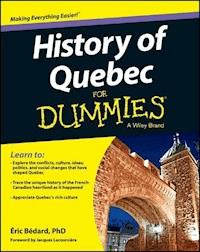
Grasp the unique history of Quebec? Easy. Packing in equal parts fun and facts, History of Quebec For Dummies is an engaging and entertaining guide to the history of Canada's second-largest province, covering the conflicts, cultures, ideas, politics, and social changes that have shaped Quebec as we know it today. "My country isn't a country, it is winter!" sings the poet Gilles Vigneault . . . Indeed, Quebec is winter, snow, cold, and freezing winds. It is also the majestic river Saint-Laurent and its numerous confluences across America. It is vast, dense forests, countless lakes, magnificent landscapes of Saguenay, Charlevoix, Côte-Nord, or Gaspésie. Quebec is also the "old capital" perched on the Cape Diamond facing the sea. It is Montreal, the first French city of North America, the creative and innovative metropolis, junction for different cultures and heart of a nation yearning to belong to the world's history. History of Quebec For Dummies tells Quebec's fascinating story from the early fifteen hundreds to the present, highlighting the culture, language, and traditions of Canada's second-largest province. * Serves as the ideal starting place to learn about Quebec * Covers the latest, up-to-the-minute findings in historical research * Explores the conflicts, cultures, ideas, politics, and social changes in Quebec Lifelong learners and history buffs looking for a fun-yet-factual introduction to the grand scope of Quebec history will find everything they need in History of Quebec For Dummies.
Sie lesen das E-Book in den Legimi-Apps auf:
Seitenzahl: 708
Veröffentlichungsjahr: 2013
Ähnliche




















History of Quebec For Dummies®
Published byJohn Wiley & Sons Canada, Ltd.6045 Freemont Blvd.Mississauga, Ontario, L5R 4J3
www.wiley.com
Copyright © 2013 by John Wiley & Sons Canada, Ltd.
No part of this publication may be reproduced, stored in a retrieval system or transmitted in any form or by any means, electronic, mechanical, photocopying, recording, scanning or otherwise, without the prior written permission of the Publisher. Requests to the Publisher for permission should be addressed to the Permissions Department, John Wiley & Sons Canada, Ltd., 6045 Freemont Blvd., Mississauga, Ontario, L5R 4J3, or online at http://www.wiley.com/go/permissions.
Trademarks: Wiley, For Dummies, the Dummies Man logo, Dummies.com, Making Everything Easier, and related trade dress are trademarks or registered trademarks of John Wiley & Sons, Inc., and may not be used without written permission. All other trademarks are the property of their respective owners. John Wiley & Sons, Inc., is not associated with any product or vendor mentioned in this book.
Limit of Liability/Disclaimer of Warranty: while the publisher and author have used their best efforts in preparing this book, they make no representations or warranties with respect to the accuracy or completeness of the contents of this book and specifically disclaim any implied warranties of merchantability or fitness for a particular purpose. no warranty may be created or extended by sales representatives or written sales materials. The advise and strategies contained herein may not be suitable for your situation. you should consult with a professional where appropriate. neither the publisher nor the author shall be liable for damages arising herefrom.
For general information on John Wiley & Sons Canada, Ltd., including all books published by John Wiley & Sons, Inc., please contact our Customer Care Department within the Canada at 800-567-4797, outside Canada at 416-646-7992, or fax 416-236-4448. For technical support, please visit www.wiley.com/techsupport.
Wiley publishes in a variety of print and electronic formats and by print-on-demand. Some material included with standard print versions of this book may not be included in e-books or in print-on-demand. If this book refers to media such as a CD or DVD that is not included in the version you purchased, you may download this material at http://booksupport.wiley.com. For more information about Wiley products, visit www.wiley.com.
Library and Archives Canada Cataloguing in Publication
Bédard, Éric, 1969
History of Quebec for dummies / Éric Bédard.
Includes index.
Translation of: L’histoire du Québec pour les nuls.
Also issued in electronic format.
ISBN 978-1-118-44055-1
1. Québec (Province) History. I. Title.
FC2911.B4313 2013 971.4 C2013-900799-7
ISBN 978-1-118-44055-1 (pbk); ISBN 978-1-118-43976-0 (ebk); ISBN 978-1-118-43974-6 (ebk); ISBN 978-1-118-43975-3 (ebk)
Manufactured in the United States of America
1 2 3 4 5 RRD 18 17 16 15 14
History of Quebec For Dummies®
Visit www.dummies.com/cheatsheet/historyofquebec to view this book's cheat sheet.
Table of Contents
Introduction
About This Book
What You’re Not to Read
Foolish Assumptions
How This Book Is Organized
Part I: New France (1524–1754)
Part II: Conquered but Still Alive (1754–1867)
Part III: Survival (1867–1939)
Part IV: The Quiet Reconquest (1939–1967)
Part V: Province or Country? (1967 to Today)
Part VI: The Part of Tens
Icons Used in This Book
Where to Go from Here
Part I: New France (1524–1754)
Chapter 1: Looking for China — and Finding Quebec! (1524–1610)
Setting Out to Conquer the West
Why the Europeans wanted to explore
Who went where
What they found when they arrived: An inhabited New World
France gets into the race
Moving toward the Founding of Quebec
Focusing on the fur trade
Meeting Samuel de Champlain: A true visionary
Founding Quebec
Consolidating an alliance
Chapter 2: Founding a Colony (1611–1660)
Hesitant Beginnings
Moving into action
Luring settlers
A New Impetus
The Company of One Hundred Associates
The mystics’ adventure
The Iroquois threat
Chapter 3: Exploring a Continent (1661–1701)
The Decisive Move Forward
L’État, c’est moi! (The state, it is I!)
A big push
Toward the Great Peace of 1701
French America
War and peace
Chapter 4: A French Province (1701–1754)
The Weakening of New France
Clashes between England and France
The Treaty of Utrecht
An Ancien Régime Society
A diverse population
A struggling economy
Day-to-day beliefs
War again
Part II: Conquered but Still Alive (1754–1867)
Chapter 5: The Coming of the English (1754–1763)
Identifying the Appeal of New France for the English
The determination of the Anglo-Americans
The English go all out
English Conquest, or French Abandonment?
The siege of Quebec and the battle of the Plains of Abraham
The surrender of Montreal
The 1763 Treaty of Paris
Chapter 6: The American Temptation (1763–1790)
To Assimilate or to Woo?
The Royal Proclamation
The Quebec Act
The American Revolution
The Americans turn angry
The American invasion
The arrival of the Loyalists
Chapter 7: The Birth of Lower Canada and the Parti Canadien (1791–1822)
Setting Up a Government with the Constitutional Act
Their own parliament
Language: A hot topic
Dampening the Mood of Optimism with War and New Leadership
The shadow of the French Revolution
The emergence of the Parti Canadien
The crisis of 1810
Seeing the British Empire at War and at Peace
A second American invasion
Pax Britannica
Chapter 8: From the Repression of the Patriotes to the Act of Union (1823–1840)
Louis-Joseph Papineau, Republican Leader
The Old World and the New World
Papineau, man of destiny
The quarrel over government finances and the 1832 election
A delicate situation
The 92 Resolutions and the Russell Resolutions
The Parti Canadien’s grievances
Hostility to reform
The reaction in London
The Patriotes’ Defeat and Its Consequences
Popular assemblies
Brawls and battles
The Act of Union of 1840
Chapter 9: Responsible Government and Religious Awakening (1840–1860)
Louis-Hippolyte LaFontaine, Reformer
Avoiding the fate of the Acadians
Presenting a manifesto to the voters of Terrebonne
Discovering the great reform government of 1848
A Religious Revival
Signs of awakening
Ignace Bourget’s program
Heaven is blue, hell is red!
Chapter 10: Confederation (1860–1867)
Falling Apart in the Province of Canada
Political instability
Having to fend for themselves
The economy hits a roadblock
A Solution: Confederation
A draft constitution
Supporters and adversaries
The British North America Act
Part III: Survival (1867–1939)
Chapter 11: “Riel, Our Brother, Is Dead” (1867–1896)
The Church Grabs Hold of Education
Chauveau: Premier by default
The Catholic Program
Fighting for Autonomy
Influence peddling — and moderation
The rise of the Liberals
Fighting for an Economic Leg to Stand On
Quebec embarks on industrialization
Taking hold of the economy, but how?
Chapter 12: Conscription (1897–1928)
Opposing Imperialism
Laurier’s compromises
Henri Bourassa and the nationalist movement
The conscription crisis
Prosperity through Foreign Capital
Triumph of the free market
The emergence of a modern Quebec state
Chapter 13: The Depression (1929–1938)
The Effects of the Stock Market Crash
The defects of the liberal economy
Immediate government reactions
Whose fault is it?
The Union Nationale
The opposition gets organized
A new regime is installed
Part IV: The Quiet Reconquest (1939–1967)
Chapter 14: War (1939–1944)
The Shadow of Conscription
The election of 1939
General mobilization
The 1942 vote
Godbout the Reformer
Women get the vote!
Compulsory education
Economic achievements and federal incursions
Chapter 15: Le Chef (1944–1959)
Defending the Established Order
A regime in control
The cold war era
The miners of Asbestos
Striving for Autonomy and Development
Income tax
Developing Quebec
Seeing Impatience Grow
Exasperated moralists
Divided nationalists
The Liberals
Chapter 16: The “Quiet Revolution” (1959–1962)
Regime Change
Mourning and succession
A Liberal victory
Equal Opportunity
Emphasizing the state over the church
Educating the masses
Healthcare for all
Masters in Our Own House
Breaking through the glass ceiling
Completing the nationalization of hydroelectricity
Chapter 17: The Reforms Continue (1963–1967)
Fighting Social Exclusion
Women’s rights
The very poor
The Caisse de Dépôt et Placement
Fighting for the Independence of Quebec
Special status
Birth of the independence movement
Seeing the Union Nationale Back in Power
Choosing continuity
Equality or independence
Part V: Province or Country? (1967 to Today)
Chapter 18: Revolt (1967–1972)
The Founding of the Parti Québécois
Sovereignty-association
The Saint-Léonard crisis
Violence and Radicalization
The October Crisis
Social radicalization
Chapter 19: The Opening of James Bay and the Election of the Parti Québécois (1973–1979)
From Robert Bourassa to René Lévesque
The James Bay development
French: Quebec’s official language
The Election of the Parti Québécois
A new step-by-step strategy
The first sovereignist government
The charter of the French language
A blizzard of reforms
Chapter 20: Federalism: A Risk Worth Taking (1980–1987)
The Parti Québécois’s Ordeal
The defeat of the “yes” side
Repatriation of the Canadian constitution
Recovery from Recession and Political Impasse
Confrontation and cooperation
A changing of the guard in Ottawa and Quebec
The Meech Lake Accord
Chapter 21: Almost a Country (1987–1995)
Canada in Crisis
A looming failure
Repairing the damage
The Second Quebec Sovereignty Referendum
Creation of the camp for change
1995, when everything seemed possible
Chapter 22: Balanced Budget and Reasonable Accommodation (1996–2012)
The Bouchard Years
The return of “good government”
The constitution: A lull followed by an impasse
Quebec in Search of Itself
Which way for the Quebec model?
The crisis of reasonable accommodation
Right, left, right, left . . .
A woman premier
Part VI: The Part of Tens
Chapter 23: Ten Mythical Personalities
Maurice Richard and the Riot of 1955
Louis Cyr: Strong Man
Albani: The Great Singer
Céline Dion: International Star
Leonard Cohen: The Soothing Voice
Émile Nelligan: The Accursed Poet
Michel Tremblay: Putting “Joual” on Stage
Gratien Gélinas
Olivier Guimond: A True Comedian
Guy Laliberté: A Clown in Space
Chapter 24: Ten Quebec Symbols
Saint-Jean-Baptiste Day: French Canadian or Québécois Celebration?
“Gens du pays”: The Unofficial Anthem
L’homme rapaillé: “I Have Never Traveled Anywhere but to You, My Country”
The Plouffe Family: A True Québécois Saga
Swearing in Quebec: A Throwback to an Earlier Era?
The Arrow Sash: Patriote Symbol
Square Dancing: “And Swing Your Partner!”
The Sugar Shack: An Indigenous Heritage
The Bombardier Ski-Doo
The Montreal Canadiens: A Hockey Dynasty
Chapter 25: Ten Quebec Landmarks
The Plains of Abraham and the Battle of Memory
Mount Royal: An Extinct Volcano?
The Saguenay Fjord and Its “Incredible Depth”
Sainte-Anne-de-Beaupré: Sanctuary for the Faithful
Île d’Orléans: Birthplace of French America
The Magdalen Islands: Acadian Refuge after the Deportation
The Quebec Citadel: Remains of a Fortified City
Percé Rock: Gateway to the St. Lawrence
Wendake: Last “Reserve” of the Hurons
Manic-5: The Pride of a Conquering People
About the Author
Dedication
Author’s Acknowledgments
Cheat Sheet
Foreword
Historian Éric Bédard is an academic who knows how to make his subject accessible to everyone, an ability he demonstrates in History of Quebec For Dummies. By telling the story chronologically rather than using a thematic approach, he allows readers to “see” the evolution of Quebec, from the French regime to the present. All aspects of Quebec’s history are covered. Intended for a mass audience, the book aims for a better understanding of this part of the country that is always in search of itself and that, one day, through experience, will no doubt find its place in the world.
No one who has read History of Quebec For Dummies will be able to plead ignorance of the history of this Canadian province, which Canadian Prime Minister Louis Stephen Saint-Laurent described as similar to other provinces. “They say,” he declared in September 1954, “that the province of Quebec is not a province like the others. I do not share this opinion.” Needless to say, Premier Maurice Duplessis of Quebec did not agree with this statement.
The way Éric Bédard has divided Quebec history into periods will surprise those who are used to thinking of the 1960s and the election of the Liberals under Jean Lesage as the beginning of what is called the “Quiet Revolution.” Instead, the author highlights the coming to power of Adélard Godbout, the Liberal premier who held office during World War II and whose achievements, although more or less forgotten today, were notable. The innovative nature of this interpretation is expressed in the title of this part of the book, “The Quiet Reconquest.” I agree with Éric Bédard on this point — and, indeed, on his interpretation of Quebec’s past as a whole. In my view, as in Bédard’s, the stage was set for rapid change to take place starting in 1960. Otherwise, the changes that Quebec would both enact and witness cannot be understood. In the traditional interpretation, it seems that everything changed overnight and Quebec suddenly entered into a new mode of civilization: Education took on a new face and the Catholic religion lost its importance. But these profound changes were in the making for a long time.
The book does not seek to present a sanitized history. You can see that especially in Part V, which asks the question “Province or country?” Here Bédard sets aside his political orientation, knowing full well that historians who openly take a position on the future of Quebec in their work will see their writings discredited. A historian is a prophet — but a prophet who looks to the past! Bédard has taken the wise precaution of avoiding prognostication on the future of Quebec.
Part VI focuses primarily on Quebec’s cultural life. Too often in a work of this kind, this aspect is skimmed over or even ignored. But not in History of Quebec For Dummies. Bédard looks at a variety of aspects of Quebec culture — including Michel Tremblay’s play Les belles-sœurs, which caused a scandal in Quebec in the late 1960s, and which continues to resonate with audiences, as the success of its 2012 revival in Paris demonstrates.
Few historians in recent years have ventured to write a comprehensive overview of the history of Quebec. Éric Bédard should be commended for having undertaken this task. He was certainly well prepared to do it. His presence in the media — television, radio, and newspapers — has made him a first-class communicator. You can read his History of Quebec For Dummies without running to the dictionary. The absence of footnotes makes the narrative easier to understand — everything is in the text. It follows the usual formula for history books in this series. The text is interspersed with inserts devoted to anecdotes and other specific points. Summaries further enhance the reader’s understanding of events.
Congratulations to historian Éric Bédard for bringing Quebec’s past to life, a colorful past where hope and despair followed each other in rapid succession. Quebec’s motto is “Je me souviens” (“I remember”). Reading History of Quebec For Dummies, you will find out why it is important to remember, and just what is it that you are remembering.
— Jacques Lacoursière
Historian and member of the Royal Society of Canada
Introduction
“Mon pays ce n’est pas un pays, c’est l’hiver!” (“My country is not a country, it’s winter”), sang the poet Gilles Vigneault.
Yes, Quebec is winter, snow, cold, piercing January winds. It’s the majestic St. Lawrence River and its many tributaries, crisscrossing the American continent. It’s the vast forests, the countless lakes, the beautiful countryside of Témiscamingue, Charlevoix, the North Shore, and the Gaspé Peninsula.
It’s also Quebec City, the vieille capitale, perched above the river on Cap Diamant, its face turned to the shores of Europe. And, of course, Montreal, Quebec’s inventive, creative metropolis, the leading French city of the New World, a meeting place and a crossroads of cultures, the nerve center of a young nation.
But most of all, Quebec is a people — brave, stubborn, and determined. A people that, from its first days in the New World, had to be strong-willed, hardy, and courageous to face the rigors of the Quebec winter, clear the land by moonlight, raise large families, explore a vast continent, survive Iroquois attacks and the hostility of the American colonies, and later withstand the greed of wealthy merchants and the turmoils of the Industrial Revolution and the Depression of the 1930s.
This great adventure is the story that’s told in the pages that follow. It’s a story of resistance and affirmation, marked by resilience and yet haunted by the frustration of having to start over. The story of a people that came through trials and tribulations and overcame dejection and resignation. The story of a dream, the dream of French America, and of the crucible of the British Conquest. Most of all, it’s the story of a long and patient reconquest through which Quebecers took back their territory, their economy, and their political life.
Quebec’s motto is “Je me souviens” (“I remember”). Unfortunately, too many Quebecers seem to look at their past as a demoralizing “Grande noirceur” (“great darkness”) that holds little of interest for the present and the future. Nothing could be further from the truth. Quebec history is rich, fascinating, and often inspiring, filled with surprising turns and larger-than-life personalities.
This is the story that will unfold as you read this book.
About This Book
In this book, I follow the thread of Quebec’s development, identifying the turning points and explaining the underlying forces at work. I tell the story in strict chronological order and provide profiles of the most important personalities. The history of Quebec was made by men and women, people whose ideas were shaped by their time. Did these people, with their passions and their dreams, sometimes make mistakes? Maybe. But my goal is to avoid being too cynical or making hasty moral judgments; instead, I try to understand their actions and explain their decisions.
The history of Quebec is one piece of the history of the world. Its key moments can be explained only in relation to the great discoveries of the 16th century, the Catholic Counterreformation of the 17th century, the geopolitical tensions of the 18th century, the Industrial Revolution of the 19th century, and the world wars of the 20th century, along with the development of the welfare state in the West and the decolonization movement of the 1960s. You can’t understand what was happening in Quebec without keeping an eye out for major events taking place in France, Britain, the United States, and other parts of the world.
What You’re Not to Read
You can safely skip anything marked by a Technical Stuff icon. (For more on icons, see Icons Used in This Book, later in this Introduction.)
You can also skip sidebars, which are the gray boxes of text. The information in sidebars is interesting, but not absolutely critical to your understanding of the topic at hand.
Foolish Assumptions
I don’t make a tremendous amount of assumptions about you, the reader of this book, but I do make a few:
You aren’t a historical researcher. You’re just someone with an interest in the history of Quebec.
You may have grown up in Quebec but feel you have a poor knowledge of its history, either because you’ve forgotten large chunks of what you learned in high school or because you never learned it in the first place.
You may have recently moved to Quebec, and you’re looking for a better understanding of your new home.
You may be traveling to Quebec and want to know the history of what you’ll see when you get there.
How This Book Is Organized
History of Quebec For Dummies is divided into seven parts, comprising 25 chapters. Here’s an overview of what each part covers.
Part I: New France (1524–1754)
In the earliest part of its history, Quebec was called New France. The young colony sometimes inspired extravagant dreams — dreams of a French and Catholic America. The impressive figures who walked across the stage of New France gave flesh to those dreams: Samuel de Champlain, Marie Guyart, Paul de Chomedey de Maisonneuve, Jeanne Mance, Pierre Le Moyne d’Iberville. In Part I, I explain why France wanted to explore the New World in the 16th century. Before the arrival of the French, what is now Quebec was inhabited by Aboriginal peoples, either nomadic or semi-sedentary. A number of these peoples made alliances with the first French settlers who founded the towns of Quebec and Montreal. I introduce the most important explorers, describe the institutions of New France, and seek to understand why this vast colony was so sparsely populated.
Part II: Conquered but Still Alive (1754–1867)
The Anglo-American colonies had larger populations than New France, and they looked covetously at the Mississippi Valley and France’s possessions in North America. In Part II, I recount the main events of the war in which British and American armies conquered New France. After the conquest, the Canadiens of the St. Lawrence Valley were confined to a small reserve called the “Province of Quebec.” A few years later, the American colonies, now in revolt against Britain, again cast their eyes on this territory. After the American War of Independence, Quebec became host to the “Loyalists,” immigrants from the south who wanted to remain faithful to the British crown and demanded real British institutions, which came into being in 1791. But the domination of these institutions by English merchants was a source of discontent among the French-speaking majority, which established a party that rebelled against the British metropolis in 1837–1838. Repression of these rebellions was followed by the Act of Union and a major religious revival in the mid-19th century.
Part III: Survival (1867–1939)
In 1867, Quebec became a Canadian province. Why did Quebecers agree to this new confederation? What would be the powers of the new province of Quebec? What would be the place of francophones in the new country called Canada? In Part III, I answer these complex questions as simply as possible.
A fundamental event in bringing to light the place of francophones in Canada was the hanging of the Métis leader Louis Riel in 1885. Two important political figures, Honoré Mercier and Wilfrid Laurier, came to power as a result of this event. This was also the period of the Industrial Revolution, which for French Canadians was a time of economic inferiority and large-scale emigration to the United States. This economic inferiority was accentuated by the Depression of the 1930s. While the Quebec government made efforts to bring the Depression to an end, reform movements brought a new party into being.
Part IV: The Quiet Reconquest (1939–1967)
The reform program instituted by the government of Adélard Godbout (1940–1944) and postwar prosperity helped Quebecers regain their confidence and emerge from the long period when their main focus was survival. However, in 1944, they elected a conservative government headed by Maurice Duplessis. Returned to power repeatedly, Duplessis ruled Quebec with an iron hand, fiercely resisted federal intrusion into provincial fields of jurisdiction, brutally repressed strikes, and praised the virtues of rural, traditional Quebec. The election of the “équipe du tonnerre” (“hell of a team”) in June 1960 was a turning point. A new political generation gave Quebec a healthcare system that provided free medical care and an education system that better prepared Quebecers to meet the challenges of postindustrial society. Above all, it endowed Quebec with a modern state that would make it possible for the French-speaking majority to catch up economically.
Part V: Province or Country? (1967 to Today)
The late 20th century was completely dominated by the debate over Quebec’s political status. Some people demanded a thorough reform of Canadian federalism leading to Quebec’s recognition as an “associated state” or a “distinct society.” Others, who sometimes compared Quebec with Algeria, Cuba, or Vietnam, dreamed of building a sovereign, independent country. A series of political movements and parties took up the cause of Quebec independence. Among these was the Parti Québécois, which came to power in 1976 and held an initial referendum in May 1980, in which Quebecers rejected “sovereignty association.” In the wake of the referendum, negotiations began in an effort to achieve greater recognition and respect for Quebecers within Canada. This constitutional saga culminated in the failure of the Meech Lake Accord in June 1990. With English Canadians having rejected Quebec’s minimum demands, Quebecers founded a new federal party, the Bloc Québécois, and once again elected the Parti Québécois to form the Quebec government in 1994. The new Parti Québécois government called a second referendum for October 30, 1995, which the No side won by a razor-thin margin. This close call sent a shockwave through the rest of Canada. The question remains unresolved.
Part VI: The Part of Tens
In Part VI, we look in turn at ten personalities, ten symbols, and ten landmarks, all of them expressive of the history of Quebec. Quebec comes alive through some of the dimensions of its popular heroes, its culture, and its geography. Why do Quebecers swear the way they do? What’s the origin of the arrow sash? When did Percé Rock lose its second arch? Where did the first inhabitants of the Magdalen Islands come from? And what about Louis Cyr, Rocket Richard, and Leonard Cohen? These sketches, brief though they are, cast light on additional layers of Quebec history.
Icons Used in This Book
Throughout the book, icons appear in the margins. Each icon helps you see at a glance what kind of information is presented in the passage beside it. Using the icons, you can focus on the kind of material you’re especially interested in or come back to a point you’re looking for. Here’s what the icons in this book mean:
The broad sweep of history is peppered with seemingly insignificant incidents and idiosyncrasies that reveal something about a person, event, or phenomenon. Anecdotes remind us that this is “human” history!
Paragraphs marked by this icon are moments that imprinted themselves in Quebecers’ consciousness. Those who were there have never forgotten these moments. In the history of any society, key dates are hooks that give us entry points into the flow of time.
This icon marks places where I focus on one of the many personalities who have left their mark on Quebec. What were their family origins and social background? What ideas did they hold dear? What motivated their political and social actions?
This icon points out an event or element in Quebec history that is especially important and should be remembered.
This icon marks information that’s interesting, but not essential to your understanding of the subject at hand.
Where to Go from Here
If you want a full picture of the history of Quebec, you can always start at the very beginning and read through to the end. But you can dip into whichever parts interest you most. Use the Table of Contents and Index to find the subjects that fascinate you. Or just open the book at random and start reading. You’re sure to find fascinating stories of impressive men and women who made Quebec what it is today.
Want to read further about Quebec? Head to www.dummies.com/go/historyofquebecfd where I list a number of other resources you can dive into, including a chronology of important events and a map of the province.
Part I
New France (1524–1754)
In this part . . .
A painful birth and difficult beginnings. . . . France got off to a late start in exploring the New World. Like the other European powers, it initially sought a route to Asia. After some hesitation, Quebec was chosen as the capital of New France. This early settlement was established by Samuel de Champlain, who forged links of trust and friendship with the Montagnais, Algonquians, and Hurons. But it wasn’t until the time of Louis XIV, his minister Jean-Baptiste Colbert, and the intendant Jean Talon that the colony truly began to develop.
In the late 17th century, a new people made its appearance. These “Canadiens” never gave up on their homeland, despite repeated attacks by the Iroquois and the growing appetite of the Anglo-American colonies. In addition to clearing new land, they explored the Great Lakes, paddled down the Mississippi, founded Louisiana, and went as far west as the Rockies.
Chapter 1
Looking for China — and Finding Quebec! (1524–1610)
In This Chapter
Exploring the New World
Looking at the role of the French in founding Quebec
The New World nation of Quebec was founded by adventurers, missionaries, and women and men who wanted to improve their lot and dreamed of a better world. When they crossed the ocean in the 15th and 16th centuries, Europe was experiencing an unprecedented period of growth. Portugal, Spain, and England were seeking new routes to China. Taking advantage of new scientific discoveries, sailors set out to sea, crossed the Atlantic, discovered America, and founded colonies.
France, 16th-century Europe’s leader in wealth and population, made the first move to colonize Quebec. In this chapter, I fill you in on when and why French leaders decided to set out for the New World, the circumstances that fed their curiosity about these vast western lands, and the ambitions that drove the French state. I also explain what the early explorers discovered (hint: they weren’t the first people there) and what kind of relationship developed between the French and the indigenous peoples. Finally, I tell you why the French decided to settle in the St. Lawrence Valley and found Quebec.
Setting Out to Conquer the West
In the 16th century, all western European powers were curious about the New World. This desire to travel and look beyond their shores took shape in the context of the Renaissance, an extraordinary and unprecedented period of artistic and intellectual growth and economic and political upheaval.
The Vikings: First explorers to the party
Well before the 16th century, the Vikings had explored the shores of the American continent. This great nation of conquering mariners originated in Scandinavia. They established settlements in Greenland that lasted three centuries, founding villages and erecting a bishop’s palace. Greenland was not very far from the shores of Newfoundland, and Vikings settled there around the year 1000 Their presence lasted several centuries, but they had completely abandoned Newfoundland by the time a later generation of Europeans decided to set out.
Lesen Sie weiter in der vollständigen Ausgabe!
Lesen Sie weiter in der vollständigen Ausgabe!
Lesen Sie weiter in der vollständigen Ausgabe!
Lesen Sie weiter in der vollständigen Ausgabe!
Lesen Sie weiter in der vollständigen Ausgabe!
Lesen Sie weiter in der vollständigen Ausgabe!
Lesen Sie weiter in der vollständigen Ausgabe!
Lesen Sie weiter in der vollständigen Ausgabe!
Lesen Sie weiter in der vollständigen Ausgabe!
Lesen Sie weiter in der vollständigen Ausgabe!
Lesen Sie weiter in der vollständigen Ausgabe!
Lesen Sie weiter in der vollständigen Ausgabe!
Lesen Sie weiter in der vollständigen Ausgabe!
Lesen Sie weiter in der vollständigen Ausgabe!
Lesen Sie weiter in der vollständigen Ausgabe!
Lesen Sie weiter in der vollständigen Ausgabe!
Lesen Sie weiter in der vollständigen Ausgabe!
Lesen Sie weiter in der vollständigen Ausgabe!
Lesen Sie weiter in der vollständigen Ausgabe!
Lesen Sie weiter in der vollständigen Ausgabe!
Lesen Sie weiter in der vollständigen Ausgabe!
Lesen Sie weiter in der vollständigen Ausgabe!
Lesen Sie weiter in der vollständigen Ausgabe!
Lesen Sie weiter in der vollständigen Ausgabe!
Lesen Sie weiter in der vollständigen Ausgabe!
Lesen Sie weiter in der vollständigen Ausgabe!
Lesen Sie weiter in der vollständigen Ausgabe!
Lesen Sie weiter in der vollständigen Ausgabe!
Lesen Sie weiter in der vollständigen Ausgabe!
Lesen Sie weiter in der vollständigen Ausgabe!
Lesen Sie weiter in der vollständigen Ausgabe!




