


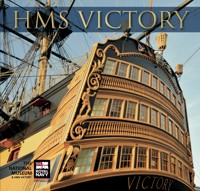
Erhalten Sie Zugang zu diesem und mehr als 300000 Büchern ab EUR 5,99 monatlich.
- Herausgeber: Pitkin
- Kategorie: Lebensstil
- Sprache: Englisch
This is a beautiful and informative guidebook and history of HMS Victory. On 7 May 1765 a magnificent new ship of the line was floated out of the Old Single Dock in Chatham's Royal Dockyard. She was HMS Victory, a first-rate battleship and the largest and most up-to-date ship in King George III's Royal Navy. In the years to come, over an unusually long service, she would gain renown leading fleets in the American War of Independence, the French Revolutionary War and the Napoleonic War. She achieved lasting fame as the flagship of Vice-Admiral Lord Nelson in Britain's greatest naval victory, the defeat of the French and Spanish at the Battle of Trafalgar. It is almost impossible today to imagine the physical brutality of fighting at sea in sailing warships. These great wooden battleships, under acres of sail, confronted each other at point blank range, their crews intent on smashing and capturing the other ship. Their heavy guns blasted tons of iron, shattering hulls, splintering masts and yards, overturning gun carriages and filling the air with deafening noise and blinding smoke. She may seem beautiful to our eyes, but Victory was built principally as a huge and complex machine of war. Every man in her 820 crew played a vital part in operating the ship and ensuring that ultimately she was in the right place and ready to fire her deadly broadside of iron shot.
Sie lesen das E-Book in den Legimi-Apps auf:
Seitenzahl: 49
Veröffentlichungsjahr: 2015
Das E-Book (TTS) können Sie hören im Abo „Legimi Premium” in Legimi-Apps auf:
Ähnliche

















Vital Statistics
Victory is 227 feet (69m) long from bowsprit to taffrail, with a keel length of 151 feet (49m) and a maximum breadth (beam) of 51 feet (15.7m).
Her three masts, the foremast, the main mast and the mizzenmast, used 26 miles of rigging.
She carried 6,510 square yards (5,440 square metres) of sail and had a maximum speed of 10 knots (11.5 miles per hour).
She was designed to carry 100 guns, although her armament varied between 100 and 104 guns, including two carronades (68-pound guns mounted on the Forecastle).
When fully armed and provisioned, Victory displaced a weight of 3,500 tons.
welcome to hms victory
On 7 May 1765 a magnificent new ship of the line was floated out of the Old Single Dock in Chatham’s Royal Dockyard. She was HMS Victory, a first-rate battleship and the largest and most up-to-date ship in King George III’s Royal Navy. In the years to come, over an unusually long service, she would gain renown leading fleets in the American War of Independence, the French Revolutionary War and the Napoleonic War. She achieved lasting fame as the flagship of Vice-Admiral Lord Nelson in Britain’s greatest naval victory, the defeat of the French and Spanish at the Battle of Trafalgar.
It is almost impossible today to imagine the physical brutality of fighting at sea in sailing warships. These great wooden battleships, under acres of sail, confronted each other at point blank range, their crews intent on smashing and capturing the other ship. Their heavy guns blasted tons of iron, shattering hulls, splintering masts and yards, overturning gun carriages and filling the air with deafening noise and blinding smoke.
She may seem beautiful to our eyes, but Victory was built principally as a huge and complex machine of war. Every man in her 820 crew played a vital part in operating the ship and ensuring that ultimately she was in the right place and ready to fire her deadly broadside of iron shot.
‘A man should witness a battle in a three-decker from the middle deck, for it beggars all description: it bewilders the senses of sight and hearing.’
(Lewis Roatley, Victory’s 2nd Marine Lieutenant, aged 20)
a new battleship
In 1758 Britain was at war with France; the conflict would last for seven years and be fought all round the world, in North America, the Caribbean, the Mediterranean and India.
The war, especially in its early years, was fought at sea, so a decision was taken in December 1758 to build 12 new ‘ships of the line’. One of these was to be an unnamed ‘first-rate ship’, that is a battleship carrying at least 100 guns, and the largest ever ordered for the Royal Navy.
This decision, with its great cost, was not taken lightly. The new first-rate ship would cost £63,176 and three shillings – not a large figure today when an equivalent capital ship costs billions of pounds, but a huge sum at the time. The decision was so important that when Victory’s keel, the backbone of the ship, was laid down on 23 July 1759 the occasion was marked by a visit from Prime Minister William Pitt.
The newly ordered first-rate was only given the name Victory on 13 October 1760. Up to that date there had been five other vessels with the name, the previous Victory, also a first-rate ship, having been lost off the Channel Islands with all hands in 1744. After her sinking some felt the name ‘Victory’ was a bad omen, but as Britain was again at war and had just enjoyed a year of famous naval victories in 1759, the name was thought appropriate. Victory has remained a Royal Navy ship ever since, and still serves as the flagship of the Commander-in-Chief Naval Home Command.
Left: Admiral George Anson was First Lord of the Admiralty when the decision to build HMS Victory was taken.
Left: The Battle of Quiberon Bay (20 November 1759) remains one of the greatest victories ever obtained by the Royal Navy and helped to create the idea of the Annus Mirabilis – Year of Miracles.
Throughout this period the Royal Navy’s principal fighting ships were ‘rated’, from sixth- to first-rates according to the number of guns. A sixth-rate was a frigate with 24 to 28 guns, whilst third-rates with 74 to 80 guns were the typical size for ‘ships of the line’, those ships large enough to fight in a fleet battle. First-rate ships were more powerful still: with an extra gun deck and 100 guns or more, they were the largest moveable man-made objects of their time.
Building HMS Victory
Victory was built in a specially prepared dry dock at Chatham to a design by Sir Thomas Slade, the Surveyor of the Navy. The design was not new, but followed the lines of the Royal George completed three years earlier. Over 250 skilled shipwrights worked on her hull, using timbers from around 2,000 oak trees which had been felled in Sussex and Kent years before.
Once the timbered frame of the Victory was completed, it was covered and the wood allowed to season for a period in dry dock. She was actually left for three years – much longer than was usual – before work to finish and fit her was resumed in 1763. This long seasoning of her great oak timbers may be one reason she has survived so long.




