


Erhalten Sie Zugang zu diesem und mehr als 300000 Büchern ab EUR 5,99 monatlich.
- Herausgeber: Pitkin
- Kategorie: Geisteswissenschaft
- Sprache: Englisch
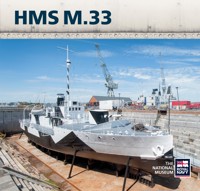
This is a beautiful and informative guidebook and history of HMS M.33. The 'monitor' HMS M.33 is a small ship with a big history. Built with incredible speed in 1915, she is one of only three surviving Royal Navy warships in the First World War, and the only remaining fighter veteran of that year's bloody Gallipoli Campaign. M.33 offers the unique opportunity to see how men lived and fought in small ships 100 years ago, and to understand a little of the dangers they faced, floating in a basic steel box in shallow waters underneath Turkish guns. HMS M.33 is also a ship with a long history of service and of restoration. Until her final sale by the Navy in 1987 she had served not only as a monitor but had been adapted to be a minelayer, a workshop and a hulk. She was known as M.33, HMS Minerva, C.23 and RMAS Minerva - and was even painted with the unofficial name HMS 'Mugwump' for three months. Now finally, after sterling work by Hampshire County Council to rescue and conserve the ship since 1990, the National Museum of the Royal Navy is delighted to complete the job, to open the ship to visitors and use her to commemorate the Gallipoli Campaign.
Sie lesen das E-Book in den Legimi-Apps auf:
Seitenzahl: 36
Veröffentlichungsjahr: 2015
Das E-Book (TTS) können Sie hören im Abo „Legimi Premium” in Legimi-Apps auf:
Ähnliche


















Vital Statistics
Class: Monitor
Length: 177 feet
Beam: 31 feet
Weight: 580 tons
Speed: 9.6 knots
Crew: 72
Guns: 6-inch
Battle Honours: Dardanelles, North Russia
Introduction
‘Had a look round the ship (didn’t take long by the way). I am more accustomed to small ships but this beats anything I’ve been in. The decks are bare iron. We have one funnel and two boilers and I am glad to see we burn oil fuel … at any rate we’ll coal ship through a hose.’
Diary of Leading Signalman Henry Mulligan, June 1915
The ‘monitor’ HMS M.33 is a small ship with a big history. Built with incredible speed in 1915, she is one of only three surviving Royal Navy warships of the First World War, and the only remaining fighting veteran of that year’s bloody Gallipoli Campaign. M.33 offers the unique opportunity to see how men lived and fought in small ships 100 years ago, and to understand a little of the dangers they faced, floating in a basic steel box in shallow waters underneath Turkish guns.
HMS M.33 is also a ship with a long history of service and of restoration. Until her final sale by the Navy in 1987 she had served not only as a monitor but had been adapted to be a minelayer, a workshop and a hulk. She was known as M.33, HMS Minerva, C.23 and RMAS Minerva – and was even painted with the unofficial name HMS ‘Mugwump’ for three months.
Now finally, after sterling work by Hampshire County Council to rescue and conserve the ship since 1990, the National Museum of the Royal Navy is delighted to complete the job, to open the ship to visitors and use her to commemorate the Gallipoli Campaign.
Designing and
Building M.33
‘In accordance with your directions … an outline sketch for the Light Draft Gunboat carrying two 6-inch guns is forwarded herewith.’
Letter from Charles Lillicrap, 12 March 1915
On 15 March 1915 the Admiralty ordered the construction of five new monitors; the last of these was to become HMS M.33. Monitors were designed to carry heavy guns but with a shallow draft that enabled them to get close to shore and bombard land targets. They were simple, cheap and quick to build – and were very much a ship of their time.
At the start of the war three river-monitors, built for the Brazilian Navy but requisitioned by the Royal Navy before their delivery, had proved their worth off the Belgian coast, using their guns against German forces trying to seize Channel ports. Winston Churchill as First Lord of the Admiralty – always looking for ships that could be used (and risked) in offensive amphibious operations (perhaps in the North Sea, perhaps in the Baltic) – quickly ordered the monitors M.1–M.14. Another 14 monitors with a single, smaller 9.2-inch gun – M.15–M.28 – were then ordered in February 1915. These monitors varied considerably in their size and the power of their guns; the largest, like HMS M.13 (which became HMS Marshal Ney), carried two mighty 15-inch guns and weighed over 6,500 tons, dwarfing little M.33. However, apart from sharing the same basic purpose, the monitors were all united by the most important factor in their design and construction – the availability of guns.
As First Lord of the Admiralty Churchill requisitioned or ordered many monitors. The monitors M.1–M.14 carried large 12-, 14- or 15-inch guns; as large ships it was felt they must have names and were quickly re-christened; the monitors with smaller guns like M.33 only ever used a number.




