


7,00 €
Mehr erfahren.
- Herausgeber: Garnet Publishing
- Kategorie: Lebensstil
- Sprache: Englisch
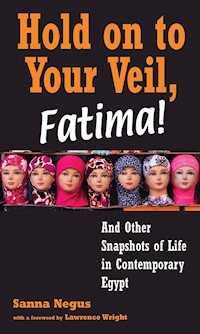
What happened to a former Miss Egypt when she took to wearing the veil under her pilot's cap? Who are the young people posting videos of policemen torturing crime suspects? Where do Coptic Christians celebrate the Holy Family's journey to Egypt? Why is President Hosni Mubarak still ruling Egypt, virtually uncontested, after more than 25 years in power? In "Hold on to Your Veil, Fatima!", author Sanna Negus answers these questions and more, taking the reader on a journey into 21st-century Egypt. As a reporter, Ms Negus witnessed Egypt's political opening after the Iraq war, the subsequent quelling of the Cairo Spring, and the growing influence of the Muslim Brotherhood. In addition to politics, the author discusses the thorny issue of relations between the sexes, listens to Copts' grievances about the worsening relations between Muslims and Christians, and reveals an appalling human rights record. On the brighter side, she also visits oriental dancers and authors who defy censorship. While Egyptians joke about the longevity of their president, there is no doubt that Egypt is a nation waiting for a new, uncertain dawn. "Hold on to Your Veil, Fatima!" relies heavily on primary sources, on the words and experiences of extraordinary Egyptian men and women, as well as the author's personal encounters as a Western woman. Intimate stories are woven together with historical narratives and news events. This is the other side of Egypt, an intriguing modern nation a long way removed from the pyramids and temples visited by most visitors to the country.
Das E-Book können Sie in Legimi-Apps oder einer beliebigen App lesen, die das folgende Format unterstützen:
Veröffentlichungsjahr: 2008
Ähnliche



















.
.
.
Hold on to Your Veil, Fatima!
And Other Snapshots of Life in Contemporary Egypt
Sanna Negus
with a foreword by Lawrence Wright
First Edition
ISBN: 9781859643648
Foreword
The fact that Egyptians have turned away from the liberalism and secularlism they once enjoyed has influenced Muslims everywhere. Egypt is the idea factory among Arab nations. The revolution led by Gamal Abdel Nasser in 1952 spread Egyptian versions of socialism and Nasser’s romantic notions of Arab unity throughout the region, where they still resonate. The powerful television, cinema, and music industries based in Cairo have long been significant carriers of Egyptian ideals of fashion, values, and social attitudes. Egyptian politics, although intellectually impoverished, influence other political actors in the region, who seek to imitate the appearance of democracy within an autocratic system. Al Azhar, the thousand-year-old Islamic university in Old Cairo, is the closest approximation Sunni Muslims have to a Vatican; meanwhile, telegenic Egyptian clerics shape the minds and the morals of millions from Morocco to the Persian Gulf. Some ideas travel easier than others. When Anwar el-Sadat went to Jerusalem in 1977 and proclaimed in the Knesset, “We accept to live with you in a lasting and just peace,” most Arab countries rejected the opportunity to open a new dialogue in the Middle East. On the other hand, the idea of politically active Islam – Islamism – first associated with the Muslim Brotherhood, was also born in Egypt and has now carried through the Muslim population all over the world. One only wishes that the Egyptian sense of humor was similarly contagious.
When I lived in Egypt, in 1969 to 1971, teaching at the American University in Cairo, the country was undergoing the Islamist uprising that would one day lead to al-Qaeda. Nasser, who had imprisoned and executed many of the leaders of the Muslim Brothers, died of a heart attack in September, 1970. Egypt at that time was a very religious country, but ostentatious displays of piety were rare. Nasser himself was an observant Muslim but a conspicuously secular leader. The fact that his successor, Sadat, carried the dark callous on his forehead – called the zabiba, or raisin – from countless hours of pressing his head into the prayer mat was actually embarrassing to many Cairenes. Now in Egypt, as in many Muslim countries, the zabiba is a mark of honor. In those days, one seldom saw educated, middle-class Egyptian women dressed in black robes and hijabs – it was mostly a phenomenon of the villages. Nowadays, even at the American University, uncovered women have become increasingly rare. One of the many cruel ironies of Egyptian history is that the pious Sadat freed the members of the Muslim Brotherhood that Nasser had imprisoned, only to be murdered by their progeny after he signed the peace treaty with Israel.
The precursor to al-Qaeda was the Egyptian terrorist organization, al-Jihad, which was led by Ayman al-Zawahiri, an Egyptian doctor. Zawahiri grew up in Maadi, which was the center of sophisticated, Eurocentric Cairo, and yet Zawahiri started an undercover cell to overthrow the Egyptian government in 1966, when he was fifteen years old. Zawahiri and his organization would later form the core of the terrorist group started by Osama bin Laden. It was the Egyptians who had the brains, the experience, and the determination; one can argue that all bin Laden added was money and mystique. To this day, al-Qaeda is largely an Egyptian organization.
When I returned to Egypt shortly after 9/11 to study Zawahiri and al-Qaeda, few Westerners in the country were familiar with the organization or the thinking behind it. Among those few was Sanna Negus, who had been studying political Islam and radical Egyptian organizations well before that tragic event. A fluent Arabic speaker, well traveled in the Arab world, Negus is one of the most informed and well-connected reporters in the region. Now she has used her experience and her impressive storehouse of knowledge to write the book that has long been missing in the library of Western perception. Negus sees Egypt with a rounded understanding that goes past the stereotypes and introduces us to a culture rarely seen. She writes authoritatively about the unempowered Egyptians – women, gays, Copts – who rarely play a part in contemporary narratives. One has the refreshing sense, after reading this book, that Negus has turned the country inside-out, making the repressed visible. Her knowing, amused eye sees Egypt in a fresh manner, free of the encrusted wisdom about Islam, radicalism, and misogyny that have become so yawningly familiar. She introduces us to a society that is still very much in turmoil, but also still spinning off ideas that will gain influence far beyond Egypt’s dusty borders.
1 Islam is the solution?
Mahdi’s phone rang. We were just finishing filming my TV debut, a story about veiling. The interview with a veiled mother and unveiled daughter was drawing to a close, and everyone seemed happy with it. As a finale, we filmed the family photo album in the brown shades of a Cairene living-room, lit by pale fluorescent lamps.
“Come to the office quickly, there’s been a major accident in New York!” a nervous voice shouted into cameraman Mahdi’s phone. We hurriedly packed away our cameras and said our goodbyes to the mother and daughter. More information on the accident became available while we were on our way to the office: two airplanes had crashed into the World Trade Center towers. All of a sudden, Muslim women’s veiling options, and with it my TV debut, seemed like the least important things in the world.
We drove as fast as we could through the Cairo afternoon traffic jam, to the Video Cairo camera crew office, located next to the Egyptian TV building, beside the Nile. At the office, TV screens were showing for the first time the now-familiar images: the blazing twin towers; smoke, ash, panic. To my surprise, the soundman and a few other members of the office staff cheered – finally someone had taught the Americans a lesson! At this stage, the magnitude of the tragedy was not yet apparent – but looking at the pictures, I prayed for the sake of Egyptians and Arabs that the attackers weren’t from the Middle-East. Fat chance.
Very soon it became evident that one of the perpetrators was an Egyptian, 33-year-old Muhammad Atta who had studied in Germany. In a widely published passport picture, square-faced Atta looks straight at the camera, piercingly serious, with a hint of scorn. This man, whom his university friends and tutors remember as a serious, conscientious student, allegedly steered the plane which hit the World Trade Center’s north tower, between the 94th and 99th floors.1
Journalists from all over the world, especially from the United States, started flocking to Cairo. Fixers and translators worked around the clock, earning stacks of dollars but at the same time complaining about how distorted the stories were, written by journalists with little understanding of the region. Suddenly, in the eyes of America, Egypt had become the haven of terrorism, producer of the fanatic Attas.
We Cairenes didn’t recognize this picture. So what if an individual was involved in a horrible act of terror? Could he tarnish the image of a peace-loving people, an image so carefully crafted by a country so dependent on tourism? Egyptians were as bemused as foreigners about the involvement of a countryman in this act of terror. But Egyptians wouldn’t be Egyptians unless they turned tragedy into comedy. According to a joke which rapidly made the rounds in Cairo, the perpetrators couldn’t have been from the Arab world because the timing was planned to the second. There is no way Arabs – who have a nonchalant attitude towards time – could have done it!
Muhammad Atta’s father was hurled into a media frenzy. Reporters from the far side of the world needed a story, but Atta senior stuck with his version of events: his son was innocent. The father held a ‘press conference’, which was little more than a monologue – and certainly not a question and answer session. His voice became louder, and his face redder as he defended his son: he asserted that he received a phone call from his son on 9/11, after the attacks had taken place. Footage from airport security cameras didn’t convince him either: his son wasn’t as broad-shouldered or big-nosed. Annoyed journalists looked in vain for answers.
In the streets of Cairo reactions were mixed. Once the magnitude of the destruction became evident, many expressed sympathy for the victims: an American friend told me that out of compassion, a taxi-driver even refused to take any payment for a journey. But almost immediately the conspiracy theories so loved by Egyptians started to circulate. According to one persistent rumour, 4000 Jews had been warned beforehand and so didn’t show up for work on that faithful day. Mossad and the CIA were the real perpetrators, not Bin Laden, many believed. On the contrary, Bin Laden was seen as a kind of resistance hero, who was admired either openly or in secret.
The Egyptian press, however, stayed silent on the fact that an Egyptian seemed to have taken part in this horrific action. Their own years of violence were still fresh in the minds of many Egyptians: in the clashes of radical Islamists against state security forces. Between 1992 and 1997 about 1200 Egyptians were killed.
Egypt can be considered as the birthplace of modern Islamism. The ideological roots of Islamism or political Islam stretch back to the establishment of the Muslim Brotherhood organization in the 1920s. This group, which fought against colonialism and supported an Islamic revival, paved the way for the more radical groups of today. The ideology became radicalized in the 1960s and ‘70s when young fanatics in the Middle East harnessed a distorted interpretation of Islam to the widespread fight against governments. Despite the terror attacks of the 1990s, the strategic fight has ceased in Egypt, although international Islamist terrorists represent a continuation of the same extremist ideology.
***
Hasan al-Banna, the founder of the Muslim Brotherhood, has been described as a charismatic leader, who ran his organization with an authoritarian grip. Preaching the strict moral code he had adopted as young boy (an unfaltering belief in the omnipotence of God), while at the same time cherishing good physical health, were the guiding principles that shaped al-Banna’s life. He called believers to salvation, while the Brotherhood’s military wing launched attacks on the British occupier. To this day, al-Banna’s thoughts form the ideological foundation of the Muslim Brotherhood.
Al-Banna’s activities were informed by movements within Egyptian society as a whole. Throughout al-Banna’s life, Egypt was (directly or indirectly) occupied by the British. In 1882, they had captured Egypt and made it into a ‘Protectorate’: the King and the Parliament were the nominal rulers, but real power lay in British hands.
A nationalist awakening in the early 20th century led to mass demonstrations initiated by the Wafd (Delegation) Party, demanding independence. This demand was realized only partially: in 1922 the Protectorate was abolished, and Egypt declared formally independent. However, the British ensured that neither the Egyptian monarch, King Fuad, nor the parliament acted against the interest of their former colonizer. In addition, the British Army maintained an obviously visible presence.
Egyptian society was undergoing a transformation brought about by modernization, industrialization and the rise of capitalism. The population was increasing fast, and rural to urban migration increased steadily. Conditions in working-class quarters of cities were often appalling, and poor sanitation led to frequent epidemics. The global depression of the 1930s only made the circumstances of the poorest worse.
By contrast, Europeans in Egypt enjoyed an easy life. French cafés and cinemas were visible reminders of the foreign presence. The Egyptian elite adopted not only European customs, but also thinking and beliefs. They spoke French and English with better fluency than Arabic, and dressed according to European fashion. Many Egyptian secularists believed that West was better than East.2
Hasan al-Banna was born into this transitional period, in the city of Mahmudiyya in the Nile Delta. Even as a young boy he showed signs of religiosity, and his childhood games gave clues to his future calling: he arranged the neighbourhood boys into ‘believers’ and ‘non-believers’ and acted out wars in this vein. As an adult, al-Banna was serious, deliberate and even though he might laugh with others, he would never make a joke himself.
One of the strongest influences on young al-Banna’s ideology was Sufism, the mystic element of Islam. Al-Azhar university in Cairo, the highest authority of Sunni Islamic learning, actively doesn’t recognize Sufism on the grounds that it is mixed with folk traditions (such as visiting tombs and celebrating saints’ birthdays). Al-Banna was a member of a Sufi group that emphasized the importance of shari’a (Islamic law) and following the rituals described in the holy scriptures: the Qur’an, the Sunna (i.e. Muslim law based on the Prophet’s words and actions), and the hadith (the traditions).
Although religion was al-Banna’s calling, he didn’t choose to study at the distinguished Islamic al-Azhar university (where most Sunni Islamic scholars study). Instead, he graduated as an Arabic teacher from the new Dar al-Ulum university, described as a combination of modern education and Islamic learning.3 Al-Banna thus combined successfully the roles of a teacher and a preacher.
On moving to Cairo, al-Banna saw for the first time the Westernization of Egyptian society, which he equated to atheism and immorality. He became convinced that Egyptians were no longer following true Islam. In his eyes, the entire society was polluted by vices: alcohol, half-naked women, theatres and dance salons. In 1924, during this formative period in al-Banna’s life, Kemal Atatürk abolished the Islamic caliphate. The discussion over the future of the umma, the Islamic community, was heated but attempts to restore the caliphate derailed.
In 1927, al-Banna was appointed to a teaching position in Isma’iliya, a town on the Suez Canal. The British Suez Canal Company, which managed the canal, had its headquarters there, and the town also hosted a British barracks, making foreigners were clearly evident on the streets of Isma’iliya. Al-Banna observed how foreigners lived a life of luxury thanks to the canal profits, while Egyptians were starving. In the midst of this self-evident inequality, al-Banna became convinced of his mission in life: corruption of Egyptian society must come to an end.
Al-Banna started to preach in coffee shops and to give private lectures. His message was simple: only a return to true Islam could heal the feeling of alienation, because Islam is comprehensive. Like many Muslim reformers, al-Banna emphasized the importance of identity: Muslims had in Islam their own perfect set of values, which needed to be restored to the place it deserved.
His unfaltering willpower and teacher’s patience started to bear fruit, and he gained more and more followers. He first termed his organization as ‘The Muslim Brotherhood’ (al-Ikhwan al-Muslimun) in 1928; al-Banna was only 22 years old at the time, but already an old-timer in organizational life.4
In the beginning, the Muslim Brotherhood’s goal was twofold: the advancement of true Islam – as defined by al-Banna – and fighting against foreign occupation. The Brotherhood’s message was in tune with the times and soon it spread to other northern Egyptian towns, and its headquarters were moved to Cairo. Although the Brotherhood grew continually, it wasn’t an open-to-all organization; rather, its members were admitted through a gradual process. The same policy applies today.
Naturally, al-Banna was the leader of the organization, and was referred to as the General Guide (al-murshid al-’amm). The name refers to a guide under God’s command, who guides others to God. The members had to take an oath of loyalty to the Guide, in which they promised to obey him absolutely and under all circumstances. Swearing an oath (bay’a) derives from the early Islamic era – followers of the Prophet pledged allegiance to him – but also from Sufism: a Sufi initiate takes an oath to his teacher. This swearing of allegiance points to al-Banna’s appreciation of strict rules, and the distinct roles of the ruler and the ruled. It also hints at authoritarianism – the Leader’s actions were not to be questioned.
A young man (who preferred to stay anonymous) who was involved in Brotherhood activities during the 1990s told me about his experience of the importance of discipline and rules:
I joined the Brotherhood when I was in high school. I had been living the Persian Gulf, so I didn’t know many people and it was very difficult to make friends. I didn’t join for political reasons – it was mostly the desire to become more religious, and also to be encouraged to be more observant.
Then I met an older Brother, who took me to a mosque to meet others. I had always liked the company of older boys, and this was like another world. They painted a picture of living happily, and of entry to Paradise – of course I couldn’t say no to something like that!
Each Brother had a ‘sponsor Brother’ ( al-akh al-mas’ul), once he became a full member (al-akh al-amil). The ‘sponsor Brother’ acted as a go-between if the senior Brothers wanted to talk to me. This same categorization is still in use: you get to become a full member if the ‘sponsor Brother’ thinks that you are mature enough. The ‘sponsor Brother’ is never questioned; everything is disciplined but no one abuses the loyalty (bay’a). I believed in all the discipline, and that you didn’t question the leaders.
Their way of bonding is to have as much collective activity as possible, to fill the day of the young Brother to an extent that would make any life outside the Brothers unimaginable. It’s a gradual process of organizing your day: meet every morning at 5 am in the mosque for prayers … then you had something every day, one or two meetings… And the more meetings you had, the more self-important you felt. An empty day would make you feel almost envious, that you hadn’t made it yet to an adequate rank within the organization.
You also feel it’s a religious duty to initiate things, and that’s the thing that is completely absent from any other political organization, or even from professional life. You feel that if you do not initiate activities, then other members who do, are sort of better Muslims, they get more scores – this becomes a mentality of keeping scores for the next life. Of course there are all sorts of human tensions, and envy and competition, but for the younger generations who are carrying the movement, they don’t have these things because they know that their reward is in the next life and there’s no access to the scores, so you can’t know how well you’re faring!
As the Brotherhood’s membership grew, its activities started more and more to resemble those of a political party rather than an Islamic charity. Its programme, and particularly its criticism of the government, was attractive to those elements of the populace which most suffered from the economic depression: civil servants, students, the urban working class and farmers.
The starting point of al-Banna’s ideology was the omnipotence of Islam: it covers all aspects of life, in this world and in the thereafter. Muslims should therefore return to the origins of Islam – Qur’an, Sunna and teachings of forefathers (salaf) – and not follow Islamic jurists’ interpretations (taqlid). At the same time, he encouraged independent reasoning (ijtihad) so that Muslims could respond to the demands of modern times.
Like many modernists before him, al-Banna believed that a return to Islam would not only strengthen the nation’s self-esteem, but also its political power vis-à-vis the West. His ideal societal model was Muhammad’s Medina community, which would become a reality if believers went through a thorough internal revival. However, for many, their faith lay dormant, and so the Brotherhood had to awaken it with the call (da’wa) to Islam.
The Brotherhood’s ultimate goal was to establish an Islamic state, or societal system. Its constitution would be the shari’a, it would have one creed, and centralized governance. The Brotherhood slogan puts it this way:
God is our objective, the Qur’an is our constitution, the Prophet is our leader, Struggle is our way and death for the sake of God is the highest of our aspirations.5
In other words, the possibility of using violence to establish an Islamic state hadn’t been ruled out – a means hinted at in the existence of the secret apparatus. Al-Banna’s primary objective, however, was to liberate Egypt from its occupiers, and to establish an independent state. Unlike secular nationalists, al-Banna considered the wider Islamic community, the umma, to be more important than identity based on nationality. Al-Banna saw the Brotherhood as the vanguard of Islam, with himself as its leader, ready for martyrdom. The details and practicalities of an Islamic state were of secondary importance to him – they would take shape on their own once the state was established. This obscurantism remains a problem that the Brotherhood suffers from to this day.
In al-Banna’s vision, the political structure of an Islamic state comprises three elements: the Qur’an (as the basis of the constitution); a parliament (formed by a single party, functioning by consultation, shura), and a ruler (who must abide by Islam and will of the people, and can be ousted by majority vote). Decision-making would be based on a simple majority vote, which the minority would agree with in the end. But as a precaution, discussion of philosophy and hypothetic questions should be avoided.6
This model is authoritarian in style, where opposition is not allowed to function fully. Al-Banna naively assumed that the umma would agree on basic issues. He also sketched an informer system, whereby citizens would keep an eye on each other. To him private and public were inseparable.
Al-Banna was happily married and had five daughters and a son. Advancement of women’s position wasn’t exactly top of the Brotherhood’s agenda – neither is it today. Al-Banna addressed the subject in a small pamphlet – al-Mar’a al-Muslima (The Muslim Woman), which is a rather provocative piece of work, in which al-Banna quotes various conservative hadiths which mostly portray women as seductresses who must be veiled and banished from the streets.
Puzzled by this booklet, I went to ask Hasan al-Banna’s youngest brother, the last of the siblings still alive, what his take on it was. Gamal al-Banna is in his 80s, a former workers’ union activist, and an author, with greenish eyes and an infectious laugh. Like many elderly Egyptian men, he favours dark safari suits and thick-rimmed glasses.
Big brother Hasan was 14 years older than Gamal, and their relationship was “dialectic, but warm”, as Gamal puts it. The younger brother has become a vocal critic of today’s Brotherhood, charging it with stagnation and failing to respond to modern day demands, instead still following the teachings of its former leader literally.
When I arrived, Gamal al-Banna was sitting at his desk, surrounded by bookshelves stacked from floor to ceiling. He proffered foil–wrapped chocolate bonbons and gently stroked a white cat, which purred in his lap. He, too, has written a book called ‘The Muslim Woman’, but in which he puts forward altogether different ideas from those of his brother, for example that veiling is not a religious obligation per se. He was amused at the memory of his brother’s booklet and thought it best to defend him.
Hasan’s eldest child was a girl – Wafaa’ – and the father would have wanted her to attend university and get a degree. But other Brothers were against this idea and so Wafaa’ had to settle for vocational training. My brother’s family matters were openly discussed in the Brotherhood.7
Many Islamists – and conservative Muslims in general – see women’s role as being tied to biology. The basic assumption is that all women want to, and can, have children. Al-Banna wanted to restrict women’s educational pursuits, and their work outside the home. Yet in reality, the 1924 constitution gave women the right to study at universities, while in the countryside and in manual labour, men and women have been working side by side for centuries.8 At the end of the day, his conservative ideas on the position of women didn’t much differ from the mainstream opinions of the day. But it was his thoughts on struggle, jihad, that sets him apart from the traditional interpretation.
The term jihad (struggle) has a dual connotation in traditional Islamic theology: both an inner striving against evil thoughts (greater jihad), and an external struggle in defence of Islam (lesser jihad). In al-Banna’s view, the inner jihad is the basis for all action, and the armed struggle is the last resort to defend Islam. During this period, all of Egyptian society was in turmoil, and al-Banna’s foremost reference was anti-British activity. He drew support for his view from the Qur’an:
Warfare is ordained for you, though it is hateful unto you; but it may happen that ye hate a thing which is good for you, and it may happen that ye love a thing which is bad for you. Allah knoweth, ye know not. (2:216)9
For al-Banna, armed struggle was both an individual and communal obligation. He didn’t rule out offensive warfare – thus differing from the Islamic canon – but he also didn’t specify the circumstances for it. He quoted often a hadith, which remains the basis for Brotherhood’s attitude towards jihad to this day: “One of the loftiest forms of jihad is to utter a word of truth in the presence of a tyrannical ruler.”10
During the period when al-Banna was formulating his ideas, the global economic depression, mounting lack of trust in the government, and the privations of war had brought Egypt to the brink of chaos. The Anglo-Egyptian Treaty of 1936 gave independence to Egypt in principle, but the British Army tenaciously remained. The Brotherhood refused to accept the Treaty and declared jihad against the British. And al-Banna really meant it – in probably the same year, the Brotherhood established a secret, armed special unit.11
At the time, Egypt had several paramilitary groups, but the Brotherhood’s ‘Boy Scouts’ were the largest and most powerful of them. The fighters of the secret force, the mujahidun, were recruited from the Brotherhood’s scout-like youth division, the Rovers, which instilled discipline, military spirit and solidarity. This emphasis on cultivating good physical health and the idea of training camps were adopted from European scout organizations.12
The secret group’s role was initially to defend the Brotherhood (and Islam). It amassed weapons via army contacts – among them the future Free Officers Gamal Abdel Nasser and Anwar Sadat. When the domestic scene got more restless, the group conducted revenge attacks on the police. The government had finally woken up to the Brotherhood’s political power: by the 1940s it had over 300 branches, and more than a million members (Egypt’s population at the time was less than 20 million). The Brotherhood had infiltrated the professional associations, and ran its own factories, companies, schools and hospitals. It was particularly active in the social sector, long neglected by the government. The Brotherhood had become a state within state.13
When the state of Israel was declared in 1948, the Brotherhood’s best fighters fought side-by-side with their Palestinian co-religionists. That year was particularly grim for the Brotherhood: Prime Minister Nuqrashi declared a state of emergency, and ordered the Brotherhood to disband. Three weeks later, Nuqrashi was shot dead – by a Brother who is presumed to have acted without al-Banna’s authorization. The Supreme Guide had previously expressed concern over losing control of the secret force. Al-Banna proclaimed his innocence of the murder, but he was arrested briefly. On his release on 12th February 1949, an officer of the Special Police Force shot him dead – with the blessing of the new Prime Minister.14
Hasan al-Banna’s thought made an impression on another Islamist thinker, Sayyid Qutb (1906–66), who is often considered to be the father of radical Islamism. His drastically different theses – of the un-Islamic nature of all society, and of jihad – forced the Muslim Brotherhood underground, and gave an impetus to newer, more radical groups.
Like al-Banna, Qutb graduated as a teacher from Dar al-Ulum and quickly worked his way to employment as an inspector at the Ministry of Education. Similar to his mentor, the young country boy found city-life confusing, and started to unravel his thoughts by writing poems, essays and even love stories. Later, he was to renounce these works as un-Islamic.
In the 1930s and ‘40s, Qutb participated in the literary discussion about Egyptian identity under foreign occupation, and made his mark as a literary critic. But he soon started to use more Islamic arguments and references, particularly when criticizing the moral decay of his fellow citizens.
But it was only after a study trip to the United States in 1948 that Qutb became convinced of the moral and cultural superiority of Islam. To him, the United States – which openly supported the newly-established state of Israel – could best be described in terms of materialism, racism and sexual promiscuity. When he returned home in 1951, he found kindred spirits in the Brotherhood, which Qutb considered to be the best weapon against Western cultural imperialism.15
After the death of Hasan al-Banna, the Brotherhood had been torn by inner disputes. The new General Guide, Judge Hasan al-Hudaybi, gave the movement a dignified image, but he didn’t enjoy the support of the ranks. He condemned attacks by the secret force, unintentionally making it even more independent. Quiet and introverted, Qutb was designated as the director of the Section for the Propagation of Call and Publishing. He was to fill the ideological vacuum left by al-Banna’s death.16
In the meantime, co-operation between the Brotherhood and the Free Officers continued. The Brotherhood believed that the Officers had both a similar social programme (based on Islam), and a will to oust the occupiers (and the monarchy). For their part, the Free Officers were impressed by the attacks launched by the mujahidun, and the Brotherhood’s internal discipline. Both sides were to be disappointed in their expectations.
The Brotherhood was very active in the preparations for the Revolution. The secret force was to protect foreign interests and strategic communication centres. It was also supposed to garner popular support – should it not arise spontaneously – and oversee security if the police refused to co-operate with the army. As it turned out, none of these measures were needed, because the Revolution took place with negligible resistance.17
It wasn’t long before the Brotherhood became disillusioned with the new regime’s reforms. They didn’t apply Islamic legislation, but rather seemed to support secularism and socialism. The Brotherhood started to spread anti-government propaganda and the government counter-attacked with their own Islamic campaign. The incipient power-struggle charged the atmosphere.
While President Nasser was giving a speech in Alexandria in 1954, someone from the crowd shot at him. Once more the attacker was a member of the secret apparatus, who according to the Brotherhood again didn’t have organizational approval for the deed. However, this act gave Nasser a perfect excuse to settle the score with the group. The Brotherhood was abolished, its assets were confiscated and its high ranking members were put behind bars. Qutb was accused of plotting a revolution, and given a 15-year hard labour sentence. Prison practically annihilated the organisation, while confessions under torture crushed the core group’s morale.18 Except Sayyid Qutb’s.
Utterly disappointed by Nasser’s empty promises, Qutb became embittered. He had suffered from bad health all his life, but in prison his condition deteriorated to such an extent that he served most of his sentence in the prison hospital. All this added to the introverted man’s depression and isolation from the rest of the world. He purged his bitterness by writing. He wrote an extensive Qur’anic commentary in prison, as well as his most controversial book, Ma’alim fi al-Tariq (Milestones), which radical Islamists adopted as a guide. His sisters smuggled the texts out of the prison and gave them to the Brothers.
Qutb’s thoughts on an Islamic state were similar to al-Banna’s, yet even more obscure. To Qutb, Islam was allencompassing, so practical details were of less importance. Like al-Banna, Qutb believed in reform of the individual, and the importance of Islam’s original sources. But Qutb differed radically from other thinkers on his views of Egyptian society. In his view, the whole society had side-stepped from the sphere of Islam, to the extent that it lived in jahiliyya (pagan ignorance). Qutb was the first to use this word to describe modern societies – Muslims had generally used it when referring to pre-Islamic era.
Because Qutb (like al-Banna) was a self-taught religious thinker, he could more easily criticize the theologians of al-Azhar, and think more independently (he emphasized the importance of independent reasoning, ijtihad). On the other hand, this led to his thoughts shifting further away from commonly accepted positions – his personal experiences had clearly affected his judgemental thinking.
Towards the end of his life, his world-view became completely binary: only two kinds of societies existed – Islamic, or ignorant (jahili, thus un-Islamic.) In his mind, even Islamic societies just pretended to be Islamic, because they didn’t give the highest authority to God, but rather supported un-Islamic rulers, like Nasser. Qutb suggested that a vanguard was needed to awaken the dormant faith of individual Muslims. They needed to keep themselves separate from others, but at the same time they should learn the habits and values of the jahiliyya, in order to overcome it. His ideal society was the Medina of Muhammad, which lived surrounded by jahiliyya, but proved to be victorious in the end.
To Qutb, the ideal Islamic society wasn’t confined to a certain place, but rather a Muslim’s home was wherever shari’a was properly applied. Qutb identified with his religion, not his nationality, regarding himself as a member of the umma, within the realm of Islam. A Muslim’s only relatives should be those who believed in God – family, tribe or nation came second.19
Intimately connected to the idea of an un-Islamic society, was the notion of fighting against it – jihad. Qutb’s interpretation of struggle was the most controversial of his theories. According to him, jihad was justified against un-Islamic (jahili) rulers. Although he didn’t mention Nasser by name, it was obvious that Qutb considered Nasser’s regime to be un-Islamic. To Qutb, jihad was a tool of Islamic revolution.
According to Qutb, the revolution was to be led by a vanguard, which would correct the beliefs of the age of ignorance by preaching and persuading. It could also use force and struggle (jihad) when destroying pagan institutions and authorities which forbade Muslims to renew their faith. If anyone was to obstruct people in their belief, they had to be fought until they admitted defeat – or died. This clearly referred to Nasser, who had jailed Islamist dissidents.
To Qutb jihad wasn’t just defensive warfare, and he selected Qur’anic verses to support his thesis:
Tell those who disbelieve that if they cease (from persecution of believers) that which is past will be forgiven them; but if they return (thereto) then the example of the men of old hath already gone (before them, for a warning). And fight them until persecution is no more, and religion is all for Allah. But if they cease, then lo! Allah is Seer of what they do. And if they turn away, then know that Allah is your Befriender – a Transcendent Patron, a Transcendent Helper! (8:38–40)
For Qutb, these verses encapsulated the essence of jihad: to establish God’s authority on earth. To him, those who fought against tyrants were on a higher morale plane due to their faith. The struggle may lead to death, but to a mujahid, a martyr’s death was the way to Paradise, while tyrants burned in the fires of Hell. In the end, the Believer would receive the highest of rewards: the pleasure of God.20
In 1964 Qutb was released from Liman Tora prison. He held small gatherings with his supporters until mass arrests of Brotherhood members began anew in summer 1965. The Muslim Brotherhood was accused of plotting an extensive conspiracy against the state; Qutb was charged with terrorist activities and encouraging sedition – the principal evidence against him was Ma’alim fi al-Tariq.21
General Fuad Allam, a former chief of the Egyptian Intelligence’s Interrogations was present during Qutb’s interrogation. Allam, who is in his 70s, has become a kind of semi-official expert on Islamism, because he took part in all the major Islamist grillings.
I met Allam at his home, a heavily guarded villa in the middle-class Muhandisin neighbourhood of Cairo. Genial as an uncle, it is hard to picture Allam as the head of such a notorious unit. We sat in his reception room, decorated in the Louis XV style, much loved by the Egyptians: golden, curvy chair backs, colourful carpets and an Indian horoscope tapestry on the wall, crystal ashtrays on side tables. His male servant left a tray by the door with karkadeh, a wine-coloured hibiscus drink.
Although Allam attended Qutb’s interrogation only very briefly, the outwardly fragile radical thinker left an impression on him:
He spoke very calmly, steadily, like I am now. He was truly impressive. Even if you knew nothing about his background, or that he had a religious background, he would have made an impression on you.
Allam was of the opinion that it was specifically Qutb’s illness that had affected the radicalism of his message.
He was very disturbed mentally. He was also physically ill; at that time, there wasn’t a proper cure for tuberculosis. He was someone who knew he was dying. And being in prison added to the feeling of being smothered slowly. I believe that a combination of his illness and the atmosphere in prison created in him a disturbed mental state, and confused his thoughts. Above all, it made him jealous of other people. That’s Sayyid Qutb.
Qutb denied the charges, but not what he had written. He was sentenced to death, and hanged in 1966. Many youngsters, inspired by Qutb’s texts, revere him as a martyr.
Several of the younger generation Islamists imprisoned in the 1960s and ‘70s shared their cells with older Brothers, who didn’t accept Qutb’s philosophy and denied violence. These youngsters were disappointed by this pessimism, and found in Qutb’s action-oriented message an escape from frustration. They read the Qur’an selectively, and (in particular members of smaller radical groups) were quite ignorant of the principles of Islam. For many of these groups, the real objective was a revolution through armed struggle.
Radicalization received another boost in the humiliating defeat of the 1967 Six Day War. In the early 1960s, some Arab countries had misgivings that Israel was developing a nuclear weapon. Egypt and Syria signed a defence agreement, which in turn made Israel nervous. There were incidents on the Syrian–Israeli border. Israel threatened to occupy Damascus, and overthrow the Syrian government for its support for Palestinian fighters. The situation grew tenser when Soviet intelligence sources told Nasser (untruthfully) that Israel had increased its troops on the Syrian border. Israel provoked war, because it knew it was stronger militarily than the Arab states.
Nasser responded to the Israeli threats by demanding that UN observers withdraw from the Sinai. Egypt concentrated troops in the Sinai and signed a defence pact with Jordan as well. Nasser believed that if Israel attacked, other Arab countries would send troops to Egypt’s aid. Right until the end, Nasser believed that war could be avoided, and that Israel wouldn’t attack. Green conscripts were sent to the frontline. The final straw was the Egyptian blockade of the Straits of Tiran, which Israel took as a declaration of war.
Israel attacked on 5th June and practically destroyed Egypt’s air force in a matter of hours. Israel advanced with ease across the Sinai, all the way to Suez. Egypt lost 12,000 men and the Sinai Peninsula; Jordan lost the West Bank, and Syria lost the Golan Heights. The capture of East Jerusalem affected all Muslims, as Jerusalem is the third holiest city in Islam, after Mecca and Medina. Egypt, Nasser and the whole Arab world were shocked by the crushing defeat. Nasser offered to resign on 9th June. The masses gathered on the streets in support, and so the president withdrew his resignation.22
But Nasser’s prestige had suffered a telling blow. No longer did the nation buy the mantra of Arab socialism and secular ideology; many ascribed the defeat to the abandonment of Islam. The religious stream gained strength: mosque attendance went up; religious literature was printed in greater quantities; and more and more women took the Islamic veil. Migrant workers, returning from the Persian Gulf oil countries, brought back the influence of Wahhabism, a more conservative school of Islamic thinking, which interprets Islam in a more literal way than the school prevalent in Egypt.
Another sign of growing religiosity was the boom in mosque building. While in 1970, the whole of Egypt had 20,000 private mosques, by 1981 the number had risen to 46,000, and (according to some estimates) to 150,000 by 1991. The mosques were funded by the voluntary Islamic zakat tax, and by contributions from the Gulf countries. The building boom was further encouraged by a law which allowed mosques to be built tax-free.23
At precisely the same time, unemployment was on the rise and recent graduates were no longer guaranteed jobs by the state. Young engineers and lawyers couldn’t find employment to match their skills, and so had to seek work as mechanics, waiters and taxi drivers. This ‘lumpen intelligentsia’ came to realize that education was no longer a foolproof way to a better standard of living. These people formed the backbone of the Muslim Brotherhood’s support.24
In Nasser’s Egypt, political participation was strictly limited: the only legal party was the Socialist Arab Union, led by the president. Nasser had failed to accomodate the religious and political opposition, because he was too afraid to test his real popularity by allowing a multi-party system. Qutb’s revolutionary message filled this ideological vacuum, which had been left in part by the clampdown on the Muslim Brotherhood. Young, action-oriented Islamists distanced themselves from the Brotherhood, which was becoming a moderate reformist movement. Some of these young radicals took Qutb’s theories on jahilyya and jihad to the extreme, often with destructive results.
After Nasser’s death in 1970, the vice-president – Anwar Sadat – took the helm. Almost immediately, he released hundreds of Brothers because he saw them as a counter-weight to the Left and to Nasserists, who criticized the new president’s anti-Soviet policy. Sadat didn’t fill Nasser’s boots well: he was neither particularly charismatic nor popular, so he opted to play political games. He changed the political field a bit – the only legal party was reformulated into Left, Centre and Right.
Simultaneously, he encouraged Islamist infiltration of student unions and professional organizations. He liked to portray himself as the Believer President, praying in front of TV cameras. Egyptian citizens just didn’t buy his piety. Before his death, a ‘raisin’ (the aubergine-coloured callous marking frequent praying) had appeared on his forehead. In Cairo after his assassination, the joke was that the street sweepers cleaning the reviewing stand had found his ‘raisin’ on the floor.25
But Sadat also supported religiosity more widely – after all, he had sworn an oath to Hasan al-Banna of the Brotherhood.26 In 1971, the constitution was altered so that the shari’a became one of the sources of legislation (in practice, this referred to family law). The Muslim Brotherhood was allowed to function relatively freely, and it even got permission to publish its newspaper, al-Da’wa, which had been banned for more than 20 years. The hope of obtaining legal status motivated the Brotherhood to support the government.27
Compared to the charismatic Nasser, Sadat was considered lightweight as a statesman. But he made returning the Sinai to Egypt his mission. He first approached the Americans, so that they would pressure Israel to withdraw. Sadat’s aim was to end the stalemate, using international attention to push Israel to withdraw to the 1967 borders. When talks led nowhere, Sadat started toying with the idea of a partial re-invasion of the Sinai. Syria and Jordan joined in the plan of attacking Israel.
Egypt and Syria attacked simultaneously on October 6th as Muslims were observing Ramadan and Jews Yom Kippur. The attack took Israel completely by surprise; it hadn’t considered Egypt’s military build-up to be serious. Israel didn’t think an Arab surprise attack would be possible – its intelligence failed. Egypt successfully crossed Suez and the Bar Lev line – this in itself was a victory for the Egyptians.
Although Israel was eventually able to win the war militarily, in the Arab World this was seen as a symbolic victory, and proof that the Arabs were catching up with Israel in the arms race. In terms of losses of men and equipment to both sides, the end of the war was closer to a draw than had been the result in 1967. Other Arab countries had supported the war effort with an oil embargo, and they were revelling in their new-found power.28
Sadat had used a lot of Islamic symbolism and rhetoric during the war, bestowing upon it a morally sanctified label. The use of religious symbols continued to grow, and Sadat supported this trend. As a result of the war, Sadat experienced increased international recognition as a noteworthy head of state, but at home the flush of victory turned sour very quickly: the Sinai remained under Israeli occupation and many regarded his religiosity as superficial.
Throughout this period, small groups of loose affiliates split off from the Muslim Brotherhood. They were termed anqud (cluster of grapes), from the idea that removal of one bunch didn’t hurt the whole vine. These small groups were very transient – many broke apart, or merged with another whenever the police got wind of them.29 Whatever the internal dynamic, external support for these groups was always marginal.
First to study Islamist groups’ support in the 1970s, sociologist Saad Eddin Ibrahim discovered that most members of radical groups were recruited at universities or among recent graduates. Three recruitment channels emerged: family ties, friendships, and mosques. Rank and file members were younger (17–26 years) than their leaders, and the majority were from the countryside (particularly from Upper Egypt) and provincial towns. They tended to be better educated than their middle-class parents, often having chosen to study engineering, medicine or pharmacy – subjects for which entry requirements were the toughest. In other words, they were the extraordinarily talented sons of ordinary families.
What made these men join radical movements? Ibrahim suggested that it was an identity crisis: young country boys encountered Western influence in Cairo for the first time in their lives – just as Hasan al-Banna and Sayyid Qutb had experienced it. In the 1970s, Egyptian society was again in turmoil: migration to cities was on the rise, but the state was unable to offer economic or political opportunities to young graduates. At the same time, American influence on Egypt, and the financial prosperity of those who had benefited from the Open Door policy (few, and far between) – became glaringly obvious. Opportunities for immediate employment and prospects for the future looked very bleak for most Egyptian youths.30
In comparison, radical Islam offered a culturally acceptable (albeit distorted) way out of despair and social inequality. Through Islam, and by destroying ‘Pagan’ (i.e. Western) structures, these youngsters believed they could not only have a positive effect on their own fortunes, but also heal the rest of Egyptian society. Scholar Nazih Ayubi put it this way:
The Islamic militants are not rebellious because they are opposed to development (or even, to an extent, to modernisation), but rather because they desired it so strongly and yet could not get it. […] The Islamists are not angry because the aeroplane has replaced the camel; they are angry because they could not get on the aeroplane.31
Later on, they did indeed get on those aeroplanes. The first evidence of the existence of armed Islamist groups became apparent in 1974, with the ‘Technical Military Academy’ case. Basing its ideology on Qutb’s thinking, the Islamic Liberation Party believed in direct action (preferably a coup d’état), followed by an Islamic transformation of society. The plan was to break into the Technical Military Academy in Cairo and steal weapons and ammunition. They intended to continue to the ruling party headquarters where Sadat was giving a speech, and assassinate him. The plan failed and 30 soldiers were killed in the action.32 Although the group was broken up and jailed, there was more to come.
Agronomist Shukri Mustafa was one of the Islamists released by Sadat. He had participated in Muslim Brotherhood activities, and while in prison he read Qutb’s radical thesis and embraced it. After completing his prison sentence, he began to preach in his hometown Asyut, in southern, Upper Egypt, where many of the Islamist groups stemmed from. Charismatic, fiery-eyed Mustafa quickly gained followers and he started to call his movement the Society of Muslims.
Mustafa was an authoritarian leader, and unusually for Islamist movements, within his group he was revered as the Mahdi, a messianic figure. Yet he didn’t know the Qur’an very well, and read it selectively: only the suras supporting his narrow vision were deemed correct.
He wanted to destroy what he considered an un-Islamic state and erect a new, Islamic society in its place. Armed jihad (struggle) would serve as a revolutionary tool. For Mustafa, those who heard his da’wa (call) but failed to embrace it, deserved to die. In this, he was an early proponent of ‘takfirism’, denouncing someone as infidel. Taking the possessions of non-believers was also deemed lawful – many Islamist groups regarded it as legitimate to rob Coptic Christians’ shops because they didn’t convert to Islam. Like many cult leaders, Mustafa’s theories weren’t well developed, and he didn’t have a plan as to how the group would function in the unlikely event that it gained power.
Mustafa took Qutb’s idea of isolation from the rest of jahili (‘ignorant’) society literally. For Mustafa, isolation meant a physical move away from the un-Islamic society: hijra (this term usually refers to the Prophet Muhammad’s flight from Mecca to Medina in AD 622, which marks the beginning of the Muslim (Hijri) dating system. Some of the group’s members fled to mountain caves near Asyut. By establishing their own ‘orthodox’ Islamic society there, the group could denounce others as infidels (takfir).33
The Islamic Society recruited both men and women, whom Mustafa married to each other. The couples lived in furnished flats in working-class quarters of Cairo, and they didn’t consider jahili marriages legal. Often the men of the group worked temporarily in the Persian Gulf oil states and sent their salaries back to the group. Upon return, they were ‘rewarded’ with a wife. Group members were not allowed to be state employees or to join the army. This policy was based on the requirement for ‘isolation’: the group maintained internal purity, and wasn’t financially dependent on the state it viewed as un-Islamic.
The group made the headlines in 1976 when its internal disputes broke out into violence requiring police intervention. Several members were arrested, although Mustafa himself managed to avoid prison. The Egyptian press described the members as ‘fanatic militants’ and labelled the group al-Takfir wa al-Hijra (Excommunication and Flight).
Mustafa continued to demand the release of the detained group members, but when nothing happened, the group kidnapped the former Minister for Religious Affairs. They also demanded a ransom and an apology for slandering the group. When their demands weren’t met, the minister was killed. In the trial after the mass arrests, it became apparent that the group had managed to recruit between 3000 and 5000 members around the country. Mustafa and four other leaders were sentenced to death.34
Fuad Allam was again present at the interrogation. I asked him what Shukri Mustafa was like as a person:
Crazy. But one has to take into consideration the circumstances: he used to live in the streets and mosques, because his father had remarried and the new wife kicked him out. He was a poor student at the agricultural faculty. When he was arrested, he had a large number of followers and he believed himself to be a prophet.
At this time, many Islamic groups ( al-gama’at al-islamiyya) enjoyed broad support on university campuses, and soon they dominated the most important student organizations. Sadat himself encouraged these groups, which organized religious conferences, distributed subsidized religious materials and even arranged special transportation for female students.35
In the mid-1970s, the Religious Committee ( al-Gama’a al-Diniyya) functioned as an official part of the Student Union. It then changed its name to al-Gama’a al-Islamiyya (Islamic Group), and subsequently became a proscribed organization. In the south it was in the hands of the radical Islamists, but in Cairo it was mostly manned by members of the Muslim Brotherhood.
I visited the Muslim Brotherhood headquarters to meet a member of its so-called younger generation, ‘Isam al-Ariyan. A former Deputy Secretary-General of the Egyptian Doctor’s Union, he was once the youngest member of the Egyptian Parliament. It was a hot day in May 2001, but wearing long sleeves seemed like the minimum requirement for entering that bastion of conservatism. Because I am not a Muslim (and I wasn’t going to a mosque), I didn’t think it was necessary to wear a veil, although many colleagues have done so.
The headquarters are located in an ordinary block of flats on the Nile island of Manyal, in the same street where several secular NGOs are also based. The Brotherhood flat was like one big prayer-room: the floor was carpeted wall-to-wall in Islamic green, and shoes are taken off and put in a rack as soon as one steps inside. My Sudanese snake-skin loafers stood out, because they were the only women’s shoes in the whole rack: the Muslim Brotherhood is a man’s world, and not a single woman could be seen.
‘Isam al-Ariyan is a short, bespectacled, serious man, who had just spent five years behind bars, for ‘reviving the activities of an illegal organization’. Brotherhood members don’t usually like to shake hands with women; al-Ariyan took my hand, but unwillingly, limply and averted his gaze – these are signs of piety. But al-Ariyan took pleasure in talking about both past and present. This is how he talked about his student days:
All the activists belonged either to al-Gama’a al-Diniyya or to al-Gama’a al-Islamiyya. But there was a huge difference between Cairo and Asyut, in the use of violence and how to approach ‘encouraging good and forbidding of evil’ [armed resistance or not]. By 1980, a visible difference could be noticed. In Cairo the majority were Muslim Brothers, whereas in the south they used force and violence. At that time al-Gama’a al-Islamiyya was open for everyone and could be found in all campuses.
Some, such as the members of al-Jihad organization, considered al-Gama’a al-Islamiyya to be too moderate. Al-Jihad didn’t operate in universities, but had been an underground organization since its inception. The ideologue of al-Jihad, electrical engineer Abd al-Salam Faraj, had written a small book, Hidden Imperative (al-Farida al-Gha’iba) which was heavily influenced by Qutb. In it, Faraj wrote that the group’s goal was the establishment of an Islamic state in the place of jahiliyya, through struggle, jihad. He understood the struggle only as armed and considered it the duty of all Muslims. Like Mustafa, he read the Qur’an very selectively, choosing only passages which supported his vision:
Then, when the sacred months have passed, slay the idolaters wherever ye find them, and take them (captive), and besiege them, and prepare for them each ambush.
But, Faraj doesn’t quote the complete ayat (verse), which ends:36
But if they repent and establish worship and pay the poor-due, then leave their way free. Lo! Allah is Forgiving, Merciful (9:5).
In his book, Faraj quotes the Islamist favourite, Ibn Taymiyya, a 14th-century AD theologian who issued a fatwa (a religious scholar’s formal opinion, legitimizing jihad against a ruler who didn’t rule in accordance with Islamic law. Again, Faraj selected Qur’anic verses which supported his view:
Lo! those who disbelieve in Allah and His messengers, and seek to make distinction between Allah and His messengers, and say: We believe in some and disbelieve in others, and seek to choose a way in between; Such are disbelievers in truth; and for disbelievers We prepare a shameful doom. (4:150–151)
According to Faraj, this verse described Egypt: the ruler could be fought against because shari’a was not applied. While al-Jihad’s primary target was domestic, it also had a global vision, of expanding the Islamic state.37
Sadat’s surprise visit to Jerusalem in 1977 and the subsequent Camp David peace agreement with Israel in 1979 angered Egyptians (see Chapter 8). Islamist students organized mass demonstrations in Alexandria and Asyut, and the previously cordial relations between Sadat and the Muslim Brotherhood soured. The Iranian Islamic revolution in 1979 further encouraged the Islamists in their demands. Yet Sadat even invited the unpopular Shah and his wife to Egypt.




