


Erhalten Sie Zugang zu diesem und mehr als 300000 Büchern ab EUR 5,99 monatlich.
- Herausgeber: The History Press
- Kategorie: Lebensstil
- Sprache: Englisch
First published in 1916, A.L. Fowler's book of Household Tips is an indispensable guide to effortlessly becoming a domestic goddess. With long-forgotten tricks for tackling twenty-first-century tasks such as removing stains, rescuing over-salted food and keeping a fridge odour-free, A.L. Fowler is practical and to the point. This delightful volume also reveals the best way to rid yourself of annoying household pests including spiders, ants and flies, and provides tips on how to remove odours from your hands while advising on the use of natural products to clean floors, windows and cooking utensils. Fowler also shows the early twentieth-century housewife how to perform miracles in the kitchen, with classic tips on making pastry extra flaky, the quickest way to peel carrots and how best to remove burnt bits from an overdone cake.
Sie lesen das E-Book in den Legimi-Apps auf:
Seitenzahl: 83
Veröffentlichungsjahr: 2011
Das E-Book (TTS) können Sie hören im Abo „Legimi Premium” in Legimi-Apps auf:
Ähnliche



















HOUSEHOLD
TIPS
HOUSEHOLD
TIPS
OVER 300 USEFUL AND VALUABLE HOME HINTS
A.L. FOWLER
The advice given in this book dates from1916 and may contradict current practice.
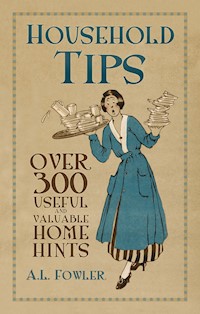
Front cover: A tray of dishes to wash (Mary Evans Picture Library/Joyce Dennys)
First published in 2011
The History PressThe Mill, Brimscombe PortStroud, Gloucestershire, GL5 2QGwww.thehistorypress.co.uk
This ebook edition first published in 2011
All rights reserved© A.L. Fowler, 1916, 2007, 2011
The right of A.L. Fowler, to be identified as the Author of this work has been asserted in accordance with the Copyrights, Designs and Patents Act 1988.
This ebook is copyright material and must not be copied, reproduced, transferred, distributed, leased, licensed or publicly performed or used in any way except as specifically permitted in writing by the publishers, as allowed under the terms and conditions under which it was purchased or as strictly permitted by applicable copyright law. Any unauthorised distribution or use of this text may be a direct infringement of the author’s and publisher’s rights, and those responsible may be liable in law accordingly.
EPUB ISBN 978 0 7524 7284 3MOBI ISBN 978 0 7524 7283 6
Original typesetting by The History Press
To the many efficient and up-to-date housekeepers of our land this book is respectfully dedicated, in the hope that they may find something herein to further increase their efficiency. While the author does not guarantee the reliability of these household helps, they have been carefully compiled from reliable sources and are believed to be efficient if directions are carefully followed.
CONTENTS
1 The Care and Use of Gas Appliances
2 Electrical Appliances
3 In the Kitchen
4 In the Sewing Room
5 In the Bedroom
6 In the Parlour
7 In the Bathroom
8 In the Laundry
9 Miscellaneous
10 To Remove Stains Etc.
1
THE CARE AND USE OF GAS APPLIANCES
CARE OF GAS RANGES
In order to get satisfactory and economical service and a long life, any range or mechanical device must be kept clean. This applies to the gas range as well, and we therefore wish to emphasise that the little attention required is very much worthwhile.
Clean the top, the ovens and removable drip pan frequently.
Clean broiler griddle and pan every time it is used.
If any burner holes become clogged, clean them out with a piece of wire or a hairpin.
Keep the air inlets on the shutter at the front of the burners near the levers clear of dust. The suction at this point draws the dust, which, if allowed to accumulate, will cause the flame to burn yellow or red instead of blue.
More ranges rust out than wear out. To keep the range free from rust rub it very frequently with a cloth slightly oiled with any kind of oil or grease, except kerosene or one containing salt; we suggest the use of olive oil or one of its cheaper substitutes. This is done to the best advantage while the range is warm.
When the burners become greasy, remove and wash them thoroughly in soap and hot water. Never black the burners or top grates.
The broiler pan and rack should be kept out of the range when oven is being used or it will rust, warp or chip. It requires the same care any kitchen enamel ware does.
Always leave oven and broiler doors open for a few minutes after lighting the oven burners and after extinguishing them. This will dry the inside of the range and prevent rusting.
USE OF THE RANGE
With reasonable care gas is much cheaper for household cooking than any other fuel.
Every range should be equipped with a top burner lighter which is convenient and economical, as it is just as easy to light a burner as to leave it burning.
Never turn on the gas until you are ready to use it.
Turn off the gas as soon as you are through with it.
Turn down the gas as low as possible to give the required heat. Remember that water boiling rapidly is no hotter than water boiling slowly.
Always open oven door before lighting oven burners.
Plan your cooking so as to use both broiler and oven at once. The same burners heat both. While a roast is in the broiler, bake the cookies, bread, apples or pudding in the oven. When the latter are done, use the oven to cook vegetables or bake biscuits.
To boil foods in the oven, utensils should be set directly on the bottom of the oven.
By following this plan both the time required to cook the meal and your fuel expense will be reduced to a minimum.
BROILING AND ROASTING
Broiling and roasting are the same form of cooking, the former term being applied to thinner and the latter to thicker foodstuffs. They consist of cooking at very high temperatures, obtained only by exposure to the direct flame.
It must be done in the broiler, which should be lighted ten minutes before cooking commences.
Always leave broiler door open and put a little cold water in the bottom of the broiler pan to prevent the food from burning. Place the food to be cooked on the cold rack in the broiling pan.
STEAKS AND CHOPS
Place the meat about two inches from the fire until well seared. Turn over and sear other side in the same way, thus preventing the escape of the juice. Then lower the pan and turn down the gas until the meat is done to taste. For steak allow about ten minutes if one inch thick, fifteen minutes if one and one-half inches thick. For chops allow eight minutes. Cooking may be done faster, but proper tenderness of meats can only be had at the slower rates.
FISH
Place fish on the rack, skin side down, and do not turn. Place rack in lower part of oven. Baste liberally and turn down gas when the fish begins to brown. Allow twenty to thirty minutes.
OTHER FOODS
Chicken, bacon, liver, ham, tripe, and vegetables, such as tomatoes, peppers, Spanish onions, can also be broiled to perfection in a manner similar to above.
ROAST MEATS
Roast meats should be treated the same as steaks and chops, except that after the meat is seared the cooking should be done more slowly, which will, of course, take more time. This part of the cooking can be done with the broiler door closed, or can be done in the upper or baking oven. Allow about twenty minutes to the pound for a roast.
BAKING
Baking is cooking at moderate temperatures in a range oven. The oven should be lighted from five to ten minutes (depending upon the food to be cooked) before the food is put in.
BREAD
Heat the oven about five minutes before using, and bake from forty-five to fifty minutes on the lower rack. Bread should be baked in a hot oven, should continue to rise about fifteen minutes, brown for twenty minutes longer, and bake fifteen minutes longer with a reduced flame.
BISCUITS
Heat oven for ten minutes. Put biscuits in oven and bake for five minutes with full heat, then turn gas off completely and bake five minutes longer.
LOAF CAKE
Heat oven five minutes. Place the cake on the rack about three inches from bottom of oven. Turn gas half on for about thirty minutes when the cake should have fully risen. Increase heat enough to make the top brown and crisp.
LAYER CAKE
Layer cake should be placed in a hotter oven than loaf cake. Heat oven ten minutes. Place cake on rack in centre of oven and turn out the gas for ten minutes. Relight both burners turned half down for twelve or fifteen minutes. If not sufficiently browned increase the heat at the last.
BOILING
Boiling is cooking in water at a temperature of 212 degrees. This is done on the open burners on top of the range. There are three sizes of burners: the giant, the ordinary and the simmerer. In bringing water to boil quickly use the giant burner, then continue boiling on the simmerer or one of the ordinary burners turned low. Do not waste gas by boiling hard. Use covers on kettles.
Green vegetables when boiling retain their colour better if the lid is left off the pot.
STEWING
Stewing is cooking in a small amount of water for a long time at simmering temperature. It is the most economical way of cooking the cheaper cuts of meat. The simmering burner should be used for this cooking.
TOASTERS
Bread toasters placed on the top burners of a gas range supply a quick and the most satisfactory method of preparing toast. Large quantities of toast can be made to advantage in the broiler.
GAS WATER HEATERS
Gas water heaters supply the most economical and convenient source of hot water obtainable.
The automatic water heaters are made to heat water instantly and automatically upon opening any hot water tap in the system. These heaters are made in various capacities from two to eight gallons per minute.
Circulating tank heaters which are attached to the kitchen boiler have to be lighted every time they are used.
Usually the heater is lighted a few minutes before hot water is required, the time depending upon the amount likely to be used. A thirty gallon tank may be heated in approximately one hour. Sufficient hot water for an average bath may be had in fifteen minutes. The most economical way to handle the circulating tank heater, when water is needed for a bath, is as follows: light heater and turn on tap so that the water will flow into the tub as quickly as it is heated in the tank. This is usually at the rate of one gallon per minute.
According to the city ordinance, in residences where water meter check valves are installed on the water service, the consumer should supply a safety water relief valve before connecting any hot water system. This must be done to take care of the expansion.




