


7,19 €
Mehr erfahren.
- Herausgeber: New Island
- Kategorie: Geisteswissenschaft
- Sprache: Englisch
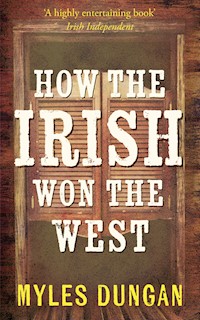
In this refreshing take on Irish-American history, broadcaster and historian Myles Dungan brilliantly describes how the exploration and exploitation of the West was vastly different from Hollywood myth. He reveals the true story of Irish immigrants and their descendants, from cannibals and prostitutes to soldiers and frontier-men, who toiled and dreamed of bigger things in America's Wild West. How the Irish Won the West is a wonderful and entertaining testament to the Irish men and women who helped build a new nation.
Das E-Book können Sie in Legimi-Apps oder einer beliebigen App lesen, die das folgende Format unterstützen:
Veröffentlichungsjahr: 2016
Ähnliche



















HOW THE IRISH
WON
THE WEST
MYLES DUNGAN
How The Irish Won The West
First published in 2006 This edition published in 2016 by New Island Books 16 Priory Hall Office Park Stillorgan County Dublin Republic of Ireland.
www.newisland.ie
© Myles Dungan, 2006
The author has asserted his moral rights.
PRINT ISBN: 978-1-84840-512-7 EPUB ISBN: 978-1-84840-513-4 MOBI ISBN: 978-1-84840-527-1
All rights reserved. The material in this publication is protected by copyright law. Except as may be permitted by law, no part of the material may be reproduced (including by storage in a retrieval system) or transmitted in any form or by any means; adapted; rented or lent without the written permission of the copyright owners.
British Library Cataloguing in Publication Data. A CIP catalogue record for this book is available from the British Library.
CONTENTS
Preface to the Second Edition
Pre-credit Sequence
Opening Credits: A Nineteenth-Century Western Timeline
REEL ONE: Introduction: How the Irish Really Won the West
REEL TWO: Mountain Men: Irish Pioneers of the Fur Trade
REEL THREE: The Donner Party: Cannibalism on the Western Trail
REEL FOUR: Indian Agent: The Later Career of Thomas Fitzpatrick
REEL FIVE: Toffs: Irish Aristocrats West of the Mississippi
REEL SIX: Not So Gentle Tamers: Irish Women Stake Their Claim
REEL SEVEN: ‘Never the Twain’: The Travel Writing of John Ross Browne
REEL EIGHT: Heroes and Villains: The Irish Good, Bad and Distinctly Ugly
REEL NINE: The Lincoln County War: Murphy, Dolan, Riley, Brady and Billy the Kid
REEL TEN: Cameos: Pioneers, Plutocrats, Popinjays and Populists
REEL ELEVEN: Boots and Saddles: The Irish Soldier in the American West
Closing Credits: Acknowledgements
Notes
Bibliography
Index
For Stacey, Best Western Gal
PREFACE TO THE SECOND EDITION
(AND EVEN MORE ACKNOWLEDGEMENTS)
Since finally deciding that enough was enough and that it was time to hand in a long overdue manuscript to my publishers – all of ten years ago now – I suppose I should have called a complete halt to any exploration of the activities of my fellow countrymen in the American West. I had better things to be doing. The fact is that I managed to do most of the better things. But I still kept travelling west of the Mississippi and continued to discover Irish rogues, vagabonds and heroes. The decision by the New Island editor Dan Bolger1 to reprint this volume has now given me a unique opportunity to inflict those extracurricular activities on an unsuspecting public.
My incurable obsession with the American West has not been helped by two lengthy periods of residence in California since the publication of the original volume, thanks to the generosity of the Fulbright Commission of Ireland. My thanks are due to Colleen Dube for her encouragement while she ran that august organisation. I am grateful also to the University of California, Berkeley, for offering a research home – and an office – during more than twelve months spent enjoying the delights of the Bay Area in 2007 and 2011. Professors Tom Brady, Mark Brilliant, Robert Tracy and James Vernon were particularly welcoming and continue to be good friends.
My involvement in the San Francisco Irish Literary and Historical Society (of which I am a now a proud board member) has also spurred on my fascination with the West, and especially with the Irish history of the greatest city in the world (that would be San Francisco, in case you hadn’t guessed). I am grateful to Tony Bucher, Matthew Spangler, Imelda White, Kathleen Kovach and Bob and Becky Tracy of the SF-ILHS for their friendship and support.
Likewise the American Conference of Irish Studies – West has been an invaluable source of inspiration and fascinating Irish-American narratives. My thanks to Caleb Richardson, Sarah Townsend, Glen Gendzel, Jim Walsh and Matt Horton for either welcoming me to their conferences or making me aware of stories I had overlooked and that really needed to be included in the revised edition of How the Irish Won the West.
To Mark Bittner and Judy Irving, thanks for the house, the view and the parrots.
My wife Nerys Williams and four pre-existing children (Amber, Rory, Lara and Ross) are thanked elsewhere, in the original acknowledgements page at the rear of this volume. But allow me to welcome Gwyneth Owen Máire Dungan Williams to these pages. She has arrived since the publication of the first edition, thinks of San Francisco as her second home and has already been to her first Giants baseball game with her Dad. She even has a certificate to prove it on her bedroom wall.
So enjoy the addition of the water engineer Michael O’Shaughnessy, some extremely dodgy Irish sheriffs, and the expansion of the roles of John Ross Browne – precursor of Mark Twain – and Denis Kearney, Irish bigot extraordinaire.
PRE-CREDIT SEQUENCE
This may look like a book. But don’t be fooled: it’s really a movie. In the 1960s, when I was growing up, the western ruled our TV screens. It’s hard to believe now but it seemed like every second programme back then was set in a saloon, a ranch or a sheriff’s office. A lot of the films shown on TV were westerns as well, so, naturally enough, this was where we escaped to as kids in the school-yard or the back garden. There was a time (in between wanting to be a train driver and preparing to climb Mount Everest) when I yearned to be a cowboy. Of course, if I’d known how dangerous, dirty, dusty, badly paid and uncomfortable a job it was, I would have stuck with train driving.
The Wild West had a hold on the imagination of boys (it was an almost entirely male obsession) of a certain age. Few under the age of fifty and no one under the age of forty would have been similarly fixated. We thought we knew all about Billy the Kid, Jesse James, Butch Cassidy, the Sundance Kid and the Hole in the Wall Gang, the Wild Bunch, Cochise, Geronimo, Crazy Horse, Sitting Bull, Custer, Wyatt Earp, Bat Masterson and the Union Pacific Railroad. The fact that their stories always seemed to vary wildly depending on what film you were watching was of minor importance. We trusted John Wayne, James Stewart and Gary Cooper to get it right. (We’d have known precious little about Howard Hawks, Henry Hathaway or probably even John Ford at the time.)
Of course, we knew precisely nothing. What we were getting was black and white situations in Technicolor. Before our gawping eyes, America was inventing its mythic past while projecting the contemporary preoccupations of its society (McCarthyism, Vietnam) in the guise of simple boys’ adventure yarns.
Ed Buscombe, in his BFI Companion to the Western, has described the genre as ‘a site for the dramatization of the formation of America’s evolving national identity’.1 This is undoubtedly the case, assuming that Buscombe was referring to white America. The westerns we saw were largely mono. When it came to the portrayal of virtue and heroism, they were racially monochrome and monocultural. Not that we were bothered at the time. The only dark faces we saw were Native Americans (though nobody had thought of that designation back then) and Mexicans. Both filled the role of antagonist. They were the dark, sinister forces preying on innocent settlers and plucky cowboys and attempting to roll back the manifest destiny of the white man to tame and settle the West.
That is why the western is dead. Although he kept faith with the genre himself, Sergio Leone’s Once upon a Time in the West was as much a farewell to the western as it was a hymn to the death of the old West. Despite occasional one-off revivals such as Dances with Wolves or Unforgiven, and despite latter-day attempts to atone for previous sins, it will not be coming back. In the ‘modern’ western, ‘the stories of men and women who both entered and created a moral wilderness have begun to replace the simple contests of savagery and civilisation’,2 acknowledges historian Patricia Limerick. But it is too little, far too late.
The classic Hollywood western spoke to the myths and illusions of one race. Films like Broken Arrow or Soldier Blue will never make up for the innumerable westerns that slandered a conquered people subjected to virtual genocide. In addition, Mexican Americans must find the depiction of their forefathers particularly offensive. For others, the sins are those of omission. Although there have been attempts to make the western relevant to the African American experience, with films such as Posse, and to point out that African Americans went west in huge numbers, the genre is as fundamentally alien and irrelevant to black culture, as is country and western music.
So if you have been waiting patiently for a resurgence of the western, you will have to be content with its bastard children: the action movie and the science-fiction adventure. It ain’t comin’ back, Ma. Given that the inheritors of the ‘Gunfighter Nation’, of which Richard Slotkin has so memorably written, are currently in the political ascendant in the USA, I could be wrong, but America doesn’t strike me as a nation that thrives on metaphor any more.
Even within the context of the prevailing template, the brave and oppressed white cowboys/farmers/settlers realising their American dream, there was very little diversity. All the accents seemed to be American. Granted, there was the occasional sing-song Scandinavian lilt, the slurred, drunken Irish slobber, the indecipherable Chinese patois or the oily, aristocratic English drawl, but they were usually only trotted out when a little light relief was required. So we might have been forgiven for thinking that the trans-Mississippi American ‘frontier’ was tamed exclusively by native-born Americans. That’s what I thought until I began researching a book called Distant Drums in the early 1990s and discovered that more than thirty of the men who died with Colonel George Armstrong Custer at the Little Bighorn had been born in Ireland. About the same number again had been born in the USA of Irish parents. Nearly 140 members of Custer’s 7th Cavalry (out of a total of 800 men) had been born in Ireland.
That discovery led to a desire to find out whether there were other Irishmen and women who hadn’t just stopped in New York, Philadelphia and Boston after they emigrated from Ireland in the nineteenth century. There were. Lots of them. They have turned up in all sorts of places. One or two are principals in some of the great mythical stories of the American West. The rest are peripheral, but nonetheless colourful for that. The time has now come to stop collecting.
In this survey of nineteenth-century Irish migration to the American West, I have, by and large, concentrated on stories rather than on analysis, though I have benefited greatly from the writing of scholars of New Western History such as Richard Slotkin, Patricia Limerick and John Mack Farragher. Most of the material contained within these covers is based on secondary sources, on more than 120 books collected over a period of six years from the United States and on four visits to the USA – to Wyoming, California, New Mexico and Minnesota.
I have probably failed to deal adequately with the experience of Irish miners and railroad workers in the American West. This is because they were, mostly, unlettered men who left little account of themselves and whose lives, though relentlessly hard and often brutal, were often otherwise unremarkable. Some of those who achieved success or great riches in either field have been acknowledged and I hope that a little of the flavour of the lives of ordinary Irish miners and railroad builders can be gleaned from their experience. After all, they began at the bottom too – they just got lucky.
If this book has a thesis of any kind, it is not seriously attempting to suggest that the Irish actually won the West. It is merely pointing out that, contrary to the Hollywood version of the truth, the exploration, subjugation, development and exploitation of the West was multicultural and multifaceted. There are many mansions in this particular house. The Irish room happens to be very lavishly and flamboyantly furnished.
Enjoy the movie.
Roll it!
OPENING CREDITS
A NINETEENTH-CENTURY WESTERN TIMELINE
1803
Talleyrand offers ‘whatever we took from the Spanish’ to American negotiators for $15,000,000. The USA gets half of the ‘West’ for a few dollars more than it was prepared to offer for New Orleans in the Lousiana purchase.
1804
Lewis and Clark begin their epic voyage of exploration.
1806
Lewis and Clark return with the Corps of Discovery after they had been given up for dead.
1807
Manuel Lisa sets up the first permanent American fur trading post, Fort Raymond, at the meeting of the Yellowstone and Little Bighorn rivers in Montana.
1808
John Jacob Astor secures a charter from the State of New York, setting up the American Fur Company.
1811
Astor’s men establish a trading presence at the mouth of the Columbia River.
1823
William Henry Ashley’s newly recruited trappers journey up the Missouri River in search of fur pelts.
1824
Discovery of South Pass by Thomas Fitzpatrick and other Ashley employees.
1831
Jedediah Smith killed.
1843
John C. Fremont’s influential account of his expedition to the Rockies is published by Congress.
1844
The Stevens–Murphy party blaze an emigrant trail to the West.
1846
Mexican–American War begins.
The Donner party set out for California.
1847
Twelve people murdered by Cayuse Indians at the Whitman settlement in Oregon.
1848
Gold discovered near Sutter’s Fort in California, sparking an unprecedented gold rush the following year.
1851
First Fort Laramie Treaty negotiated by Thomas Fitzpatrick with Plains Indian tribes.
1859
Comstock lode discovered.
Henry McCarty (aka Billy the Kid) born in New York.
1861
American Civil War begins.
1864
Sand Creek Massacre of a Cheyenne encampment by Colorado militia.
1865
End of American Civil War.
1866
Goodnight–Loving Trail opens route for cattle drives from Texas to the Midwest.
1867
Fetterman Massacre – Red Cloud and Oglala Sioux on warpath – three Union officers and ninety men killed in ambush.
1868
Red Cloud signs Fort Laramie Treaty, ending his war on relatively favourable terms.
1869
Union Pacific and Central Pacific railroad lines meet at Promontory Point in Utah.
1874
Custer-led expedition to the Black Hills discovers gold and starts another gold rush.
1876
Two hundred and sixty-eight officers, men and camp followers are killed by combined Lakota/Sioux and Cheyenne forces at the Battle of the Little Bighorn.
1878
The Lincoln County War erupts. The murder of John Tunstall, the killing of Sheriff Brady by Billy the Kid and the ‘Big Killing’ of July all happened in this year.
1881
The Earps and the Clantons shoot it out at the OK Corral in Tombstone.
Pat Garret tracks down and shoots Billy the Kid.
1882
Oscar Wilde arrives in the USA for his celebrated lecture tour.
1883
‘Buffalo’ Bill Cody stages his first travelling Wild West Show.
1889
Johnson County War: Wyoming beef barons hire killers and take vigilante approach to rustling.
1890
Sitting Bull killed by Lakota policemen.
Ghost Dance movement comes to abrupt and bloody end at Wounded Knee massacre – resistance of the Plains Indians ends.
1896
Gold strikes in the Yukon start another gold stampede.
1903
Edwin S. Porter’s
Great Train Robbery
(a western) becomes the first American feature film.
REEL ONE
INTRODUCTION: HOW THE IRISH REALLY WON THE WEST
Sorry to disappoint, but … the Pony Express went out of business after nineteen months, the gunfight at the OK Corral lasted less than thirty seconds, the Stetson was invented in Philadelphia, farmers outnumbered cowboys in the Old West by a thousand to one, Billy the Kid did not kill one man for each year of his short life, Frederick Remington never actually saw any cowboys in action because he was much too fat to get on a horse, Zane Grey was a New York dentist … and so on.
The American ‘Wild West’ has been successfully mythologised over a period of a hundred years or more to the point where reality and fiction have become interchangeable. A young emerging American nation needed an heroic past of its own. Its very size, remoteness and harshness, as well as the hardy, independent characters who inhabited its space, meant that the American West was ready-made for hyperbole. Even before memories of significant historical events had begun to fade, storytellers were creating a mythic past from those very sources. It was ‘a past that never was and always will be’, as one student of the frontier has put it.1 Certain elements of that past were undeniably ground breaking and ‘heroic’. But the nineteenth-century American West has been over-mythologised. Buffalo Bill, Frederick Remington, Hollywood and the ‘dime’ novel have seen to that.
Just as there are countless myths about the American West, there are many preconceptions about the Irish in the USA. They derive from convenient over-simplifications. One version of the Irish American story would have us believe that Irish nineteenth-century immigrants settled almost exclusively in the great eastern conurbations of New York, Boston and Philadelphia. Of course they did so in great numbers, but an interrogation of this particular myth quickly dispels it. Many, having acquired the urban skills they lacked on arrival, moved on from the stifling Irish ghettoes of the eastern seaboard. A significant percentage of those who did so settled in the West. In 1850 there were 900,000 Irish-born immigrants in the USA, only 0.4 per cent of whom lived in the western states. By 1920, one million US residents were Irish-born, 9 per cent of whom lived in the West.2 As historian David Emmons has put it in his monumental work on Butte, Montana, The Butte Irish: Class and Ethnicity in an American Mining Town 1875–1925:
Contributing to the historical neglect of these westering Irishmen has been the assumption that the American West was the exclusive province of native-born Protestants who wished to farm or graze their cattle on it. Farmers and cattlemen there were, but there was also an urban West, filled with miners and smeltermen, loggers, railroad workers, longshoremen, and industrial tradesmen of every sort. Many were Irish.3
There is a natural tendency to equate the words ‘West’ and ‘frontier’ and indeed they are often interchangeable. But while the ‘West’ was clearly the ‘frontier’ at one point in American history, the ‘frontier’ was as much an eastern as a western phenomenon. Arguably the American ‘frontier’ was to be found east of the Mississippi for far longer than it was located to the west of that great river. From the time of the landing of the Pilgrim Fathers until the late 1700s, American expansion was west-ward but the West itself was terra incognita. When Thomas Jefferson became president of the USA in 1801, two-thirds of the American people lived within fifty miles of the Atlantic Ocean. The USA itself ended on the eastern bank of the Mississippi River. Many of the men who had expanded the land area of the USA even that far had been Irish. They were the so-called ‘Scotch-Irish’, Protestant pioneers who had also played such a huge part in winning American independence and in formulating the US Constitution.
However, as the USA poured across the Mississippi and pushed, punched, cajoled, fought and cheated its way to the Pacific Ocean, the Irish pioneers who played a part in making a garden out of that wilderness were very different from the men who had helped bring America thus far. For a start, they were almost all Catholic. They were also, largely, from more impoverished backgrounds than the Scotch-Irish Protestants and Presbyterians who had preceded them. Mines, railroads and the army were the principal employers of the Irish in the American West. Most never rose above the status of lowly wage earner, but few became indentured wage slaves like many of their eastern counterparts. In states such as Montana there were no indentured employees. No company stores or company boarding houses ensured that the employee never escaped the economic grasp of the employer. There was also an abundance of land for the thrifty former miner, soldier or railroad worker who might decide to return to the avocation of his Irish ancestors.
In a newly minted society with few barriers to upward mobility, NINA (No Irish Need Apply) attitudes were not allowed to prevail. The Irish who moved west managed to avoid much of the bigotry and Know-Nothing4 spirit that pervaded many of the mid-nineteenth-century eastern cities. In New York, Boston and Philadelphia, the Catholic Irish from the 1840s onwards faced organised and improvised racism on a considerable scale. The Irish in the West faced no such condescension or discrimination in western cities, primarily because the cities didn’t exist, at least not on the scale of the eastern seaboard. Institutionalised racism cannot thrive in the absence of institutions, and the West of the mid-nineteenth century lacked an entrenched WASP establishment of the kind that directed the suspicion and scorn of their stooges towards the immigrant Irish in the East. And where cities did begin to flourish, such as San Francisco, Butte or St Louis, they did so with a healthy proportion of Irish first-generation inhabitants who were not about to be dictated to by Know-Nothings or vigilantes.
Furthermore, the environment in which the western Irish lived was more rough and ready than the one they abandoned (or avoided altogether in the rare cases of direct migration to the West) on the east coast. Despite many attempts to civilise the towns and cities of the West, middle-class, Protestant American values were slow to take hold in places that might not exist the following week if the gold/silver/copper gave out, the army fort closed down or the promised railway line went elsewhere. Without wishing to reinforce certain familiar ethnic stereotypes, there was an elemental wildness about the West that suited the rebellious anti-establishment streak in the post-Famine Irish who were uncomfortable and often unwelcome in the Nativist Protestant enclaves of the East until they banded together and learned to manipulate the politics of the big cities.
Aside from which, everybody in the West was a migrant except the indigenous peoples. They would become far more plausible scapegoats for the tribulations of the region than the Irish had ever been east of the Mississippi. And when the Indian threat was gone, if the Irish had ever been an underclass in the West, they had been replaced by the Chinese and the Mexicans.
In his highly influential essay ‘The Significance of the Frontier in American History’, Frederick Jackson Turner proposed that ‘in the crucible of the frontier the immigrants were Americanised, liberated and fused into a mixed race’.5 He was referring to the eighteenth-century frontier but applies his proposition to the trans-Mississippi frontier as well. Was this true of the Irish? How quickly did those who ventured west become American?
Far more quickly than in the eastern cities, where they faced anti-Irish and anti-Catholic bigotry. In a milieu where the Nativist had replaced the English as the oppressor, it was difficult not to cling to one’s ethnicity and band together with one’s countrymen for protection and in pursuit of political influence. But in an environment where preoccupations and priorities were somewhat different, it was not so essential to coalesce and cleave to one’s Irishness. Granted, a remote California mining town like Bodie (population 10,000 at its height) might boast a branch of the Ancient Order of Hibernians and the Irish Land League, but that can be ascribed as much to nostalgia as to any distrustful clannishness. The Bodie Irish, comprising as they did 30 per cent of the town’s transient population, did not need to band together for protection. In the book Irish Settlers on the American Frontier, Michael C. O’Laughlin suggests that the reason relatively little attention has been paid to the Irish story in the American West is because rapid assimilation became the norm. Because the Irish were more readily accepted, their own ethnicity became less significant. ‘Being an American proved more important than being Irish. Becoming a successful part of this new nation, their older heritage was often set aside.’6 Perhaps ‘new region’ would be more appropriate than ‘new nation’ in this instance, but the nature of the assimilation of the Irish into western society has, ironically, led to their achievements often being overlooked. This is because they were not at the margins. Their experience was seldom at odds with the western narrative.
Although this study will concentrate on a few significant individuals, it is worth making some more general observations before launching into their stories. The classic image of the nineteenth-century Irish immigrant to the USA is of the peasant fleeing economic and political serfdom and sailing to North America in an unseaworthy ‘coffin ship’ – the indigent vassal on a leaky vessel. He (for the stereotypical Irish emigrant is male) would arrive in Boston or New York, stick close to his own, settle in an eastern urban ghetto and endure poverty and bigotry at the hands of the dominant WASP culture. He would become political fodder for an Irish Democratic Party ward heeler, probably become a trade-union activist and his children and grandchildren might, slowly and painstakingly, climb the political and economic ladder.
Like most stereotypes it has more than a grain of truth. But it can be challenged and questioned. What is outlined above was the experience of many nineteenth-century Irish immigrants to the USA (except for the gender balance – it was much closer to fifty–fifty). But, as we will see, a significant percentage didn’t remain on the eastern seaboard. Many moved into the Midwest, to cities like St Louis and Chicago. Some even moved to the South, though there was a marked disinclination to do so because of the perception of antipathy towards Catholicism in the states below the Mason-Dixon line. What has gone largely unremarked is the significance of the American West to the Irish immigrant and vice versa.
The experience of the Irish in the West challenges certain axioms. It puts in some doubt, for example, the notion that the Irish did not engage with the land because the land had betrayed them. Aside altogether from the fact that many of the post-Famine Irish, despite their agricultural backgrounds, were not competent to work American farmland (assuming they could afford to buy it even on generous government terms), there is evidence that a significant percentage of the Irish who moved westwards did opt for the agricultural life. Work done on the 1870 and 1880 census in two Washington counties (Clarke and Spokane) shows that between 50 and 60 per cent of a substantial Irish population was working the land.7
It also challenges the notion that in an industrial dispute the Irish were more likely to be on the side of labour than of capital. The West was good to Irish enterprise. Unshackled by the Freemasonry and exclusivity of the eastern capitalist cabals, many newly arrived Irish immigrants were able to stake their claim to wealth, literally and metaphorically. The ‘Silver Kings’ were merely the most famous of a range of rich mine-owning Irishmen (and women). In a town like Butte, Montana, where most of the miners were Irish, as were most of the mine-owners, ethnic cohesion and some element of fair dealing seems to have blunted the tendency towards industrial action. Between 1878 and 1916, the Irish-dominated Butte Miner’s Union never led its workers out on strike.8 According to David Emmons:
there were times when ethnic nationalism and working class protest reinforced one another. But there was a far tighter seam that marked the place where the rights of Ireland were joined only with the rights of Irish workers and there were more times when that ethnic exclusivity was used against rather than in defense of the rights of all workers.9
Confronting anti-Irish and anti-Catholic bigotry and racism was something many Irish were forced to do in the East and Midwest. This phenomenon was less prevalent in the West. In fact, if anything, the western experience reinforces the unpalatable fact established by the New York draft riots of 1863, namely that the Irish were just as capable of racism and bigotry as their oppressors. This is borne out by their treatment of the Native American, the African American and the Asian American.
The role of the Irish in the subjugation of the Native American population is largely beyond the scope of this work (because it is mostly associated with the US Army), but the evidence of Irish complicity in this nineteenth-century form of ethnic cleansing is compelling. Suffice it to say that the charity of a virtually destitute Choctaw nation in the mid-1840s in sending a large sum of money for the relief of famine in Ireland was not reciprocated in kind in the years that followed by Irish officers and soldiers in the western army.
The attitude of Irish communities on the eastern seaboard towards the issue of slavery has also been well advertised. In the near west and Midwest, the opposition of Irish settlers and labourers to the emancipation of slaves was hardly less virulent than was evident from the lynching of black men by Irish mobs in New York in 1863. As one historian of the Midwest has put it, ‘There were antislavery Irish people, but contemporary observers agreed that the bulk of the Irish population in the 1850’s was not moved by the abolitionists arguments.’10 An Irish Midwesterner in the pivotal 1860 election wrote home, ‘All Catholics here is Democrats or for slavery and all Republicans is prodestants [sic] or not for slavery but it is not known yet which will beat.’11
In the far west the Irish had a highly ambiguous relationship with the Chinese. Thrown together on the Central Pacific Railroad in huge numbers, relations between the Irish navvies and the Chinese coolies were often strained and occasionally burst into open violence. In the city of San Francisco a strange paradox can be seen at its most stark. There
the Chinese presence was of great importance to the Irish. The cultural gulf between Chinese and white society … was so great as to diminish, by comparison, almost to vanishing point the differences between the natives of Cork and Boston, Limerick and New York.12
The point being made by historian R.A. Burchaell here is that the Irish were, to some extent, beholden to the Chinese for their own status in San Francisco society. The Chinese were a ready-made underclass that discharged the Irish from their recurring obligation to be society’s footstool.
This fact, however, did not prevent the Irish in San Francisco from discriminating against the Orientals in a mirror image of their own treatment in the mid-nineteenth-century in the eastern cities. Their colour meant they could make common cause with white groups who might, conceivably, have discriminated against them had the Chinese not been available as an alternative. Denis Kearney’s Workingmen’s Party of the 1870s, which advocated the expulsion of Chinese from the USA, was an egregious example of this phenomenon. Kearney himself was an immigrant, but that did not prevent him inciting violence against Chinese communities in the Bay area. Sadly, the same intolerance was often true of Irish trade-union activity: ‘anti Oriental racism became the cement for labor union organization’.13 Ironically, the closest a No Irish Need Apply sign got to San Francisco was on a mill owned by a migrant New Englander in Mendocino County. The Irish riposte was to cover the sign in graffiti.
Because the West lacked a social register (money determined social status) and because there were more resources to be distributed amongst fewer people, the Irish race fared relatively well there. Cities such as San Francisco had a 12 per cent Irish population in the 1850s, with a far higher percentage in highly paid professional employment in the 1870s than in eastern cities. Individual Irishmen, such as the ‘Silver Kings’ of Virginia City or ‘Copper King’ Marcus Daly of Butte, made huge fortunes and became first-generation ‘lace curtain’ Irish. Protected from Nativist bigotry by their relative prosperity and the existence of ethnic groups more vulnerable to racism than themselves, the Irish made a better home in the American West far more rapidly than they did in the East. Their strange lack of political cohesion was a function of this assimilation. As James Walsh, who has made a particular study of California, has put it, ‘In California Irish-Americans had never built a consistent political machine … In San Francisco, Irish-American politicians acted as individuals for the most part.’14 There was little need for them to do otherwise. They had none of the impetus for self-protection that spawned Tammany Hall and other eastern ‘Irish’ political machines.
But just because the Irish relationship with the western economic and political landscape was less fraught than it was in the cities that had been their first ports of call on reaching the USA does not mean that the story of that relationship lacks interest. The focus of this study will be on individuals and small groups who intersected with those landscapes in a fascinating and often violent manner. They are every bit as colourful and influential as the Irish icons of the eastern seaboard. As befits the Land of the Big Sky, they are also somewhat larger than life.
REEL TWO
MOUNTAIN MEN: IRISH PIONEERS OF THE FUR TRADE
The iconography of the American West may not survive long into the third millennium, but the imagery from that period, laced with dollops of jagged romanticism, left a permanent mark on the twentieth century. Whether it was the poncho-clad Clint Eastwood extracting the last measure of revenge in a ‘spaghetti western’ or the Marlboro Man encouraging the association between the ruggedness of the great outdoors and the banal act of smoking a cigarette, there was no escape from the imagined and romanticised Wild West long after the more mundane reality itself had petered out.
One of the West’s most enduring icons is the grizzled, beaver-hatted, buck-skinned and aromatic ‘Mountain Man’. He is the quintessential loner, closer to nature and to the Indians amongst whom he lives than he is to the ‘society’ that he has rejected in favour of the simple, nomadic life of the hunter.
As with all such western images, there is an element of myth and of truth about this depiction of the lonely fur trapper or ‘voyageur’. They were tough, independent (and unhygienic) men who opened up the West through their explorations, through their pursuit of the beaver and by trading with the indigenous population. But they weren’t all native-born Americans and neither were they necessarily illiterate, uncultured nomads who shunned the society of all but other courageous misfits like themselves.
To put the significance of the Mountain Men in western history into perspective, it is important to understand the relationship between the United States of America and its vast hinterland in the early part of the nineteenth century.
America before the Louisiana Purchase
When Thomas Jefferson became president of the USA in 1801, two-thirds of the American people lived within fifty miles of the Atlantic Ocean. The USA ended on the eastern bank of the Mississippi River.
Others, who were not American, had explored the vast interior of the continental USA. French and Spanish fur traders had moved up the Missouri River. Employees of the British-owned Hudson’s Bay Company had moved down from Canada as far as the Mandan Indians in what is now North Dakota. But to most, the area west of the Mississippi was a vast white space on the map of North America, a sort of Unfoundland.
Jefferson himself had never been much farther west than the Shenandoah Valley and he believed that
a) The Blue Ridge Mountains were the highest in the USA.
b) Somewhere in the West was a tribe of blue-eyed Indians who spoke Welsh. They were the mythical descendants of Prince Madoc, who was supposed to have settled in the New World in the twelfth century.
c) The Northwest Passage actually existed. This was a theoretical river series that would connect the east and west coasts of the continent. Whoever had control of this mythical river system would be able to realise the economic potential of the enormous land mass that was North America
Jefferson was committed to exploration and to pushing the uncertain boundaries of the USA, but not at the risk of war with the European nations with which the USA shared the continent – Britain, France and Spain. In 1804 he sent an Irish-born engineer, Thomas Freeman, with a group of thirty-five scientific and military personnel to the southwest border with Spain to explore the Red and Arkansas rivers upstream towards their sources. Freeman began his explorations on the Red River in two flat-bottomed boats. On 29 July his team encountered a force of Spaniards under Commandant Francisco Viana, who ordered the Irishman back downriver, claiming that he and the men under his command had strayed into Spanish territory. As Viana had a complement of 150 soldiers and Freeman had been warned not to engage or even antagonise the Spanish, he did as he was ordered.
Jefferson had already made two attempts to persuade explorers to search for the Northwest Passage. Those had come to nothing. In 1803 he secured authority for a ‘scientific expedition’ to cross French and British lands in a journey to the west coast. Spain refused permission, but this time Jefferson was prepared to ignore Spanish objections. The man Jefferson appointed to lead this expedition (christened the Corps of Discovery) was his own personal secretary, Meriwether Lewis, a twenty-eight-year-old former soldier given to occasional bouts of depression and not universally approved of as commander of such an enterprise. Lewis appointed as co-commander his thirty-two-year-old friend William Clark, an extrovert Virginian with an army background and much experience on the Kentucky and Ohio frontiers. It was probably the best executive decision he made. Ironically, it was Lewis who insisted on describing Clark as his co-leader – the War Department refused to recognise him as such.
With the sort of consummate timing which often seems to separate momentous historical events from mere footnotes, just the day before Lewis, Clark and their Corps of Discovery were due to leave for the West, on 4 July 1803, Napoleon Bonaparte signed a treaty selling off the Louisiana Territory to the US government for $15 million (twice the then federal budget). Bonaparte made the gesture to American delegates who had sought, merely, to purchase New Orleans itself. He needed the money for further hostilities against England. Jefferson’s plenipotentiaries got the 820,000 square miles (far greater than what we know of today as Louisiana) for three cents an acre and doubled the size of the USA with the acquisition. Some thought it was a bad idea. The Boston Columbian Centinel exhibited considerable foresight when it observed that ‘We are to give money of which we have too little, for land of which we already have too much.’1
The USA now bordered on Texas and California (Spanish owned) and the Oregon Territory (whose ownership was disputed with Britain). Suddenly Lewis and Clark were going to be crossing American, as well as British and Spanish, land. Their mission took on a diplomatic as well as a scientific purpose: contact had to be made with the indigenous tribes of the region to bring them the joyful news that they were now ‘American’.
Probably not until the era of space exploration would Americans again take such a leap into the unknown. The Corps (which consisted of about fifty men) sailed up the Missouri on 14 May 1804. Slow progress was generally made against the five-mile-an-hour current by rowing. The river was ‘resistant’ in that it was muddy, full of logs and other snags. The expedition wintered at the village of the Mandan tribe on the banks of the upper reaches of the Missouri in what is now North Dakota.
The Mandan (a sedentary, farming people, quite unlike the stereotype of the nomadic Native American) were accustomed to white traders and trappers – both from St Louis and from Canada. The Corps had no problems either with adjacent tribes such as the Otoe, Missouri and Arikara. They made their way west, bestowing gifts on the Native American population as they went. Their first problems were with the Brule Sioux/Lakota, who threatened them with death, but Clark faced them down with his own threats of greater force to come if anything happened to the Corps of Discovery. The confrontation was a prelude to the ongoing tension between the white man and the powerful Lakota that would persist throughout the nineteenth century.
On 26 May 1805 the Corps saw the distant Rockies for the first time. They continued their journey along the upper Missouri to its source then beyond that to the Continental Divide, from where the rivers began flowing westwards. The Northwest Passage remained elusive and they were further from the Pacific than they thought with a second winter closing in. Also, they were beyond the boundaries purchased by Jefferson’s $15 million and were in territory claimed by Britain.
They had also picked up one of the most famous French-Canadian fur trappers of the day, Toussaint Charbonneau, and one of his Indian wives, Sacagawea – a fifteen-year-old Shosone who had been kidnapped from her own tribe and sold to Charbonneau. She was to prove crucial to the safety of the Corps as the winter of 1805 set in. Lewis needed to buy horses from the Shosone to avoid getting caught in the mountains during the winter. The Shosone were reluctant. Sacagawea saved the day when she recognised the Shosone chief as her brother. After they were reunited he agreed to give the Corps the horses they needed. The very presence of Sacagawea served as a guarantee of the friendly intentions of the Corps of Discovery as, according to Clark, ‘no woman ever accompanies a war party of Indians in this quarter’.2
Later, as they struggled through the snows of the Rockies, they were saved from starvation by the Nez Perce, who took pity on them and fed them. They also helped them build the canoes used to descend the Clearwater, Snake and Columbia rivers to the sea and looked after the horses of the Corps until the following spring. Lewis and Clark reached the Pacific coast of California on 3 December 1805. They began their return journey the following spring and in September 1806 were back where they had started twenty-eight months before. They returned as heroes, having been given up for dead.
Mountain Men
When Lewis and Clark reached the Mandan villages in August 1806 on their return journey to St Louis, they saw two white men paddling up the Missouri in the opposite direction. They were trappers, lured by the prospect of the fortune to be made from hunting beaver. At the time, demand for beaver pelts was huge in Europe. They were used to make felt hats. (For the record, the two men were Forest Handcock and Joseph Dickson and they were never heard of again.)
The fur trade had operated for years before the USA laid claim to the area west of the Missouri. It had involved Indian trappers supplying English, French and Spanish traders with furs. But the Americans decided to do it for themselves. In 1807 Manuel Lisa, a Spaniard who was based in St Louis, set up the first permanent American trading post. Fort Raymond was at the meeting of the Yellowstone and Little Bighorn rivers in Montana. In 1809 Lisa and William Clark, now a national hero, formed the Missouri Fur Company.
Its great and enduring rival, the American Fur Company, owes its very existence to a piece of advice given on board a US-bound ship. The identity of the adviser is lost to history. The nature of the advice was to invest profits (from the sale of musical instruments in New York) in the purchase of furs. The man who accepted the advice was one of the most famous businessmen of the nineteenth century, John Jacob Astor. Those few words started him on the road to becoming the richest man in the USA at the time of his death in 1848.
Astor was born in Germany in 1763 in the town of Waldorf, near Heidelberg (hence the name of one of the most famous hotels in the world, the Waldorf Astoria). An ambitious and confident type, he decided to try his luck in the USA. It was his brother’s musical instruments (seven flutes) he was bringing with him to sell when he met his lucky counsellor. They were his share of the family business. He did buy the furs. Then he sold them at a huge profit in London. From that point he was out of the music industry and into the fur trade. In 1808 he secured a charter from the State of New York that established the American Fur Company
The Lewis and Clark expedition had revealed a profusion of beaver in the catchment area of the Missouri and west of the Rockies – this, and the fact that a presence on the west coast gave access to the Oriental market for furs, prompted Astor to attempt to establish a foothold on the Pacific coastline. The fact that the area in which he wished to operate was effectively under the control of Spain, Britain and Russia did not deter him. Neither did it concern Jefferson, who saw it, as he said in a letter to Astor, as ‘the germ of a great, free and independent Empire on that side of our continent’.3 Clearly Jefferson was developing an aversion to sharing the bounty of continental North America with any European states. A similar aversion would inform the policies of many of his successors.
Astor’s plan was simple and financially risky. He invested $200,000 (about $4 million today) in a business colony (Astoria) at the mouth of the Columbia River on the Pacific coast. The intention was to resupply it each year by ship and have the supply ship take the furs accumulated during each year’s trading with local Indian tribes to the Orient. There, a variety of marketable products would be purchased with the proceeds of the fur trading and the ship would return with them to New York.
To advance his plan, Astor established the Pacific Fur Company. His assault was to be two-pronged. As well as the ship that would sail to the Pacific coast, to arrive in the early months of 1811, an overland expedition would travel west with the intention of reaching Astoria at the same time as the supply vessel. This expedition included an Irishman called John Reed. (His place of birth in Ireland is unclear.) It fared badly, with the overland travellers suffering from hunger, thirst, exposure to extreme cold and periodic desertion by understandably disaffected employees, before members of a much-reduced group straggled into Astoria in February 1812.
The first ship chosen for the journey to Oregon was the Tonquin, which weighed in at 290 tons. It came to grief after a dispute with local Nootka Indians, exacerbated by the character of the ship’s captain, a martinet by the name of Jonathan Thorn. The Indians, having already been badly treated by Thorn, managed to inveigle their way on board the ship and attacked and killed most of the crew. The last surviving sailors onboard locked themselves below deck and ignited the ship’s gunpowder, blowing themselves, dozens of Indians and the ship into oblivion.
On 17 October 1811, some weeks after the Tonquin had set sail, the Beaver became the next Astor supply ship to make the journey west. On board was the second Irishman in the Pacific Fur Company, Ross Cox. Much more is known about Cox than about his compatriot John Reed. Cox described himself as having a ‘cropped head, John Bullish face’ and being a ‘low and somewhat corpulent person’.4 He was a Dubliner, born there in 1793 and so only eighteen years of age when he signed up for his great life’s adventure with Astor’s company. His youth meant that his annual salary, as a clerk with the Pacific Fur Company, was $100, when others doing the same work were paid $150. Cox’s importance was that he wrote one of only three first-hand accounts of the Astorian experiment. He remained on the west coast until 1817, when he began his return to Dublin. Subsequently Cox worked for the Dublin Metropolitan Police and, until 1837, as the Dublin correspondent of the London Morning Herald. In 1831 he wrote The Columbia River – or Scenes and Adventures during a Residence of Six Years on the Western Side of the Rocky Mountains among Various Tribes of Indians Hitherto Unknown, a colourful but not entirely reliable account of life in Astoria.
The Beaver reached Astoria in May 1812 and augmented the traders and trappers already at the post. However, the Astorians’ sense of isolation and paranoia, already running at a high level after the Tonquin débâcle, must have been greatly amplified by the failure of an overland party, sent east with despatches, to make it very far before being attacked by Indians and forced to turn back. Among the unhappy returnees was John Reed (Cox spells the name ‘Read’). Reed was the member of the group who actually carried the despatches, in a tin case. According to Cox, ‘Its brightness attracted the attention of the natives and they resolved to obtain possession of the prize.’ They duly did so, almost killing Reed in the process. As the attack proceeded, the Irishman was left for dead and would never have survived had one of the leaders of the party not insisted on searching for him. Reed was found, badly wounded and minus the despatches, trying to drag himself to safety.
Cox includes a description of Astoria in his account. The fort was situated on a promontory known as Point George, close to the mouth of the Columbia River and another headland named, no doubt in a fit of pure pessimism, Cape Disappointment. It was a short distance north of the spot where Lewis and Clark had spent the winter of 1805–06.
The buildings consisted of apartments for the proprietors and clerks, with a capacious dining-hall for both, extensive warehouses … a provision store, a trading shop, smith’s forge, carpenter’s workshop, &c. The whole surrounded by stockades forming a square, and reaching about fifteen feet over the ground. A gallery ran round the stockades, in which loopholes were pierced sufficiently large for musketry.5
The fort also boasted a six-pound cannon. The Astorian diet was overwhelmingly carnivorous, consisting largely of elk, wildfowl and fish. Anchovies were in abundant supply. ‘We had them generally twice a day,’ wrote Cox, ‘at breakfast and dinner, and in a few weeks got such a surfeit, that few of us for years afterwards tasted an anchovy.’6
On 28 June 1812, a party of nearly a hundred well-armed Astorians started up the great Columbia River in canoes, intent on trading for furs with friendly Indian tribes. Each member of the expedition wore leather body armour, a sort of heavy-duty shirt made of elk hide, which Cox insists was arrow proof and could withstand a musket ball fired from a distance of more than eighty or ninety yards. While portaging the set of rapids where Reed’s party had been waylaid the previous month, a feeble attempt was made by two Indians to steal some of the trade goods being transported. This was repulsed. Clearly the local Indian tribe had no intention of taking on the entire group. The journey upriver continued without any interference. Contact was made with the well-disposed Walla Walla and the Nez Perce peoples. A smaller group stored their canoes and started for the country of the Spokane tribe. The expedition was going well. But on 17 August, Cox’s own luck ran out.
On the afternoon of that day he became separated from the main group when he went off in search of fruit and fell asleep in the afternoon heat. When he woke up his companions were gone. ‘My senses almost failed me,’ he wrote. ‘I called out, in vain, in every direction, until I became hoarse; and I could no longer conceal from myself the dreadful truth that I was alone in a wild uninhabited country, without horse or arms, and destitute of covering.’7
Over the following fortnight Cox attempted to track and overtake his party (which had divided into three sections, each one assuming that he was travelling with one of the others) without possessing anything other than rudimentary wilderness-survival skills. His account of his ordeal is highly colourful and, more than likely, highly coloured. There is no doubt that he experienced constant hardship and occasional moments of terror, but his reported encounters with ‘a murderous brood of serpents’, a raging bear who chased him up a tree (where he was forced to remain overnight), as well as hazardous brushes with wolves, must be treated with at least some scepticism. The privations from which he reported suffering, lack of food and water, are far more credible. In such an environment, without firearms or the means of creating fire, hunger and thirst would have been inevitable. In addition, his moccasins were not equal to the terrain and quickly became shredded, slowing his progress and making walking extremely painful. He survived mainly on wild berries and fruit, which was, at least, a contrast to the carnivorous diet of Astoria.
On the fourteenth day of his ordeal, Cox came across fresh horse tracks. He followed these and soon imagined he heard the neighing of a horse. Pursuing the sound, he found himself on the opposite side of a stream from a grazing herd. When he crossed the stream one of the horses approached him. ‘I thought him the “prince of palfreys”,’ he wrote rather floridly, ‘his neigh was like the bidding of a monarch, and his countenance enforced homage.’8 The herd of horses was owned by a Spokane Indian family and, in an act of charity which would be repeated hundreds of times in the history of the West, the Indians fed Cox, offered him rudimentary medical attention and reunited him with his Astorian companions. It transpired that for a rookie Mountain Man the young Irish clerk had made an amazingly good fist of tracking his party in extreme circumstances. They were only a couple of hours away! When the Indians brought him to where some Canadian members of the expedition were chopping wood, he was greeted with frank astonishment.
Away went saws, hatchets, and axes, and each man rushed forward to the tents … it is needless to say that our astonishment and delight at my miraculous escape were mutual. The friendly Indians were liberally rewarded; the men were allowed a holiday, and every countenance bore the smile of joy and happiness.9
Perhaps the same smiles also masked some small trace of guilt at having so carelessly ‘lost’ a fellow Astorian. When it was finally discovered that he was missing, the search for Cox had continued for six days, at which point it was assumed, not unreasonably, that someone as devoid of experience of the wild as the Irishman could not have survived.
Cox’s Astorian compatriot was not as fortunate as the young Dubliner. John Reed had established himself as a trapper (Cox spent more of his time involved in trading activities with co-operative Indian tribes). In the summer of 1813 he was sent to what is now southern Idaho to trap along the Boise River. There, in January 1814, he, along with all the other trappers in his company, was killed by members of the Snake tribe. Cox’s epitaph for Reed is appropriately extravagant:
Mr Read was a rough, warm-hearted, brave, old Irishman. Owing to some early disappointments in life he had quitted his native country while a young man, in search of wealth among regions, Where beasts with man divided empire claim/And the brown Indian marks with murd’rous aim; and after twenty-five years of toils, dangers, and privations, added another victim to the long list of those who have fallen sacrifices to Indian treachery.10
Cox himself decided not to ride his luck too far. In 1813 he had proved his worth on a trading trip to the Flatheads, returning to Astoria with a healthy complement of furs. He was to make many more successful trading expeditions, so much so that his decision to quit Astoria in 1817 appears to have been received with regret by his employers. Cox had arrived by sea but departed by land. He left Astoria in April 1817, accompanying a party of eighty-six men, ascended the Columbia then crossed the Rockies into Canada. Five months after leaving the Pacific Ocean, Cox reached Montreal.11
Cox’s significance does not lie in anything he did while he was in Astoria. His exploits, while they might have impressed a European ‘salon’ audience, were nothing out of the ordinary in the fur trade. His legacy is his 1831 memoir The Columbia River. Although elements of his story are often contradicted by two other first-hand accounts of Astorian clerks (Gabriel Franchiere and Alexander Ross), it remains a valuable document, overflowing with historical and anthropological detail in spite of its exaggerations, inaccuracies and Cox’s occasional self-aggrandising excesses. Despite playing a more minor role in the opening of the West than other countrymen who would follow, Cox is one of the few Irishmen to have left any sort of literate, readable account of his life and times. For that alone we should be grateful.
The Birth of the Legend of ‘Broken Hand’
The fur trade really became established in the West when the lieutenant governor of Missouri, William Henry Ashley, who had made a small fortune in the War of 1812 by manufacturing gunpowder, placed an advertisement in a St Louis newspaper, The Missouri Republican, in 1822. It read, ‘To Enterprising young men: the subscriber wishes to engage one hundred men, to ascend the river Missouri to its source, there to be employed for one, two or three years.’12 He got his enterprising volunteers and an expedition into the far West, under the command of Ashley’s partner Andrew Henry (who had more than a decade’s experience in the trade), left St Louis in April 1822 and built a trading post on the Yellowstone. It was a modest enough beginning. Ashley aimed to reinforce the limited success of that foray the following summer, so he recruited another hundred men with the intention of leading them upriver himself to reinforce Henry.
That expedition became legendary, not least for the personnel whose services Ashley managed to engage. Among its members was a western legend in the making, a twenty-three-year-old New Yorker, Jedediah Strong Smith. Smith helped Ashley recruit the rest of his troupe. Some were of sufficiently dubious origins for Smith to write ‘a description of our crew I cannot give, but Falstaff’s Battalion was genteel in comparison’.13
Another member of that battalion would, like Smith, become a western hero. Jim Bridger would come to be known as ‘Old Gabe’, but at the time that he answered Ashley’s advertisement he was only eighteen years old. His is a name that continually crops up in stories with Irish links right up to the 1880s. His first Irish ‘connection’ was one of his associates on that groundbreaking Ashley expedition of 1823.
Thomas Fitzpatrick, born in County Cavan in 1799 probably in the town of Killeshandra, is probably the single most significant Irish-born figure in western history. He is described in one account as ‘a slender Irishman full of drive and intelligence’.14 According to his biographer, Leroy R. Hafen, ‘No other man is so representative of this epoch.’ His life story is ‘the epitome of the early history of the Far West’.15




