


3,99 €
Mehr erfahren.
- Herausgeber: Fairways
- Kategorie: Fachliteratur
- Sprache: Englisch
This book is highly productive if you are a CEO who wants to take your company to the next level, an employee who wants to develop your career, an entrepreneur who wants to start a business from scratch and a professional doctor, engineer, officer or freelancer who wants to establish their name as a brand or a student who wants to achieve your full potential and take the lead in your first career move.
This book is useful for everyone who wants to build their personal brand and make a difference in developing their professional profile. Identifying and marketing your personal brand is an essential core competency for managing and sustaining a successful career. Empower yourself by knowing what you have to offer, what you want and how to ask for it. The simple fact is that many entrepreneurs and senior executives completely miss out on one of the most powerful branding strategies available in today’s market.
A Personal brand when used as a marketing tool can make your professional profile more attractive, visible, credible, lucrative, and long lasting. This book serves as a dynamic tool to develop your professional profile in a diverse world.
Take your professional profile to the next level. Get started with this stellar book to grasp the fundamentals of Personal branding.
Das E-Book können Sie in Legimi-Apps oder einer beliebigen App lesen, die das folgende Format unterstützen:
Veröffentlichungsjahr: 2020
Ähnliche

















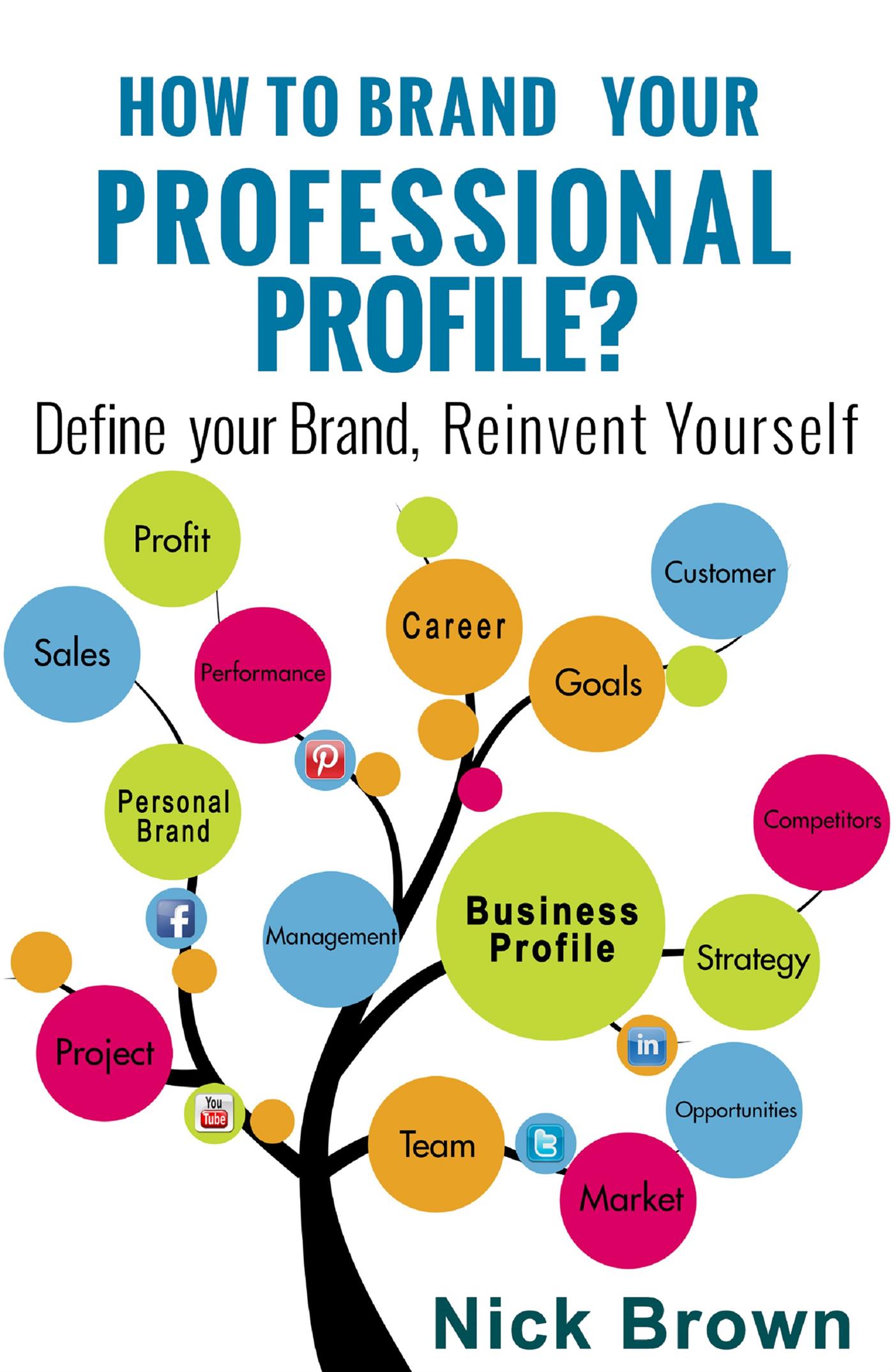
How to Brand Your Professional Profile? Define your Brand, Reinvent Yourself.
Nick Brown
Published by nashitf, 2014.
While every precaution has been taken in the preparation of this book, the publisher assumes no responsibility for errors or omissions, or for damages resulting from the use of the information contained herein.
HOW TO BRAND YOUR PROFESSIONAL PROFILE? DEFINE YOUR BRAND, REINVENT YOURSELF.
First edition. January 5, 2014.
Copyright © 2014 Nick Brown.
ISBN: 978-1497790865
Written by Nick Brown.
10 9 8 7 6 5 4 3 2 1
Table of Contents
Title Page
Copyright Page
How to Brand Your Professional Profile? Define your Brand, Reinvent Yourself.
How to Brand Your Professional Profile?
Chapter—1 | What is a Personal Brand?
Chapter—2 | Is Your Personal Brand Disappearing?
Chapter—3 | A Strong Personal Brand is a Leadership Requirement
Chapter—4 | How to Optimize Your Personal Brand
Chapter—5 | How to build your personal brand in a Company
Chapter—6 | Using Personal Brand to Drive Performance and Profit
Chapter—7 | When is the Right Time to Build Your Personal Brand?
Chapter—8 | Things to Do before you Build your Personal Brand
Chapter –9 | How to Build your Personal Brand?
Chapter—10 | Authentic Personal Branding
Chapter – 11 | Tools to Market Your Personal Brand
Chapter –12 | Social Media tools to Optimize Your Personal Brand
Chapter – 13 | The Power of Personal Branding
Chapter—14 | Personal Branding Tips for Entrepreneurs
In Conclusion | Personal Branding for Success
Sign up for Nick Brown's Mailing List
Acknowledgments
Acknowledgement is due to all those people whose references or ideas have been included in this book. While all attempts have been made to verify information provided in this publication, the Publisher assumes no responsibility for errors, omissions, or contrary interpretation of the subject matter herein. Any perceived insights of specific persons, peoples, or organizations are unintentional.
How to Brand Your Professional Profile?
Intro:
Have you ever heard of Hulk Hogan, Madonna, Lady Gaga, Elton John, Payne Stewart? What do all these celebrities, and near billionaires have in common? Yes, they all have one thing in common, they created a personal brand, followed a dream, and as a result, have dramatically changed their lives, experienced everything imaginable, and made hundreds of millions of dollars.
As you evolve in your career development and job search, you often hear that you need to “brand yourself.” This term might sound bizarre, as we normally associate branding with the products and services we use.
But just like our favorite candy bar or Smartphone, we can differentiate ourselves from the competition as a strong, unique brand of our own. A brand is a set of key characteristics that represents, identifies, and differentiates you from the rest.
For example, Pepsi and Coke are similar looking and tasting sodas, yet they embody different qualities.
Coke is associated with its iconic red can and the idea of happiness and tradition, while Pepsi is linked with its blue can and celebrity endorsements. Likewise, we can brand ourselves to stand out from the pack.
Personal branding is a life-long construction process that will be part of your legacy. Maybe you will be remembered for your poised work ethic or be associated with a unique ability to reason with people.
Take the rapper Drake for example. His infamous motto, “YOLO” (you only live once), has become part of his brand. Whether it’s hash-tagging YOLO in your Twitter status or referencing to YOLO when you are debating a risky decision, Drake has made an impression on you.
Beyoncé is another good example of personal branding.
Whether it is her message of “Who runs the world? Girls.” or even her choice to lead a private celebrity lifestyle, each individual controls the information sent out to the world about them.
Since we are all Baruch College students and have a lot in common, our resumes and cover letters tend to look strikingly similar. Thus, we need to embrace and exhibit our personal brand to employers, to make a lasting impression.
By developing your own brand, you’ll not only stand out, but you’ll have control over the employer’s initial perception of you. Instead of letting them form their own impressions of you, you ensure that they grasp who you really are and what you can offer.
To develop your personal brand, start by reflecting on your strengths, personality, interests, hobbies and life experiences. Understand who you are, what you stand for, and how you want others to view you.
If you get stumped, ask your good friends. Those that know you well can pinpoint your defining aspects. Once you narrow down your key components, you can even formulate a personal branding statement. Just a few words can truly embrace your essence.
Here’s how I developed my own personal brand. I asked myself where I wanted to go and how I wanted to get there. In the beginning, I wanted to be someone who made a difference in other people’s lives.
While developing a brand may sound a bit like pie in the sky, there are many ways to apply this idea to your job and internship search, your startup and your established business venture. Outlets such as social media, cover letters, and personal pitches embody your personal brand.
A cover letter is more than just a writing sample, it is a reflection of who you are in paper form. LinkedIn demonstrates your level of professionalism, which should be heavily weighed when determining how to brand yourself. A personal brand is channeled through virtually any and every experience you have or step that you take.
It is a small world. What you say or do goes a long way. Therefore, to be a successful brand, you must always be conscious of your image and remain consistent in your message.
Whether you are a senior executive, an entrepreneur or an employee of a company of any size, this book will show you that the best way to succeed in the new world economy, achieve your professional goals and surpass your competition is to differentiate yourself. Let us show you how to understand, build and communicate the unique brand that is you!
Chapter—1
What is a Personal Brand?
A Process whereby people and their careers are marked as brands and idea that success comes from personal packaging with consistent grooming.
A ‘personal brand’ is in many ways synonymous with your reputation. It refers to the way other people see you. Are you a genius or an expert? Are you trustworthy? What do you represent? What do you stand for? What ideas and notions pop up as soon as someone hears your name?
The world of work has been changing rapidly during the past decade due to increased globalization, proliferation of online social media, and technological advances which are blurring the boundaries between work and personal lives. However, in the past few years because of an incredibly difficult economy, changes have been even more rampant. Layoffs are the word of the day and for the FEW remaining jobs that are available, the competition is INTENSE to say the least.
Personal branding isn't a new topic. Personal Branding has been around for a while and really caught on when Tom Peters authored an article called "The Brand Called You" in a 1997 issue of Fast Company magazine. In this article, he talks about how everyone is a brand and has a chance to stand out, not just the large consumer products companies with massive marketing budgets. But as we slowly recover from the economic crunch and with the rise of new technology and an increase in IT consulting, personal branding has become even more prevalent and more important.
“We are CEOs of our own companies: Me Inc. To be in business today, our most important job is to be head marketer for the brand called You.”—Tom Peters
In the last 12 months, personal branding has become a household word as individual job seekers and small business owners try to figure out how to stay afloat in this very difficult economy.
A personal brand is nothing complicated. It's just a way of describing yourself to people who don't already know you. People protest "Oh, I don't have a personal brand, and I don't want one" but that's like saying, "When I walk in the sun, I choose not to cast a shadow.” You've got a personal brand, whether you know it or not. Sometimes, people talk about you when you're not there.
People form opinions about us, the same way we form opinions about people and organizations and things every day. So if the term 'personal branding' makes you want to hurl, keep in mind that 'personal branding' is just a newish term for self-description and reputation—two phenomena that have existed for millennia. The only thing modern about personal branding is its name.
Think back, when you were a child, we all did it, at one time or another.... In childhood, our imagination and creativity are unrestricted, we all created many characters, images, and super heroes that we stepped into their roles to live out our youthful fantasies. It was natural, we created, or installed ourselves inside characters with everything from super powers, self esteem, unshakable confidence, and everything else we needed to achieve our immediate goals.
The Power of Personal Branding
Personal branding is a combination of the way you describe yourself to other people - in your social media profile for instance, and in conversation - and the way other people describe you. That's pretty much the whole show. A personal brand includes your social media presence, any content you produce (or curate, on a site like Wordpress or scoop.it) and even your style of dress, the way you wear your hair, your accent and the vehicle you drive. All of it is part of your brand.
In order to understand personal branding we have to accept the idea that people form opinions organically and instantly. We react to people not as collections of skills and experiences but as whole entities. So, what is personal branding? Personal Branding is how others view and describe you, it’s what value you bring to a given situation, your expertise on a subject, and what will help you to pave your path in pursuit of your passion. The best part is that anyone and everyone can build a unique personal brand, no matter what industry or niche they are pursuing.
Have you ever heard the phrase “perception is everything”? Unfortunately, it couldn’t be truer – you are how people perceive you. The good news, however, is that you are in complete control of how they perceive you. You have the power to decide who you want to be, and display to others what you want them to see. This is the power of personal branding.
Think of personal branding as you would think of product or corporate branding. How does the Disney brand make you feel? What does the Nike brand inspire you to do or be? It’s the same for people with personal branding. When you see a link to a post by Chris Brogan, what kind of online marketing credibility does it bring? If you see a headline regarding Lindsay Lohan...it will evoke extremely different imagery than a headline involving Michelle Obama. That’s personal branding.
Helpful Personal Branding Tip:
Choose an area of expertise that you can truly make your own. Choose a niche that you can be the official thought leader on. The more broad the subject matter; the more competitors there will be in your area. If your focus lies in executive coaching, you may want to highlight your expertise in “coaching CEOs of technology start-ups.” The key is to be specific.
On the other hand let’s think about some unique personalities many of us know well, like Elvis, Liberace, Sting, Prince, Pele, Lightning bolt, to name a few. Branding is as effective personally as it is for a corporate entity. Oftentimes, unique personal branding has a multitude of commercial and financial benefits to those who take time to develop one. Corporations are always striving for recognition, and media is sure to oblige. Just think of paparazzi, and how each day, they fight for unique photos that are used to leverage mindshare of those who are in the limelight.
Steps to Create Personal Branding
It’s easier than you think to get started. Follow these easy steps to begin building your journey of personal branding:
1- Asses Yourself
The first step in the personal branding process is not too difficult. In order to begin building your personal brand you must assess your strengths and weaknesses to decide what you know well, what you are an expert in, and what you are passionate about. Think about and write down your skills, experience, knowledge base and what subjects you would consider yourself an “expert” in. Conducting a personal SWOT analysis would be a good exercise to discover your personal brand. It’s always good to start a business you love.
If you don’t consider yourself an authority in any one area, that’s ok. You can build your skills in a specific area to build your personal branding. Never give up on what you really want to do. The person with big dreams is more powerful than the one with all the facts.
2. Set Your Goals
In order to progress in developing a personal brand, decide what you want that brand to be centred on. Who do you aspire to be? How do you want to be perceived? What knowledge or expertise do you want to be sought out for? If you aren’t comfortable enough with any one subject to consider yourself an expert, start with your goal setting. Once you have decided what direction you want to go in, and how you eventually want to be perceived, determine how far you are away from your goal, and what it will take for you to become that “expert”.
You must decide on a direction, then decide which steps to take to get there. Do you want to be a social media guru? Or, perhaps a Hollywood based “fashionista”? Or maybe you want to be an authority figure on “going green” and environmental activism. All of these are great, but you must choose one you are most passionate about. This one takes a lot of time and consideration.
3- Develop Your Online Personal Branding
Your online brand includes any and all portals that have your name and likeness visible to the public, and therefore represent who you are to them. A great way to audit the platforms you are already being found for and judged on is to type your name into Google, and see what websites and images are returned.
You should be active on the platforms that remain cohesive with your personal brand and where your prospective audience will be looking for you. More creative-based personal brands could have more of a presence on Instagram, or Pinterest; whereas more serious, business oriented personal brands may want to focus their efforts on LinkedIn and Google+. And Facebook is for everyone to stand out in the corwd.
The most important thing to remember with social media in regards to personal branding is to determine which social sites coincide with your personal brand and where your audience is, and to post only content that coincides with your personal branding and what your audience would find value in. Choose the same image across platforms to encourage recognition and awareness of your personal brand.
The following social media platforms are the most popular, and are considered the “big 4”.
Google+
The most important and effective way to brand yourself, is to convey your thoughts, knowledge, and expertise through the use of a blog and engage with your audience. Content creation is the best way to display your personal brand and your subject matter expertise.
How to Manage Your Personal Brand?
The 3 most important words to keep in mind for the ongoing management and development of your personal branding are: Relevancy, Consistency and Frequency.
1- Relevancy
Stay up to date, and stay in your niche (or very close to it). Post content that relates to your personal branding, whatever it is you are passionate about or “expert on”, and continue learning to make sure you remain the “expert”. Post a mix of your own blog content and third party content that relates to your subject matter.
2- Consistency
Make sure your voice is consistent across all platforms. Make sure your audience knows exactly what they are going to get from you. If you decide to write 2 blog posts per week regarding social media marketing, stick to it.
3- Frequency
Post often, stay in front of your audience and stay in the game. If you’re too quiet, people will forget about you.
Stand Out among the Crowd
Personal branding describes the process by which individuals and entrepreneurs differentiate themselves and stand out from a crowd by identifying and articulating their unique value proposition, whether professional or personal, and then leveraging it across platforms with a consistent message and image to achieve a specific goal. In this way, individuals can enhance their recognition as experts in their field, establish reputation and credibility, advance their careers, and build self-confidence.
Personal Branding is about identifying and then communicating what makes you unique and relevant and differentiated for your target audience, so that you can reach your career or business goals. If you understand your strengths, skills, passions, and values, you can use this information to separate yourself from your competitors and really stand out.
Personal branding is very powerful because it sends a clear, consistent message about who you are and what you have to offer. A strong, authentic personal brand helps you become known for what you're good at, sets you apart from everyone else, and can position you as a niche expert.
Personal Branding Process
A well-executed personal branding campaign creates a strong, consistent, and specific association between the individual and the perceived value they offer. Personal branding is common among entertainment, political, and sports figures. In business, individuals such as Donald Trump, Martha Stewart, and Jack Welch have created enormous personal visibility and success by actively promoting their personal brands. Donald Trump will show you how to get rich. Martha Stewart will show you how to look good. Jack Welch will show you how to manage a business.
Personal branding typically begins with establishing an inventory of core competencies, expertise, demonstrated abilities, and existing level of recognition, informed by market research or feedback. Questions to be answered revolve around who needs to know about you, what need are you best-positioned to fill, and what differentiates you from others in your field or space?
Personal Branding consists of three elements:
Value Proposition
: What do you stand for?
Differentiation:
What makes you stand out?
Marketability:
What makes you compelling?
How it Works: Extract, Express, Exude
According to the 1-2-3 Success!™ program in Time Magazine, the first and most important step in the process is the "Extract" phase, where you do your own market external research and introspective analysis. One of the first steps in the "Extract" phase is the 360Reach Personal Branding Assessment, which has been used by nearly 1 million people worldwide, career professionals, entrepreneurs and small business owners. It is a Web-based confidential personal branding tool that helps you get the real story about how you are perceived by those around you and what sets you apart. It provides honest feedback about how you are perceived and what your professional reputation is. This data is synthesized and combined with input provided by you on your VPs (Vision, Values, Passion, and Purpose) and your career goals.
In phase two, the "Express" phase, you decide how you are going to communicate your unique attributes and qualities to the people who need to know about you (your target audience). In this phase, you'll craft your Personal Brand Statement, Branded Bio, rework your resume, elevator pitch, and other career tools that will be essential to reaching the goals you have identified above. A comprehensive communication plan is developed based on your communication style and preferences.
In phase three, the "Exude" phase, you learn about how to reflect your brand in everything you do, including your personal network, your use of technology, office surroundings, your identity system, your appearance, your volunteer activities, etc.
Think about the people who would lend their personal brand to a company or association. An example of this is Hulk Hogan to WWE, or Lady Gaga to her record label. There’s ultimately mutual benefit.
Landing on a Job
When you navigate a career change, job search, or a business launch with your unique brand, you're working from a position of power. Personal branding is the process by which we market ourselves to others. As a brand, we can leverage the same strategies that make celebrities or corporate brands appeal to others. We can build brand equity just like them. Just like businesses need to find their niche market so do you.
With the help of a Certified Personal Brand Strategist, you can take the raw data and key nuggets found in phase one and create new and rework existing career marketing documents (resume, elevator pitch, LinkedIn profile, etc.), all of which consistently communicate your "unique promise of value" to decision makers and focus on the immediate value and benefit you can offer to a prospective employer. This work will force you to pinpoint with utmost clarity what you are good at and known for.
Branding breathes life into your career marketing documents (which are often quite "flat" and "boring") and creates a vivid way to generate interest in you, helping you land faster and, hopefully, at a higher compensation level. If you are a small business owner or solopreneur, branding helps you narrow down the target market you want to service and develop highly differentiated messages for that audience.
Personal Branding Strategy
Your personal branding strategy must focus on one of these steps - creating a more confident YOU. When you have more confidence, your brand will definitely shine through.
Know Thyself: Understand your Personal Brand and you will understand the direction of your business or career and enable you to create a unique position for you and your business/ career. It will help you to focus on how to brand in your network.
Confidence: One word. That’s it. If you can learn to nurture your inner confidence, you will accomplish far more than any logo, slogan, website, dress, tie, shoes or car. Being confident about who you are and what value you bring is a brilliant personal branding strategy.
It may not be easy to recover from a confidence blow, but you can do it and if you want your brand to rock, now is the time to put the past behind you and recreate BRAND YOU.
A quick story you may relate to... The late Steve Jobs said it this way... We all know who we are, and what we want to become. It’s built in. It’s the little voice in our head that never shuts off. That little voice that talks to us about our inner most desires. If you have to be a busboy, and clean tables until you get it right, do that, but find that voice, and act on it.
Important steps to create Personal Branding
People tend to get so excited that they forget to do their homework before taking action. To avoid mis-steps, take the time to work through these six steps first.
1- Define your overall aspirations. Be specific and clearly define your goals and objectives. Is it to become known as the best project manager in a certain industry? Obtain the job of Creative Director at a large advertising agency? Become VP of Marketing or a successful entrepreneur in any field?
2- Conduct research. How are those who have made it to where you want to be conducting their personal branding efforts? What can you learn from what others are doing, be their efforts good or bad? Who are your biggest competitors and what are they doing to brand themselves?
3- Determine your brand attributes. What do you want your personal brand to convey? What adjectives do you want people to associate with you (as the product) and why? In what niche of the market do you want to become known?
4- Assess your current state. How do people currently perceive you? How large is the gap between the current you and the person you want others to perceive you to be? What needs to change and why?
5- Create your game plan. Your game plan should include more than just branding yourself in social media – it needs to include all aspects of YOU, as a product. Defining your plan needs to include the tangible and intangible characteristics of personal branding including attire, hair, makeup, behavior, verbal and non-verbal communication.
Your game plan also needs to include the specific social media aspects you’ll use to convey your new personal brand (such as LinkedIn, Facebook , Twitter, blogs, etc.) and how you will use each of those aspects to build your brand.
6- Manage your brand. Proactively manage all aspects of your brand, ensuring these aspects are in sync and that they continue to reinforce your brand attributes and market niche.
For example, your LinkedIn picture should look similar to the in-person you, your Tweets and any social media posts should stay within your market niche and your in-person behavior should be representative of how you want others to perceive you. And if you’ve branded yourself in social media as a creative fashion diva, then make sure that extends to how you come across in person (attire, hair, makeup, etc.).
Don’t create a mismatched brand by conveying different or competing attributes in various social media outlets, such as tweeting negative opinions about gowns worn at the Oscars and posting comments on LinkedIn about your vacation when you’re trying to brand yourself as a savvy cross-functional project team leader. Doing so will create audience confusion about who you are and what you do.
In the digital age, your name is your only currency.
Here’s a really fun game you can play to better understand the resounding effects of personal branding have, and you’ll notice it immediately. This game can be played without much effort, or cost.
Pick a close friend, and explain to them that you’ve always wanted to live out a lifelong fantasy for a day. Tell them it’s life changing, it’s very important to you, and because your friend knows you so well, they are the only person capable of living the dream with you. Ask them if they will be a part of it. Most are excited to be a part of this.
Together, spend a few minutes selecting the person, or character you’d like to be if you were granted one wish. It can be something as simple as a princess, a president, Bonnie and Clyde, a jet pilot, country & western singer, or even a rock star.
Then draft on a piece of paper the physical attributes of that character including, what they look like, what they wear, how they walk, talk, where they hang out, and how they present themselves.
Ask your friend to do the same for a character that would accompany your character. Once you are clear about the details, tell your friend your goal is to take a day where both of you will suit up and be that person or couple for a day. It’s simply an amazing life transformation if you live it out. The creativity will astound you.
It may require shopping at a consignment store, or costume store to acquire the proper attire to dress out your character, but it’s worth it, even if you have to rent the outfit for a day.
Then go live the dream, do the things that character would do, go to the places where they would frequent, associate with the people they would, and just see what happens. The universe works in amazing ways. Magic will begin to happen everywhere you go... Doors will open to places, you could normally never visit. People will respond in different ways. Ways that will stir up emotions inside you that can become almost addictive. That’s the power of aligning the universe with your soul. That’s personal branding.
Once you experience the excitement you have during your fantasy day, you’ll quickly see the benefits of creating your personal brand. One quick thought before we move on... Could this be how Elton John got started creating his personal brand? A brand that’s been responsible for generating almost a billion dollars, and serving up the lifestyle of dreams. What do you think? It’s entirely possible isn’t it?
Chapter—2
Is Your Personal Brand Disappearing?
If you’re worried about your personal brand disappearing, it’s important to understand the warning sign before it disappears completely. Your personal brand is a very sensitive tool for your career, so when you don’t give it the attention it needs, it’s going to disappear before your eyes! Do you feel like your personal brand is disappearing? If so, what are you doing to rebuild your online presence?
If your personal brand is on the verge of disappearing or no longer exists, here are five signs to explain the source of your problem:
1. Low engagement from the start. When you first launched your personal brand, you didn’t take the time to interact with people in your industry and interests. You also didn’t reach out to people in your network nor did you share valuable content. Because of this, you were never able to build your personal brand and expand your networks. Engagement is key to a strong personal brand and if it lacks the value people seek, you’ll quickly see your networks disappear.
2. Your brand is a one-way street. Sure, you want your personal brand to be a megaphone for your experience and skills, but it’s not going to grow if you don’t interact with your followers. If your personal brand didn’t grow with your audience or promote conversation, then it’s a definite sign your brand became a one-way street. When this happens, your network can begin to shrink and your brand will disappear with it. This is why it’s important to listen to your networks, provide a helping hand, and share the content of others.
3. Lack Focus. Brands often disappear because they lack some type of focus. If you are confused about your brand, this could be a good reason why it disappeared. In order to revive your brand and its focus, it’s a good idea to start your brand over at square one. Ask yourself what purpose you want the brand to serve you and your career. Do you want to inform people? Do you want to make connections with people in your industry? Figure out how you can create a brand that will not only be beneficial for your career but will also be an asset for your network.
4. Your followers feel neglected. When you used to receive tweets or emails from your followers, did you respond in a timely manner or did you forget to respond? When you don’t take the time to respond to your followers, it can easily make your brand disappear. Your network will try to reach out to you, but if you don’t respond, they’ll assume that your brand is inactive.
5. Reviving your brand. When you try to revive your brand, nothing works. If you tried engaging with your followers and sharing content, but none of your efforts are working, then your personal brand has definitely disappeared. The people in your networks are very busy and are willing to take the time to build relationships, however once you forget about your followers, it can be difficult to win those relationships back.
Bringing life back to your personal brand isn’t an easy task. It will definitely take time and dedication. Although you will have to start from scratch, it’s the best way to relaunch your brand. However, make sure to keep these points in mind when you rebuild your personal brand so you can prevent it from disappearing in the future.
Personal Branding Pitfalls




