


15,99 €
Mehr erfahren.
- Herausgeber: John Wiley & Sons
- Kategorie: Geisteswissenschaft
- Sprache: Englisch
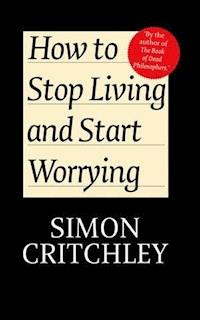
The question of how to lead a happy and meaningful life has been at the heart of philosophical debate since time immemorial. Today, however, these questions seem to be addressed not by philosophers but self-help gurus, who frantically champion the individual's quest for self-expression and self-realization; the desire to become authentic.
Against these new age sophistries, How to Stop Living and Start Worrying tackles the question of 'how to live' by forcing us to explore our troubling relationship with death. For Critchley, philosophy begins with the question of finitude and with his understanding of a key classical theme - that to philosophize is to learn how to die. Learning how to accept both our own and others' mortality as a part of life also raises the question of how to love. Critchley argues that the act of love requires us to give up something of ourselves, to lose control so as to be open to the demands of love. We will never be equal to this demand and so we are brought face to face with our own limitations - one form of which is what Critchley calls our 'originary inauthenticity'. By scrutinizing the very nature of humour, Critchley explores what we need to laugh at ourselves and presents the need to confront the inescapable ridiculousness of life.
Reflecting on the work of over 20 years, this book provides a unique, witty and erudite introduction to the thought of Simon Critchley. It includes a revealing biographical conversation with Critchley and a fascinating debate with the critically acclaimed novelist Tom McCarthy about the nature of authenticity. Taken together the conversations give an intimate portrait of one of the most lucid, provocative and engaging philosophers writing today.
Sie lesen das E-Book in den Legimi-Apps auf:
Seitenzahl: 223
Veröffentlichungsjahr: 2013
Ähnliche


















How to Stop Living and Start Worrying
How to Stop Living and Start Worrying
Conversations with Carl Cederström
Simon Critchley
polity
Copyright © Simon Critchley & Carl Cederström 2010
The right of Simon Critchley & Carl Cederström to be identified as Authors of this Work has been asserted in accordance with the UK Copyright, Designs and Patents Act 1988.
First published in 2010 by Polity Press
Polity Press
65 Bridge Street
Cambridge CB2 1UR, UK
Polity Press
350 Main Street
Malden, MA 02148, USA
All rights reserved. Except for the quotation of short passages for the purpose of criticism and review, no part of this publication may be reproduced, stored in a retrieval system, or transmitted, in any form or by any means, electronic, mechanical, photocopying, recording or otherwise, without the prior permission of the publisher.
ISBN-13: 978-0-7456-5959-6
A catalogue record for this book is available from the British Library.
Typeset in 12 on 14 pt Bembo by Servis Filmsetting Ltd, Stockport, Cheshire.Printed and bound in Great Britain by MPG Books Group Limited, Bodmin, Cornwall.
The publisher has used its best endeavours to ensure that the URLs for external websites referred to in this book are correct and active at the time of going to press. However, the publisher has no responsibility for the websites and can make no guarantee that a site will remain live or that the content is or will remain appropriate.
Every effort has been made to trace all copyright holders, but if any have been inadvertently overlooked the publisher will be pleased to include any necessary credits in any subsequent reprint or edition.
For further information on Polity, visit our website: www.politybooks.com
Introduction
1 Life
2 Philosophy
3 Death
4 Love
5 Humour
6 Authenticity
Bibliography
Index
The conversations offered here provide an introduction and overview to the thought of Simon Critchley, one of the most influential, provocative, engaging, creative and witty philosophers of our time. In addition to discussions of the nature and tasks of philosophy, Critchley presents the reader with haunting meditations on life, death, love, humour and authenticity. All these miscellaneous subjects are treated in a reckless spirit of candour and shot through with a dark and uncompromising humour. They offer a relentlessly critical diagnosis of our time, but also a uniquely fun and easy entry into philosophy, even for those who otherwise find philosophy an arcane practice.
Simon Critchley is presently Chair and Professor of Philosophy at the New School for Social Research in New York. But his role as philosopher goes far beyond the boundaries of the university. He frequently writes for the New York Times and the Guardian, and his strenuous engagement with anarchism, the politics of resistance, social movements and experimental art practice has turned him into a spokesman for the Seattle generation, alongside Alain Badiou, Michael Hardt, Antonio Negri and Slavoj iek. The regrettable side-effect of this engagement, Critchley explains, is that that ‘one ineluctably becomes a brand’. But Critchley seems resigned to this fate. Philosophy is not, in his words, ‘a solely academic or professional activity’, but an activity that involves ‘exposure and risk’.
To summarize a philosopher, such as Critchley, whose work constantly moves in various and unexpected directions, is a fraught endeavour. At best, it would involve an open invitation. At worst, it would turn a thinker into a set of stereotypes and slogans: a commodity. As will become clear from these conversations, Critchley is neither a commodity nor a brand. His work cannot be reduced to one single line of thought. As he explains: ‘I devoutly hope that everything I do and say doesn’t add up.’
With that caveat in mind, it can be said that Critchley’s work falls squarely into the Continental tradition in philosophy. Combining close readings of Rousseau, Heidegger, Derrida, Levinas and Blanchot with accessible accounts of humour and contemporary forms of political resistance, he offers a fascinating and lively account of philosophy and the history of philosophy. Relentlessly, he has moved from subject to subject, including the intimate and complex relationship between philosophy and poetry, the problem of nihilism and humour, the relation between ethics and politics, and psychoanalysis. And what defines his approach, whether the theme is death or laughter, is that it fearlessly follows a train of thought even when it leads into morally unsafe territories. He explains: ‘I sometimes follow a line simply because it interests me’, and adds: ‘There’s no morality in writing.’
Today, philosophy is often erroneously regarded as a solipsistic activity produced by a haughty, self-professed intelligentsia that remains out of touch with the culture at large. (And there are, undeniably, circles working hard to verify that prejudice by dispassionately, and at great length, discussing things with no cultural relevance.) However, what you find in the work of Critchley is the very opposite of this tendency. Following Hegel’s definition of philosophy as ‘its own time comprehended in thought’, he writes with a constant eye on the present, whether the subject is social movements, popular culture, or Barack Obama.
What makes these social and political analyses especially engaging is that Critchley’s personal views come to the fore. He openly applauds the subversive potential of groups like Ya Basta and the Invisible Committee, he celebrates the Marx Brothers and he looks upon the self-help movement with healthy contempt. But however ruthless he might be towards others, he always saves the most scathing mockery for himself.
This self-critical wit comes forth in many forms. We find it on a personal level, when Critchley describes how he is racked with self-doubt in his professional role as a philosopher and teacher. But more importantly, we find it in his theoretical writing, especially on humour, where he ardently defends a divided subject that is helplessly inauthentic. From psychoanalysis, Critchley takes the idea of the split subject – or what he calls the ‘dividual’ – which is a subject that lacks the ability to coincide with itself. This same structure or theme is also at the heart of Critchley’s reading of the work of Samuel Beckett. For Critchley, Beckettian subjects are inhabitants of a sinful world in which they can neither live nor die. And yet, they strenuously move on with the courage of self-impotence.
One way to understand the concept of the dividual is in relation to today’s pervasive self-help culture. Against self-help manuals, like the 1940s classic, How to Stop Worrying and Start Living, where we find detailed techniques for controlling ourselves and getting on with our daily routines, this book, How to Stop Living and Start Worrying, offers an alternative approach – namely, that in a world defined by ever-growing inequality, political violence, ecological devastation, war and ethnic conflict, there are good reasons to worry; and in a time where death has become the last great taboo, we should revive the philosophical art of dying well: ars moriendi.
The book consists of six chapters. Chapter 1 contains a biographical description of Critchley’s life: from his early childhood, family background, failures in formal education, the punk scene, through to a serious industrial injury which had huge psychological effects, to the formative years at the University of Essex and finally to life in New York and many other corners of the world.
Critchley’s orientation towards philosophy, which he lays out in chapter 2, is one in which the division between philosophy and culture is rejected. For Critchley, philosophy has a radically ‘local character’ and ‘must form part of the life of a culture’. Philosophy cannot, therefore, be conceived of as a merely professional or academic activity, but a practice that aims to challenge the status quo of the contemporary sociopolitical situation. This means – and here Critchley turns to Husserl and Heidegger – that the role of the philosopher is to generate ‘genealogies which produce crises’. The worst possible situation for a philosopher occurs when a crisis is not recognized. For in such a situation, Critchley argues, ‘human beings sink to the level of happy cattle, a sort of bovine contentment that is systematically confused with happiness’.
In chapter 3, which is concerned with the question of death, Critchley begins with Heidegger’s claim that death is the ‘possibility of impossibility’. For Heidegger, the question of death is a question of my death. This is to say that no one can be a substitute for my own death. Critchley turns against this argument, claiming that death comes into life through the death of others. To make this argument, he draws on Blanchot and Levinas, for whom death is the ‘impossibility of possibility’. This idea that death is no longer a possibility for the subject is explored in greater detail through the dramas of Ibsen, Racine’s Phaedra and the work of Beckett. We also find, in this chapter, a long commentary on his bestselling book, The Book of Dead Philosophers (2009), which is motivated by Montaigne’s well-known line, ‘to philosophize is to learn how to die’. While defending the ideal of the philosophical death (up to a certain point), Critchley describes how he has become increasingly sceptical towards its currency.
A question that has run through Critchley’s work for a long time, but of which he has remained surprisingly silent until now, is the question of love. In chapter 4, Critchley paints a captivating picture of love by turning to medieval mysticism, including the movement of the free spirit and the fascinating figure of Marguerite Porete, a Beguine mystic who was burned at the stake in 1310 in Paris. For Porete, love is a question that concerns the love of god. In her dramatic language, she says that ‘one must hew and hack away at oneself in order to make a space that is large enough for love to enter’. Following Porete, and with a nod to the poet Anne Carson, Critchley suggests that ‘love is an act of absolute spiritual daring that eviscerates the old self in order that something new can come into being’. By the end of the chapter, these thoughts are discussed in relation to masochism, possession and female and male sexuality.
Chapter 5 lays out Critchley’s theory of humour, which is defined by its ability to change the situation in which we find ourselves: jokes ‘tear holes in our usual views of the empirical world’. They allow us to see things in a different light, as in Freud’s example, which describes ‘a condemned man who, on the morning of his execution, leaves his cell, walks out into the courtyard, sees the gallows ahead of him, sees his fate, looks up at the sky and says: “well, the week’s beginning nicely”’. The lesson of this joke is that humour allows us to look upon ourselves, from outside of ourselves, and find ourselves inescapably ridiculous. And this, Critchley argues, is what comic acknowledgement comes down to. The comic subject accepts finitude as a brute fact, but, like the characters in Beckett, keeps moving. Linking comic subjectivity to ethics, Critchley takes this argument to another level, arguing for an ethical subjectivity based on the experience of conscience.
One of the distinctive features of Critchley’s work is his interest in collaboration, as is evidenced by his work with the French artist Philippe Parreno and the psychoanalyst Jamieson Webster. The final chapter – chapter 6 – presents a three-way conversation to include Critchley’s long-time collaborator Tom McCarthy, the novelist of, among other books, Remainder and Men in Space. Over the past decade, they have written a number of texts and declarations on the relationship between literature and philosophy. However, it is predominantly through the International Necronautical Society (INS) that their collaboration has centred. The INS began as a conceptual art project but has now grown into a semi-fictitious organization, where McCarthy functions as General Secretary and Critchley as Chief Philosopher. In form, it is highly indebted to the historical avant-garde: the futurists and the surrealists all the way up to the situationists. But what separates the INS from these other movements is that it fetishizes, not technology – as the futurists do – but death. As described in McCarthy’s first manifesto: ‘death is a type of space, which we intend to map, enter, colonise and, eventually, inhabit.’ In our conversation, McCarthy explains how, for him, the ultimate question concerns the subject, and the subject’s relationship to death. Rather than defending tragic subjectivity, which, in his words, ‘pits the self against death in a way that produces authenticity’, he defends comic subjectivity, which concerns ‘the inability to be oneself, and to become what one wants to be’. Apart from these themes – which mainly revolve around the emergence of the INS and their engagement with philosophy and literature – the conversations also include an assault on neuroscience, post-humanism and what both Critchley and McCarthy see as a regrettable obsession with the future. As Critchley, puzzlingly, put it: ‘The future is the enemy of radical thought. It prevents interesting thinking. It’s reactionary.’
The idea for this book came out of a television series, broadcasted on Swedish television’s TV8, in early 2009. Over four episodes, Critchley and I, together with three invited guests, discussed the nature of philosophy; death; poetry and philosophy; and the relation between science and religion. This book has given us the much-desired opportunity to extend those discussions.
Finally, I would like to thank Emma Hutchinson, John Thompson, Todd Kesselman and Peter Fleming for indispensable editorial work.
Carl Cederström
CARL CEDERSTRÖM: This interview will focus on your life and how you got into philosophy. But before that I would like to ask a more general question about the relation between philosophy and biography. What can you say about this connection?
Lesen Sie weiter in der vollständigen Ausgabe!
Lesen Sie weiter in der vollständigen Ausgabe!
Lesen Sie weiter in der vollständigen Ausgabe!
Lesen Sie weiter in der vollständigen Ausgabe!
Lesen Sie weiter in der vollständigen Ausgabe!
Lesen Sie weiter in der vollständigen Ausgabe!
Lesen Sie weiter in der vollständigen Ausgabe!




