


7,19 €
Mehr erfahren.
- Herausgeber: Fitzcarraldo Editions
- Kategorie: Geisteswissenschaft
- Sprache: Englisch
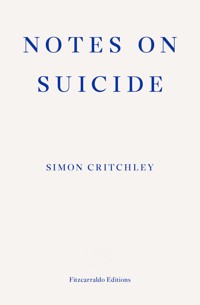
Suicide is everywhere. It haunts history and current events. It haunts our own networks of friends and family. The spectre of suicide looms large, but the topic is taboo because any meaningful discussion must at the very least consider that the answer to the question – 'is life worth living?' – might not be an emphatic yes; it might even be a stern no. Through a sweeping historical overview of suicide, a moving literary survey of famous suicide notes, and a psychological analysis of himself, Simon Critchley offers us an insight into what it means to possess the all too human gift and curse of being of being able to choose life or death. Five years after its initial publication, this revised edition of Notes on Suicide includes a new preface by the author addressing shifts in the discourse surrounding suicide, particularly in relation to social media.
Das E-Book können Sie in Legimi-Apps oder einer beliebigen App lesen, die das folgende Format unterstützen:
Veröffentlichungsjahr: 2020
Ähnliche


















‘No one ever lacks a good reason for suicide, wrote Cesare Pavese. With passionate lucidity and philosophical intelligence, Simon Critchley explores what these reasons might be, bracketing simple moral judgement and trying to fight his way past the social, psychical and existential blockages that inhibit us whenever we try to think about this ever-baffling issue.’
— Lars Iyer, author of Wittgenstein Jr
‘We must talk about suicide without shame or sanctimony. This book is a good place to start.’
— Max Liu, Independent
‘This intense book is an instance of thought born in the hour of anguish, which eloquently makes the case for suicide not as an act to be pitilessly condemned, but a possibility for which any of us might be thankful.’
— Rob Doyle, Irish Times
‘It is a willingness to accommodate ambiguity that gives Notes on Suicide its quiet moral authority; Critchley is generous without being platitudinous, rigorous but not overbearing. Remarkably for a disquisition on self-killing, one comes away from it feeling curiously chipper.’
— Houman Barekat, Vol. 1 Brooklyn
‘Notes on Suicide examines the sociological and literary history of the act, before performing an unflinching self-examination of Critchley’s own relationship with the choice between life and death.’
— Rosie Clarke, Music & Literature
‘Notes on Suicide shows us not how to understand, but how to realise what we don’t know, can never know, and what it is to deal with that awareness.’
— Cal Revely-Calder, 3:AM
NOTES ON SUICIDE
SIMON CRITCHLEY
Followed by OF SUICIDE by DAVID HUME
Contents
Preface
When I wrote Notes on Suicide, my aim was simple: to try and open up a space for thinking about suicide as a free act; and to expand, as far as I could, the vocabulary for such thinking.
Suicide is a topic that invites strong, indeed panicked and confused, reactions. So, in order to find leeway for the kind of space I was imagining, some ground had to be cleared. I had become increasingly frustrated by the limited and predictable ways in which suicide and suicides were discussed, both in the news and public debate, but also among friends and acquaintances. It seemed as if we suffered from a genuine impoverishment of language and compassionately minded clear thinking on the topic. Even worse, my own ruminations on suicide were mired in the same muddiness and limitation. I decided to try and do something about it in the way I know best, in writing.
I had become fascinated in why it was that many people saw suicide as somehow wrong, as the expression of a moral failure, a life somehow gone awry, and which gave rise to the most peculiar and powerful reactions of upset, outrage, voluble gossip or, quite often and oddly, stubborn silence. I began to look into the historic reasons that lie behind the prohibition against suicide. As I read about it more carefully, I became increasingly convinced that the moral and legal framing of the prohibition against suicide had its roots in the idea of suicide as a sin. This idea can be traced to medieval Christian theology and metaphysics, specifically the claim that life is a gift from God which grants us the right of use, but not the right of governance or dominion over our lives. To kill oneself is to assume a power over life that 10does not lie with us, but only with the deity, however the latter might be conceived. Although arguably only a small fraction of people still holds such Christian metaphysics to be true, it nonetheless has enduring effects on our moral and legal thinking about suicide, giving rise to extreme and confused reactions.
Once the theological history of the prohibition against suicide has been better understood and unravelled, it becomes easier to show how the secular discussion of suicide in terms of rights and duties is often misplaced and conceptually incoherent. This is what I try and do in the longish second part of the essay. But I also criticize the libertarian argument for suicide, which turns on questionable assumptions about rationality and autonomy. I am deeply opposed to any argument that the sovereignty of God, monarch, country or community should be the basis for a prohibition of suicide. I am also suspicious of claims to self-sovereignty that support any right to suicide as a simple rational choice or self-evident civic liberty. So much for the polemical part of the essay.
I then turn to suicide notes and try to examine them, with deliberate coldness, as a distinct and compelling literary genre. Not all suicides leave notes – many don’t – and their reliability can be easily questioned, given that they often follow quite predictable, indeed stereotypical rhetorical patterns. And yet they are crucial evidence for the extreme mental distress and incontrovertible tunnel-vision experienced by the suicidally depressed. They also exercise a peculiar fascination on the living and have an almost pornographic appeal that draws readers in, myself included. As Kay Redfield Jamison writes, ‘The particulars of suicide hook our imagination in a dark way.’ This is hardly wholesome, but it is a phenomenon that merits careful attention. For me, the most 11powerful feature of suicide notes is the way in which they make manifest the extraordinary psychical ambivalence of depressive isolation and extreme exhibitionism of masochism and sadism, and, most importantly, hatred and love. In suicide notes, the most intense self-hatred gives rise to the most radical exclamations of love.
From there, I look into suicide as a vehicle of revenge, as a way of giving voice to persecutory fantasies of victimization and narcissistic self-justification. Here we confront the disturbing phenomenon of homicide-suicide in cases like the Sandy Hook Elementary School shooting of 2012 and, more particularly the case of Elliot Rodger, who killed himself after killing six people in California in 2014, leaving behind a lengthy manifesto and a disturbing video suicide note. Since the time of writing, Rodger has become a hero of the INCEL (involuntary celibate) movement, an online subculture of often reactionary and consistently misogynistic young men, which has been behind a significant number of killings since 2014.
In the final part of the essay, I consider the following question: what if suicide is not the unasked-for consequence of a psychopathological condition with a possibly organic basis, but is chosen as a free act, as an end in itself? How might we think about suicide when there is no apparent motivating cause? If such a thing is possible – and it clearly is – then it leads everyone to ask themselves the question: why live? Here I very consciously move into the area of existential analysis, which is perhaps not surprising since I think of myself as an existential phenomenologist, and work through a number of examples and texts by authors such as Edouard Levé, Albert Camus and Jean Améry. I try to think through the question of why it is that suicide seems so morally 12rebarbative, and face up to what Levé calls its scandalous beauty. Homo sapiens is distinguished by the capacity for self-slaughter, which is perhaps the price that we pay for self-consciousness, in particular the forms of acute self-consciousness characteristic of some writers, artists and scientists. It is essential to our sense of ourselves, others and the world that we face up to the experience of finitude that the question of suicide raises.
At every single moment we live and breathe, the arms for our self-destruction lie in our hands. Not that I am counselling in any way that we take up those arms against ourselves. On the contrary. I finish the essay by leaning on the wonderfully comic pessimism of Cioran, namely his notion that the problem with the suicidally depressed is that they are too optimistic. Nothing will be saved by taking our own lives, and a belief in suicide as the only way out derives from an arrogant over-estimation of our capacity for salvation through self-destruction. Therefore, why not stay awhile and enjoy the tender indifference of the world that holds itself out for our attention and our seemingly infinite capacity for disappointment? I end the essay with what we might think of as the pessimist’s refutation of suicide, but this is a pessimism of strength, good humour and, hopefully, even high spirits. The question of the meaning of life is the wrong question and I humbly suggest that we stop asking it. Our minds will never stop rummaging through the drawers of self-doubt, self-disgust and self-pity in order to find some piece of forgotten dirty moral laundry. What is important is the ability to get life to stand still in order to look at it tenderly and with care, to cultivate slower forms of attention without renouncing life in some sovereign violent act. One should go on. 13
¶ I do not think that I am necessarily right in my views on suicide, nor do I think that I am particularly well-qualified to give them. What the reader will find in the following essay are impressions based on observation and reading. Nothing more. Those looking for real expertise in the psychopathology and neurobiology of suicidal depression can look elsewhere, for example in the writings of Redfield Jamison, such as the Night Falls Fast. Rather, this essay is what I wrote after I took myself off to the Brudenell Hotel in Aldeburgh on the Suffolk coast in November 2014. In retrospect, this seems like a very odd thing to do (in fact, writing during the Covid-19 summer in New York, going anywhere at the moment seems like an odd thing to do). The location now also seems more than a little self-dramatizing, with all those references to the vast North Sea. All I can say in my defence is that it didn’t at the time. It felt like a logical decision to have made by someone who was struggling with what we might call the pains of love and a feeling of life’s disintegration.




