


4,00 €
Mehr erfahren.
- Herausgeber: tredition
- Kategorie: Lebensstil
- Sprache: Englisch
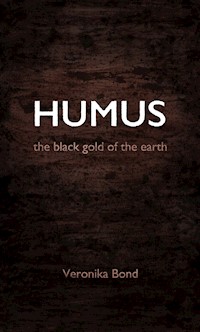
Humus is the most precious resource on earth. Our survival depends on it, and it is running out. Dramatic losses of fertile soils are caused mostly by human activities. But humans can also help regenerate humus. 'HUMUS, the black gold of the earth' is an invitation to become EarthKeepers. If we want to take care of Mother Earth, then we must get to know her better. What makes her come alive? What kind of food does the soil need? In what environment can the soil-population grow and thrive? These are some of the questions explored in this book. Everybody can do something to take care of our soils and keep the earth alive. It is easier than you might think.
Das E-Book können Sie in Legimi-Apps oder einer beliebigen App lesen, die das folgende Format unterstützen:
Veröffentlichungsjahr: 2018
Ähnliche















HUMUS
deep soil for life
Veronika Bond
HUMUS
the black gold of the earth
a book about
an endangered species
and things we can do to save it
Title: HUMUS
Subtitle: the black gold of the earth
Author: Veronika Bond
Editor: Joshua Bond
Cover design: Savannah Theis
Publisher: Tredition
Website: www.thehumusproject.org
© 2018 Veronika Bond
All rights reserved. No part of this book may be reproduced in any form or by any means, electronic or mechanical, including photocopying, recording, or by any information storage and retrieval system, without permission in writing from the author.
The material presented in this book is intended for educational purposes only. No expressed or implied guarantee of the effects of the use of the recommendations can be given nor liability taken by the author.
978-3-7469-2067-2 (Paperback)
978-3-7469-2068-9 (Hardcover)
978-3-7469-2069-6 (e-Book)
to the soil mother
and to my mother
Humus is the real black gold.
~ Friedensreich Hundertwasser ~
Contents
Prologue
Introduction
Chapter 1: The Earth Kingdom
A brief history of humus
Humus gets mixed up
Topsoil
Compost
Humus
The very alive
Chapter 2: The Soil Mother
Mother soil
Humus gives fertility
Humus gives protection
Humus gives balance
Humus gives stability
Humus gives energy
Humus gives food
Humus gives health
Humus gives life
Chapter 3: The Creation of Humus
The edaphon
Humus: a slow act of creation
Organic humus by observation
Biodynamic humus by inspiration
The right conditions for humification
Chapter 4: The Extinction of Humus
The rapid loss of humus
Natural and manmade erosion
The feeding habits of plants
Destruction and exploitation
Domino effects
The real value of humus
Chapter 5: Composting as an Art Form
The creativity of humus
Understanding compost as a medium
Experimenting with compost
Art is more than technique
Growing your own mixed media
The greatest of all crafts
Chapter 6: The Sacred Worm
Reverence for the earthworm
Earthworms as soil builders
Breeding earthworms
The gold standard of humus
An entourage of loyal supporters
Chapter 7: Clay, Rock, and Lava
Tools for earthworms
Nutrients for plants
Medicine for the forest
Food for the soil
Sustenance for life
Detox for the garden
Chapter 8: Schools of Composting
Many ways, one journey
Slow compost
Classic organic compost
Container compost
Biodynamic compost
Permaculture compost
Surface compost
Bed compost
Humus storage ditches
Fast track compost
Worm compost
Terra Preta compost
Bokashi compost
The Golden Rule of composting
Chapter 9: The Wholeness of Humus
The colloidal state
Humus as a hologram
The way of love
Paradise Islands
About the Author
Appendix
1 - Creating Humus
2 - Food for the Edaphon
3 - Compost Activators
4 - Maye Bruce’s Homoeopathic Preparation
Glossary
Bibliography
Links
Prologue
If the soil is ill, all living beings suffer. The remedy must start there.
~ Maye Bruce ~
In October 2017 a firestorm swept across Central Portugal. Approximately two thirds of the area was burned, most of it in one single night. Within a few hours, miles and miles of countryside, forests, houses, people, animals, livestock, small holdings, gardens, livelihoods were consumed by flames.
How could that happen? Apparently ‘500 fires started on Sunday night independently of each other and got out of control because of Hurricane Ophelia coming over the Atlantic’. But 500 fires don’t start spontaneously like that, not even in soaring temperatures at the height of summer.
Was it human negligence? Was it arson? Are the eucalyptus plantations in this area the root cause of theproblem? Many questions remain open.
Then the second wave of questions came: Will this happen again? Can we do anything to stop this and protect ourselves? What, if anything, can we do to prevent this from happening in the future?
The morning after the firestorm I built a new compost heap. The air was filled with smoke and ashes. In the woodlands next to our house and across the road small ‘volcanoes’ were still smouldering, spewing fumes and flames. Arranging organic materials from piles which had miraculously survived the fire was the most comforting activity of the moment.
They say, the soil is more fertile after a fire. But, what if there is no soil left? We see black pines and olive trees stripped bare, collapsed on top of the skeleton of rocks, the naked bones of the earth mother exposed.
Two months after the fateful night I read a headline in The Guardian — Mass starvation is humanity’s fate if we keep flogging the land to death. In the article, George Monbiot points out that “the trouble begins where everything begins: with soil. The UN’s famous projection that, at current rates of soil loss, the world has 60 years of harvests left, appears to be supported by a new set of figures.”
In other words, when ‘the world has no harvests left’ there will be no fertile soil, no crops, no food, no fodder, no animals, no trees, no materials to burn. The earth will be ‘burnt out’.
Fires of increasing ferocity and voracity are flaring up all over the world. Think of Australia, California, Italy, Spain, Tasmania… These are not ‘natural wildfires’. They contribute to the loss of fertile soil in many ways. Other causes for soil erosion are the use of chemical fertilisers and pesticides, deep ploughing, deforestation, overgrazing and last but not least our personal food habits.
10 years ago my husband and I bought a Quinta in Portugal, partly because we wanted to have a go at growing our own food. In the night of the firestorm, many lives were changed. For us, it catalysed a fundamental change of perception. An old key question had been: How can we grow more food during more months of the year?
From the ashes of disaster a more burning question has arisen: How can we help our soil mother recover and heal her suffering?
This book is written in response to that new question. The soil is the mother of all living creatures. The olive trees, sheep, farms, humans who lost their lives in the fire and those who survived that tragic night — we are all her children. What can we do to make sure our soil doesn’t get reduced to ashes — or dust — as the case may be? Our very existence depends on finding answers to this question, fast.
The Buddhists say, ‘all suffering can be healed through understanding.’ This book is a contribution towards a better understanding of soil as a living organism. An improved understanding of another living being is the foundation for any healthy relationship. ‘HUMUS, the black gold of the earth’ is primarily about earth, soil, compost and of course humus, the lifeblood of the living soil. Paraphrasing Amy Stewart, ‘there is more to humus than what we can see, much more. To know the soil mother for what she is, to find her heartbeat, to expose her soul, you have to go underground where she lives and breathes.’
‘HUMUS’ is also about humans as guardians of the soil. Humans are intimately related to humus in more ways than most of us currently realise. Researching materials for this book, following the trails of many pioneers and visionaries who knew about this inseparable link, has been a true eye-opener and an inspiration.
I don’t have all the answers to the questions listed above. I did, however, find valuable information from sources which are not easily accessible to many readers. Several ‘humus-pioneers’ from German speaking countries (published 50-100 years ago) have not been translated into English. Several important ecologists from English speaking countries (also writing in that era) have almost been forgotten. To keep their voices alive is one of the aims of this book.
In 2015 the FAO (the United Nations Food and Agriculture Organisation) declared that, “the main problem humanity is currently facing is not global warming, extinction of species or any other environmental crisis – the main problem we will have to face is the degradation of our soils. The world population continues to increase while we destroy more and more topsoil. If this is allowed to continue there won’t be enough fertile soil left to feed a growing world population.”
Can you imagine the Earth 60 years from 2015, with no soil left to grow any food at all? I like to imagine sparks of inspiration flying across the humus-sphere, lighting cozy fires in winter all over the Earth and ensuring that our grandchildren and greatgrandchildren can still cook a healthy, nutritious soup in 2075 and beyond.
Veronika Bond, Portugal, January 2018
Introduction
Put your faith in the two inches of humus, that will build under the trees, every thousand years.
~ Wendell Berry ~
It’s not petroleum, nor a rare mineral or a noble metal. The most precious substance in the earth is humus. Humus gives life to the earth. It keeps the soil healthy. Good humus produces strong healthy plants, and healthy plants provide food for healthy animals and humans.
What exactly is humus?
Why is it so precious?
How is it made?
How is it lost?
What is the secret of healthy humus?
These are some of the questions we explore in this book. Of course, almost every gardening book has a section about humus. Do we need another book on such a basic topic?
Gardeners and farmers usually describe humus from a material perspective. They talk about its composition: well-rotted plants and animal manure, rich in minerals and trace elements, with lots of microorganisms in it etc. Such a description gives the impression that humus is mostly ‘dead matter’, inhabited by relatively insignificant tiny creatures. This idea is confirmed when contemporary soil scientists call humus ‘the very dead’.
Not everybody sees it that way. Lady Eve Balfour, the founder of the British Soil Association, was convinced that humus is “far from dead…It is still organic matter, in the transition stage between one form of life and another.” And Sir Albert Howard, founder of the organic movement, taught that ‘humus is alive, and it makes the soil alive.’
Is it very dead, or very alive? — such fundamental disagreements can only be explained by radically different perspectives. Some people look at humus through the lens of a microscope and try to grasp it ‘objectively’ by identifying its chemical and physical components. Others experience its miraculous life-giving and fertilising powers and understand the crucial part humus plays in the life-cycles of the Earth.
This book explores humus as a living organism, a vital organ of a living earth. Humus plays an essential role in the health of our soil and all life on our planet. Many people concerned about their health want to eat ‘healthy organic food’ and drink ‘pure healthy water’. Not so many think about the key role of healthy soil.
We are so used to defining humus as a material substance — an ‘end product of the decomposition process of plant and animal matter’ — that seeing it as a ‘living organism’ is not easy. On the other hand, if we define humans in terms of their material composition — bones and muscles, organs and nervous tissue, blood and lymphatic fluid etc. all enclosed in a bag of skin, partially covered in hair — we can readily accept that this clearly doesn’t capture the essence of humanness. A living organism is far more than the sum of its parts. A description of it in purely chemical elements, physical structure and physiological functions can never do it justice. This is partly because our language often lacks the right words to convey the difference between aliveness and deadness.
In this book, we want to get to know live humus a little better. We look at its functions as a ‘soil-organism’ and the effects it has on plants, animals and humans. We want to find out why it is important for our survival, and how we can protect it and ensure its survival. We’ll meet a number of ‘composting artists’ who have dedicated their lives to the regeneration of the soil and know a thing or two about how to stimulate the creation of humus. We shall discover that humus is not ‘very dead’ — at least not yet…
Most importantly, we want to get to know humus as a living being, or more accurately, as a species of living creatures. Humuses (plural of humus) can live for millions of years. They can be very young, mature, or ancient. They occur in all climate zones, and their geological background is quite diverse. What makes us assume that an ancient humus of a Russian grassland, a medieval humus in a German monastery garden and a ‘young’ 70-year-old humus on a biodynamic farm in Australia are ‘the same beast’? Depending on their maturity, nourishment and living conditions, humuses show distinctive personalities and behaviour. They vary in appearance, stability, resilience and fertility.
Humus should be considered an endangered species. According to the Global Agriculture Report, “More than 24 billion tons of soil are lost each year through erosion — that is more than 3 tons of soil per inhabitant of the planet!” It is true, the soil currently erodes much faster than it regenerates itself. Moreover, the authors of this report call fertile soil ‘our most significant non-renewable geo-resource.’ This means we should be very concerned about the disappearance of the soil altogether. It almost sounds as if a major ‘soil crisis’ is inevitable.
However, ‘non-renewable’ can be a misleading description. Our ancestors knew how to regenerate and renew the soil. People have done this for thousands of years all over the world. If a major soil crisis is looming, everyone should know what they can do to promote the renewal of our most indispensable, most precious geo-resource! In chapter 4




