


Erhalten Sie Zugang zu diesem und mehr als 300000 Büchern ab EUR 5,99 monatlich.
- Herausgeber: Kamera Books
- Kategorie: Geisteswissenschaft
- Sprache: Englisch
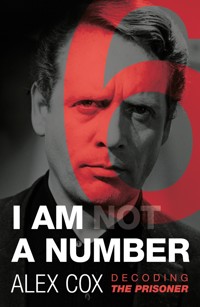
The enormously puzzling TV series THE PRISONER has developed a rapt cult following (author Alex Cox watched all the episodes on their first broadcast, at the ripe old age of 13), and has often been described as 'surreal' or 'Kafkaesque.' In his new book I AM (NOT) A NUMBER, Cox takes an opposing view. While the series has surreal elements, he believes it provides the answers to all the questions which have engrossed and confounded viewers: who is Number 6? Who runs The Village? Who - or what - is Number 1? According to Cox, the key to understanding THE PRISONER is to view the series in the order in which the episodes were made - not in the re-arranged order of the UK or US television screenings. In this book he does exactly that, and provides an entirely original and controversial 'explanation' for what is perhaps the best, the most original, and certainly the most perplexing, TV series of all time.
Sie lesen das E-Book in den Legimi-Apps auf:
Seitenzahl: 201
Veröffentlichungsjahr: 2017
Das E-Book (TTS) können Sie hören im Abo „Legimi Premium” in Legimi-Apps auf:
Ähnliche



















I Am (Not) A Number
The enormously puzzling TV series The Prisoner has developed a rapt cult following, and has often been described as ‘surreal’ or ‘kafkaesque’
Alex Cox watched all the episodes of The Prisoner on their first broadcast, at the ripe old age of thirteen. In I Am (Not) A Number, Cox believes he provides the answers to all the questions which have engrossed and confounded viewers including:
• Who is Number 6?
• Who runs The Village?
• Who – or what – is Number 1?
According to Cox, the key to understanding The Prisoner is to view the series in the order in which the episodes were made – and not in the re-arranged order of the UK or US television screenings. In this book he provides an innovative and controversial ‘explanation’ for what is perhaps the best, the most original, and certainly the most perplexing, TV series of all time.
About the author
Maverick British filmmaker ALEX COX is responsible for directing a host of acclaimed films from Sleep Is for Sissies, Repo Man, Sid & Nancy, Straight to Hell, Walker and Highway Patrolman to Death and the Compass, Three Businessmen, Revengers Tragedy, Searchers 2.0, Bill the Galactic Hero and Tombstone Rashomon. From 1987 to 1994, he presented the acclaimed BBC TV series Moviedrome, bringing unknown or forgotten films to new audiences. He’s is also the author of 10,000 Ways to Die, The President and Provocateur, Alex Cox’s Introduction to Film, and X Films: True Confessions of a Radical Filmmaker. He has written on the subject of film for publications including Sight and Sound, The Guardian, The Independent and Film Comment.
for Pablo
Introduction
When The Prisoner was first broadcast in 1967 and 1968 I thought it was the best thing I had ever seen on TV. I was barely a teenager, watched quite a lot of telly, and had never seen the like. Fifty years later, having re-watched all the episodes, repeatedly, I feel exactly the same way. We’re often told today that episodic television has replaced the cinema as ‘intellectual’ narrative fare. I don’t think this is true. While mainstream cinema has never been less intellectually challenging, modern episodic TV is in its own unique ways equally dull. More happens in two hours of McCabe & Mrs. Miller than in an entire season of Deadwood. Contemporary episodic TV takes one idea and runs very slowly with it. Supporting characters who would be given one line of dialogue in a feature film have whole episodes and subplots devoted to them. And series never end - instead each season ‘concludes’ with a bunch of cliffhangers and unresolved characters - because the goal is to rack up the episodes. TV is bought and sold in bulk, and 100 episodes is the goal.
The Prisoner could not have been more different. The first season had thirteen episodes, each discrete unto itself. Every episode was intellectually challenging, disturbing, and remarkably prescient. The hero and a couple of apparent villains were the only recurring characters. The early, standalone, episodes presented dire threats to The Prisoner. In how many other shows was the protagonist threatened with a ‘leucotomy’? Who even knew what a ‘leucotomy’ was? But, as the series proceeded, the threats receded, and The Prisoner was able to game The Village and influence events there. Blows were frequently exchanged, but until the final episodes guns were never seen. An aura of enforced politeness and cleanliness of body and mind prevailed. There seemed no escape from the pretty seaside resort town known as The Village – but who ran it? Who was The Prisoner? What information did he have? Who were his captors, and why were they so desperate to break him? And who was Number 1?
In this book, I’ll try to answer these questions. I believe that there are answers to be found, that they are contained in the 17 episodes of The Prisoner, in its scripts, in its story notes, and nowhere else. So, I’m not going to consider Danger Man, the TV series which made Patrick McGoohan a star, nor his subsequent work as an actor, nor – for the most part – the enigmatic and elusive interviews he gave regarding the series. McGoohan remarked that everything one needed to know was contained within those 17 episodes: asking for additional information would have meant that the series had failed. His point is an excellent one. McGoohan’s series is free-standing, concrete, intelligent, and can be interpreted on its own terms, on the basis of what it contains.
The Prisoner is a complex whole, rooted in the Cold War, but even more deeply embedded in its Britishness (I almost wrote Englishness, since the series is so London-centric, but that would not do when its most memorable location was Portmeirion, in Wales). McGoohan, born in New York, could be American, English, or Irish as it suited him. But the clipped, public-school tones of Number 6 are the hallmark of a certain type of Englishman, and it is that character, and his relationship with his world, which I will explore here.
The Cold War was characterised by spying, surveillance, propaganda, and the amassing of vast nuclear arsenals. All are featured here. In the 1960s, Britain was in the process of giving up what remained of her Empire, and becoming increasingly dependent, militarily and economically, on the United States. While refusing to commit troops in Vietnam, Britain remained a dedicated member of NATO, the Americans’ nuclear-armed alliance against Russia – the other big player in the Cold War. In the west, Russia was always our perceived antagonist, together with its Eastern European satellites, and the Asian communist countries, principally China. Russia and China actually had very little in common and disagreed on most issues, but in the minds of American war-planners and fiction writers the ‘Iron Curtain’ countries were all the same, both octopus and monolith. So, when the Chinese brainwash American GIs in The Manchurian Candidate, there are Russian advisors present. And when the North Vietnamese keep American GIs prisoner in Rambo, there are Russian advisors lurking behind the tiger cages.
Numerous were the sixties TV shows in which valiant British and American secret agents outsmarted and outgunned their Russian counterparts. Few indeed were shows which suggested that the two sides might be fundamentally alike, and neither worth fighting for. Indeed, there was only one series which raised that issue: The Prisoner. But the series went far beyond secret agent craft, frequently dealing with the perversion of medical science for military and intelligence purposes. It dealt with the state of the art – as it then was – of Mind Control, something which obsessed both CIA and KGB; as we shall see, The Prisoner was both knowledgeable and prescient about this hideous quasi-science.
Patrick McGoohan had been the star of the popular British TV series, Danger Man, which was picked up by the American networks – something all British producers dreamed of. At the end of the third season of Secret Agent (as the Americans knew it), McGoohan approached the TV mogul Lew Grade, and proposed they make a different series together. Grade wanted another season of Danger Man – more than one, ideally – but he also wanted to keep McGoohan on board. He didn’t read treatments or scripts, so, at a six am meeting, McGoohan made him a verbal pitch for the new show.
McGoohan showed Grade photographs of Portmeirion, where several episodes of Danger Man had been filmed. In this picturesque, Italianate Welsh village, he said, he wanted to shoot a series called The Prisoner. We don’t know how exactly McGoohan pitched the show, nor whether he mentioned his collaborator, George Markstein – Danger Man’s most recent story editor. Markstein had told McGoohan of a secret government ‘holiday camp’ in Scotland – run by an entity called the Inter-Services Research Bureau – where defunct or dubious intelligence agents were detained, in comfort, during the Second World War. When he gave interviews in later years, Markstein insisted that The Prisoner was John Drake, McGoohan’s character from Danger Man. According to Markstein, Drake, a spy in the James Bond mould, quit the British secret service and was kidnapped – by one side or the other – so that he could be thoroughly debriefed in an ISRB-type camp. It’s possible McGoohan gave Lew Grade the idea that these were Drake’s further adventures – but in later years he would insist that The Prisoner was not Drake, and that his take on the project was not Markstein’s.
Whatever the pitch contained, it worked. Grade’s company, ITC, would fund a series called The Prisoner, starring McGoohan. It would be produced by McGoohan’s company, Everyman Films, and McGoohan would act as executive producer. Presumably, if the series was successful, ITC would finance a second season. Each episode was given a budget of around £75,000. McGoohan, earning £2,000 a week, was said to be Britain’s highest-paid actor. No doubt reassuring to Grade and ITC, the series would involve a number of key crew from Danger Man: David Tomblin, who had been an AD and 2nd unit director on Danger Man, would be the producer; George Markstein would be the script editor; Brendan Stafford, chosen as DP, had shot all the Danger Man episodes; Jack Shampan, having left Danger Man to work as art director on Modesty Blaise, rejoined McGoohan for The Prisoner; Frank Maher was fight arranger (and double for McGoohan) on both series; Rose Tobias-Shaw, the casting director, goes unmentioned in Prisoner literature, yet her contribution to both series was crucial – she cast 86 episodes of Danger Man, and all The Prisoner episodes. After The Prisoner she embarked on a feature film career which included The Seven-Per-Cent Solution and Equus.
On 3 September 1966, the London-based cast and crew boarded a train at St Pancras station. Their destination was Portmeirion, nine hours away, where all the exteriors of the early episodes were to be filmed. The shoot began on Monday 5 September. Production was logistically complicated as only partial episodes could be shot at Portmeirion. Interiors would be filmed on sets yet to be built at MGM Studios, outside London. One set was The Prisoner’s cottage interior; another was a vast circular space which served as Number 2’s office, the Control Room, the Town Hall council chamber, and other locations. Scenes here often involved rear-projections of Portmeirion exteriors or of The Prisoner’s cottage set; technical considerations like these (and the use of matte shots) dictated the order in which scenes were shot, and meant that no episode would be finished for several months. There were two principal Portmeirion shoots: the first one, involving McGoohan, and a second-unit shoot later in the season, when Frank Maher was used. McGoohan revisited Portmeirion with a mini-unit on subsequent weekends. Other exteriors were shot at the studio outside London, or in the city itself.
The first episode, Arrival, aired in Britain on 29 September 1967 – more than a year later. The first season was still in production. Was the public reaction to the first episodes bad? Had something changed in the relationship of McGoohan and Grade? Even before the first season, thirteen episodes long, was finished, word came down that ITC would not complete the second season – instead, there would be only four more episodes.
Or did it? This has been the ‘official’ version of this tale for many years. But the Unmutual website has unearthed a CBS press release, reported in the Kansas City Star dated 23 October 1966, about their acquisition of The Prisoner, a 17-part series, from ITC. Was this a typo? Was there a seventeen-episode minimum guarantee by ITC? Steven Davies has pointed out that while a ‘prime time’ US season was 13 weeks, a less-prestigious summer season might run to more episodes. Did CBS distrust the series, even while buying it, and hedge their bets by requesting extra episodes? In a script meeting for Living in Harmony, McGoohan told the screenwriter, Ian Rakoff, that he didn’t know how many Prisoner episodes there would ultimately be: it could be 13, 17, or 26. Later, he said he felt seven was the ideal number. Everyman Films had commissioned at least two additional scripts, Don’t Get Yourself Killed, by Gerald Kelsey, and The Outsider, by Moris Farhi, and had prepared synopses for further episodes. Frank Maher, McGoohan’s double, called the 17 cut-off a complete surprise: he and the rest of the crew had been booked, they thought, for 26 shows.
The first, 13-part, season of The Prisoner was shot by the end of October 1967. Production on the last four episodes began the following month. The short second season was all filmed (though not edited) before the end of the year. The best source for when episodes were shot is always the production call sheet. These are more reliable than production schedules, which encompass an entire picture or series and are subject to change. Call sheets are written and distributed the night before the shoot, and – unless there was an unexpected incident or accident – can be relied upon as accurate. (Another reliable resource would be camera reports with scene numbers, but I haven’t seen any of these. Fortunately, some call sheets, together with the series’ scripts, were made available as ‘extras’ on DVD and Blu-ray sets.)
Legend has it that McGoohan wrote the last episode, Fall Out, in 36 hours, and that it was broadcast on British TV only two weeks later. It’s certainly possible the prolific writer/director/producer/actor wrote the screenplay in a fast, creative frenzy; but the shoot itself wasn’t a quick one. Making The Prisoner was a difficult logistical process, and the notion that the last, and most complex, episode could be shot, edited, and delivered in two weeks is an unlikely one. Fortunately, we have the call sheets for Fall Out. These show twelve days of shooting during the month of November 1967, together with scenes from another episode, The Girl Who Was Death. Fall Out was in the can before December 1967 and was broadcast on 1 February 1968. So, there were two months, not two weeks, to get the editing done.
The Prisoner is an extraordinary piece of work: a continuous planning/production/editing process which stretched for almost a year and a half, and produced seventeen remarkable films. It was the product of a big team, an excellent and ever-changing cast, and a dedicated creative core: McGoohan, Markstein, Tomblin, Shampan, and Tobias-Shaw. Markstein was crucial to the early episodes, selecting the writers and giving them the ‘pitch’; increasingly at odds with McGoohan, he quit after the first season. In Markstein’s absence, Tomblin became more important, writing and directing his own episodes. At the outset, McGoohan was intensely involved with almost all production aspects. He wrote and directed, and fired two or three directors on set, taking over their duties. Yet towards the end of the first season, his commitment waned. He was absent for some time, acting in a Hollywood action movie. So one episode – ironically, one of the best – features another actor playing his character. It’s been suggested that McGoohan took the Hollywood job so as to be able to fund the last four episodes. This seems unlikely. ITC owned the series, and was paying for it. Everyman, the production company owned by McGoohan and Tomblin, was making The Prisoner, but wasn’t the financier.
The chapters which follow will deal with each of the episodes. Every episode but one provides the viewer with consistent information – about The Village, about The Prisoner, about his captors and their relationship with London and the Cold War – all of which adds up, I believe, to a complicated but consistent vision, and in the aggregate provides an answer to its persistent questions: who is The Prisoner? Why did he resign? Who or what is Number 1? The wild-card episode is Do Not Forsake Me Oh My Darling, made in McGoohan’s absence, which fundamentally contradicts the other episodes, as we shall see.
‘Questions are a burden to others; answers a prison for oneself’. Signs in the Labour Exchange tell us this in the first episode of The Prisoner. Nevertheless, in the Decoding chapter I’ll try to provide unambiguous answers to the puzzles this extraordinary work of art contains.
Any complex work is open to multiple interpretations: Moby Dick would not be a great novel, nor The Prisoner a great dramatic series, if they didn’t inspire confusion, argument, and impassioned disagreements among their fierce adherents. But we don’t look for the meaning of Moby Dick by reading White Jacket, or an evasive interview Herman Melville gave to Spin magazine. The meaning of the piece is contained within the text, and only there.
For that reason, in the following chapters I’m going to consider the episodes in the order in which they were made. I know this is contrary to the way they’re normally viewed, which tends to follow the British broadcast sequence. But The Prisoner was a creative project which developed as it went along. Of course, much was known about it at the outset – especially by McGoohan. Markstein created a four-page ‘bible’ titled T.V. Series – Working Title – The Prisoner, which sets a template for the conflict and the environment of the whole series. But much more came to be known as the story developed, episode by episode. One of McGoohan’s most notable stage experiences had been playing Starbuck in Orson Welles’ production of Moby Dick – Rehearsed. So the notion of gradually crafting an epic, ambiguous, potentially infuriating work of unique art was not unknown to him.
Certainly The Prisoner aspires to be enigmatic. It appears to reach out for multiple interpretations, just as Moby Dick might seem to do. Many labels can be attached to it, ‘surreal’ or ‘Kafkaesque’ being the most common. This invites the danger that the series will be thought of as having no fixed meaning (other than a vague aspiration to support individuality and ‘freedom’). But appearances can be deceiving, especially when a work like The Prisoner maintains its own conspiracy of silence against the viewer.
Consider the narrative, as it unfolds. The Prisoner is assigned a number, Number 6, as his only identification in The Village. He rejects this. Presumably he knows his own name. Why, then, does he never in 17 episodes speak it: ‘I am not a number – I am a free man! And my name is John Drake/Winston Jones/Whatever’? In Many Happy Returns he claims his name is Peter Smith, so unconvincingly that we assume he’s lying. In Do Not Forsake Me he identifies himself by an alphanumeric code. Why does The Prisoner not insist on using his real name? Why do we never know it?
Similarly, The Prisoner and Number 2, his interrogator, must know what his former job was. So why don’t they ever discuss it? In the first episode, Arrival, there’s a suggestion in the dialogue – not in the script – that Number 6 was once a spy.
Do suggestions of this kind continue?
As the series progresses, what do we learn of Number 6 and of the other prisoners? How many of them were secret agents? How many were something else, entirely?
Who runs The Village? What does the Penny Farthing mean? And what is The Village for? To break and debrief recalcitrant secret agents? Or something else? What does The Prisoner, especially in its remarkable last episode, tell us? There are answers to these questions. Let us watch the series, and uncover them.
Since I think viewing the episodes in the sequence in which they were made contributes to understanding the series, I’ll view and address them in this order:
1. Arrival
2. Free for All
3. Checkmate
4. Dance of the Dead
5. The Chimes of Big Ben
6. Once Upon A Time
7. The Schizoid Man
8. It’s Your Funeral
9. A Change of Mind
10. The General
11. A. B. and C.
12. Hammer into Anvil
13. Many Happy Returns
14. Do Not Forsake Me Oh My Darling
15. Living in Harmony
16. The Girl Who Was Death
17. Fall Out
By contrast, the original British broadcast running order (the way I first saw them) went like this:
1. Arrival
2. The Chimes of Big Ben
3. A. B. and C.
4. Free for All
5. The Schizoid Man
6. The General
7. Many Happy Returns
8. Dance of the Dead
9. Checkmate
10. Hammer into Anvil
11. It’s Your Funeral
12. A Change of Mind
13. Do Not Forsake Me Oh My Darling
14. Living in Harmony
15. The Girl Who Was Death
16. Once Upon A Time
17. Fall Out
The first US release retained that running order, apart from Living in Harmony, which was not screened. Later broadcasts and DVD releases changed the overall order in different ways, though Arrival was always first, and Fall Out last. According to some sources, Once Upon A Time was intended by McGoohan to be the final episode of the first season. When the second season was curtailed, he made it the penultimate episode of the second season, instead. Once Upon A Time makes sense here, as it ends with the death of Number 2, and Fall Out involves his rebirth. Regardless, Fall Out also begins with a long series of flashbacks from Once Upon A Time, so the reader/viewer will not suffer if s/he views all the episodes, including this one, in the order suggested.
There are several books dealing with The Prisoner, and there will no doubt be more in this, its 50th anniversary year. I’ve found four to be very useful: Ian Rakoff’s Inside The Prisoner: Radical Television and Film in the 1960s, The Official Prisoner Companion by Matthew White and Jaffer Ali, Rupert Booth’s biography of McGoohan, Not A Number, and Steven Paul Davies’ The Prisoner Handbook (for which I wrote a brief introduction). Steven has been particularly helpful, having been kind enough to read this manuscript and offer me his excellent advice. There is also much interesting stuff online, including the Six of One and Unmutual websites. The screenplays and call sheets are, together with the episodes, the most useful resources of all.
Alex Cox
Tucson, AZ
June 2017
Episode One
arrival
The first episode of The Prisoner was scripted by George Markstein and David Tomblin. It was directed by Don Chaffey, who had several features and much TV work to his credit, including some episodes of Danger Man. Chaffey was most notable for directing the live action on Ray Harryhausen’s films Jason and the Argonauts and One Million Years B.C. His work is solid, but not interesting or inspired. That is presumably what McGoohan wanted. McGoohan had worked with Orson Welles, and various other talented directors. He and his colleagues chose Chaffey for a reason. Perhaps his selection also pleased Lew Grade.
A pre-title sequence was shot on 28 August 1966, on the Bank Holiday weekend. It shows McGoohan’s character speeding down a racetrack in a sports car. Then he’s in London, driving past the Houses of Parliament and entering an underground garage. He walks purposefully down a featureless corridor, confronts a bureaucrat seated behind a desk, slams down his letter of resignation, and is gone.
As he drives home, his photograph is xxxxxed over and automatically deposited in a ‘resigned’ drawer. While he’s packing his bags, a pair of men in funeral garb exit a hearse which has been following him. Gas is pumped through the keyhole and he collapses. When he awakes, his room looks the same as ever – but its location has changed. Gone are the London high-rises. It is now situated in The Village.
(There are two versions of Arrival




