


16,99 €
Mehr erfahren.
- Herausgeber: Parkstone International
- Kategorie: Ratgeber
- Sprache: Englisch
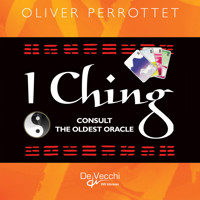
This version of the ancient Chinese oracle uses picture cards. Each hexagram is a natural scene to help you understand its meaning and relationship with others. * Understand the universal laws. * Discover the nature of trigrams and hexagrams. * Use the oracle for guidance and wisdom.
Das E-Book können Sie in Legimi-Apps oder einer beliebigen App lesen, die das folgende Format unterstützen:
Seitenzahl: 58
Veröffentlichungsjahr: 2021
Ähnliche

















OLIVER PERROTTET
I Ching
CONSULT THE OLDEST ORACLE
Despite having put the utmost care in drafting this work, the author or publisher cannot in any way be held responsible for information (formulas, recipes, techniques, etc.) expressed in the text. It is advisable, in the case of specific problems - often unique - to each reader in particular, to consult a qualified person to obtain the most accurate, complete and most up-to-date information possible. EDITORIAL DE VECCHI, U. S. A.
© De Vecchi Ediciones 2021
© [2021] Confidential Concepts International Ltd., Ireland
Subsidiary company of Confidential Concepts Inc, USA
ISBN: 978-1-63919-013-3
©All rights reserved. No part of this publication may be reproduced, stored in a retrieval system, or transmitted in any form or by any means, electronic, mechanical, photocopying or otherwise, without prior written permission of EDITORIAL DE VECCHI.
Contents
INTRODUCTION
How it might have been
The I Ching picture cards
THE EIGHT BASIC CARDS
GENERAL SURVEY
THE ORACLE
The issue
Creating the answer
Building the hexagram
Changing lines
Dividing the hexagram
Interpretation
Combination cards
GAMES AND EXERCISES
Domino
Interpretation
Memory
Interpretation
The square
A meditative version for one player only
Interpretation
The square arrangement
The circle arrangement
INSIDE AND OUTSIDE YOURSELF
Yourself
Partnership
Family
ADVANCED GAMES AND EXERCISES
Meditation
Tracing the oracle
The two elemental forces
The four elements
The eight basic forces
Interaction
Exposure
Chess
Extensions of games and exercises
THE SIXTY-FOUR PICTURE CARDS
Your own relationship
NOTE
The ideas are expressedin pictures,
the pictures are expressed in words.
Clinging to the words,
we fail to understand the pictures;
clinging to the pictures,
we fail to understand the words.
Having understood the pictures,
we can forget the words;
having understood the ideas,
we can forget the pictures.
WANG PI (226–249 CE)
INTRODUCTION
When I first came across the I Ching, at the age of 22, I was not at all attracted by it. I knew a number of people who used to toss coins from time to time and then looked up the result in a book where, they told me, they would find the answers to their very personal questions. When I asked them who had written the book and how it worked, they did not know, nor did they care; they just knew how to consult the ‘oracle’. I wondered how they could get meaningful answers from a source they used like a humble cookery book and I did not like the idea of it. If it really was a ‘book of wisdom’, surely one should have to do more than simply toss coins in order to merit a share in its knowledge?
I paid little attention to the subject until one day a relative gave me a newspaper cutting he had saved for me, because he knew I was interested in ‘Chinese stuff’. It was a review of an I Ching translation that had just been published, and was illustrated with a whole page of strange-looking signs, each composed of six horizontal lines. Some of the lines were broken, others not, but each sign seemed to be different from all the others. It seemed there was a symbolic language and possibly also a structure behind that mysterious and obscure book.
I immediately bought a copy of the new edition and started studying. From the short introduction and from other sources, as well as by drawing my own conclusions, I started learning something of the history of I Ching, the Book of Changes.
How it might have been
Several thousand years ago, the sages of ancient China began to design a system that would enable man to understand and explain the mutability of things, the mechanisms which make all things happen the way they do. By observation of nature they arrived at the conclusion that the whole world is one eternal flow of changes, and that all changes are, in some way, products of the interaction of two original forces: Yin and Yang.
Yin is passive, weak, dark and female.
Yang is active, strong, bright and male.
Yin and Yang stand for all the contrasts in this world. They are in opposition to each other, but at the same time, as there is no day without night and no peace without war, neither of them can exist on its own. They complement each other and together make a new unit. This relationship was represented as a symbol: a circle with one half light and one half dark. The contrasting dots indicate that each of the two halves also contains its opposite. Hence the mutual attraction.
In writing, the two contrasting forces were represented as lines, a broken line for Yin and an unbroken line for Yang.
From this, the laws of polarity were formulated: to every unit there is an opposite unit. These two complement each other and form together, on a higher level, a new unit. The latter in turn finds its complement with which it forms, on a still higher level, another new unit, and so forth. Vice versa, every unit can be divided into two complementary units, of which each can be subdivided into two again, and so on, infinitely.
In this way, the ancient sages could demonstrate that complexity could be reduced to a simple and understandable polarity.
The division of the two original forces produced four forces: Yang was divided into Yang/Yang and Yang/Yin, while Yin was divided into Yin/Yang and Yin/Yin. In writing, another line was simply added to the first one.
The four resulting signs were associated with the four directions of the heavens.
In order to refine the system still further, the four forces were divided once more: From Yang/Yang came Yang/Yang/Yang and Yang/ Yang/Yin, and so on. Thus a third line was added and eight signs called trigrams emerged.
The sages named the eight signs after nature: Heaven and Earth, Fire and Water, Thunder and Wind, Mountain and Lake. Everything in the world could be fitted into their scheme, and for the time being, no further refinement was needed. Scholars began studying the meanings of the trigrams and their applications in life.
GENERAL NOTE:All signs of I Ching are read from bottom to top and, if arranged in a circle, looked at from the centre.
But as one force on its own cannot effect change, the scholars soon started to combine the trigrams by placing one above the other. Thus sixty-four combinations could be formed.
After having read this, I looked again at the illustration in the newspaper, and there they were: the sixty-four signs of six lines each, called hexagrams.
The legendary king Wen is said to have first recorded all sixty-four hexagrams and given a name to each, thus laying the foundation stone for the Book of Changes. The sages and rulers of succeeding generations studied the symbols and their meanings thoroughly, drawing more interpretations from them. Rulers began to consult I Ching, seeking counsel for their official duties.




