


Erhalten Sie Zugang zu diesem und mehr als 300000 Büchern ab EUR 5,99 monatlich.
- Herausgeber: Luath Press
- Kategorie: Geisteswissenschaft
- Sprache: Englisch
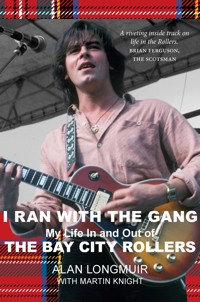
The Bay City Rollers were one of the brightest things to happen in the tumultuous 1970s, illuminating a dark decade marred by falling stock markets, a plummeting economy and industrial unrest. Alan Longmuir, an apprentice plumber from Edinburgh, was inspired by the Beatles to form a band. After enlisting his brother and throwing a dart at a map, they became the Bay City Rollers. In I Ran with the Gang , Alan recounts his incredible journey from the Dalry backstreets to the Hollywood hills and back again. Along the way, he punctures some of the myths and untruths that have swirled around the group, and unflinchingly tells of the acrimony and exploitation that led to the disintegration of the band. Most of all, though, Alan captures the great adventure of five young boys from Edinburgh who for a few heady years threatened to turn the whole world tartan.
Sie lesen das E-Book in den Legimi-Apps auf:
Seitenzahl: 386
Veröffentlichungsjahr: 2018
Das E-Book (TTS) können Sie hören im Abo „Legimi Premium” in Legimi-Apps auf:
Ähnliche




















First published 2018
e-ISBN: 978-1-912387-21-2
The authors’ right to be identified as author of this book under the Copyright, Designs and Patents Act 1988 has been asserted.
The paper used in this book is recyclable. It is made from low chlorine pulps produced in a low energy, low emission manner from renewable forests.
Printed and bound by ScandBook AB, Sweden
Typeset in 11 point Sabon by Lapiz
© Alan Longmuir and Martin Knight
I dedicate this book to my beloved wife and soulmate, Eileen.
She picked me up when I was down and has put up with me ever since.
Also, to Neil Porteous. He was the third Roller, my cousin and best friend. I miss him every day.
‘These wee boys should have had everything’
– Bill Martin
Contents
Acknowledgements
Foreword by Martin Knight
Introduction by Alwyn Turner
1 Rock ’n’ Roll Love Letter
2 My Teenage Heart
3 Dedication
4 Give It to Me Now
5 Keep on Dancing
6 Don’t Let the Music Die
7 Rebel Rebel
8 Rollin’
9 Bye Bye Baby
10 Rollermania
11 Inside a Broken Dream
12 Saturday Night
13 The Way I Feel Tonight
14 Strangers in the Wind
15 Yesterday’s Hero
16 Back on the Street
17 We Can Make Music
18 And I Ran With The Gang
Epilogue
End Piece
Appendix 1 – Caroline Coon article
Appendix 2 – Timeline
Acknowledgements
THIS BOOK IS the story of my life as I best remember it, in and out of the Bay City Rollers. I will not be dishing dirt, speculating, commenting or making any shocking revelations about the personal lives of any of my band colleagues. What happened or didn’t happen to them is their business and not for me to state or judge. They can, have and might write their own accounts. In this book I will willingly invade my own privacy, but not theirs.
I apologise in advance to anybody whose part in my story I have overlooked or forgotten. My recall is not so great these days, which is one of the reasons why I decided to write down my memoirs.
I would like to thank my family for their support, not only in this endeavour but in everything in my life. Also, my circle of friends – some old, some new. I am really very lucky on that score.
Finally, I would like to thank and send love to the fans. Without you none of this would have been possible and you are as much a part of this extraordinary adventure as anybody.
Alan Longmuir
June 2018
I WOULD LIKE to thank Jim Grant for introducing me to Alan; to Alan’s close pals Alastair Muir and Chris Balanowski, not only did they supply a car and house, respectively, for our use they created an ambient atmosphere for Alan to recall stories from his life; Debra Blakley for providing all manner of Roller material and memorabilia, and a deep knowledge of the band’s history; Derek Longmuir, Alan’s brother and bandmate, and Sandra Young, Alan’s cousin, for information on their family and the band’s background. Thanks are due to Janet Gill for sharing her research on Alan’s ancestry. And thanks also for the permission to reprint the Melody Maker interview, copyright Caroline Coon, and for the permission received from Bill Martin to reproduce lyrics from Remember, copyright Martin/Coulter. Most of all I would like to thank Alan Longmuir for his friendship. One of the nicest, humblest men I have ever known.
I would like to dedicate this book to my friend, Mitch Harrison, who died in 2018 while Alan and I wrote the book. Mitch and I made poor attempts together to travel the world at a time when the Bay City Rollers were conquering it.
Martin Knight
October 2018
Foreword
by Martin Knight
I WAS SITTING in a bar in El Campello, a quiet resort on the Costa Blanca somewhere between Alicante and Benidorm, with my wife, daughter, son-in-law and newly arrived grandson, Harry. We were having a beer and a bite to eat, watching the world go by and the blue sea rolling back and forth. A couple were sitting behind us and I could tell by their accents they were Scottish. Somehow, as they sometimes do in outdoor bars and restaurants, our conversations merged into each other. The subject was football. The couple, who introduced themselves as Jim and Shirley Grant, mentioned Dave Mackay, legendary defender of Hearts, Spurs and Derby.
‘He wrote his book,’ said Ryan, my son-in-law, pointing at me.
‘Never. Bloody genius, Dave was. What was he like? Hard bastard, Dave,’ said Jim.
The conversation moved on from Scottish football to books and what or who was I writing now. Nothing, I told Jim. But who would you like to write? I don’t know. No more footballers. Maybe a rock star. Who? Ringo Starr, I said. He’s the only Beatle not to have had a biography or autobiography. Jim countered quickly – what about the Bay City Rollers? ‘What about them?’ was my first reaction but I didn’t verbalise it. I tried to find a path politely away. It crossed my mind for a minute Jim was a Roller himself.
‘It’s been done, surely?’
‘Nae, not really. Alan Longmuir, the founder member, is my mate. He wants to do a book. Bloody coincidence this. Well, do you wannae do it or not?’
I said something non-committal like I’d certainly be interested to find out more and do a bit of research. Jim was a determined man. He took my email and phone number but as we waved goodbye and headed back to our hire car I fully expected never to hear from him again. Another blurred, drink-smeared conversation in a bar. We’ve all had them.
Maybe a month later, back at home, a number I did not recognise flashed up on my phone. I nearly ignored it thinking it would be likely be an Indian man from a Bangalore call centre informing me in a surreal Yorkshire accent about the latest road collision I had been involved in yet had no memory of.
‘Hello?’
‘Hello, Martin. Alan Longmuir,’ and, in case I didn’t know, ‘Alan Longmuir. I was in the Bay City Rollers.’
His humble, modest approach set the tone of our subsequent conversations.
I believe my less than enthusiastic response to Jim’s initial overture is one that would be shared by many men of my generation, especially in England. We were conditioned to dislike and dismiss the Bay City Rollers at the time and later as history paraded them as the negative poster boys of that much maligned decade – the 1970s.
Of course, I could recall some of their songs. Bye Bye Baby particularly. They had a way of embedding themselves in your subconscious. I remembered their individual names, but, besides Les McKeown, I couldn’t have told you which one was which such was my detachment. I knew there was one that played guitar who seemed a tad uncomfortable in his tartan-edged trousers riding up his leg. Possibly older than the others he claimed the background, an amused and bemused smile playing on his lips. Like he couldn’t quite process what was happening to him and around him. I now know that member was Alan Longmuir.
The Bay City Rollers arrived decisively in the public consciousness at a time of intense musical snobbery. It was the mid-1970s and the country was in a serious mess – quite literally – as rubbish piled up on the streets following industrial action by public sector workers. There were power-cuts and three-day weeks, high unemployment and plummeting stock markets. Denis Healey, the Chancellor, took his begging bowl to the International Monetary Fund to keep the country afloat and The Wombles dominated the singles chart. Yes, depressing times. It says it all that the term ‘womble’ has entered the English language, permanently, denoting a person who is a complete idiot. It was this timing that accounts for both the Bay City Rollers’ enormous impact and their vicious public denigration in some quarters.
In 1967 the album Sgt. Pepper’s Lonely Hearts Club Band was released, and it marked The Beatles’ transformation from the world’s most successful pop group to something altogether more serious. Deeper. No longer were the kids twisting. They were sitting cross-legged thinking. Analysing lyrics. Searching for hidden messages. The unseemly scrabble to the higher plane was on.
Musical artists had to act fast and decisively to adapt. Gravitas credentials were demanded. Concept albums were de rigueur, greatest hits and foot tappers were passé. Music that did not pass the ‘meaningful’ test was dismissed and labelled as ‘bubble gum’ or ‘teenybopper’. This was to forget that pop music was traditionally aimed at and created by teenyboppers for teenyboppers. Perfectly good groups like The Searchers, Herman’s Hermits and the Dave Clark Five couldn’t get a hit for love nor money.
As the 1960s gave way to the 1970s this trend built in momentum. The new musical mindset was termed ‘progressive’, ‘underground’ or ‘heavy’. Schoolboys risked losing all credibility if they admitted to buying Chirpy Chirpy Cheep Cheep by Middle of the Road, although many of them must have as it was number one for five weeks. Youths would carry around copies of the TarkusLP by Emerson, Lake & Palmer under their arms. It was as much a personal and fashion statement as the Afghan coat they were wearing. The reality was when they relaxed in the privacy of their own bedrooms alone they’d probably be playing The Pushbike Song by The Mixtures or Tiger Feet by Mud rather than subjecting themselves to Tarkus.
The ‘serious’ acts themselves were generally a morose bunch, brooding, with long lank hair in ankle length dull trench coats, preferably pictured staring vacantly into the middle distance. They were producing self-indulgent, sleep-inducing double-albums and taking the view that people who didn’t like the ‘tracks’ didn’t understand them. If you didn’t dig the music man that was your fault, not theirs.
But adolescent girls did not fall for such nonsense. While all this was being played out they were still buying pop songs with catchy tunes by the truck load and anointing idols like The Osmonds, T. Rex, Slade, David Cassidy and Michael Jackson. They were enjoying the pop scene as they always had. Many boys looked on enviously, yearning for the music they actually liked rather than the music they thought they should like.
The kickback against the ‘heavy’ movement that gathered pace from 1971 onwards was soon being labelled ‘glam rock’. At various times it was spearheaded by Sweet, Gary Glitter, Alvin Stardust, T. Rex, David Bowie, Slade, Suzi Quatro, Mud and others. The musicians sang and dressed loud, all having their own quirky characteristics and styles. Initially the music intellectuals sneered but even they found it hard to dismantle artists whose talents, charisma and marketability were undeniable. By 1973/4 it was the likes of Emerson, Lake & Palmer, and their ilk, that were looking tired and marginal.
And then came the Bay City Rollers. They had a brief chart flirtation in 1971 but then returned to relative obscurity until 1974 when they assaulted the charts with a string of feel-good, bouncy songs and a look that delighted and infuriated in equal numbers. In tartan-edged trouser-suits, jackets, colourful socks and stack shoes their smiling cherubic faces sent teenage girls into apoplexy and nearly everyone else into a simmering rage. Here was a group of boys that were happy and enjoying themselves. How very dare they? Their name smacked of a band that was trying to ride that American skateboard/surfboard vibe and then it was discovered they were Scottish. Not even English! Out of bloody order!
All the resentment against glam rock, bubble gum, pop, teenybopper could now be marshalled against one entity. Bolan, Noddy Holder, Bowie et al were capable of defending themselves. Their body of work and performance spoke for itself. They were proving themselves in the wider genre. But the Bay City Rollers were easy prey and all the prejudices and vitriol was gathered up and directed against them. It was cultural bullying. The mantra went something like this: They don’t write their own songs/They don’t even play their own instruments/Their songs are shit anyway/They look like pratts/They’re Scottish/They’re manufactured.
I can remember hearing such abuse about The Monkees a few years before and would hear it again about boy bands and various X Factor creations in the future.
But the Rollers could not easily be dismissed and consigned to the embarrassing shelf in the local record shop. The fan reaction was the closest anyone had come to Beatlemania, surpassing the Monkees, The Osmonds, David Cassidy and artists yet to come including, most notably, Take That and One Direction. It defied logic for many but it was happening. It happened. The Rollers had four or five intense years at the pinnacle, more than the Monkees, The Osmonds and Cassidy and they conquered the world, notably successful in America, Canada, Japan and Australia. In the annals of pop music, they confounded everyone. None of the likes of Slade, T. Rex, Sweet or Gary Glitter had made significant inroads stateside.
The Bay City Rollers are thought to have sold more than 120 million records, probably more. Nobody really knows as the lack of visible accounting is one of the features of the miserable financial backdrop to this story. It is estimated they generated £5bn of revenue at current prices when merchandise sales are included. There was a period when most of the country’s teenage girls were wearing something Roller related. There were magazines and annuals, pencil cases and bags. The Rollers image rights should have generated many millions and they certainly did for some people.
History has re-evaluated glam rock and now Sweet, for example, are remembered fondly and with respect, though they were often mocked and denigrated during their pomp. Crazy Horses, a song penned and performed by The Osmonds, is today lauded as a pioneering heavy metal classic and David Bowie went on to become one of the most revered and creative artists in the world and in history. Yet the Bay City Rollers remain largely un-rehabilitated. Joey Ramone, Courtney Love and other ‘credible’ rock figures have come out of the closet and admitted to loving and being influenced by them, but they still attract opprobrium among many.
The proof is in the pudding though. Watch at any wedding or party when the DJ puts on Bye Bye Baby. Smiles spread across creased faces, especially the women, and there is a dignified rush to the dance floor. When the Rollers reformed briefly in 2015, two dates at the Hammersmith Apollo were sold out in minutes – likewise, in Barrowlands in Glasgow and other prominent venues. This was 43 years on from their peak and nearly 40 years since they last rode high in the UK charts. More people are fond of the Bay City Rollers and the era and emotions they evoke than is popularly imagined. They just don’t admit it, yet.
The irony in all this rock snobbery is that the Rollers were from the streets. They’d grown up the hard way in tenement blocks in Edinburgh’s poorer districts. No London School of Economics, art school or Charterhouse educations among them. They’d served long and arduous apprenticeships in working men’s clubs and dives up and down the British Isles and were competent musicians and accomplished performers. In Les McKeown they had a front-man potentially more wild, working-class and controversial than the so-called bad boys of rock. He was ‘proper street’. He was accused of firing an air gun at and injuring a fan. He was involved in a fatal car accident. He fought other band members on stage. Had he died young, the Rollers would have been viewed in a whole different light. Manager Tam Paton may have seen it as a good career move but for Les that would have been a high price to pay have history treat him with respect. Alan Longmuir once wryly observed when the Rollers were attempting a comeback: ‘The problem we have is that we’re too old to die young.’
Another irony that occurred to me in discovering their back catalogue as part of my research is that, as their popularity waned, their music got better. As Alan’s story will tell, they were thwarted by everyone they worked with in trying to grow creatively, although he is the first to admit they would probably have never broken through if they had recorded their own material from the beginning. The more the critics decried them the more the band wanted to prove to the world that they could grow artistically. This battle for credibility eventually contributed to their demise. Some of the tracks from their later albums are mature and strong songs that stand the test of time. Don’t Let The Music Die, written by Eric Faulkner and Stuart Wood and recorded in 1977, is, in my opinion, one of the best Rollers’ efforts and up there with the top ballads by anyone that came out of that decade. If the band had been given the opportunity to have the recording of their own material managed sensibly, I believe they would have enjoyed a much longer career at the top. Bill Martin, who with Phil Coulter co-wrote Shang-A-Lang, among others, for the group, has said similar in recent years.
The band’s legacy has also been smeared by the nefarious activities of their controlling and dominant manager Tam Paton. It transpired after the boys and he had parted company that he was a predatory paedophile and a major drug dealer among other things. There is a growing suspicion that he may have been an integral part of an organised group who exploited vulnerable children for sexual gratification – the full truth about him has yet to be unearthed. A thoroughly nasty piece of work and now dead, Paton casts an unwelcome shadow over the group. That shadow should evoke sympathy for the Rollers, not otherwise, as they were mere boys, innocents, some as young as 16, when they came under his malign stewardship.
* * *
When I met Alan, he took me to his local pub in Bannockburn. He was quite clearly a regular.
‘All right, Shang-a-Lang?’
‘That’s my nickname in here,’ Alan explained sheepishly.
His mate asks me if I can understand his accent. I said I could.
‘Strange, I have friends in London and my nickname down there is Subtitles. They can’t understand a word I say.’
They are a seasoned and humorous bunch. Alan melts in to the background, his Roller status not counting for much in here. I expect he wouldn’t have it any other way. He doesn’t look like a former pop star. He looks like a former plumber, which, incidentally, he is. He acknowledges that these days the Rollers attract attention mainly in relation to legal battles, tales of hardship and acrimony, and the Paton factor. He acknowledges a dark side to the Bay City Rollers has emerged and grown in momentum. Alan says he hopes to provide some balance and tell his story. After all, he was there at the beginning and at the end: a story of a boy from Dalry who played some guitar and wanted to be famous. He wants to tell of the soaring rollercoaster success, the laughs, the wave of happiness that spread across the globe and the highs and the lows. He doesn’t want to settle scores or point fingers. He just wants to get it all out before it’s too late. A rags to riches and back again tale with bells on. I get it. We go in the back room and I switch my tape recorder on.
Introduction
by Alwyn Turner
I wish it could be 1975 again
‘GOODBYE, GREAT BRITAIN. It was nice knowing you.’ The sentiments of the Wall Street Journal in 1975 rang all too true for many British people in that difficult year. It was less than ten years since Time magazine had anointed London as ‘The Swinging City’, and so much seemed to have gone wrong in the interim.
Even the emblems of the Swinging Sixties were looking tattered, having barely survived the end of that already-hallowed decade. Mods had become skinheads; the image of Bobby Moore holding aloft the World Cup was tainted by footage of rampaging hooligans; films like Performance and Get Carter depicted a grubby gangster-ridden world of pornography where once there had been a sexual revolution. And, as a symbolic full stop, Biba – the shop that had set so much of the look of the previous decade – closed down in August 1975, the victim of an unsustainable property boom and crash. ‘It really is the end of a dream,’ noted cabinet minister Tony Benn, as he walked past the store, unconsciously echoing John Lennon’s lyric on the demise of The Beatles: ‘The dream is over.’
A tetchy, grumbling note of conflict had entered the culture. By 1975 the nation’s favourite TV sitcom was Love Thy Neighbour, with Jack Smethurst and Rudolph Walker hurling racial abuse at each other, and the biggest drama series – debuting that year – was The Sweeney, depicting the police as boozing, womanising brawlers, almost indistinguishable from the villains they were chasing.
On a bigger stage, there was an unmistakeable note of crisis to be heard, as well, maybe even one of panic. Inflation was creeping towards 30 percent in the summer of 1975, prompting talk of Weimar Germany and the death of democracy. Retired military officers were proposing the formation of private armies, and dropping dark hints of coups to come, while Northern Ireland was already in the grip of something approaching civil war. The country was still reeling from the political chaos of the previous year, when an oil crisis and a miners’ strike had resulted in a state of emergency, two general elections and a three-day working week; there had been food shortages, power-cuts and early closedowns on TV (which was still more likely to be viewed in black-and-white than in colour).
It was Britain’s turn to be ‘the sick man of Europe’, a term first used to describe the Ottoman Empire at the time of the Crimean War and subsequently applied to… well, to pretty much every country on the continent at one point or another. The fact that Britain was neither the first nor the last sick man was little comfort, though. Not when the phrase was coupled with another: ‘the British disease’, referring to the terrible state of industrial relations.
The country was, in short, experiencing a harsh comedown from the adrenalin rush of the sixties. Perhaps it was inevitable. The rapid collapse of the world’s largest ever empire, in the space of a single generation, had led to a confusion of identity, an uncertainty over the nature of what Britain had become. While the extraordinary boom in popular culture – the worldwide success of James Bond and The Beatles, of Michael Caine and Mary Quant – had briefly masked the reality of that predicament, still that uncertainty remained.
It wasn’t all doom and gloom, of course; and, even when it was, the doom and gloom were shared out pretty fairly. When there was a power-cut, everyone’s lights went out; when the motorway speed limit was reduced to 50 mph to save fuel, all drivers were affected; when an IRA bomb exploded in London, it didn’t discriminate between its victims. If the country sometimes felt as if it were under siege conditions, there was at least communality, the reassurance of a shared suffering. While the politicians spoke of the Hungry Thirties, the popular culture was awash with a sense of community that consciously evoked the Blitz spirit. There was a plotline familiar to television viewers of their favourite characters being stranded away from their homes and keeping their spirits up by singing old wartime songs together: it turned up in Coronation Street, Are You Being Served?, Mind Your Language and elsewhere. Although 1975 was the year that a referendum confirmed Britain’s membership of what was then the European Community, seeming to suggest a new vision of the country’s future, Europe was still seen through the prism of 1940.
These were confusing, confused times.
In addition, rock ’n’ roll, which had largely driven the cultural explosion, was enduring its own crisis of identity, apparent at the very dawn of the new decade. In January 1970 The Beatles recorded their last song together, George Harrison’s I, Me, Mine (albeit in the absence of John Lennon), and then went their separate ways. In the same month Pink Floyd announced that they would be releasing no more singles, such things being below the dignity of serious musicians. Led Zeppelin, whose second album was then at number one in the American charts (and would shortly reach the top in Britain, displacing Abbey Road) never did release a single in Britain. A seemingly unbridgeable gap had opened between rock and pop. The cross-class, cross-gender cultural coalition that had proved so productive in the sixties lay in fragments.
By the end of the year, there was the first sign of an attempt to build a new consensus. T. Rex’s Ride a White Swan prefigured the rise of glam rock, which took over the charts from 1972. Glam was a style, an attitude, rather than a movement, defined – insofar as it was ever properly defined – by its approach to performance. It was also a broad church, finding room for acts as diverse as Roxy Music and Sweet, or David Bowie and Alvin Stardust.
There was, though, at least one common factor: a vein of nostalgia that ran right through glam. The way forward was to reconnect with the original spirit of rock ’n’ roll. The imagery of the 1950s became a touchstone for the songs of the early 1970s: from David Essex’s Rock On and Gary Glitter’s Rock ’n’ Roll (Part One) to David Bowie’s Rock ’n’ Roll Suicide and Mott the Hoople’s The Golden Age of Rock ’n’ Roll. The early repertoire also returned in a new guise: T. Rex covered Eddie Cochran, Eno covered Neil Sedaka, Suzi Quatro covered Elvis Presley. The same desire to find inspiration in the music of an earlier, more innocent age could be seen on both sides of the Atlantic, with the stage musical Grease (1972), the movies American Graffiti and That’ll Be the Day (both 1973), and the TV sitcom Happy Days (1974).
This was of a piece with the wider cultural mood. If the present felt like the country was sinking into oblivion, then perhaps the best option was a retreat into the past. Much of the most successful culture of the 1970s was rooted in bygone times: Upstairs Downstairs, All Creatures Great and Small, Pennies from Heaven, Laura Ashley, Portmeirion Pottery’s Botanic Garden range, The Country Diary of an Edwardian Lady, as well as, inevitably, the presence of the Second World War in everything from Dad’s Army to Colditz. Glam was part of that trend, with the crucial difference that rock ’n’ roll had just a two-decade history on which to draw.
Glam died as a potent artistic force in the late summer of 1974. Partly its demise was due to the ever-changing tastes of the audience and the industry, but there were two very specific factors at work as well. First, there was the distaste felt by the weightier figures that they were being lumped in with pure pop acts: David Bowie and Roxy Music, in particular, shed their satin and tat and embraced the new sounds of soul. And second, there was a technicians’ strike at the BBC, which stopped the making of new shows. One of those hit was Top of the Pops, which had become the home of glam, and which was not broadcast for a full month. The result was that new releases by established stars – Suzi Quatro, Mott the Hoople, Wizzard, David Essex – failed to sell anywhere near as well as would normally be the case, and instead there was a rise in music that was primarily to be heard elsewhere, most notably disco, though there was also a return of reggae to the charts.
What glam left behind was a love of dressing up and an appetite for nostalgia. The chart groups who stepped into the newly vacated platform boots were those wearing identifiable uniforms, playing music that was rooted in pre-Beatles pop: Showaddywaddy, Mud, the Rubettes, Kenny. And then, above all, there were the Bay City Rollers.
Because the reason we started in 1975 is that, despite the problems that were wracking the country that year, despite all the crises and the negativity, this was also the Year of the Rollers. By the spring of 1975, they were everywhere: on television with Shang-a-Lang, on the cover of every tabloid and every self-respecting teen magazine in the land, and at No.1 with both their album Once Upon a Star and their single Bye Bye Baby.
That song, of course, was a cover of an old number by the Four Seasons, just as the band’s first hit had been a cover of the Gentrys’ Keep on Dancing. The records in between, the string of hits in 1974 that heralded Rollermania, weren’t oldies, but they weren’t far off. Remember (Sha-La-La-La), Shang-a-Lang, Summerlove Sensation – these were songs that deliberately conjured up a bygone era of American pop, a time when the music was simple and direct, and when drugs and politics had yet to manifest themselves. They were nostalgic snapshots of cherished teen summers, remembering the days when the band began to play and we all began to sway – those of us, at least, who were all in the news with our blue suede shoes.
This was slightly odd because these were records aimed at an audience for whom nostalgia was not an option. When the glam acts had referenced the early days of rock ’n’ roll, it had made some sense; certainly, it had made sense for the artists themselves, all of whom remembered those times, and some of whom (Alex Harvey, Alvin Stardust, Gary Glitter) had been releasing records back then. But for Rollers fans, there wasn’t a great deal to remember. Nor was there, for most, anything much to escape from: strikes by miners or power-workers might damage the economy and disrupt the lives of adults, but for kids they also meant there’d be power-cuts, which were fun because you could have candles at breakfast-time.
In any event, the lyrics to a song like Shang-a-Lang didn’t matter a great deal, any more than they did in Bye Bye Baby, with its inappropriately bouncy tale of adultery. The words were simply the right noises, a collage of half-familiar pop phrases, set to chord sequences that were taken from basic blueprints. This wasn’t a re-creation or a revival; more like the distilled essence of pop music’s joyous rush. And, as such, it had nostalgia built into its every bar, for while the best pop celebrates the present, it also has a bittersweet subtext that these happy days will never be here again. The nostalgia has survived; heard now, those Rollers’ hits are more of their time than almost anything by their contemporaries.
This was another paradox of the 1970s. The state of the nation produced an appetite for an evocation of the past, which proved so powerful that it was adopted as the soundtrack for those too young to have known that past. Now the same music evokes its own era – an era when there was a shared culture, when there was such a thing as society. For those who were there, even if they disparaged the Rollers – and many did – Bye Bye Baby is a fast-track ticket back to 1975. And the memories it conjures up are likely to be happier than the newspaper headlines of the time would suggest.
The image of the Bay City Rollers is an indelible stamp on the era: a youth-club gang of a rock ’n’ roll band, a blur of big hair, short trousers and skinny chests. And there, off to one side of the stage in the long tradition of semi-detached bassists, was Alan Longmuir. Older than the others – let alone the fans – he was the big brother not only of Derek, but of the whole Rollers family, and he looked on, slightly bemused as it seemed, at the screaming mass of tartan-clad kids behind flimsy security barriers. He gave the appearance of someone not quite able to believe the juvenile juggernaut he’d set in motion.
Alwyn W Turner is a cultural and political historian. His critically acclaimed book Crisis? What Crisis?: Britain in the 1970s was published in 2008, followed by Rejoice! Rejoice!: Britain in the 1980s and A Classless Society: Britain in the 1990s in 2010.
1
Rock ’n’ Roll Love Letter
‘DEREK.’
‘Yes, Alan.’
‘Do you want to join my group?’
Derek did not look away from the television. He loved Bonanza.
‘Your group of what, Alan?’
‘My pop group, Derek. Like The Beatles.’
The word ‘band’ for a pop group hadn’t entered common parlance yet. It was the mid-1960s and it was all beat groups and combos. The mention of the word Beatles prompted Derek to turn around and pay attention. The four lads from Liverpool were having that effect on everyone.
‘Yes, please.’
‘Guid. Now what instrument would you like to play?’
That foxed Derek.
‘Well, I’m playing bass guitar because I’m left-handed like Paul McCartney,’ I informed my younger brother.
‘But you cannae play guitar.’
‘Not yet, Derek. Not yet.’
‘In that case I’ll play drums like Ringo Starr.’
‘That’s fine. We just need to get some instruments and think of a name.’
‘But who will be our John and George?’
I wasn’t ready for that. Pondered for a few seconds.
‘What’s cousin Neil up to these days?’
Aye, it may not have happened quite that way, but the scenario would not be far off the mark. Brother Derek was (and still is) almost three years younger than me – it could have been him courting me. That precise defining moment is lost in the sands of time.
I’d had it in my head to be a pop star for some years even before the loose idea of forming a band first bubbled up inside me. The trigger was going to see a film called Jailhouse Rock at the local cinema, The Scotia, in 1958. I was ten-years-old and the star of the film, Elvis Presley, knocked me sideways and awakened all sorts of feelings inside, some of which I could not understand. The plot about a young man in prison who is taught to sing and perform by a fellow jailbird and on release becomes a star was attractive enough in a rebellious and rags to riches way, but the scene where Elvis performs the title track was electrifying. There he was pole dancing four decades before it became popular in nightclubs across Europe. With his thumbs defiantly hitched into his trousers he swivelled, swerved and gyrated. I was too young to understand any nuances in the lyrics but knew I was experiencing a sort of epiphany.
Not as much, though, as the people around me. Teenagers. It was the buzz label. You heard grown-ups talking about them all the time. You read newspapers screaming headlines about them. Television and film analysed them. Anyone would have thought there had been no teenagers until the mid-1950s and, in a way, there hadn’t. If you didn’t know better you could have thought they had arrived in space ships and were colonising communities with their damned youth clubs, loud records and outlandish clothes. Now I was witnessing teenagers first-hand. They were dancing in the aisles. Boys and girls. Rock ’n’ roll dancing. Twirling and spinning each other around. Younger lassies were gripping their seats, kicking their legs wildly, yelping and sighing. Even surly Teddy Boys at the back with their Brylcreemed quiffs, drainpipe trousers and winkle-picker shoes dragged on their cigarettes more urgently, deeply anxious not to reveal any signs that Elvis was impacting on them. As they say, the place was rocking.
I was a great patron of the local cinemas. Films, especially American ones, were our chief source of entertainment. Mum took me to see Seven Brides for Seven Brothers when I was very young, but I think the first film I saw was Annie Get Your Gun with Doris Day. We loved Doris, us Longmuirs. Also, there was Saturday morning pictures, a collection of short films put together for the kids and to take them off the parents’ hands for a couple of hours. I gulped down my weekly ration of Flash Gordon, Buck Rogers, Hopalong Cassidy and the Three Stooges. There might have been some misbehaviour among us kids then. It was not unknown to lob chewed bubble gum across the aisles and shout out rude words at the screen and crawl along the floor between the seats on all fours among the debris to annoy others, but this universal crackling energy I was witnessing with Elvis was something else. I wanted some of that.
I was more excited by the impact than the music. I didn’t rush off and buy all of Elvis’s records. Nor did I seek out the composers, Jerry Leiber and Mike Stoller, who went on to pen many songs of quality as diverse as Stand by Me and Pearl’s a Singer made their own by Ben E King and Elkie Brooks, respectively. I just wanted to have the stage power of Elvis. Be able to create a stir. Be part of a musical phenomenon.
We had a piano in the house which Dad played, and I slowly taught myself. Have you heard my Chopsticks? Dad was also a competent accordionist and I, again, coached myself on that. The accordion is an underrated instrument that is not as easy to play as most people imagine. Auntie Edie was the most talented musically in the extended family and could play our piano well. Edie and her husband Jim Porteous, and their children Neil and Sandra all lived with us for a while just after the war. We had musical evenings around ours or we’d sometimes decamp to a neighbour’s. It was really like that then, families in and out of each other’s houses. That sort of society has been lost, sadly.
I also sang a bit. When I was 15, I appeared with the Tynecastle School Choir at the Usher Hall, Edinburgh. Sometimes we made a little stage at 5, Caledonian Road, our home, and Derek, my cousin Neil Porteous and I would perform for the adults; maybe recite a poem or sing a little song. Occasionally, I’d don my father’s undertaker’s top hat to charm the audience. Arguably, these musical interludes were the first performances of the Bay City Rollers. One time I remember, during one of these shows, was when a small packet fell out of Neil’s pocket. He had been to the barber shop earlier and pinched a packet of condoms thinking, probably, they were sweets. I knew what they were, but poor old Neil didn’t grasp why the adults seemed so embarrassed by it. Afterwards I spent some time explaining (or trying) to Neil what a Rubber Johnny was.
But, I was essentially a shy boy and deep down, although I was bewitched by Elvis Presley in Jailhouse Rock, I knew I could never be him. I could never be the front man. The thought of appearing on a stage alone in front of halls full of expectant people terrified me more than it excited me. In fact, the thought of appearing in front of a garden shed full of strangers terrified me more than it excited me. My ambitions to pop stardom went on the back-burner.
The Beatles changed all that. There was a hiatus between Elvis and The Beatles. There was plenty of music around in that five-year period between the coming of Elvis in my life and the birth of the ‘Fab Four’ but nobody that really tilted the world on its axis. This is not to detract from Billy Fury, Cliff Richard, The Shadows and countless other groups and solo artists. Some of them were exciting but Elvis was a hard act to follow. And none of the British talent had ever broken America. Yet.
John, Paul, George and Ringo first troubled the UK charts late in 1962 with Love Me Do. It was a wee hit, peaking at number 17, but it was merely feeling the way for the avalanche to follow. The Beatles already had a massive and passionate following in their home town of Liverpool and were a tight outfit having honed their stagecraft over a few hard graft years at home and in the fleshpots of Hamburg, Germany. Unusually, for the time, they were also writing their own material.
I cottoned on to them in 1963. Their music was everywhere. Fresh, urgent and distinctive pop numbers like She Loves You and I Want to Hold Your Hand. Rockers like Twist and Shout. Ballads like Yesterday. Their B sides were better than most other acts’ A sides. They were there whenever you switched on the television – on the panel on Juke Box Jury, waving on the revolving stage on Sunday Night at the London Palladium, even wisecracking with Morecambe and Wise. They were funny, sharp and relaxed. Four working-class laddies who had taken over the world.
Paul McCartney captivated me. Left-handed bassists were few and far between, but he was so much more. He had a great voice that could move quickly from sweet and melodic to earthy and rocky. He was good looking in a next-door-neighbour kind of way. Even in those early days you could see he was diplomatic and determined. And he co-wrote the songs. He and John Lennon were so prolific they were giving them away: I Wanna Be Your Man to the Rolling Stones, Misery to Kenny Lynch, Do You Want to Know a Secret to Billy J. Kramer. The list is endless.
The mainstream could not ignore The Beatles. Newsreels and television showed the fans at their concerts, screaming like we’d never seen before and fainting and throwing themselves recklessly at their idols. Not even Elvis produced mass hysteria on this scale. When they climbed on to their USA bound airplane for the first time at London Airport in early 1964 fans filled the balconies waving and swaying with hundreds locked outside. When they landed at Kennedy Airport it was the same. They’d conquered America from the sky. Until that point we, in the United Kingdom, were all in thrall to American culture: Charlie Chaplin, Fred Astaire, Ginger Rogers, Humphrey Bogart, Laurel and Hardy, Marilyn Monroe, Frank Sinatra and Elvis. Everything the Americans did was better than us in the UK. They lived in smarter, bigger houses. They had refrigerators, we had larders. They cruised around in Buicks, we still pedalled around on Raleigh bicycles. But now we had something they didn’t – The Beatles. The Fab Four. They spread across the world like a bushfire. A word was needed to describe what was happening and someone coined the term ‘Beatlemania’.
On 29 April 1964, very soon after they returned from that first, historic American visit, The Beatles came to Edinburgh. It was pandemonium. They sold 5,000 tickets for the shows they played at the old ABC cinema on Lothian Road. However, if you believed every Edinburgh person that says they went, you’d be looking at ten times that number. I am not one of those who will claim to have been there but I did see the huge fan reaction. The cinema was only a short walk up the road from where we stayed. Queues of girls and boys snaked from the cinema down the road and around the corner as far as the eye could see. Teenagers (them again) were camping outside the night before in their hundreds, hoping for entry. Police were buzzing everywhere, keeping order. The newspapers were full of it before, during and after. Two local girls had raised a petition to get the boys to come as I don’t think Edinburgh was on the original schedule. If I remember the two girls that had kicked off the campaign didn’t get into the show after all. It was a febrile, mad few days in my home town.
When it had all calmed down a bit, it got me thinking: those old Jailhouse Rock butterflies were dancing in my stomach again. I could form a group. I wouldn’t have to front it or at least I could share the glare of attention and fame that would surely come my way. Why didn’t I think of it before? It’s obvious. It’s my destiny. Where’s Derek?
2
My Teenage Heart
I WAS BORN on 20 June 1948 in the Simpson Memorial Maternity Pavilion in Edinburgh, not too far from the family home at Smithfield Street, which was close to the Heart of Midlothian football stadium. The hospital was new when I came along and delivered around a third of million babies before it closed a few years ago to make way for posh flats for the burgeoning Edinburgh gentry. Local people knew it then, and fondly remember it now, as the Simpson’s. I’m sure many notable people opened their eyes for the first time there but there are two individuals, especially, who I must mention.
The first was Stuart Sutcliffe, born three days after me but eight years earlier. He was an early member of The Beatles, having moved from Scotland to Liverpool as a boy and befriending John Lennon at art school. He died of a brain haemorrhage before the band broke through but because of that his mystique remains intact. Had he of lived would he have played at the




