


Erhalten Sie Zugang zu diesem und mehr als 300000 Büchern ab EUR 5,99 monatlich.
- Herausgeber: Atlantic Books
- Kategorie: Lebensstil
- Sprache: Englisch
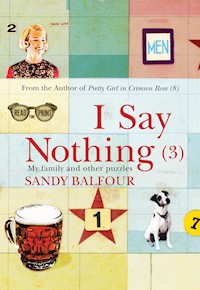
This delightful book explores the world of the cryptic crossword clue, a place where nothing is quite as it seems. From reflections on his children's musical tastes (might ABBA be an Old Testament citation?) to veiled digs at Labour's foreign policy ('What could be subtler during search for weapon!' 7, 4), each of Sandy Balfour's perfectly proportioned essays is a joyful investigation of these devilishly difficult puzzles and the life they punctuate.
Sie lesen das E-Book in den Legimi-Apps auf:
Seitenzahl: 170
Veröffentlichungsjahr: 2013
Das E-Book (TTS) können Sie hören im Abo „Legimi Premium” in Legimi-Apps auf:
Ähnliche

















I Say Nothing (3)
First published in Great Britain in 2006 by Atlantic Books on behalf of Guardian Newspapers Ltd.
Atlantic Books is an imprint of Grove Atlantic Ltd.
Copyright © Sandy Balfour 2006
The moral right of Sandy Balfour to be identified as the author of this work has been asserted in accordance with the Copyright, Designs and Patents Act of 1988.
The Guardian is a registered trademark of the Guardian Media Group Plc. Guardian Books is an imprint of Guardian Newspapers Ltd.
All rights reserved. No part of this publication may be reproduced, stored in a retrieval system, or transmitted in any form or by any means, electronic, mechanical, photocopying, recording, or otherwise, without the prior permission of both the copyright owner and the above publisher of this book.
Every effort has been made to trace or contact all copyright-holders. The publishers will be pleased to make good any omissions or rectify any mistakes brought to their attention at the earliest opportunity.
1 2 3 4 5 6 7 8 9
A CIP catalogue record for this book is available from the British Library.
ISBN 10: 1 84354 517 9 ISBN 13: 978 1 84354 517 0 eISBN: 978 1 78239 372 6
Printed in Great Britain
Atlantic Books An imprint of Grove Atlantic Ltd Ormond House 26–27 Boswell Street London WC1N 3JZ
Contents
O Tempora, O Mores
The Italian for Love
Relative Values
Travels with my Crossword
Setters and Solvers
The Omnibus Puzzle
Epilogue
O TEMPORA, O MORES
Anyone for Crosswords
Bill Clinton used to do crosswords. I wonder whether Tony Blair does? The idea has a quixotic appeal, a bit like the notion of President Bush, say, reading a novel. But I can’t quite see it and Downing Street wouldn’t say. Crosswords require patience and humour and a willingness to submit to the random and surreal orthography of the setter’s mind. They do not, by and large, provide a home for control freaks. A crossword setter, Fawley once told me, is entering a game in which the point is to lose gracefully. By the same token the point for the solver is to win – appreciatively.
Like I say, Tony and Araucaria? I don’t think so.
But if he did, he might feel that the Guardian setters were having a go at him. A couple of weeks back Paul was on the case with a very sarcastic ‘What could be subtler during search for weapon! (7,4)’i It was a theme he started on some months ago. ‘Say it aloud, sending ships to the Gulf was such a mistake – a build-up demanding contemplation (5,5),’ii for example.
It was no coincidence that this appeared in a puzzle in the Guardian on 15 February 2003, which alert readers will recall was the day news chiefs had been warned by the Pentagon to expect the second Gulf War to begin. In the same puzzle we found a number of other clues critical of Our Leader’s enthusiasm for all things military.
Paul is not the only one. Three weeks ago Bunthorne weighed in with ‘Spites Blix over possible arms sales, say? (7,7)’iii which could hardly be taken as a neutral comment on our ongoing imperial adventures. And last Saturday, Araucaria anticipated the government’s discomfort over its statements on Iraq with his usual subtlety: ‘Abjure blue berets? (5)’.iv Alistair Campbell must wish he could, literally and cryptically.
If things continue to slip in Iraq the Prime Minister would do well to heed Bunthorne’s warning: ‘Living with past record? Fail and “You will —!” (2,7)’.v I suspect that, despite the Iraqi failure to lose gracefully and the American inability to win appreciatively, the Prime Minister’s place in history is secure.
But is it the one he wants?
18 AUGUST 2003
i CLUSTER BOMB; ii NAVEL FLUFF; iii VISIBLE EXPORTS; iv UNSET;v BE HISTORY
Tony Blair’s Place in History
Following intelligence failures in Iraq, there has been much talk of ‘blame’ recently, which is what happens when real life intrudes on our carefully constructed semantic fantasies.
‘Russian nouns decline,’ I said before the storm broke last Wednesday.
‘How many letters?’ asked my girlfriend.
For some years she has been campaigning to get me to call out crossword clues properly. The ‘proper’ method is to say the number of letters first, then the clue, then any checked letters and then the number of letters again. It’s a question of manners.
‘It’s not a clue,’ I replied.
‘What is it then?’
‘Well, I don’t know. I suppose you’d call it a “remark”.’
‘Oh.’
We were in bed at the time (sensitive readers may want to turn away at this point) and the sun was rising over London.
‘What made you say that?’
I supposed I had said it because my Russian teacher had drummed it into us the previous evening. ‘Today we will do the accusative,’ he said. He has a habit of stressing two or three words in every sentence, like a camp version of Graham Norton. ‘The accusative is the object of the sentence. The object of the exercise, on the other hand, is that you will learn about nouns.’
The effect was to make me slightly seasick, bobbing about as I was on the choppy seas of his scansion. But you take my point. Never again in our house will a word be used as though it has only one meaning.
By breakfast therefore, storm clouds were gathering in the west.
‘You don’t understand how I feel,’ said my girlfriend. I hesitate to say petulantly.
She wrested the newspaper from me and went to drink her coffee.
‘You’re imagining things,’ I replied, not necessarily helpfully.
There was a silence, mostly in the accusative.
‘I’m sure all I feel includes more than what I imagine,’i she said eventually.
But since she failed to call out the number of letters (which was ‘four and four’), I had no way of knowing that this was not ‘a remark’, but a clue – taken from that morning’s Cinephile puzzle in the Financial Times.
For which I blame her. Or him. Or anyone other than me.
25 JULY 2003
i REAL LIFE
The Hutton Inquiry
There has been much made – in the Guardian particularly – of the different approaches taken by various media owners to the deliberations of Lord Hutton in the matter of the death of Dr Kelly. Commentators have suggested that some newspapers are motivated more by the political calculations of their proprietors than by any respect for what one might term ‘the truth’.
Happily the crosswords setters (many of whom are, ah, promiscuous in their setting allegiance) have no truck with this sort of thing and it was possible to discern their maverick commentary on the Hutton inquiry in most of the papers. In the FT on Tuesday for example (atoning for a couple of repeated clues and solutions the previous day) Quark described ‘How some went for attack lacking sense of proportion (4-3-3)’.i
But it was Rufus, normally the most amenable of setters, who seemed to be almost prescient on Monday. ‘Something said about Anthony (6)’ii (or TB, as they seem to call him in the e-mails that fly around what the papers refer to as the ‘upper echelons of Downing Street’), was clearly not something Alistair Campbell was about to ‘Let pass (6)’,iii especially not given the ‘Global degree of freedom (8)’iv enjoyed by the press and in particular by that ‘Intriguing, if cruel, devil (7)’,v the BBC.
Actually that last clue was from Wednesday’s Times, a paper that has consistently supported the government (and anyone else) in its battles with the BBC. The setter, though, wanted to know whether there were ‘Any left who’ll get worried by inconspicuous observer? (3,2,3,4)’.vi
Not by the time they have finished with them. I have in my time been such an observer and know as well as any government apparatchik that it is not your presence that counts as much as what you say afterwards. Still, I did enjoy the extracts widely quoted. I wondered only that when Campbell described the government’s evidence on 10 September as a ‘detailed draft dossier’, the papers forgot to mention that ‘detailed’ is an anagram of (amongst other things) ‘dated lie’.
22 AUGUST 2003
i OVER-THE-TOP; ii REMARK;iii PERMIT; iv LATITUDE; v LUCIFER;vi FLY ON THE WALL
The Death of Stephen King?
Is Stephen King OK? Has anyone heard? I only ask because Paul had a puzzle themed on the great man and his work on Tuesday and Paul’s record in these matters is, ah, mixed. Screaming Lord Sutch, for example, passed away the moment Paul put him in a puzzle.
I feared the worst when I saw that this puzzle appeared the day after the National Book Club awarded King a lifetime achievement medal. The award is given to ‘an American author who has enriched the literary landscape through a lifetime of service or body of work’. Previous recipients include Arthur Miller and Oprah Winfrey – and you may make of that what you will.
The difficulty – or the challenge – of a puzzle like this one is that one’s ability to solve it depends in part on one’s familiarity with the theme. I have not – as far as I know – read a Stephen King novel although I did once see the movie Misery on an aeroplane and so I found this one harder than usual. But not impossible. And in fact Stephen King was the last answer I filled in – and that was only because it fitted. It took a while longer (and some superior smiles from my girlfriend) before I worked out how you get his name from ‘“It” was one of his favourites, written up for a sort of party piece (7,4)’.
And that’s the test. Good – which is to say fair – clueing should still allow the solver to get the answers, whether or not he knows the theme.
But back to Stephen King. There is something sinister about the phrase ‘a lifetime of service’. It suggests that the life in question may be over...or almost over. And King is only fifty-six years old. He is reported to have said that he will donate the $10,000 that comes with the medal to the National Book Foundation. But the medal, he said, ‘I will keep and treasure for the rest of my life.’
Which will be long and happy, I trust.
19 SEPTEMBER 2003
Duffers
You see them hanging around the centres of our cities on a Saturday night: shifty-looking young men with the word ‘duffer’ emblazoned across their chests. I had hitherto thought this to be a surprisingly honest admission on the part of the wearers, rather than a fashion statement. I was raised, you see, with Arthur Ransome’s maxim ringing in my ears: ‘Better drowned than duffers. If not duffers won’t drown,’ was Commander Walker’s encouraging response to the suggestion that his children should go sailing on their own in Swallows and Amazons. But – having solved last week’s prize puzzle by Taupi – I now realize that these hooded youths are part of a crack unit of crossword setters, specializing in anagrams.
‘Sailor’s shanty: “MacDuff” (9)’i was the clue. My son was, at the time, prancing about the living room with a plastic sword telling his sisters to ‘Lay on, MacDuff,’ and it took me a while to get past Macbeth and realise that what we were dealing with was an anagram. But was it legitimate? There is occasional debate in crossword circles as to whether clues like ‘Ancient Hindu in a jiffy (4)’ii in which the indicator – ‘iffy’ – is part of another word, can be allowed. I’m in favour, but find it harder to answer the question of, ‘How much movement/change must the word suggest to be a legitimate anagram indicator?’ In this case, I suppose ‘pudding’ would be acceptable, especially as ‘duff’ in this sense was a term commonly used by seamen, which gave the clue a nice symmetry.
But ‘duff’, I discover, has much more to offer than that, both as a noun and a verb. A duffer may duff his duff while sitting on duff covered in duff, which is to say a ‘worthless fool’ may ‘alter the appearance of’ his ‘buttocks’ while sitting on ‘a bed of decaying leaves’ covered in ‘fine coal dust’. What a word! Best of all, in Australia it can mean to alter the branding on stolen cattle.
Perhaps those young men are not crossword fanatics after all.
17 OCTOBER 2003
i YACHTSMAN; ii JAIN
England Wins the Rugby World Cup
You know winter is here when cricket clues seem to be fewer and further between and in their stead our National Winter Sport rears its ugly head.
My friend Andy is not a crossword person, but he does take a passing interest in my world in much the same way as I tease him each time Tottenham Hotspur lose. I was pleased therefore to be able to show him Paul’s puzzle last Friday in which we found ‘At Portsmouth, then another team (9,7)’.i Even then he didn’t get it. Spurs’ run of form has been so bad of late that he couldn’t believe anyone would put them in a puzzle. On the same day (perhaps by coincidence) Dac in the Independent put out a rival clue in the form of ‘Football team seen half-heartedly taking dip in sea (7)’.ii And even the Financial Times, a newspaper whose sports coverage is not famously lavish, was at it. Neo’s clue did at least reveal a certain distaste for football, or for the current version of it where only three teams have a chance at the title: ‘City game unfinished in cheerless season (10)’.iii
Of course, now that England’s National Winter Sport is in danger of being booed off, stage left, by the New Official Home Counties (and Newcastle) Winter Sport, we may soon witness a rash of rugby-related clues. The sport is not, I think, as linguistically fertile as cricket, but there is no doubt that words like ‘ruck’, ‘maul’ and ‘conversion’ will crop up regularly as anagram indicators and various players will get to see their names in print. Whether Neil Back can, like Pele, become a regular feature of puzzles remains to be seen. But for the assistance of those not familiar with the England rugby team’s goal-scoring tactics, I offer the following advice.1 In any clue containing one or more of these words: ‘razor’, ‘close shave’, ‘sword’ or ‘Messiah’, the answer is ‘Wilkinson’.
This holds true until, oh, 2007, at which point things may or may not be different.
5 DECEMBER 2003
i TOTTENHAM HOTSPUR; ii ARSENAL; iii WINCHESTER
Iraqi ‘Freedom’
The late Hunter S. Thompson is reported to have said of television that it is ‘a cruel and shallow money trench, a long plastic hallway where thieves and pimps run free, and good men die like dogs.’ According to an article in Newsweek at the weekend, the same could be said of the new Iraq in which drugs, prostitution and pornography are rife. According to Iraqis quoted in the article, these new features of everyday life in Baghdad represent ‘the bad side of freedom’. I have spent much of the past year in the United States where other unhappy sides – or side effects – of freedom were all too obvious, particularly the number of people damaged by guns and the numbers of people suffering from obesity.
In the media white noise following the arrest of Saddam Hussein ‘at 8.30 p.m. local’ it was possible within the reporting of the event to discern a number of undercurrents around which a consensus had clearly not yet been reached. Most obviously the question of where Saddam should face trial which, depending who was talking at the time, may or may not have been the same question as whether or not he should face the death penalty.
As always I found much to interest me in the details. The reported presence of Mars Bar wrappers, for example, was eerily reminiscent of those accounts of Adolf Hitler in the bunker in April 1945, by which time he is now known to have subsisted almost exclusively on a bottomless diet of chocolate cake.
But I also caught a remark at the weekend on one of the news channels. It was said off camera and indeed I could not see the speaker, whom I took to be an American soldier talking to an Iraqi reporter. The soldier was trying to be helpful.
‘Well, just ask,’i he was heard to say, and it was only when I did Paul’s puzzle on Tuesday that I wondered for how many Iraqi women the answer to this clue to a seven letter word will now be the career path of freedom.
19 DECEMBER 2003
i SOLICIT
Beckham (1)
To Turin this week, where I am engaged in the process that is a tragedy to those who feel, and a comedy to those who think – otherwise known as television production. It was, I decided on the flight over here, time for me to grow up – at least in crossword terms. With some trepidation therefore, I folded back the page at what has previously proved to be my crosswording limit: the Azed puzzle in the Observer. It was one of his ‘plain’ ones, which is to say that I had a passing chance of solving at least two clues, and I set to it with a will.
Well, I say ‘with a will’. Twenty minutes and one solution later I found my eyes straying to the Mail on Sunday, which one of the stars of our new show was reading beside me. I have only the most passing acquaintance with this newspaper, but I was intrigued to read its page-three story (‘Nice Tackle David’) in which, after an evening at the ‘exclusive Nobu restaurant’ (whom or what does it exclude?), Victoria Beckham was photographed with her hand on her husband’s crotch.
Well, I ask you! How can crosswords possibly compete with such diversions? The article helpfully (for those of us who didn’t get the point) told us that Mrs Beckham calls him ‘Goldenballs’ and that the couple live in a £3 million home ‘dubbed Beckingham Palace’. There was some speculation too as to whether or not she was checking to see if he was wearing one of her thongs, another thing he ‘famously’ did. Or does. Who knows? Who cares?
Thinking, in that sense, that I had learned nothing from this, ah, interlude, I returned to the more sedate waters of the Azed puzzle...only to find that suddenly it started to make sense.
There is a prize for solving it, and so I can’t give the answer, but in the world of the Mail on Sunday, 34 across goes without saying: ‘Fashion in sport isn’t silly for today’s artistic reactionary (13)’.i
16 JANUARY 2004
i POSTMODERNIST
One Word, Trois Mots
A few years ago at the United Nations in New York there was a conference of sorts that began the successful political process which has brought a degree of stability and – who knows? – even peace to the (as yet anything but) Democratic Republic of Congo. The event was chaired by a very senior French diplomat who gave me a moment of amusement with the slight miscount in his final injunction to the delegates. ‘As you return to your countries,’ he said in French, ‘remember these three words, “La paix, la paix, la paix”.’
But the delegates went forth, and now the DRC has a government consisting of most of the previously warring parties and the real prospect of elections at some not too distant point. In the meantime the UN forces, called MONUC, act as nursemaid to the peace.
The surface reading for 9 across by Aelred in the Independent last Tuesday therefore seemed a little harsh, although the clue itself was pleasingly coherent: ‘Peacekeepers under canvas charge friendly power without meaning to (15)’.i
On the same day Paul managed to put a little more edge into another clue using the United Nations. Tuesday was, of course, a different era, back when it seemed possible that Tony Blair would be deposed by the twin threats of a backbench revolt and the findings of the Hutton inquiry. ‘Entry into Baghdad wasn’t about overthrowing of government, so has come apart (9)’.ii
Well, perhaps. Clues like this can drive the unwary solver (myself included) to distraction. It looked and felt too much like an anagram and I confess that I spent a moment longer than I would have liked trying to make something of ‘so has come’. After all, the letter count was right, and ‘apart’ was perfectly serviceable as an anagram indicator.
But, as I say, that was a different era. In the new age of Blair, Paul’s cry of frustration in 9 down seemed more likely to reflect the current mood of the nation: ‘What do you want from us, Tony Blair? Give over! (13)’.iii
30 JANUARY 2004
i UNINTENTIONALLY; ii UNCOUPLED;iii GOVERNABILITY




