


Erhalten Sie Zugang zu diesem und mehr als 300000 Büchern ab EUR 5,99 monatlich.
- Herausgeber: Fox Chapel Publishing
- Kategorie: Lebensstil
- Sprache: Englisch
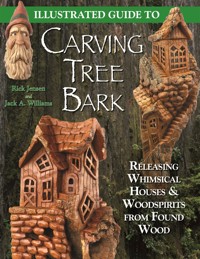
Award-winning carver Rick Jensen, with the help of carver and photographer Jack A. Williams, helps you release the inner spirit from tree bark in this new book. The natural beauty found in a piece of weathered cottonwood bark provides inspiration and direction to create something new and original each time. Inside, you'll find step-by-step instructions on carving a whimsical tree house, plus detailed advice on painting and finishing your carvings. You'll learn about the various species of cottonwood and their particular carving characteristics, plus tips on where to find your supplies. Learn the bark carving basics, tools, how to sketch your ideas, and so much more. Follow along with a series of detailed patterns of a variety of wood spirits and be guided through each step of the finishing process to gain a soft, touchable finish by using a unique combination of lacquers, waxes, shoe polish, and paint.
Sie lesen das E-Book in den Legimi-Apps auf:
Seitenzahl: 73
Veröffentlichungsjahr: 2004
Das E-Book (TTS) können Sie hören im Abo „Legimi Premium” in Legimi-Apps auf:
Ähnliche



















ACKNOWLEDGMENTS
I would like to express my sincere appreciation for the contributions of the following individuals that made this book possible. First and foremost, thanks to my family and especially my wife, Jody, and my daughter, Jaime, for their invaluable assistance with writing, transcribing and editing materials for this book. In addition, I would also like to thank Irene Bertils, whose artwork was a real complement to this project. Thanks also to Larry and Carol Yudis, owners and managers of The Woodcraft Shop, for the use of their shop for the step-by-step photo session. A very special thank you goes to Carole Williams for all of her photographic editing work and to my co-author, Jack A. Williams, for the photography included in this book, as well as his constant support, guidance and encouragement throughout this project. A special thanks goes to Marshal Artime, president of the National Bark Carvers Association, for his support and encouragement. I’d also like to thank Jim Hilty for his scientific contributions on the growth of bark.—Rick Jensen
© 2004 by Rick Jensen and Fox Chapel Publishing Company, Inc., East Petersburg, PA.
Illustrated Guide to Carving Tree Bark is an original work, first published in 2004 by Fox Chapel Publishing Company, Inc. The carvings and patterns in this book are copyrighted by the author. Readers may make copies of these patterns for personal use. The patterns themselves, however, are not to be duplicated for resale or distribution under any circumstances. Any such copying is a violation of copyright law.
Print ISBN 978-1-56523-218-1eISBN: 978-1-60765-899-3
Publisher’s Cataloging-in-Publication Data
Jensen, Rick.
Illustrated guide to carving tree bark / written by Rick Jensen; photography by Jack A. Williams. -- 1st ed. -- East Petersburg, PA: Fox Chapel Publishing, c2004.
p. ; cm.
“Releasing whimsical houses & woodspirits from found wood”--Cover.
1. Wood-carving--Technique. 2. Wood sculpture--Technique. 3. Bark. I. Williams, Jack A., 1938- II. Title.
TT197.7 .J47 2004
2003116442
736/.4--dc22
2008
To learn more about the other great books from Fox Chapel Publishing, or to find a retailer near you, call toll-free 800-457-9112 or visit us at www.FoxChapelPublishing.com.
Note to Authors: We are always looking for talented authors to write new books.
Please send a brief letter describing your idea to Acquisition Editor, 1970 Broad Street, East Petersburg, PA 17520.
Contents
About the Authors
Introduction: Why I Carve Bark
Gallery of Bark Carvings
Chapter One: About Cottonwood Bark
Chapter Two: Bark Carving Basics
Chapter Three: Carving a Whimsical House
Chapter Four: Carving Tree Bark in the Round
Chapter Five: Finishing Bark Carvings
Chapter Six: Patterns
Appendix: Sources for Cottonwood Bark
About the Authors
Rick Jensen got his first taste of carving growing up along the Missouri River bottoms in North Dakota. His father supplied him with a pocketknife at the age of seven. Whittling on sticks started what would become a lifetime of woodcarving.
Upon moving to northwestern Minnesota, Rick became interested in art, including drawing and sculpting. His first carved project was done in a high school art class in 1965. Today, that piece hangs in his home as a reminder of what sparked his interest.
Taking several years off from his art, Rick served in Vietnam, gained a post-secondary education, and began to raise his family of three daughters. He resumed carving in 1984.
Soon after, Rick became interested in woodcarving shows and competitions. While showing his work, he was often approached with the idea of sharing his talent with others by teaching them to carve. He now travels throughout the Midwest and Canada hosting woodcarving seminars.
Some awards he has received at various woodcarving competitions include Best of Show, People’s Choice, Judge’s Choice and Best Table Display, in addition to numerous first and second place awards. Rick has judged carving shows in Canada, Montana and Minnesota.
Rick feels very fortunate to have been chosen by his peers to have his work included in the book, Carving Found Wood by Vic Hood and Jack A. Williams. Other artistic endeavors of Rick’s include antler carving, bone carving and stone carving.
Jack A. Williams is a commercial photographer working from his studio in Knoxville, Tennessee. Photography was once a hobby for Jack until he discovered he could make a living doing what he enjoyed. He then needed a new hobby, so in 1973 he started woodcarving. His first project involved carving an eagle from scrap lumber, not knowing that scrap lumber was not a recommended carving wood.
Undaunted, Jack continued carving. He has since won a third Best of Show in the first National Caricature Carving Competition, a Best of Show at the Ward Wildfowl Carving competition, the People’s and Carver’s Choice and Best of Wood Sculpture at Dollywood and a Best of Division at the International Woodcarvers Congress. Jack also won first place in the Flex-Cut Tool Internet Carving Competition in 2001.
In addition to carving, Jack is also active in the carving community. October 2003 marked the twelfth year for him to coordinate the woodcarving show at Dollywood and the first year to coordinate the National Caricature Carving Competition and Exhibit, also held at Dollywood. He is also a founding member and the current president of the Tennessee Carvers Guild. Jack’s artistic talents have been acknowledged by his peers with an invitation in 2003 to join the Caricature Carvers of America.
Jack now spends a great deal of time photographing carvings at shows and for friends, and his photography appears frequently in many magazines on woodcarving and other subjects. Along with Vic Hood, Jack co-authored Carving Found Wood and Extreme Pumpkin Carving, both published by Fox Chapel Publishing Company.
Introduction
Why I Carve Bark
Cottonwood bark is my choice as the ultimate media for carving due to its rough exterior surface and the beautiful red and gold tones found in the interior of the bark. On average, cottonwood bark is one of the easiest carving materials to use due to its softness, but I have found an occasional piece to be nearly as hard as rock. These, thankfully, are few and far between.
When I began carving bark, I followed the trend and carved wood spirits like so many other carvers. I found this to be fun but looked to find a more individual way of challenging my progressing carving skills. I soon found that more unique shapes better held my interest. Over time, I learned to take advantage of the natural irregularities and textures in cottonwood bark, using them to create carvings of whimsical houses and castles.
Back then I thought the best kind of bark for carving was five inches thick, five inches wide and two feet long. These approximate dimensions were wonderful for realistic face carving and for wood spirits. My ideas concerning the “perfect” piece of bark have most certainly changed.
I now purposely look for twisted, gnarled, uniquely shaped pieces of cottonwood bark. Some of the bark I pick up almost tells me what to carve just by its basic shape. With these pieces, I can create lighthouses, churches, tree houses and more. I utilize natural flaws and lines in the bark to enhance my whimsical creations.
I believe that you can force any carving out of a block of basswood or butternut, but when carving a whimsical house or other figure in bark, the bark truly leads you in the right direction. For this very reason, my houses are like fingerprints. There will never be two that are exactly alike.
Shanty on Beaver Creek
1½" thick, 3" wide, 8" long
Carved from Eastern Cottonwood Bark; lacquer and wax finish
Gallery of Bark Carvings
Breezeway
4" thick, 4" wide, 16" long
Carved from Black Cottonwood Bark; shoe cream finish
The Penthouse
3½" thick, 4" wide, 11" long
Carved from Plains Cottonwood Bark; lacquer and wax finish
On Shakey Ground
4" thick, 5" wide, 10" long
Carved from Plains Cottonwood Bark; lacquer and wax finish
Portobello Palace
3" thick, 5" wide, 15" long
Carved from Eastern Cottonwood Bark; shoe cream finish
Untitled Santa
2½" thick, 3¾" wide, 8" long
Carved from Eastern Cottonwood Bark; acrylic paint, lacquer and wax finish
Untitled Santa
2½" thick, 3½" wide, 11½" long
Carved from Eastern Cottonwood Bark; acrylic paint, lacquer and wax finish
North Shore Breeze
3" thick, 4" wide, 16" long
Carved from Plains Cottonwood Bark; lacquer and wax finish
On-A-Slant Villa
3" thick, 3" wide, 16" long
Carved from Plains Cottonwood Bark; lacquer and wax finish
Chateau Par La Mer
5" thick, 6" wide, 23" long
Carved from Plains Cottonwood Bark; lacquer and wax finish
Island Retreat
2½" thick, 4" wide, 16" long
Carved from Plains Cottonwood Bark; briwax finish
North Shore Retreat
4" thick, 5" wide, 17" long




