


17,99 €
Mehr erfahren.
- Herausgeber: John Wiley & Sons
- Kategorie: Fachliteratur
- Sprache: Englisch
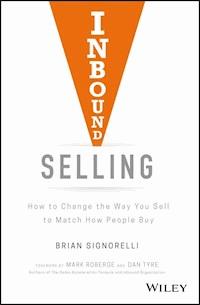
Change the way you think about sales to sell more, and sell better. Over the past decade, Inbound Marketing has changed the way companies earn buyers' trust and build their brands - through meaningful, helpful content. But with that change comes unprecedented access to information in a few quick keystrokes. Enter the age of the empowered buyer, one who no longer has to rely on a sales rep to research their challenges or learn more about how a company's offering might fit their needs. Now, with more than 60% of purchasing decisions made in the absence of a sales rep, the role of the rep itself has been called into question. With no end in sight to this trend, sales professionals and the managers who lead them must transform both the way they think about selling and how they go about executing their sales playbook. Expert author and HubSpot Sales Director, Brian Signorelli has viewed the sales paradigm shift from the inside--his unique insights perfectly describe the steps sales professionals must take to meet the needs of the empowered customer. In this book, readers will learn: * How inbound sales grew out of inbound marketing concepts and practices * A step-by-step approach for sales professionals to become inbound sellers * What it really means to be a frontline sales manager who leads a team of inbound sellers * The role executive leadership plays in affecting an inbound sales transformation For front-line seller, sales manager, executives, and other sales professionals, Inbound Selling is the complete resource to help your business thrive in the age of the empowered buyer.
Sie lesen das E-Book in den Legimi-Apps auf:
Seitenzahl: 363
Veröffentlichungsjahr: 2018
Ähnliche


















CONTENTS
Cover
Praise for
Inbound Selling
Title Page
Copyright
Dedication
Acknowledgments
Foreword
On the History of Sales through the Salesperson's Eyes
On the Current State of Sales and What the Decades Ahead May Hold
Preface
Introduction
An Interview with Brian Halligan, CEO and Chairman, HubSpot 2
Part 1: The “Why?” Behind Inbound Sales
Chapter 1: I Was Never Supposed to Be in Sales
Chapter 2: Why Inbound Sales Matters
Core Characteristics of the Modern Sales Rep
Why Inbound Sales Matters
The Inbound Sales Process and Inbound Sales Methodology
The Inbound Sales Methodology7
Part 2: How to Be an Inbound Seller: A Playbook for the Front-Line Sales REP
Chapter 3: Identify: How to Identify the Right People and Businesses to Pursue
How to Define Buyer Fit Before Practicing Inbound Sales
We've Documented, Shared, and Socialized Everything. What's Next?
Final Planning Steps before You Attempt to Engage Anyone, in Any Way
Chapter 4: Connect: How to Engage Active—and Not So Active—Buyers
Connect Call Mechanics
Chapter 5: Explore: How to Properly Explore a Buyer's Goals and Challenges
Getting in the Right Frame of Mind
Exploratory Call Question Examples, in Context
Exploratory Call Follow Through: The Power of a Recap Letter
Chapter 6: Advise: How to Advise a Buyer on Whether or Not Your Solution Addresses Their Needs
Part 1: Goals, Plans, Challenges, and Timeline
Part 2: Plans to Achieve Sales and Marketing Goals
Concluding the Advise Step: The Soft Close
Chapter 7: Closing and Negotiating
The Inoffensive Close1
The “1 to 10” Technique
The Perfect Close
Facing Reality: Closing and Negotiating Are Similar, but Not the Same
How to Negotiate
Part 3: How to Lead Inbound Sellers: Reflections for the Front-Line Sales Manager
Chapter 8: The First-Time Sales Rep–to-Manager Survival Guide
So, You Think You Want to Be a Sales Manager?
“Growing Up” as a Sales Leader
If You Want to Become a Better Coach—and in Turn, a Better Leader—Here's What to Do Next
Chapter 9: Reflections on Sales Leadership
Leadership Artifacts and Examples from My Own Management Experiences
Part 4: What Inbound Selling Means Across the Executive Suite
Chapter 10: Sales Is a Team Sport: The Executives' Guide to Transforming into an Inbound Sales Organization
Part 1: Inbound Selling and the Future of the Sales Function
Part 2: How to Create Sales and Marketing Alignment to Drive Growth
Part 3: The Role of Sales Enablement to Fuel Revenue Growth
Part 4: Building a Sales Operations Team to Set Up Growth
Part 5: The Future of Sales and the Sales Profession
Chapter 11: The Future of Sales: An Epilogue
U.S. Consumer Spending (in Millions)
Index
End User License Agreement
List of Tables
Table 11.1
List of Illustrations
Figure 2.1
Figure 3.1
Figure 3.2
Figure 3.3
Figure 3.4
Figure 3.5
Figure 3.6
Figure 3.7
Figure 3.8
Figure 3.9
Figure 5.1
Figure 6.1
Figure 6.2
Figure 6.3
Figure 6.4
Figure 6.5
Figure 6.6
Figure 7.1
Figure 8.1
Figure 8.2
Figure 11.1
Figure 11.2
Guide
Cover
Table of Contents
Begin Reading
Part 1
Chapter 1
Pages
i
ii
v
vi
vii
xi
xii
xiii
xiv
xv
xvi
xvii
xviii
xix
xx
xxi
xxii
xxiii
xxiv
xxv
xxvi
xxvii
xxix
xxx
xxxi
xxxii
xxxiv
xxxv
xxxvi
1
2
3
4
5
6
7
8
9
10
11
12
13
14
15
16
17
18
19
20
21
22
23
24
25
26
27
28
29
30
31
32
33
34
35
36
37
38
39
40
41
42
43
44
45
46
47
48
49
50
51
52
53
54
55
56
57
58
59
60
61
62
63
64
65
66
67
68
69
70
71
72
73
74
75
76
77
78
79
80
81
82
83
84
85
86
87
88
89
90
91
92
93
94
95
96
97
98
99
100
101
102
104
105
106
107
108
109
110
111
112
113
114
115
116
117
118
119
120
121
122
123
124
125
126
127
128
129
130
131
132
133
134
135
136
137
138
139
140
141
142
143
144
145
146
147
148
149
150
151
152
153
154
155
156
157
158
159
160
161
162
163
164
165
166
167
168
169
170
171
172
173
174
175
176
177
178
179
180
181
182
183
184
185
186
187
188
189
190
191
192
193
194
195
196
197
198
199
200
201
202
203
204
205
206
207
208
209
210
211
212
213
214
215
216
217
218
219
220
221
222
223
224
225
226
227
228
229
230
231
232
232
233
234
235
236
237
238
239
240
241
242
243
244
Praise for Inbound Selling
“Inbound Selling is a handbook for organizations, managers, and sales professionals who are ready to adapt to a world where the buyer is in control and competition is closing in.
As a first-time salesperson and sales manager, a top performer and studious learner, Signorelli provides a first-person account of his years inside the HubSpot rocket ship as it grew revenue from tens to hundreds of millions per year. Combined with interviews with accomplished sales executives and lessons learned from books and training, Signorelli builds on decades of sales expertise that will be useful for sales professionals of all levels of experience and organizational responsibility.
Having read hundreds of sales books, I have not read one that so thoroughly provides so many practical lessons.”
—Peter Caputa IV, CEO, Databox
“Inbound Selling dismisses the notion that “sales” is a dirty word and shifts the way you think about how you sell. In departing from the well-known, pushy, and abrasive sales tactics of yesteryear, Brian advocates a highly personalized, yet scalable approach of identifying and remedying a buyer's current business challenges. He laces the pages with humorous anecdotes of humbling experiences to present an inviting learning environment for anyone in sales or anyone interested in sales. It's an evocative read that provides a turnkey framework that's as comprehensive as it is pragmatic. To put it plainly, if you're not inbound selling, you're doing it wrong.”
—Rachael Plummer, sales professional and Inbound Seller, HubSpot
“You hold in your hands a complete playbook for the journey of a sales rep from old school to what works today. Buyers have changed. Many salespeople haven't. Nearly every buying decision starts online. Buyers have as much or more information than salespeople. Salespeople need to work on improving the all-too-tenuous relationships that exist (or more likely don't exist) between buyers and sellers today. Sales rep processes have been shaken up due to the disruption of technology. Brian's been there and done that. He states, “I was never supposed to be in sales.” Yet he learned and grew as a young rep at HubSpot into a sales leader. He's been down and dirty in the front lines of sales. He's emerged with this book and both strategic and tactical advice for how to navigate the sales journey with today's empowered buyers. Beginning with his journey as an inexperienced rep with lots of ideas, but no real sales experience, Brian walks us step-by-step through his sales journey: his emotions on hearing no over and over (and what it felt like to hear yes), his real-world experiences and how he could have done better, why he decided to move into sales management—and what he wished he had known before making that move. Unlike high-level strategic sales leadership books, which are great in theory but aren't practical in reality, this one is deep in the trenches, sharing hard-won insights from personal experience and digging into the mechanics of how to sell now. Today, not 10 years ago. Buckle up for this inbound sales journey—it's packed with actionable examples throughout.”
—Lindsay Kelley, head of digital and content marketing, Telit
“For any salesperson, sales manager, or business owner looking to learn how to adapt to the new way customers buy and turbocharge their growth, this is the book!”
—Matthew Cook, CEO, SalesHub
“The world of sales has been flipped on its axis over the past decade. Buyers have seized control from what once was a highly orchestrated, controlled, and (some would say) manipulative process. Salespeople and sales organizations have had to learn new skills and to develop new processes. A result of this “sales revolution” has been a new approach to selling called Inbound Sales. There are few people in the world who have studied, practiced, and refined the process like Brian Signorelli. In this book, Brian shares everything you need to know to be successful with this approach. It's a must-have for any salesperson or growth executive's bookshelf (or Kindle).”
—Doug Davidoff, CEO and founder, Imagine Business Development
Inbound Selling
How to Change the Way You Sell to Match How People Buy
Brian Signorelli
Cover design: Wiley
Copyright © 2018 by Brian Signorelli. All rights reserved.
Published by John Wiley & Sons, Inc., Hoboken, New Jersey.
Published simultaneously in Canada.
No part of this publication may be reproduced, stored in a retrieval system, or transmitted in any form or by any means, electronic, mechanical, photocopying, recording, scanning, or otherwise, except as permitted under Section 107 or 108 of the 1976 United States Copyright Act, without either the prior written permission of the Publisher, or authorization through payment of the appropriate per-copy fee to the Copyright Clearance Center, 222 Rosewood Drive, Danvers, MA 01923, (978) 750-8400, fax (978) 646-8600, or on the web at www.copyright.com. Requests to the Publisher for permission should be addressed to the Permissions Department, John Wiley & Sons, Inc., 111 River Street, Hoboken, NJ 07030, (201) 748-6011, fax (201) 748-6008, or online at www.wiley.com/go/permissions.
Limit of Liability/Disclaimer of Warranty: While the publisher and author have used their best efforts in preparing this book, they make no representations or warranties with respect to the accuracy or completeness of the contents of this book and specifically disclaim any implied warranties of merchantability or fitness for a particular purpose. No warranty may be created or extended by sales representatives or written sales materials. The advice and strategies contained herein may not be suitable for your situation. You should consult with a professional where appropriate. Neither the publisher nor the author shall be liable for damages arising herefrom.
For general information about our other products and services, please contact our Customer Care Department within the United States at (800) 762-2974, outside the United States at (317) 572-3993 or fax (317) 572-4002.
Wiley publishes in a variety of print and electronic formats and by print-on-demand. Some material included with standard print versions of this book may not be included in e-books or in print-on-demand. If this book refers to media such as a CD or DVD that is not included in the version you purchased, you may download this material at http://booksupport.wiley.com. For more information about Wiley products, visit www.wiley.com.
Library of Congress Cataloging-in-Publication Data
Names: Signorelli, Brian, author.
Title: Inbound selling : how to change the way you sell to match how people buy / Brian Signorelli.
Description: Hoboken : Wiley, 2018. | Includes bibliographical references and index. |
Identifiers: LCCN 2017056770 (print) | LCCN 2017058103 (ebook) | ISBN 9781119473442 (pdf) | ISBN 9781119473275 (epub) | ISBN 9781119473411 (hardback)
Subjects: LCSH: Selling. | Telemarketing. | Customer relations. | BISAC: BUSINESS & ECONOMICS / Sales & Selling. | BUSINESS & ECONOMICS / Marketing / Telemarketing.
Classification: LCC HF5438.25 (ebook) | LCC HF5438.25 .S567 2018 (print) | DDC 658.85--dc23
LC record available at https://lccn.loc.gov/2017056770
To Pete and Dannie
Acknowledgments
Thank you to Ryan Ball, Sam Belt, Kipp Bodnar, Dani Buckley, Peter Caputa, Matthew Cook, Doug Davidoff, Katharine Derum, Matt Dixon, Nathaniel Eberle, Debbie Farese, Jill Fratianne, Brian Halligan, Danielle Herzberg, Justin Hiatt, Lauren Hintz, Lindsay Kelley, Hunter Madeley, David McNeil, Rachael Plummer, Mark Roberge, Dan Tyre, Derek Wyszynski, Leah, Dixie, and Charlotte for contributing to this work in many ways, shapes, and forms. Thank you to my entire HubSpot family, and, of course, the team at John Wiley & Sons, for making this possible.
Foreword
I couldn't ask for a more dynamic, experienced, and exciting duo to write the foreword for this book. The sixth employee and current director of sales at HubSpot, Dan Tyre is a world-renowned speaker, adviser, mentor, and investor to companies and individuals around the world on the topic of sales. Mark Roberge was HubSpot's fourth employee and head of sales through its run up to $100 million in revenue. Now a senior lecturer at Harvard Business School, Mark served as HubSpot's SVP of Global Sales and Chief Revenue Officer from 2007 to 2016. He is the author of the best-selling book The Sales Acceleration Formula.
I've asked Dan and Mark to discuss—in their own words—the history, current state, and future of sales.
On the History of Sales through the Salesperson's Eyes
by Dan Tyre
From my earliest recollection, the sales profession has suffered from a tarnished image. It's hard to pinpoint exactly where this reputation started. In the late nineteenth century—the early days of the geographic expansion of the United States—settlers purchased essential goods from a peddler or traveling salesman basically because they had no choice. The sales profession wasn't so much a profession as it was just someone with a horse and wagon. Transportation was the differentiating factor; the product and quality were secondary. Faced with an option to sell to a customer once and likely never see the prospect again, you can guess how that turned out. Exactly. Unfortunately, this activity usually resulted in an awful customer experience, tarnishing the image of the salesperson.
As the early US economy matured, storefronts became a more acceptable place to purchase goods and salespeople or shop owners became a bit more accommodating. It was much more important to sell and support quality products alongside good service when your customers knew who you were, how to get to your house, and saw you every day.
Fast-forward to the 1950s. The inevitable changes in mass media and technology created the Golden Age of Marketing when the Mad Men era gave rise to a mass marketing of products and services to a wide population, mostly through radio and TV. At that time, marketing became more important than sales as a way to create demand, but most salesmen (mostly a male-dominated industry at this point) maintained relatively low or nonexistent ethical, honesty, and quality levels.
My Own Start in Sales: The Days of the Disenfranchised Buyer
When I started my sales career as a teenager in the 1970s, the sales occupation was decidedly dicey. Sales was the land for misfit toys, a vocation of last resort, and the place managers stuck people who had very little aptitude (and in some cases, intelligence). The sales role required a lot of hard work, but it did pay well, and in most cases, you didn't have to sit in an office all day working on spreadsheets or study and pass any difficult certifications. With a grade point average that made my parents wince, I thought it might be a reasonable way to make a living for myself.
My first sales job was selling dictionaries for the Southwestern Corporation in 1976 and 1977. It was a comprehensive education in people, process, human motivation, and hard work. I went to school in Upstate New York, but was assigned a territory in Bellingham, Washington, and Portland, Oregon. I was given no salary, one week of group sales training, and dropped off with two other sales recruits, 3,000 miles from home. Our bible at the time was Tommy Hopkins's How to Master the Art of Selling. The odds of success were steep. But I realized a few things that proved to be valuable lessons throughout my business career. First, people were very different and had very different reasons for purchasing a product, so a successful salesperson needed to modify behavior to increase the potential to close a deal. Second, there was an actual process to work through a sale—a similar, repeatable way that you could determine who to spend your time with and how to treat the prospect at every stage. And, third, the more times you repeated this predefined sales process, the greater your success.
In those days, we followed a very seller-centric sales process. We were indiscriminate in our approach and would sell to virtually anyone (although people with school-age children or grandkids were more qualified). Prospecting was an actual physical process, where you would knock on as many doors as possible to try to connect face to face (sometimes referred to as “belly to belly”) with people. This process included identifying prospects, doing a small bit of qualifying to determine fit, demoing a product, leaning hard into an emotional reason to buy, answering objections, and then going for the close.
Back then, we used sales techniques like the puppy dog close (let them hold the dictionaries so they wouldn't give them back) or the porcupine close (answering a question with a question). It was fascinating to learn these skills because the sales profession was shrouded in mystery and understanding how people made decisions regarding a product purchase gave you additional power and insight into human behavior that could be applied to other parts of your life.
In the 1980s, I went to work for a startup that sold IBM personal computers and learned an evolved way of selling—solution-oriented selling. Although this was still seller centric, it involved asking a series of questions to understand the problems a prospect wanted to solve and digging into her specific information and situation to provide a unique solution. It was transformative for several reasons: First, it involved discovery of what the customer was looking for rather than the product features you were selling. Second, it required you to know something about your prospect's business and how your product would fit into that business. And, third, it became a competitive advantage for building trust and closing the deal. It worked, and it worked well.
Sales at the Beginning of Content Marketing
For the first 25 years of my sales career, sales and marketing were diametrically opposed and almost always at odds. When you were running a company, and wanted to increase revenue, you would hire a hard-charging sales leader to come in and hire field salespeople to gain market share. In most cases, the more salespeople you added, the more revenue you generated. Marketing, however, was always in the doghouse with everyone. At the board of directors level, marketing was always an expense with little correlation to success. At the senior management level, marketing was “squishy” and hard to measure. In the trenches, marketing was always in the doghouse because they would create the brand and generate leads, but the leads were either not coming fast enough (therefore, they were in the doghouse) or exhibited questionable quality (so they were in trouble with that, too).
As virtually the entire world shifted its buying behavior online as opposed to in-person channels (2000–2010), marketing proved to be a much more important contributor to revenue generation for several reasons. First, the sheer efficiency for lead generation through a website dwarfed any type of manual lead generation process that a salesperson (or marketing department could produce). Second, the effectiveness and ease through which sellers connected with qualified buyers increased because a salesperson understood who was interested in their company's products or services. Third, inbound marketing eliminated the most time-consuming, low-value activity in the sales process (prospecting) and replaced it with a self-selection process to connect with higher value clients. Fourth, that enhanced sales process typically led to better results. Fifth, because of the online nature of the transaction, it could be accomplished via the web or phone, greatly reducing the typically high cost of most sales processes. Finally, with that high volume of transactions came an ability to capture valuable data and use it to improve the sale process itself.
In 2007, as the second salesperson for HubSpot, I was lucky enough to work with Mark Roberge and witness the dawn of the inbound marketing era. I initially cold-called to generate new business. I started with all my friends and family and connected with anyone who would listen and explained the HubSpot inbound marketing value proposition. People typically had two questions: What is inbound marketing? And, Will it work? I always smiled and explained that the discipline was new, but that it seemed to make sense to me and that I had experienced the value myself as an early HubSpot customer.
Moving from traditional sales to inbound sales was extraordinarily transformational. I went from meeting face to face at the prospect's office to meeting over the phone. I went from investing a lot of time and effort prospecting to working with people who were already expressing interest in my company's research, blog posts, and other content. I went from pushing a “pitch” to simply starting a conversation, armed with an understanding of what the prospect was likely looking for help with. Inbound was completely different because it was prospect centric, not seller centric. It was efficient, consultative, and just felt right.
Over the next 10 years, salespeople will have the same opportunities that marketers have had for differentiating their value based on the way in which they sell. Marketers who invested in inbound in the last decade largely saw a significant return on that investment. It will be the same for salespeople. In my opinion, it might be a bit harder for salespeople to change to the new way of doing things, but that does not make it a meaningless or worthless endeavor. In fact, quite the opposite is true.
The future is super exciting for the salesperson who is willing to learn this new way of selling, leverage the technology right in front of them, and ultimately transform the way they sell to match how people want to buy.
On the Current State of Sales and What the Decades Ahead May Hold
by Mark Roberge
When I interviewed and hired the author of this book back in 2012, I had no idea of the impact he would have on our company. Accelerating through the ranks, first as a top-performing salesperson, then sales leader, Brian exhibited a form of salesperson-ship that made me proud. Seeing him assemble this work and further the entire field takes pride to an entirely new level.
In 2007, I teamed up with a few classmates from MIT to help start HubSpot, a software company based in Cambridge, Massachusetts. I was the fourth employee and first salesperson. Using many of the concepts Brian has captured in this book, I successfully scaled sales to more than 10,000 customers, generating more than $100 million in annualized revenue, and oversaw a global team of more than 400 employees. It was an amazing ride. The pace was exhilarating. The impact we had on our customers' lives was enormously gratifying. However, hiring people like Brian, watching them develop in our organization, and now seeing the broader impact they are having on the field is probably the most satisfying aspect of the experience.
Since I left HubSpot, my perspective has expanded across a range of go-to-market contexts. I teach sales and entrepreneurship full time at Harvard Business School. I help large companies transform their go-to-market functions as a senior adviser for Boston Consulting Group. I help dozens of startups each year accelerate their revenue growth as an investor, adviser, and board member. Through these experiences, I have developed an appreciation around how broad the applications of inbound selling truly are.
The Internet-Empowered Buyer Made Legacy Selling Ineffective
As Dan noted, before the Internet, buyers had to talk to salespeople to make a purchase. They needed to understand the details of the offering, how the offering differed from the competition, how much it cost, the resources needed to install or use it, and so on. Some salespeople abused this information power. They used it to engage with buyers that were not a good fit. They manipulated the truth to get a sale. And they got away with it. Sales left a bad taste in many buyers' mouths.
The Internet changed both situations. Buyers no longer need salespeople to make purchases. Online, buyers can read about the details of the offering, compare offerings across competitors, and usually understand how much it costs. Sometimes they can even try the product and often they can buy it, all without talking to a salesperson. Does that mean sales is dead? No, in my humble opinion. However, this context shift dramatically changes the way sales must be executed.
Second, salespeople can no longer get away with jamming bad-fit products or services into buyers' hands, nor can they get away with overselling. Before the Internet, a small fraction of the addressable market would hear about this negative behavior. Today, a lot of buyers will find out and within minutes. Between the major social media sites like Facebook, LinkedIn, and Twitter, and customer review sites like Yelp or G2 Crowd or even niche industry forums where peers across companies are well connected, word travels fast. Overselling is the kiss a death for a salesperson, their offering, and their company.
The Transformation to Inbound Selling
Because of these buyer context evolutions, some sales roles have been and will continue to be automated. Whether you call it “show up and throw up” or crocodile selling (big mouth, little ears), this basic form of selling will become extinct. These salespeople add no value. The information these salespeople provide is already accessible at the buyer's fingertips in a more trustworthy setting than the salesperson can provide.
For more complex selling contexts where automation is difficult, legacy salespeople will be replaced with inbound sellers. Complex contexts come in many forms. Perhaps the offering has many configurations, which makes it difficult for the buyer to understand which is best for them. Perhaps the offering is in a new, underdeveloped space and the buyer needs help understanding it. Probably most common, perhaps buyers are not sure they are framing their own business challenges or opportunities correctly. They need help from knowledgeable salespeople to understand how to frame challenges or opportunities before hearing about offerings.
In these selling contexts, inbound sellers will thrive. They will engage with buyers in a highly personalized way, turning the data accessibility of the Internet into an ally rather than an enemy. They will build trust with buyers and use that trust to understand deep buyer context. They will educate the buyer to help them frame their context even more accurately. They will present their offerings in a manner customized to the buyer's context, acting as a translator between the generic messaging available online and the unique buyer needs. These sellers will develop a reputational track record, both online and offline, that will fuel their sales success exponentially.
So, as a Seller, What Can You Do to Align with the New Selling Paradigm?
Walk in your buyer's shoes. It is not enough to understand your offering. Understanding your buyer's context is just as important. At HubSpot, every salesperson went through a month of training before they ever talked to a prospect. While they did receive some sales training, most of the training revolved around walking in the buyer's shoes. Each salesperson had to create a website and blog, publish articles, engage in social media, set up landing pages, develop email and lead nurturing campaigns, and analyze their marketing results, all using the HubSpot software. Salespeople developed a deep understanding of a marketer's challenges, related to these prospects more intimately, and could better help prospects through the challenges they were facing.
Contribute to the knowledge your buyer consumes. The best HubSpot salespeople invested time each week in engaging online where our prospects were congregating. They read the blogs the prospects read and commented on them. They followed the influencers our prospects followed and highlighted the best articles. They participated in the industry forums where prospects were active. Most impactful, they wrote guest posts on our company blog. Sometimes these efforts generated leads for the salesperson. However, more importantly, these efforts enabled these salespeople to develop trust with their prospects. They could point prospects to work they had done or work they had promoted that aligned with prospect's unique needs. These efforts also kept these salespeople on the forefront of the industry thought leadership.
Don't oversell. Be honest. Set accurate expectations. Be trustworthy. Rebrand the field of sales. At HubSpot, we measured, compensated, and promoted salespeople not just on new revenue acquisition but also on lifetime value of their customers.
Read this book. Brian helped us figure out this new mode of selling at HubSpot. He has now eloquently codified these principles into a valuable piece of work.
Preface
I started writing this book in September 2015, right before a wedding in Gloucester, Massachusetts, for two people who had become good friends of mine in the years prior. Sitting in a hotel room by myself waiting for the ceremony to begin, I had a flash of panic come over me, totally unrelated to the night ahead—I realized that I was starting to forget some of the core principles I had learned as a sales rep at HubSpot.
At that time, it had only been a year since I became a sales manager for the team that I was previously a member of. But in that short period––focusing my efforts more on coaching, training, and recruiting for my team rather than selling day in and day out––my sales “blade” seemed to be losing its edge. During one-on-one meetings, team members who had worked with me for some time started reminding me of core selling principles that had somehow slipped my memory. So, in that moment, I started to write down everything I could remember about how sales worked at HubSpot. I wanted to capture everything I had learned and that had been passed on to me. At the time, I didn't know what I would do with the resulting work, but I knew that I needed to get it out of my head before it was gone for good.
In the matter of a week or two, I had about 10,000 words written…and still had a lot more to say. I started to realize that, despite my mentor's advice, this would end up being more than a long blog post or even an e-book. So, I kept writing. When I was done, I had produced around 50,000 words over the course of about four or five months. But it was unstructured; it didn't have a clear arc, and it felt incomplete.
While that stream of consciousness document I started producing in that hotel room was originally intended solely for the front-line sales rep (Chapters 3 to 7), it felt like it would have been a waste had I stopped there. I had learned more as a sales manager, and had also learned so much from other executives, that it felt like a worthy endeavor to include and share those learnings too, as best as I could. As you navigate through this work, keep in mind that it's broken into roughly five parts:
Part 1
: The “Why?” behind Inbound Sales (
Chapters 1
and
2
)
Part 2
: How to Be an Inbound Seller: A Playbook for the Front-Line Sales Rep (
Chapters 3
through
7
)
Part 3
: How to Lead Inbound Sellers: Reflections for the Front-Line Sales Manager (
Chapters 8
and
9
)
Part 4
: What Inbound Selling Means across the Executive Suite (
Chapter 10
)
Part 5
: The Future of Sales and the Sales Profession (
Chapter 11
)
My humble hope in sharing what I've learned, as well as my own personal story, is that front-line sales reps take away just one thing that they might want to do differently, sales managers consider just one way they can make their team members' lives better, and that leaders in the executive suite realize their business needs to change the way it sells to match how people buy if it is to succeed in the age of the empowered buyer.
Don't hesitate to share your criticism—for better or worse—by connecting with me on LinkedIn. I look forward to hearing from you, helping you, or learning from you in the future.
Introduction
It's of paramount importance to recognize business pioneers and give credit where credit is due for industry-transforming concepts. Brian Halligan is one such pioneer, and I can't think of a better way to introduce this book than by sharing my late 2015 interview with him. Alongside his co-founder, Dharmesh Shah, he founded HubSpot in 2006, setting out on a mission to transform the way the world does marketing.
It's a funny thing though, when you set out to transform a business function. Once you accomplish that goal, it's difficult to just stop at one function. So, Brian and Dharmesh went on to expand their mission in 2014 and shared their vision for creating an entirely inbound business. The next stop on their journey lay in transforming the way the world does sales, which is, of course, what this book is all about.
So that you can develop your own understanding and appreciation for how Brian sees the sales world transforming, on the next pages I reproduce the transcript of that 2015 interview. First, though, a little bit about Brian and his background.
Brian Halligan is co-founder and CEO of HubSpot. Prior to HubSpot, Brian was a venture partner at Longworth Ventures and VP of sales at Groove Networks, which was acquired by Microsoft. Previously, Brian was a senior VP of sales at PTC.
He has co-authored two books, Marketing Lessons from the Grateful Dead, with David Meerman Scott and Bill Walton, and Inbound Marketing: Get Found Using Google, Social Media, and Blogs, with Dharmesh Shah.
Brian serves on the board of directors for the Fleetmatics Group (FLTX), a global provider of fleet management solutions. He was named Ernst & Young's Entrepreneur of the Year in 2011, a Glassdoor 25 Highest Rated CEO in 2014 and 2015, an Inc. Founders 40 in 2016, and a #2 Best CEO of 2017 by Employees on Comparably.
Around the community, Brian's favorite charity is Camp Harbor View, serving nearly 1,000 youths from Boston's at-risk neighborhoods through two four-week summer camp sessions on Long Island in the Boston Harbor.
In his spare time, Brian follows his beloved Red Sox and is a voracious reader. He teaches a course called Designing, Developing, and Launching Successful Products in an Entrepreneurial Environment at MIT's Sloan School of Management.1
An Interview with Brian Halligan, CEO and Chairman, HubSpot 2
December 2015. Edited for length and clarity.
Brian:
Brian, I appreciate you taking the time to chat with me. Let's start with how you got started in sales.
Halligan:
I started in sales in 1990, right out of school. I'll give you my full back story. I was an engineer in college, an electrical engineer. I did an internship during my junior and senior year at an engineering job, and I concluded that I just didn't like it. Always hanging out with the sales guys, their focus was on customers and sales. So, I inevitably went to work for a very fast-growing software company with a strong sales culture as a secretary for a VP of sales. They started giving me sales projects when I became their first BDR—in today's language—and it just went from there. That's how I got started.
Brian:
Tell me about that job. I'm also interested to know how you see it being different from what sales looks like today.
Halligan:
I was in outside sales, and outside sales worked back then compared to today. There was no such thing as WebEx or GoToMeeting or Zoom. You spent your whole life, basically, on a plane visiting accounts. You would fly across the country and go on a bunch of sales calls in the city. It was wildly inefficient. On a trip, I had to bring a Unix work station and a giant monitor with me, which is like a hundred-pound thing to carry through airports and through everywhere. Your hands would fall off, it was so painful.
One out of every three or four times, the meetings I had scheduled would cancel at the last minute. You slept in the city with your really heavy computer. It was ridiculous when I think about it now. Back then people wanted to see you and spend time with you. People wanted to go out to dinner with you and go to the game with you.
I just think about selling today. Outside makes no sense given the cost of a telephone call, given the technology with telepresence software, webinars, and so on. To get on a plane and fly across the country now, there's at least a 30% chance you're going to have a meeting canceled. It's just crazy. I also just think people don't want to see a sales rep face to face anymore. They don't necessarily want to have dinner with that sales rep or go to the game with the sales rep. They want to go home and see their family.
It was different when I was a sales rep. Every Tuesday was “cold-call day.” You'd cold-call all day to set up appointments for the rest of the week. It was the worst day of the week. But it actually worked. People would pick up the phone back then. They didn't have caller ID. There was no email. You just called them. That was the only way you got though. People needed you more. People picked up the phone more.
Second, they were more likely to call you back because there was no good way to find out what products were in the marketplace. You'd go to the library or talk to friends. You couldn't just do a search on competitive options; it was actually hard to figure that stuff out. Buyers were much more reliant on you, whereas today, the calling just doesn't work. Nobody answers the phone.
Today, buyers don't need you as much as they used to because all that information is right at their fingertips. They can make a recording and ask questions, go to a website and find products and pricing, Google and find your competitors, connect with you on LinkedIn. It's totally different. The thing that is frustrating to me, and the thing I think is a big opportunity, is most salespeople still operate like it's 1990. It's a big opportunity, if you completely rethink it.
Brian:
If the way the buyers buy has changed, why do you think sellers haven't caught up to that yet? Where's the disconnect?
Halligan:
I think behavior is hard to change. Let's say you're a sales rep and you've spent the past 20 years doing something to make your numbers. You've got a system and a process that you've developed and you're making decent money. It's just hard to change behavior. Even though intellectually it's sort of not, it makes sense. For example, you're sitting there and you're a sales rep. Calls are coming into your phone. You're looking at your caller ID, you don't answer it. You get cold emails coming in and you never answer them. You consider those cold calls when they come to you, and you consider those messages spam when they come to your email. But for some reason, in your eyes, they're
not
spam when you're sending those same emails to prospects, you call that email marketing. And it's not a cold call when you pick up the phone to call some, it's prospecting. It takes a long time for that disconnect to work its way out.
Brian:
What's the tipping point then? Is it just waiting for a new generation?
Halligan:
We're seeing it on the marketing side. It's the same thing with marketers. They're still doing tons of TV ads. They're wasting their money on that. Tons of them are buying lists and spamming people. Many are doing all that old-school stuff that doesn't work as well anymore and is incredibly hard to measure. It just takes time to get past it. It's just like anything else. It just takes time for a market to adapt to modern realities.
Brian:
One thing I've been thinking about recently is whether or not the term “inbound selling” is an oxymoron. Inbound selling is predicated on the idea of engaging prospects by listening for buying signs, answering the questions they have, and helping them solve their challenges and problems. But it still typically requires the sales rep to initiate contact, which would be considered “outbound”; the buyer didn't actually start the conversation with the rep specifically. Can a salesperson truly be
inbound
? Is it possible?
Halligan:
I think you can. Let's just compare and contrast how I might do it. The traditional way of doing it as a salesperson is this: I go get a list of a hundred people in my territory and I get the email addresses. The emails get sent to the company and I begin there. I'm a climber. I get the first name and the person right on the email but basically I just pound out the work. The likelihood of getting a response is so low, you might get one response. I think you're better off spending the time to call on the people who are already on your website, because you already have people you're trying to connect with on your site in the first place.




