


49,99 €
Mehr erfahren.
- Herausgeber: John Wiley & Sons
- Kategorie: Fachliteratur
- Serie: IEEE PCS Professional Engineering Communication Series
- Sprache: Englisch
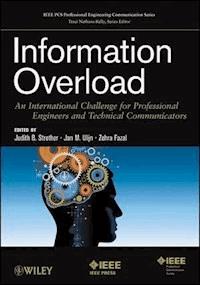
This book covers the ever-increasing problem of information overload from both the professional and academic perspectives. Focusing on the needs of practicing engineers and professional communicators, it addresses the causes and costs of information overload, along with strategies and techniques for reducing and minimizing its negative effects. The theoretical framework of information overload and ideas for future research are also presented. The book brings together an international group of authors, providing a truly global point of view on this important, rarely covered topic.
Sie lesen das E-Book in den Legimi-Apps auf:
Seitenzahl: 651
Veröffentlichungsjahr: 2012
Ähnliche


















Contents
Cover
Series Page
Title Page
Copyright
Dedication
List of Practical Insights from Corporations
List of Figures
List of Practical Insights Figures
List of Tables
Foreword
About the Author
References
Preface
Acknowledgments
A Note from the Series Editor
Contributors
About the Editors
Chapter 1: Information Overload: An International Challenge to Professional Engineers and Technical Communicators
1.1 Definitions, Causes, and Consequences of Information Overload
1.2 Perspectives on the Concept of Information Overload
1.3 Readers of this Book
1.4 Structure of this Book
References
Section I: Causes and Costs of Information Overload
Chapter 2: Of Time Magazine, 24/7 Media, and Data Deluge: The Evolution of Information Overload Theories and Concepts
2.1 Introduction
2.2 Theory and Concept of Information Overload
2.3 Information Overload as a Twentieth Century Phenomenon
2.4 Evolution of Information and Its Proliferation in Society
2.5 Information Overload Concepts
2.6 Conclusion and Four Lessons Learned
Acknowledgment
References
Practical Insights from IBM
Chapter 3: The Challenge of Information Balance in the Age of Affluent Communication
3.1 Introduction
3.2 Quantitative Aspects of Information Overload
3.3 Qualitative Aspects of Information Overload
3.4 Conclusion
3.5 A Call for Fundamental Research
References
Practical Insights from Xerox
Xerox Takes on Information Overload
Identifying the Problem
Sharing Information
Sorting Information
Cutting Through the Clutter
Life-Saving Software
Urban Central Nervous System
Chapter 4: From Cave Wall to Twitter: Engineers and Technical Communicators as Information Shaman for Digital Tribes
4.1 Introduction: The Dawn of the Information Shaman
4.2 The Magic of Metaphor
4.3 The Audience: The Emergence of Digital Tribes
4.4 Quill to Keyboard: The Writer and New Media
4.5 Helping the Reader: Techniques for the Information Shaman
4.6 The Magic of Hypertext Techniques: Journeys at the Speed of Thought
4.7 Conclusion: The Responsibilities of the Information Shaman
References
Practical Insights from the Limburg Media Group
Newspaper Position in The Netherlands
Managing Information Overload Using an Evolutionary Approach
A Revolutionary Perspective
Chapter 5: The Influence of Culture on Information Overload
5.1 Introduction
5.2 Levels of Culture
5.3 Cultural Patterns of Discourse Organization
5.4 High Context Versus Low Context
5.5 Internationalization Versus Localization
5.6 The Effect of Professional Culture
5.7 Japan and U.S. Discourse Structures
5.8 Cultural Issues in Reader Versus Writer Responsibility
5.9 Implications for Engineers and Technical Communicators and Their Corporations
5.10 Conclusion
References
Practical Insights from A2Z Global Languages
Chapter 6: Effect of Color, Visual form, and Textual Information on Information Overload
6.1 Introduction
6.2 Previous Studies of Decorative and Indicative Effects
6.3 Experiments and Results
6.4 Practical Implications for Engineers and Technical Communicators
6.5 Conclusion
References
Practical Insights from Applied Global Technologies
Chapter 7: Cost of Information Overload in End-User Documentation
7.1 Introduction
7.2 Information Overload
7.3 Causes of Information Overload
7.4 Sources of Noise in User Documentation
7.5 Effects of Information Overload on Users
7.6 The Current Study
7.7 Cost of Information Overload
7.8 Conclusion
References
Practical Insights from Harris Corporation
Sources of Information Overload
Strategies for Dealing with Information Overload
Section II: Control and Reduction of Information Overload: Empirical Evidence
Chapter 8: Taming the Terabytes: A Human-Centered Approach to Surviving the Information Deluge
8.1 Introduction
8.2 Reducing Information Overload by Being Precise About What We Ask for
8.3 Steering Clear of Information Glut Through Live Visual Feedback
8.4 Improving Search Engines by Making Them Human Centered
8.5 Conclusion
Acknowledgments
References
Practical Insights from the Laboratory for Quality Software
References
Chapter 9: Technologies for Dealing With Information Overload: An Engineer's Point of View
9.1 Introduction
9.2 Information Overload: Challenges and Opportunities
9.3 Storing and Querying Semistructured Data
9.4 Techniques for Retrieving Information
9.5 Mining Large Databases for Extracting Information
9.6 Processing Data Streams
9.7 Summary
References
Practical Insights from the College of Aeronautics, Florida Institute of Technology
From Data to Information to Situational Awareness to Decisions
Transformative Airspace Architecture
Robust, Agile, and Intelligently Responsive Information-Sharing Architecture
Next Generation Efforts to Manage Information
Distributed Decision Making
System-Wide Information Management (SWIM)
Shared Situation Awareness and Collaborative Decision Making
Automation and Information in the NAS
Summary
References
Chapter 10: Visualizing Instead of Overloading: Exploring the Promise and Problems of Visual Communication to Reduce Information Overload
10.1 The Qualitative Side of Information Overload
10.2 Causes of Information Overload
10.3 How Information Visualization Can Improve the Quality of Information and Reduce Information Overload
10.4 Using Visualization in Practice: Understanding the Knowing–Doing Gap
10.5 Methods and Context of the Study
10.6 Indications of the Knowing–Doing Gap: Visuals Are Valued, but Poorly Used
10.7 Understanding the Knowing–Doing Gap with TAM
10.8 Discussion
10.9 Conclusion
10.10 Future Research Directions
10A.1 Appendix
References
Practical Insights from Alvogen
The Challenges of Information Overload
Strategies for Dealing with Information Overload
Chapter 11: Drowning in Data: A Reviewof Information Overload Within Organizations and the Viability of Strategic Communication Principles
11.1 Introduction
11.2 Defining Information Overload within Organizations
11.3 Evolution of the Information Overload Concept in Organizations
11.4 Implications of Information Overload within Organizations
11.5 Traditional Strategies for Addressing Information Overload
11.6 Strategic Communication Principles: A Viable Solution?
11.7 Putting Strategic Communication into Practice
11.8 Further Research
11.9 Conclusion
References
Practical Insights from the Dutch Employers' Association
Acting as an Information Resource
Focusing on the Added Value of Information
Co-Creating Added Value in Interaction with Companies
A Final Observation
References
Chapter 12: Blindfolded Through the Information Hurricane? A Review of a Manager's Strategy to Cope With the Information Paradox
12.1 Introduction
12.2 Decomposing the Information Paradox
12.3 A Framework to Analyze the Information Paradox
12.4 Illustrating the Framework with Some Dutch Empirical Evidence
12.5 Discussion and Conclusion: Lessons in Information Strategy
References
List of References for Boxed Quotations
Chapter 1
Chapter 2
Chapter 3
Chapter 4
Chapter 5
Chapter 6
Chapter 7
Chapter 8
Chapter 9
Chapter 10
Chapter 11
Chapter 12
Author Index
Subject Index
Professional Engineering Communication Series
IEEE Press
445 Hoes Lane
Piscataway, NJ 08854
IEEE Press Editorial Board 2012
John Anderson, Editor in Chief
Kenneth Moore, Director of IEEE Book and Information Services (BIS)
Cover image: Volodymyr Grinko/iStockphoto
Copyright © 2012 by the Institute of Electrical and Electronics Engineers. All rights reserved.
Published by John Wiley & Sons, Inc., Hoboken, New Jersey.
Published simultaneously in Canada.
No part of this publication may be reproduced, stored in a retrieval system, or transmitted in any form or by any means, electronic, mechanical, photocopying, recording, scanning, or otherwise, except as permitted under Section 107 or 108 of the 1976 United States Copyright Act, without either the prior written permission of the Publisher, or authorization through payment of the appropriate per-copy fee to the Copyright Clearance Center, Inc., 222 Rosewood Drive, Danvers, MA 01923, (978) 750-8400, fax (978) 750-4470, or on the web at www.copyright.com. Requests to the Publisher for permission should be addressed to the Permissions Department, John Wiley & Sons, Inc., 111 River Street, Hoboken, NJ 07030, (201) 748-6011, fax (201) 748-6008, or online at http://www.wiley.com/go/permission.
Limit of Liability/Disclaimer of Warranty: While the publisher and author have used their best efforts in preparing this book, they make no representations or warranties with respect to the accuracy or completeness of the contents of this book and specifically disclaim any implied warranties of merchantability or fitness for a particular purpose. No warranty may be created or extended by sales representatives or written sales materials. The advice and strategies contained herein may not be suitable for your situation. You should consult with a professional where appropriate. Neither the publisher nor author shall be liable for any loss of profit or any other commercial damages, including but not limited to special, incidental, consequential, or other damages.
For general information on our other products and services or for technical support, please contact our Customer Care Department within the United States at (800) 762-2974, outside the United States at (317) 572-3993 or fax (317) 572-4002.
Wiley also publishes its books in a variety of electronic formats. Some content that appears in print may not be available in electronic formats. For more information about Wiley products, visit our web site at www.wiley.com.
Library of Congress Cataloging-in-Publication Data:
Information overload : an international challenge to professional engineers and technical communicators / [edited by] Judith B. Strother, Jan M. Ulijn, Zohra Fazal.
pages cm. – (IEEE PCS professional engineering communication series ; 2)
Includes bibliographical references.
ISBN 978-1-118-23013-8 (pbk.)
1. Information resources management. 2. Time management. I. Strother, Judith B. II. Ulijn, J. M. III. Fazal, Zohra.
T58.64.I5285 2012
658.4'038–dc23
2012004721
This book is dedicated to our parents—to the memory of Judy Strother's parents, Thelma and Bailey Banks, and her stepmother, Grace Alexander Banks; Jan Ulijn's parents, Wim and Riek Ulijn-van den Oever; and Zohra Fazal's father, Muradali Fazal, and to the honor of her mother, Nasseem Fazal. We will be eternally grateful for their many contributions toward making us who we are today.
List of Practical Insights from Corporations
A2Z Global LLC
Alvogen
Applied Global Technologies (AGT)
The Dutch Employers' Association (AWVN)
College of Aeronautics, Florida Institute of Technology (Florida Tech)
Harris Corporation
IBM
Laboratory for Quality Software (LaQuSo)
Limburg Media Group (LMG)
Xerox
List of Figures
Figure 3.1 A multidisciplinary hierarchical view on human information.
Figure 4.1 Online, people may be using a subset or refinement of scanning and skimming skills that pose greater or different demands on the author.
Figure 5.1 Interrelated levels of culture.
Figure 5.2 Examples of cultural styles of discourse organization.
Figure 6.1 Graph design alternatives tested in study two.
Figure 6.2 Samples of restaurant and Web page menus.
Figure 6.3 Menu design alternatives tested.
Figure 6.4 Effects of added contrast and decorative features (action and emotion information) on viewer preference.
Figure 6.5 Effects of added contrast and color features (action and emotion information) on response accuracy.
Figure 6.6 Effects of added contrast and color features (action and emotion information) on response accuracy.
Figure 6.7 Excessive divisions in color coding.
Figure 6.8 Limited but intelligible divisions in color coding.
Figure 7.1 Preferred information choices.
Figure 7.2 Information choice trend.
Figure 8.1 Query elaboration as an ongoing conversation.
Figure 8.2 A second example of query elaboration.
Figure 8.3 Three-dimensional representation of an information need (white dot) among documents pertaining to it (black dots).
Figure 8.4 The interface for query tracking.
Figure 8.5 Part of a user's knowledge for the aircraft domain.
Figure 8.6 The retrieval stage for images.
Figure 8.7 The selection stage for images.
Figure 8.8 Coherence matching for a compound concept containing two subconcepts and a relation between them.
Figure 9.1 Fragment of a student XML data set.
Figure 9.2 Fragment of a student RDF data set.
Figure 9.3 SPARQL query to locate student names.
Figure 9.4 SPARQL query to find the names of students with known addresses.
Figure 9.5 SPARQL query to find people socially related to people known by A. Smyth.
Figure 9.6 A spam report for one e-mail.
Figure 10.1 The causes and symptoms of information overload.
Figure 10.2 A model for understanding the knowing-doing gap for using information visualization to reduce information overload.
Figure 10.3 Perceived usefulness of information visualization.
Figure 10.4 Results of adapted TAM model for information visualization.
Figure 11.1 Strategic communication process.
Figure 12.1 Backbone model.
List of Practical Insights Figures
Practical Insights from The Limburg Media Group
Figure 1 Managing the flow of information by editorial boxes at LMG.
Practical Insights from the College of Aeronautics, Florida Institute of Technology
Figure 1 Current NAS communication technology updated for enhanced information sharing [9].
List of Tables
Table 1.1 The Chasm Between Technology and Corporate Culture—Between Possibility and Practice [9]
Table 7.1 Summary of Information Overload Sources in User Documentation
Table 7.2 Variables Used to Calculate the Cost of Documentation Failure
Table 8.1 Comparison of Proximity and Coherence Matching for the “BNC Sampler,” a Corpus with Manually Checked Grammatical Tagging
Table 8.2 ROBUST04 Results, Comparing Mean Average Precision (MAP) for Title, Description, and Their Combination, for Baseline and epi-HAL
Table 10.1 Key Attributes of Information Contributing to Information Overload
Table 10.2 Measuring Qualitative Drivers of Information Overload Through Perceived Usefulness Items
Table 10.3 Correlation Matrix of Construct Variables
Table 10A.1 Measurement Analysis for the Knowing–Doing Gap Model of Information Visualization
Table 11.1 Definitions of Information Overload
Table 11.2 Implications of Information Overload
Table 12.1 Overview of Potential Improvement in the New World of Work
Table 12.2 Examples of Situations of Information Overload in Innovation
Foreword
As I am writing this foreword, I am keenly aware of the many e-mails I still have to answer, the phone calls that I still have to return, and the piles of papers on my desk that I still have to process. I cannot resist occasionally checking my e-mail, but I try not to reply to or be distracted by any message. I set my telephone directly to voicemail, so I can catch incoming messages later. A few times, however, I do interrupt the writing process: there are some e-mails that I really should respond to today, and I check my voicemail anyway to see if there are important messages. Soon, I find myself making calls after all, and I grow frustrated with the interruption that I initiated myself. I try multitasking, listening to voicemail messages while simultaneously reading text on my screen. I switch back and forth between the screen of my PC and that of my smartphone. No, this is not working well! Let us concentrate on the writing process!
To prepare for the writing of this foreword, I consulted various information sources, including Web of Science, Google, and Google Scholar. Finding information on the topic of information overload has turned out to be easy, but there is too much! Google gives me 3.9 million hits for “information overload” and Google Scholar gives me 61,000 articles. Where should I start? Given my other obligations, I only have about 10 hours to read up on the latest literature, so after 3 hours of searching and collecting information, I am left with only 7 hours to read the various articles I have collected. I need to read fast and smart; otherwise, I will not have the required information for my essay, as I am already past my deadline. I realize that my essay will add another 50 or 60 KB of information to the more than 2 billion GB of information that will be produced and disseminated this year [1].
I am, it seems, one of those individuals suffering from information overload, this disease of modern times that affects so many of us. Information overload has, in recent decades, become a phenomenon that is complained about in offices and homes, commented on in mass media, and studied by scholars. Books and articles warn us of the dangers of data smog and information glut and exhort us to get rid of information clutter and get control of our lives. Psychologists study how information overload leads to information anxiety, work stress, and information fatigue syndrome, and warn us about their perilous consequences. In management and organization studies, scholars consider how information overload negatively affects productivity and worker well-being and how the overload may be managed more effectively. In addition, in fields like information technology, library and information studies, and management information systems, researchers study how information systems may be developed and set up so as to help reduce information overload.
The concept of information overload was popularized in the 1970s by Alvin Toffler in his 1970 book Future Shock and in later publications [2]. It has since then been picked up as a topic of study in various academic fields, including library and information science, management, organization studies, psychology, and others. With the proliferation of new information technologies, information overload has been receiving increasing attention as a research topic. Although there are many conceptions and definitions of information overload, most conceptions revolve around two central ideas: they define information overload as corresponding to situations in which the amount of information supplied to an individual exceeds his or her information processing capabilities, and they emphasize the negative consequences of these situations on the functioning or well-being of such an individual. Information overload, in most conceptions, is a state of having too much information to digest, with resulting negative effects on performance or well-being. Moreover, in many conceptions, it is construed as a problem specific to the workplace. In other conceptions, it is defined more broadly, as a general condition of modern life that can manifest itself in different contexts and activities.
The academic study of information overload precedes the rise of the Internet and the emergence of e-mail and mobile and social media in the 1990s and 2000s. Classical notions of information overload, developed before the rise of these new media, tend to define a particular type of information overload, which I call task-related information overload. Task-related information overload concerns situations in which there is too much potentially relevant information to perform certain tasks or make certain decisions, relative to the information processing abilities and the amount of time and resources that an individual has available. As a result, the individual becomes overburdened and either performs tasks poorly or spends too much time and too many resources on the task, thereby causing problems in other areas.
Task-related information overload is simply a situation in which an individual performing a task has to wade through massive amounts of information to find and interpret those pieces of information that are most relevant to the task at hand, and finds that he or she does not have enough time and resources to perform the task well, given the information requirements of the task. A typical example would be a situation in which an employer is asked to write an internal report of the safety procedures in a factory and is confronted with dozens of internal documents that may contain information about the factory's safety procedures, with very little time to process them. Another example is a case in which an individual wants to learn about atherosclerosis, only to find that his or her PC gives 12,000,000+ entries on this topic to choose from and to realize that it is difficult to determine which entries contain reliable information that is relevant to the topic.
In the 1990s and 2000s, the emergence of new communication media like e-mail, mobile communications, and social media introduced a new kind of information overload. These media confront individuals with a continuous bombardment of messages that require their attention and interrupt their activities. The resulting type of information overload may be called message overload (or, alternatively, communication overload). In message overload, the problem is not so much the abundance of information available for a given task, but rather the abundance of received messages, each of which invites a new task to be performed. Unlike a mere piece of information, a message has a sender and one or more receivers. While some messages merely contain some information that the sender wants its receivers to read or see, others invite replies or define tasks that its receivers are expected or invited to perform. Messages can cause overload in two ways. First, if people receive too many messages, they fall behind in their responses to them and feel overloaded in the processing of messages and any further tasks that their proper processing requires. Second, messages often interrupt activity and divert attention and may invite multitasking activities, thereby contributing to a feeling of overload.
Information overload is sometimes associated with a third type of overload, which I call media overload. In media overload, the overload does not result from having too much information to perform a task or from being bombarded by messages that ask for attention and a response. Rather, overload results from having too much choice in media content and being lured by media messages that invite ever more consumption of media content. Media overload is the result of the abundance of content and channels in contemporary media, including television, radio, the Internet and mobile and social media, music, games, movies, lifestyle and infotainment sites, news sites, blogs, and twitter feeds. As a result of this abundance of content, media consumers may become distracted from everyday activities and become superficial channel surfers without a focus in their media consumption activities, lost in a sea of media content.
Information overload thus comes in at least three forms, which include task-related, message, and media overload. In the workplace, the first two are the most important, whereas in the home, the third is often the most important. Information overload in the workplace often correlates with work overload, which refers to situations in which the workload is greater than the amount that workers can take on given the time and resources that they have available. Work overload can exist independent of information overload, for example, in professions such as construction work or farming in which the processing of information is not a major part of the job. But in today's offices, work overload is strongly correlated with information overload. Today's office workers are bombarded with messages that define or prompt tasks, and these tasks often require the collection and processing of large amounts of information under time pressure. Both the number of messages to be processed and the information intensity of tasks to be performed are major contributors to work overload in office environments.
That information overload has negative consequences for the functioning and well-being of individuals is often considered to be an integral part of its definition. Information overload negatively affects performance because it engenders poor decision making, poor execution of tasks, loss of time because of interruptions in work activity, and diminished creativity. It also negatively affects well-being by contributing to stress, anxiety, fatigue, loss of motivation, and even depression. From an organizational viewpoint, information overload in workers may result in loss of productivity, poor strategy and implementation processes, and resulting economic losses [3].
Why has information load become such a pressing issue in our time? Some of its more immediate causes are found in changing practices of producing, transmitting, storing, and consuming information, which are themselves driven by recent developments in information and communication technology (ICT). Developments in ICT have enabled a variety of developments that contribute to information overload: increased production of new information; easy and cheap duplication, storage, and transmission of information; an increase in new information channels such as e-mail and instant messaging; and a democratization of the roles of information producer and provider, which allows anyone to easily generate content and disseminate it to others, which then results in an abundance of new content and has contributed to a low signal-to-noise ratio.
It is not just developments in ICT, however, that have yielded information overload. It is also transformations of workplaces and organizations, as well as larger changes in culture and society. Work has changed because of globalization and economic restructuring. In his well-known study of the information society, Manuel Castells argues that since the 1970s, a new, global capitalist economic system has been forged, which is highly competitive, flexible in its labor and production processes, and organized around ever changing networks of individuals and organizations rather than factories. These networks are held together by ICT. In this new economic structure, there is an imperative of constant communication and the constant production and absorption of information. Information and communication processes are moreover subject to competitive standards of efficiency and quality standards [4].
Everyday life is also changing in the information society that has emerged since the 1970s. Contemporary society is a highly liberalized consumer society, centered around individual choice and opportunity. People draw up their own plans, make their own lifestyle choices, create their own social networks, and choose the products and services they want. They do not necessarily trust authorities and experts; instead, they form their opinions after consulting multiple information sources. This highly individualized way of life requires constant management of information and communication processes. It results in what Heylighen has called opportunity overload, the paralysis that results from having too many options to choose from in life: too many ways to spend one's vacation, too many brands of detergents to choose from, too many ways of going from A to B [5]. The desire to manage opportunity overload is itself a cause of information overload, as it causes people to seek forever more information to guide their decision-making processes.
These factors suggest that information overload will not go away easily. Information overload seems to be an aspect of the modern condition, bound up with the way we have organized the modern economy and life. So what are our prospects for limiting information overload? Part of the solution may be found in better information technology. Information systems may be designed to do some of the work of processing and structuring information for us and to help us interpret and recognize relevant information. Better search engines and filtering systems may be developed, intelligent agents may help us with information queries, and the development of semantic web technologies may further facilitate information retrieval and organization. As philosopher Hubert Dreyfus has argued, however, intelligent processing of information requires that information systems are capable of discerning relevant from irrelevant information. This is a skill that computers are not particularly good at [6]. There are limits, therefore, to the extent to which information systems can help manage information overload for us.
Part of the solution must therefore lie in better information management by humans and organizations. Workers may be trained to master better techniques for sifting through information, and they may learn to be more selective and efficient communicators in the messages they send out. Organizations may be redesigned so as to support a more efficient transmission and utilization of information resources. Fields like management and organization studies, library and information science, communication studies, and psychology may help us in developing these improved tools for information management.
Computer Scientist David Levy has argued, however, that good information management is not enough to avoid information overload. As he argues, workers also need a space and time for thinking, reflection, and extensive reading. They need to be able to step back from the constant stream of information piled onto them, and devote time to creative thinking, musing, and careful consideration [7]. Organizations may want to consider creating such room for their workers, running against the trend of an ever-increasing production and consumption of information. Productivity and quality may eventually improve because of it.
The present book considers causes of information overload, its harmful consequences, and possible steps toward a reduction of information overload. Therefore, it makes an interdisciplinary contribution to the study of information overload that should be of value to professionals in a variety of fields.
Philip Brey
About the Author
Philip Brey, Ph.D., is currently a Full Professor of Philosophy of Technology and the Chair of the Department of Philosophy, University of Twente, Enschede, The Netherlands. He is also the Director of the 3TU Centre of Excellence for Ethics and Technology. His research interest is in the philosophy of technology, with special emphasis on ethical issues in technology and the philosophy of information and communication technology. He is particularly concerned with the implications of information technology for the quality of life. He has extensively published on the social and ethical impacts of information technology. His most recent publication is The Good Life in a Technological Age.
References
J. Gantz and D Reinsel, Extracting Value from Chaos. IDC Corporation Report, 2011. Available at http://idcdocserv.com/1142. Accessed June 30, 2012.
A. Toffler, Future Shock, New York: Random House, 1970.
M. Eppler and J. Mengis, “The concept of information overload: A review of literature from organization science, accounting, marketing, MIS, and related disciplines,” The Information Society, vol.20, no. 5, pp. 1–20, 2004.
M. Castells. The Rise of the Network Society. Information Age, vol.1, Oxford: Blackwell, 1996.
F. Heylighen. Complexity and information overload in society: Why increasing efficiency leads to decreasing control. ECCO working paper, 2002. Available at http://pespmc1.vub.ac.be/Papers/Info-Overload.pdf. Accessed June 30, 2012.
H. L. Dreyfus. On the Internet. London: Routledge, 2001, pp. 8–26.
D. Levy.“Information overload,” in The Handbook of Information and Computer Ethics, K. Himma and H. Tavani, Eds, Hoboken, NJ: John Wiley and Sons, Inc., 2008.
Preface
This book is the culmination of four years of work that developed from an idea that germinated during the International Professional Communication Conference (IPCC) 2008 in Montreal, Canada. The conference chair, Dr. Kirk St. Amant, pointed out that the program committee had received a number of proposals that would have made great papers, but that did not fit the theme of that particular conference. A number of these proposals addressed a timely issue—information overload.
We all experience information overload, and it shows no signs of abetting. We wondered: What is it? How do we manage it? What does the research say about it? As we started looking into the literature, we realized the paucity of solid information and research on the topic of information overload. Our discussions quickly evolved into a book project, during which additional authors—from both the United States and abroad—were invited to contribute. In addition, we felt a strong need for corporate input, so we invited key corporations to share their strategies for coping with the challenge—for both their employees and their organizations. This book is the result of significant efforts from all involved.
We hope that, with its wide range of insights from this international group of scholars and practitioners, this book helps you, the reader, further understand the challenges and costs of information overload. In addition, we sincerely hope that the strategies presented herein will help you not only reduce the problem for those around you, but will also devise and/or improve your own system of dealing with the information deluge that is all too common in today's information economy.
Acknowledgments
This book would not have come to fruition without the generous assistance and guidance from a number of colleagues on both sides of the Atlantic.
Special thanks go to Traci Nathans-Kelly, IEEE Series Editor, Professional Engineering Communication, IEEE Professional Communication Society, for her insights, her willingness to help with every phase of the manuscript preparation process, and her unflagging good humor. We would also like to thank Taisuke Soda, Senior Editor, and Mary Hatcher, Associate Editor, Wiley/IEEE Press as well as Sanchari Sil, Customer Service Manager, Thomson Digital, for their assistance with the publishing process. We are also grateful for the support of The Professional Communication Society of the IEEE and its leadership. In particular, during the early stages of conceptualizing and preparing the manuscript, Kirk St. Amant provided valuable insights, for which we are very appreciative.
For our Practical Insights boxes, a number of corporate executives and professionals generously gave of their time for interviews about their companies' challenges and best practices in the area of information overload. These executives include the following.
A2Z Global LLCTheodora Landgren, DirectorAlvogenDr. Svafa Grönfeldt, Chief Organizational Development OfficerAGTJosh Lott, Software EngineerAWVNDr. Arjen Verhoeff, Senior AdvisorCollege of Aeronautics,Captain Nicholas Kasdaglis, U.S. Air Force, Retired,Florida TechAerospace and Human Factors ResearcherDr. John Deaton, Director of Research and Chair, HumanFactorsHarris CorporationAmar Patel, F22 Program ManagerIBMJelmer Letterie, External Relations, IBM BeneluxKees Verweij, CIO, IBM NetherlandsLaQuSoDr. Harold Weffers, DirectorLimburg Media GroupHans Thijssen, Human Resources ManagerHuub Paulissen, Editor-in-ChiefXeroxBill McKee, Corporate Public RelationsCaroline Privault, Project Leader, Xerox Research CentreEuropeChris Holmes, CEO, Meshin (a start-up funded by Xerox)We appreciate Dr. Arjen Verhoeff's assistance in arranging the interviews with IBM and with the Limburg Media Group as well as his input on the text of the interviews themselves. Dr. Michael Gould was a skillful facilitator for the Xerox interview, as Dr. Svafa Grönfeldt was for the Alvogen interview, and we appreciate their assistance.
During the final stages of manuscript preparation, the following people contributed their editing skills, and we are grateful for their assistance: Rolanda Gallop, Bill Leach, Maya Oluyesi, Kay Rettich, Jenna Sheldon, Edwin Strother, Murtaza Syed, and Michelle Verkooy. Ivana Kostadinovska created the artwork for Chapter 4, and Dean Faithfull, Katheryn Broderick, and Jillian Knight provided assistance during the final manuscript preparation.
Such a monumental undertaking could only have been completed with support from our families and friends. Edwin Strother, Judy's husband; Pieta Ulijn, Jan's wife; and Murtaza Syed, Zohra's husband, have provided unflagging encouragement and enduring understanding. For that, and so much more, they have our love.
A Note from the Series Editor
The IEEE Professional Communication Society (PCS), with Wiley-IEEE Press, is excited to launch its book series titled Professional Engineering Communication with this collection of insightful essays. Judith Strother, Jan Ulijn, and Zohra Fazal have gathered a chorus of knowledgeable voices that will contribute greatly to the ways that we think about the plethora of information channels crowding our working and leisure hours. While this may be the Age of Information, the information we get is now filtered, sponsored, edited, firewalled, blogged, tagged, hashtagged, shared, liked, deleted, filed, stored, archived, tweeted, and pinned—many of these permutations for information delivery could not have been predicted even 5 years ago. Understanding and controlling information input has become yet another task professionals need to fit into their daily workflow. In truth, the stability of this printed book may be a nice reprieve from the electronic influx sitting in your e-mail box right now, even if you are reading it on a Kindle®.
We begin the series with an examination of “information overload,” a term which can have various interpretations, all of them seemingly negative. To engineers, an overload of anything is detrimental and to be avoided. Information overload, however, is an interesting problem to have. Is too much information bad? Is increasing transparency within and around organizations somehow a detriment? Most of us would argue that more information is better, regardless. Thus, this book examines from many angles the ways in which we have come to manage the now-constant flow of information presented in the twenty-first century industrialized workplace.
I want to back up a bit and talk about this new PCS-sponsored project. As a series, Engineering Professional Communication (ECP) has a mandate to explore areas of communication practices and application as applied to the engineering, technical, and scientific professions. Including the realms of business, governmental agencies, academia, and other areas, this series will develop perspectives about the state of communication issues and potential solutions when at all possible.
The books in the ECP series will keep a steady eye on the applicable while acknowledging the contributions that analysis, research, and theory can provide to these efforts. Active synthesis between on-site realities and research will come together in the pages of this book as well as other books to come. There is a strong commitment from PCS, IEEE, and Wiley to produce a set of information and resources that can be carried directly into engineering firms, technology organizations, and academia alike.
At the core of engineering, science, and technical work is problem solving and discovery. These tasks require, at all levels, talented and agile communication practices. We need to effectively gather, vet, analyze, synthesize, control, and produce communication pieces in order for any meaningful work to get done. It is unfortunate that many technical professionals have been led to believe that they are not effective communicators, for this only fosters a culture that relegates professional communication practices as somehow secondary to other work. Indeed, I have found that many engineers are fantastic communicators because they are passionate about their work and their ideas. This series, planted firmly in the technical fields, aims to demystify communication strategies so that engineering, science, and technical advancements can happen more smoothly and with more predictable and positive results.
Traci Nathans-Kelly, Ph.D.Series Editor
Contributors
Lesen Sie weiter in der vollständigen Ausgabe!
Lesen Sie weiter in der vollständigen Ausgabe!
Lesen Sie weiter in der vollständigen Ausgabe!
Lesen Sie weiter in der vollständigen Ausgabe!
Lesen Sie weiter in der vollständigen Ausgabe!
Lesen Sie weiter in der vollständigen Ausgabe!
Lesen Sie weiter in der vollständigen Ausgabe!
Lesen Sie weiter in der vollständigen Ausgabe!
Lesen Sie weiter in der vollständigen Ausgabe!
Lesen Sie weiter in der vollständigen Ausgabe!
Lesen Sie weiter in der vollständigen Ausgabe!
Lesen Sie weiter in der vollständigen Ausgabe!
Lesen Sie weiter in der vollständigen Ausgabe!
Lesen Sie weiter in der vollständigen Ausgabe!
Lesen Sie weiter in der vollständigen Ausgabe!
Lesen Sie weiter in der vollständigen Ausgabe!
Lesen Sie weiter in der vollständigen Ausgabe!
Lesen Sie weiter in der vollständigen Ausgabe!
Lesen Sie weiter in der vollständigen Ausgabe!
Lesen Sie weiter in der vollständigen Ausgabe!
Lesen Sie weiter in der vollständigen Ausgabe!
Lesen Sie weiter in der vollständigen Ausgabe!
Lesen Sie weiter in der vollständigen Ausgabe!
Lesen Sie weiter in der vollständigen Ausgabe!
Lesen Sie weiter in der vollständigen Ausgabe!
Lesen Sie weiter in der vollständigen Ausgabe!
Lesen Sie weiter in der vollständigen Ausgabe!
Lesen Sie weiter in der vollständigen Ausgabe!
Lesen Sie weiter in der vollständigen Ausgabe!




