


17,99 €
Mehr erfahren.
- Herausgeber: John Wiley & Sons
- Kategorie: Fachliteratur
- Sprache: Englisch
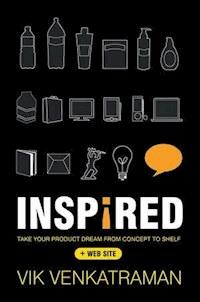
The definitive reference guide for developing, launching, and rolling out a new product Each year, thousands of new products are introduced to market. Most fail. What's worse is it doesn't have to be this way. The fact is product failure is rarely the result of either a lack of need or desire for a product, but, rather, is due to an entrepreneur who lacks the know-how to successfully develop, launch and rollout his or her product. Inspired! Take Your Product Dream from Concept to Shelf helps entrepreneurs to successfully navigate the marketplace, avoiding the common mistakes most people make, while finding traction faster, and building an attractive brand that players across the value chain will want will want to buy. * Provides readers with inspiring true stories and anecdotes, as well as insightful interviews with top entrepreneurs and merchandisers * Presents invaluable research as to producers, designers, distributors, and retailers * Divided into three easy-to-follow sections - Development, Launch, and Rollout With unemployment hovering around 10%, many individuals are turning to the world of entrepreneurship. Now more than ever individuals, start-ups, and small businesses need expert guidance on how to bring their products from concept to shelf. Inspired! provides that guidance.
Sie lesen das E-Book in den Legimi-Apps auf:
Seitenzahl: 450
Veröffentlichungsjahr: 2010
Ähnliche


















Contents
Preface
Acknowledgments
Phase I: Development
Chapter 1: Develop the Idea
Overview
Start with Yourself
Use Web Tools to Gauge Demand
Capture Inspiration
A Difficult Game
Overcoming Obstacles
Summary
Chapter 2: Create Your Product
So What’s It Going to Be?
Personal Predilection
Making It Happen
Lay Out the Idea . . . and Be Ready to Adapt It to Your Customer
Product Basis
What Is It?
The Factory: To Use or Not to Use?
The Friendly Supplier Review
Finding an Assistant
The Quiet Before the Storm
V-Zero Prototype
Key Feature Identification
Summary
Chapter 3: Brand Marketing
From Cattle Brands to Car Brands
Brand Pillars
Brand Design: Premium and Utility
It’s All in the Name
Matching Your Product to Its Personality
Brand Marketing
Summary
Chapter 4: Design the Process
Meet the Players
The Demand-Driven Supply Chain
Talk to the Right Customers; Ask the Right Questions
Tie Your Customer to Your Product
The Retailer: Where the Proverbial Rubber Meets the Road
Manufacturer or Co-Packer Selection
The Bottom of the Chain: Find Your Raw Materials Supplier
Summary
Phase II: Launch
Chapter 5: Packaging a Product
Planning Your Package
Stock versus Custom
Test the Package Compatibility
Types of Packaging
Basics of Design
Summary
Chapter 6: Produce Your Product and Platform
Taking It to the Next Level
Let’s Get Practical and Get Some Help!
Nailing Down the Details
Supplier Negotiation
In the Negotiation: Asks
The First Full Production Run
Summary
Phase III: Rollout
Chapter 7: Get Distribution, and Get on the Shelf
Get on a Shelf!
Distributor Reachout
Tactical: The Distributor Deal
Hiring a Sales Team
Summary
Chapter 8: Demonstrate Local Success
The Three Ps
When Shelf Space Is Scarce, BYO
Support Your Sales
Public Relations
Web Marketing with the Three S’s
Mission: Possible
Optimizing the Role of the Co-Packer
Defining the Responsibility of the Distributor
Incentivizing Sales Personnel
Improve Your Web Site
Changing the Price
Manage and Track Sell-Through
Summary
Chapter 9: Financing Primer
It Takes Money to Make Money
Buyer Beware
The Perfect Business Plan
The Compelling Investor Presentation
Private Placement Memorandum
Valuation
Understanding Terms
Summary
Notes
About the Author
Index
Copyright © 2011 by Vik Venkatraman. All rights reserved.
Published by John Wiley & Sons, Inc., Hoboken, New Jersey.
Published simultaneously in Canada.
No part of this publication may be reproduced, stored in a retrieval system, or transmitted in any form or by any means, electronic, mechanical, photocopying, recording, scanning, or otherwise, except as permitted under Section 107 or 108 of the 1976 United States Copyright Act, without either the prior written permission of the Publisher, or authorization through payment of the appropriate per-copy fee to the Copyright Clearance Center, Inc., 222 Rosewood Drive, Danvers, MA 01923, (978) 750-8400, fax (978) 646-8600, or on the Web at www.copyright.com. Requests to the Publisher for permission should be addressed to the Permissions Department, John Wiley & Sons, Inc., 111 River Street, Hoboken, NJ 07030, (201) 748-6011, fax (201) 748-6008, or online at http://www.wiley.com/go/permissions.
Limit of Liability/Disclaimer of Warranty: While the publisher and author have used their best efforts in preparing this book, they make no representations or warranties with respect to the accuracy or completeness of the contents of this book and specifically disclaim any implied warranties of merchantability or fitness for a particular purpose. No warranty may be created or extended by sales representatives or written sales materials. The advice and strategies contained herein may not be suitable for your situation. You should consult with a professional where appropriate. Neither the publisher nor author shall be liable for any loss of profit or any other commercial damages, including but not limited to special, incidental, consequential, or other damages.
For general information on our other products and services or for technical support, please contact our Customer Care Department within the United States at (800) 762-2974, outside the United States at (317) 572-3993 or fax (317) 572-4002.
Wiley also publishes its books in a variety of electronic formats. Some content that appears in print may not be available in electronic books. For more information about Wiley products, visit our web site at www.wiley.com.
Library of Congress Cataloging-in-Publication Data:
Venkatraman, Vik.
Inspired! : take your product dream from concept to shelf / Vik Venkatraman.
p. cm.
Includes index.
ISBN 978-0-470-63845-3 (cloth); ISBN 978-0-470-93376-3 (ebk); ISBN 978-0-470-93377-0 (ebk); ISBN 978-0-470-93378-7 (ebk)
1. New products—Marketing. 2. Product management. I. Title.
HF5415.153.V45 2010
658.5'75—dc22
2010032276
To all the friends I’ve made launching products, to New York City, where anything can be made to happen, and to you, my dear reader (and customer for this product), without whom nothing would be possible. Thank you.
Preface
I took the road less traveled by, and that has made all the difference.
—Robert Frost
It was late at night in a smoky room slightly off the beaten path in New York City. My heart was pounding. I was meeting for the first time with a New York City beverage distributor—pitching him on why he should take my product. I had poured my heart into creating this product, and stretched myself past my limit to do so. Making this deal could be the difference between affording a new pair of shoes or a new pair of socks—the difference between telling my family that I made it happen or that I didn’t—the difference between epic success and epic failure. Distributors like him were more than just customers—they were powerbrokers, gatekeepers to the success that waited on the retail shelves in my city. He represented tremendous potential for my new beverage product, and was as a result rather intimidating.
I sat anxiously with my sales advisor as we poured out samples for people in the room, casually discussing the benefits of the product to consumers, as well as our hopes to partner with this distributor to get our word out across New York City. I ask them:
“What do you think? Can we make a deal?”
Silence. There were two partners at this distributorship, and they stared at me as if they expected me to crumble under their glare. I knew they liked my juice, since they smiled when they were drinking it. But they said nothing, lest they give away their position. This was a negotiation that had the potential to get them an excellent product, and they wanted to be sure they extracted the best possible pricing and terms from me.
“We think your price is too high.” They thought my terms were too steep too. I wanted them to pay me up front! Three or four cigarettes had already been smoked during this meeting—the smoke blown in my face, and I’m certain, sticking to my clothes.
“I’ll give you 60 days,” I said, surprising them with my generous broadening in terms. “And I’ll put an incentive program together for your accounts and your salespeople. Free cases for key accounts, and commission-style dollars to your people.” I was no expert, but I could talk the talk. I knew exactly which buttons to push, and was waiting for my opening.
“Lock it down.” My sales advisor whispers in my ear, after working through some math. “You still net 25 percent after incentives.” That’s what I was waiting for. Too many young product launchers make the mistake of over-promoting and poorly managing cash flow and I was determined to be different.
“I can reduce the price by 50 cents if you’ll pick up the pallet now. I’ve got another meeting to get to, and can’t dance with you guys all night.” And we shook on it.
That was how I launched my product in New York City, and probably one of the most exciting moments of my life.
Hopefully, through this book, we’ll do the same for you.
Why I Wrote This Book
Each year, more than 10,000 new products are brought to market. Most product launchers are doing so for the first time or are new to the industries in which they launch the product. These launchers approach the market as bold consumers with a great idea. They start with what they want to make and go from there. Some of them are creating a product for themselves, others just for fun. They work really hard designing, making, producing a product, and then work really hard to sell it. They pour their soul and all their money into their precious product.
Sometimes these product launchers are able to make it, and sometimes they aren’t. Sometimes people like the product, and sometimes they don’t. Every now and then, one or two products are able to make local or regional successes for themselves. The majority of the time, they fail. In fact, over 90 percent of them go out of business in a few years.
Why does this happen? It isn’t because product launchers are not intelligent or not hard-working, or because the products they created were bad or faulty. It is most likely because they didn’t plan properly, didn’t design the product as well as they could, and didn’t go to market in the most effective way. They didn’t know who the key players were, so they spread their resources thin trying to work on everything, and trying to spend money on all different channels. By the time they are done, they are exhausted from doing everything at once, and undercapitalized because they spent money in 10 different directions. When there are as many product launches in the market as there are, a competitor that runs a little better quickly outpaces them and they soon fall away.
What would have happened if they had a road map to a successful product launch? How might they have made decisions differently if they had insight from of the leading players in the industry? How might their inspiration be directed if they could hear firsthand from those who had walked in the footsteps before them?
If you think that you want to create a product and set it free to wander store shelves and win the hearts of consumers—you’re in the right place. If you’ve got a great idea or two that you’ve always wanted to put in front of customers but never knew how, this book will guide you along. If you’ve got a product in front of you, but don’t quite know how to make the system work for you, I’ll show you what I and my friends have learned in our adventures launching products.
If you follow the suggestions and examples in this book, not only will your product become a reality, but you will put it on at least one shelf. If you play your cards correctly, you can put it on dozens of shelves and get it into the hands of a few consumers.
Who Am I?
Like you, I once had the dream to put my product in front of my consumer. Unlike many similar products that tried and failed to share my shelf, I did it. I did it on a modest budget, which would have undoubtedly been smaller had I read this book first. While I might be something of an expert now, I certainly was not when I got started.
My first business was a web and graphics design firm, when I learned that aesthetics and design can be the difference between a successful concept and one that fails. As a brand manager for a hugely successful energy drink brand, I learned that successful brands can be built on a single well-designed product, and that execution is everything. As a management consultant, I learned that relationships are as important to the sale as the idea and the execution, and that clean communications make the difference between confusion and understanding.
Along the way, I did a smattering of other things. I bartended at a happening spot in New York City—the kind of place where people start dancing on the bar after midnight. I taught calculus. I got an engineering degree with honors from Columbia University. I ran a pet store. I hosted art gallery openings. Through all of these jobs I learned a very important thing—all people are emotionally driven, which counterintuitively allows well-run businesses to be math and data-driven.
Naïvely thinking I understood the world, I tried starting a few companies. I got together with a group of guys to create a new kind of entertainment company: The World Breakdancing League, which would turn breakdancing into a competitive league sport. Together we created an innovative and entertaining product that was far ahead of its time, organized teams, and got in front of the guys at major sporting arenas and TV networks. But within a few years, our product (that is, a team) fell apart. Lesson learned—work harder to make sure the founding team is on the same page. Tired of the entertainment space, where success was dictated by power brokers and luck, I realized that I had always wanted to create real, tangible products that people could hold and love. As such, I created Star Power, an exotic fruit juices company, and the first to bottle and sell starfruit juice in the United States. In the same vein, I also created V Bespoke, a new kind of custom-tailored clothing concept that would try to change the way people thought about clothing retail.
Creating something new is never easy or straightforward; when I started, I only knew that I had a great idea for a product and that I would do whatever it took to get it in front of my customer. I would let them decide my fate—be it success or failure.
And I struggled. I screwed up my product before I got it right. I spent a long time building a supply chain I ended up not using. I botched sales. I made some enemies. I made some great friends and also learned some tough lessons from people I should not have trusted. I wasted time and capital chasing opportunities written in the fog.
Many of the examples in this book draw from the experiences I had trying to get my product from concept to shelf quickly, effectively, and on a dime. If I am able to help you save a few weeks of your valuable time, a few thousand dollars, or raising capital that you don’t need yet in exchange for stock that you don’t yet want to lose, then I’ve done my job. You can thank me later.
Why You Should Keep Reading . . .
In this book, we’re going to talk about how to test and learn, how to build great relationships in your industry, and ultimately, how to turn your dream product into a company that is lucrative and satisfying to you, and valuable to your customer.
Every step of the way, I’m going to refer to a methodical approach to new relationships and key decisions we’ll call the Inspired Method. It involves a mutually exclusive, comprehensively exhaustive (MECE) analysis of key players, key variables, and key details—or as close as we can get with information readily available—to help make fully informed decisions.
This might mean doing a lot of research before selecting an important business partner, studying an industry (or many industries) before building product features, or surveying lots of customers before deciding on a marketing approach. It definitely means getting a ton of information from vendors before negotiating with them, and ultimately, to be sure that the end product and the end process that we build is optimal and sustainable.
I’m going to start at the top, assuming that you have not yet come up with the product you want to launch, that you have no specialized skills, and that you want to spend as little money and time as possible. I’ll assume that you don’t necessarily have a great sense of what makes a product cool, and that you may not even have any personal skills that are going to help you manufacture or sell your product. If you’ve got some of this in your bag, great. If not—that’s okay, too.
While doing so, I’m going to arm you with scripts and documents that I’ve used and share interviews with some of the coolest people I’ve met. Along the way, I’ll give you exercises (that you really should do), ways to apply the Inspired Method, and challenges at the end of the chapter that will really make you question some of your basic assumptions of life:
Exercises: Often, a chapter will dip into areas in which you will need to do homework, or tactical steps that need to be in place for you to be able to make a reasoned decision or learn more about the topic at hand. Some are more involved than others, and I insist that each time one of these pops up, make the time to do it. Otherwise, you risk being uninformed and potentially missing opportunities.Apply the Inspired/Launch Method: As you continue reading, you will see this method pop up on occasion as we work through the various challenges you might face as you create and launch your product. While difficult, and sometimes time intensive, launching a product on your own is very feasible and something you will absolutely accomplish by the time you finish this book. Taking the time to make calculated decisions through the Inspired Method is sure to save you both headache and cash, allowing you the space to enjoy your accomplishment.Challenges: Launching a product is going to take all your resolve. At the end of each chapter, I’ll challenge you to do something that might take you just a little bit out of your comfort zone. They might be fun to read, but I’ll suggest you actually go do them.If you take the time to listen to this advice and do these exercises, application methods, and challenges, I’m confident that you will find yourself putting a product on the shelf in no time. Plus, you will save as much time, money, and heartache as possible. Trust me—this is insight that I wish I had known when starting my project.
Author’s Note
I’ve opted to use the subject “he” throughout the text. This is not intended as sexist language, but simply for grammar consistency.
Let’s Get Started
In Inspired! Take Your Product Dream from Concept to Shelf, I’m going to inspire you come up with your concept and then we’ll move through developing your concept and cobbling together a prototype. Once you know exactly what you need, we’ll start thinking about the supply chain—who’s going to make it, who’s going to buy it, and how you get your stuff from factory to retailer. We’re going to be thinking about our customer the whole time, why they need our product, and how best to communicate that to them. We’ll also learn how to launch a web site and a blog, and discover some interesting marketing ideas. As we push through the sell, we’ll make sure we’ve got the right team around us, a way to get capital, and an airtight plan for growth. In Table P.1, I suggest an eight-month plan that takes us through this entire process so that you can take your product from idea to shelf.
Table P.1: Eight-Month Target Product Launch Time Line
If all of this seems looks like a lot of work, don’t feel daunted. We’re going to get a lot of help, meet some interesting people, outsource the difficult work to the experts, and build a product and company that we can be truly proud of.
To make your job easier, I’ve put up some materials and documents on the website at www.wiley.com/go/venkatraman. Its all material I’ve used (some of it more than once) to help get an idea off the ground. Consider it my gift to you for checking out my book.
You are about to embark on the most fulfilling journey of your life. Let’s get started.
Acknowledgments
First and foremost, I want to thank my mother and father for encouraging me unconditionally during my formative years to believe that anything is possible, and my brother for challenging me when it was not. Without you, I might not have dared.
I want to thank my friends for their curious spectatorship and sustained support in my various projects, and my braintrust for their constructive devil’s advocacy. Without you, I might never have taken the plunge.
I have a special thanks for my friend Nikhil Gutha for believing in my book strongly enough to introduce me to the team at John Wiley & Sons, and to Pamela Van Geissen, my editor, for her passionate endorsement that got the green light. Without you, I might never have become an author.
Thanks of course to the editing, copywriting, business, and literary talents at John Wiley & Sons for helping me to take a cool concept and make a finished book. Without you, my product might not shine as brightly on its shelf.
Finally, thanks to you, my reader, not for just reading my book, but to take the gentle push it offers to create your dreams and live an inspired life.
PHASE I
DEVELOPMENT
CHAPTER 1
Develop the Idea
Nations may rise and fall, but an idea lives on. Ideas have endurance without death.
—John F. Kennedy
The path to being a product creator starts with wanting more. Wanting more satisfaction out of our work, more control over our time, or more money. It grows with curiosity. Curiosity about what happens outside our cubicle, away from our desk, and elsewhere in society. Curiosity about what is really possible, and what we are really capable of. These emotions ignite with a spark. A light bulb goes off in our heads. Suddenly, we have an idea that might help or entertain people. The idea refines itself and takes the shape of a product: an object that holds the power to simultaneously solve a problem and make money.
The new shoes you want to make for style or comfort, the new snack you want to make for taste and health, the new toy you want to make for decoration and entertainment—are all within reach. Every successful product around you started as a concept, many of them created and brought to market by people just like you.
Lesen Sie weiter in der vollständigen Ausgabe!
Lesen Sie weiter in der vollständigen Ausgabe!
Lesen Sie weiter in der vollständigen Ausgabe!
Lesen Sie weiter in der vollständigen Ausgabe!
Lesen Sie weiter in der vollständigen Ausgabe!
Lesen Sie weiter in der vollständigen Ausgabe!
Lesen Sie weiter in der vollständigen Ausgabe!
Lesen Sie weiter in der vollständigen Ausgabe!
Lesen Sie weiter in der vollständigen Ausgabe!
Lesen Sie weiter in der vollständigen Ausgabe!
Lesen Sie weiter in der vollständigen Ausgabe!
Lesen Sie weiter in der vollständigen Ausgabe!
Lesen Sie weiter in der vollständigen Ausgabe!




