


Erhalten Sie Zugang zu diesem und mehr als 300000 Büchern ab EUR 5,99 monatlich.
- Herausgeber: Crown House Publishing
- Kategorie: Ratgeber
- Sprache: Englisch
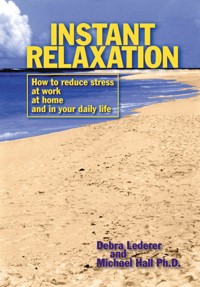
This is the last word in quick effective NLP and yoga techniques to reduce stress at work and at home. The book offers a seven-day programme enabling readers to access their own relaxed core state. Unlimited web support is also provided. " A masterpiece of its kind." The Hypnotherapist
Sie lesen das E-Book in den Legimi-Apps auf:
Seitenzahl: 121
Veröffentlichungsjahr: 1998
Das E-Book (TTS) können Sie hören im Abo „Legimi Premium” in Legimi-Apps auf:
Ähnliche

















Instant Relaxation
How To Reduce Stress At Work, At Home And In Your Daily Life
State-Of-The-Art Fun And Easy Exercises For Developing The Advanced Ability OfFlying Into A Calm
Debra Lederer andMichael Hall, Ph.D
Table Of Contents
Title Page
Acknowledgements
Foreword
Preface
Part One
Chapter One
Introduction
• The Vision: Seven Days to Develop the Skills for Instant Relaxation
•Nuts and Bolts of the Process (The Relaxed Core State)
•The Possibility of Instant Relaxation
•How long will it take to access your Relaxed Core State?
Part Two
Chapter Two
Seven Days to Instant Relaxation
Day One: The Breath of Relaxation
•Breath Exercises
Breath Refresher
Breath Abdomen Refresher
•Reaching your Relaxed Core State while Walking
Breath Walk—In and Out
Breath Walk—Abdomen Focus
•Recapping Day One
Day Two: The Posture of Relaxation
•Posture Exercises
Posture Checklist
Relaxed Posture (Sitting) Exercise
Relaxed Posture (Standing) Exercise
•Recapping Day Two
Day Three: The Eyes of Relaxation
•Focused Eye Movements
Four-Object Eye Focus Exercise
Relaxing Eye-Clock Exercise
Eye-Letter Connection Exercise
•Recapping Day Three
Day Four: The Ears of Relaxation
•Affirmations—The Ideas and Linguistics of Relaxation
•Why Affirmations Work
•Recapping Day Four
Day Five: The Internal Imagery of Relaxation
•Visualizations
•Reaching your Relaxed Core State with Mind Affirmations and Mind Visualizations
•Visualization-relaxation Thoughts
•Recapping Day Five
Day Six: The Triggers of Relaxation
•Pattern Interrupts
•Relaxation Anchors
•Test Out your Relaxation Anchor
•Recapping Day Six
Day Seven: The Language of Relaxation
•Relaxation Language
• Words and Phrases in Non-relaxed and Relaxed State
•Habit-forming Vocabulary
•Relaxation Metaphors
•Recapping Day Seven
•Flying into a State of Relaxation
Part Three
Chapter Three
Personal Relaxation Plan
•The Relaxation Toolbox
Relaxation Signals
Anchors
•Morning Relaxation Routine
Morning Relaxation Reminders
Additional Morning Relaxation Reminders
Daily Relaxation Reminders
Daily Relaxation Bonus Reminders
•Evening Relaxation Routine
Evening Journal Questions
•Creating your Ideal Relaxed Environment
at Home
at Work
Summary
•Seven-day Relaxation Plan
Morning and Evening Relaxation Exercise Routine
•Relaxation of Parts
•Conclusion
Appendix
•Personal Relaxation Plan—Instant Relaxation Exercises
•Personal Relaxation Plan—Checklist
Bibliography
About the Author
Copyright
Acknowledgements
There are several people I would like to acknowledge and express my gratitude to for significantly contributing to this book.
I would like to thank all of my spiritual teachers who have encouraged and helped me to understand my true nature. I met various teachers in India whose teachings had a direct influence on me. Many thanks to Osho, Gangagi, Poonjaji and to all the seekers I met on my path. While in Thailand, I spent a great deal of time at a monastery called Wat Po on the island of Koh Phanghan. I would like to thank Steve and Rosemary for their teachings of Buddhist meditations. I am also grateful for my yoga teachers who have shared their knowledge of timeless spiritual principles. There have been many, and a special acknowledgement to Madhava Daddario Ravi Singh and the Sivananda Yoga Center of New York and San Francisco.
I thank Richard Bandler and John Grinder for their knowledge and insights in the development of NLP, which serves as the basis of so much of the contents of this book. I also thank all of my NLP teachers in New York City—Steven Leeds, Kevin Creedon, Mary Vanderwart; and my NLP teachers in Santa Cruz—Robert Dilts and Judith DeLozier.
I am grateful to my parents and friends, especially Gary Dear and Evi Krasnow, who were encouraging and supportive while I wrote this book on stress reduction techniques. Aspecial thanks to Ginny Dustin for her help with the graphic design illustrations and the cover design.
I thank the publishers, the visionary team at Crown House Publishing Ltd, for seeing the value in this project. Most of all, I express my gratitude to Michael Hall for his expertise in co-writing this book. His contribution has been overwhelming and immense.
New York City, New York January 2000
Foreword
After finishing college, my goal was to study meditation and relaxation techniques, while simultaneously traveling the world. In following my desire to learn from the best teachers around the globe, between jobs, I visited seventy countries on six continents. Depending on the country, I absorbed myself in different ways into the culture and studied their relaxation techniques. I noticed that many teachers used relaxation techniques that were developed hundreds of years ago. Many of the programs I participated in required extensive training, sitting in uncomfortable positions for long periods of times, chanting various mantras, and following certain religious philosophies. These earlier techniques worked for societies with more time on their hands. While I found these techniques effective, I did not find them practical for the fast-paced environment of the modern office and our busy lifestyles.
Today, our lifestyle requires that we move quickly. It requires that we employ coping techniques while staying centered during stressful situations. During my travels, I learned that we cannot control the world around us, but that we can control our reaction to events. For these reasons, I have formulated these highly effective, simple, fast and easy methods of relaxation. In this particular format, you learn how to actually fly into a powerful and resourceful state of calm. Once you learn the process, and begin to habituate it, you can then truly experience instant relaxation.
New York City, New York January 2000
Preface
I first met Debra at a Meta-states Training in New York City and immediately recognised both her special expertise in the area of relaxation, and her passion for it. She knew all about the ins-and-outs of relaxation—what it looked like, sounded like, felt like, etc. And in terms of State management (the subject of the Meta-states training), she really knew how to access her own state of inner calm that allowed her to stay focused and clear. She also knew how to coach others into the same experience.
The area of mutual interest—NLP and State management—lead us to begin collaborating about a book. In the months that followed, Debra provided me with an entire manuscript on the subject. In fact, for the most part, you have that manuscript in the following pages. Through our talking and e-mailing, we decided to title it Instant Relaxation.
In the following pages, I have added some explanation sections and some touches here and there to the training of Stress Management that Debra has studied and presented over the past ten years with businesses and in personal consultations. You will find a work that explains, shows and coaches you how to develop your own ability to “Fly Into a Calm” anywhere and anytime you choose.
Debra wrote an entire text before I ever got involved. Her exercises and ideas on the Relaxed Core State arose from the actual handson experience of coaching clients through the process of relaxation in the context of their daily stresses. Her skill truly lies in the development of these exercises. Now you can also receive her coaching as you read and practice. Doing this program will enable you to easily learn to access states of inner calm and peace.
I became involved in this out of my strong belief in State management, and in using the neuro-linguistics approach (NLP) to access our most empowering states. The neuro part refers to using our neurology to its fullest potential. You will find that being aware of your breath and posture affects your state tremendously. Linguistics refers to our use of language and the languages of the mind to powerfully effect our states.
So now, through Debra’s years of study and practice, you receive the benefit of the following direct, simple, and easy-to-follow step-by-step instructions. This means that you have in your hands a truly hands-on, how-to-do-it book. So as you read, you can just allow yourself to go ahead and fully experience the steps that will take you into this most resourceful state and when you get done, you will be able to demonstrate the power of Flying Into A Calm.
Michael Hall, Ph.D. Grand Junction, Colorado January, 2000
Part 1
idndutctrtioon
Chapter One
Introduction
The Vision: Seven Days to Develop the Skills for Instant Relaxation
Do you find that time often becomes a source of stress for you? Do you find yourself under the pressure of deadlines? Do you find yourself running from one activity to the next? If you answered yes to these questions, this book offers you lots of solutions and ideas about controlling your state as you rush to complete your busy schedules and daily activities. Having stress and lots of responsibility in our lives is part of our modern lifestyle. Since we have such little time to complete all of our daily tasks and lists, having stress reduction exercises and coping skills becomes an essential part of remaining healthy and balanced in our life.
A major source of stress comes from “squeezing everything in” and having such little time to operate this way. Many people around the world spend much of their work day, sitting in an office and thinking about all the work they have to complete each day. Often, their thoughts travel to all of the plans and responsibilities outside of the office. Feeling stressed is a by-product of the job most people are not adequately paid for.
For these reasons, I have developed simple, short, innovative and powerful methods for stress reduction and relaxation. These transformational methods help you to “fly into a powerful and resourceful state of calm,” both in your office and in whatever environment you choose. Once you understand and learn the process, it becomes a habit. Then you can have fun and use these methods for relaxation in an instant—anywhere and anytime.
These Instant Relaxation Exercises keep you calm, centered, energized, focused, and at ease as you complete your daily activities. If you invest just twenty minutes per day (ten minutes in the morning and ten minutes in the evening) over the next seven days, you will learn the secrets of how to relax instantaneously. Then, after those initial seven days, if you continue setting aside ten minutes each day (five minutes in the morning and five minutes in the evening) to feel your Relaxed Core State, you will feel refreshed and renewed. You will also feel empowered in the realization that you can re-access that state of instant relaxationwhenever you desire.
The methods for the Instant Relaxation Exercises include the resources of breath techniques, postural alignment, focusing techniques, affirmations, and visualizations. We have put together a compilation of powerful and transformational relaxation techniques, tools and strategies. We have based this book upon the mnemonic—
Be Prepared For A Very Positive Aware Life.
This mnemonic stands for the exercises in this book: Breath, Posture, Focus, Affirmations, Visualizations, Pattern Interrupts, Anchors and Language. Doing these exercises allows you to feel calm, centered, energized, focused, and at ease anywhere and anytime.
We have based the tools, strategies and techniques that help you to instantly relax on a combination of physical and mental training.Physically, you focus on posture, breathing and movement exercises.Mentally, you work on focusing your mind through visualizations and affirmations. You will find that we have intentionally designed the Instant Relaxation Exercises in short and easy formats. Most exercises take less than five minutes and you practice them at any time and in any place.Nuts and Bolts of the Process (The Relaxed Core State)
By practicing Instant Relaxation Exercises, you become increasingly in touch with your Relaxed Core State. This state of being centered within yourself is an ever-present part of you. Stepping into this state, you will feel calm, energized, focused, centered, at ease, and relaxed. Relaxation signals, such as your posture, breathing pattern, and choice of language will indicate that you have stepped into your Relaxed Core State.
As you continually practice Instant Relaxation Exercises, your mind will become focused, aware, and centered. And when your mind becomes focused, you will feel calmer, energized, focused, and at ease. You will find many different techniques and strategies which will leave you feeling great during your day. And the more aware you become of your physiology, thought and belief systems, the more control you will develop over your Relaxed Core State. Many people practicing Instant Relaxation Exercises feel more loving towards themselves, their family and others in their life.
Perhaps you have situations in your life that create tension and leave you feeling less empowered and confident. By following the guidelines laid out in this book, you will soon discover how you can stay calm and relaxed during these situations. My (D.L.) clients always feel amazed at how concentrating on their internal resources of breath, posture, focusing techniques, affirmations, and visualizations enhance their ability to feel good.
The Possibility of Instant Relaxation
You may wonder, “Can I actually change my state of mind and body so quickly?” I often hear people asking this question. Most people find it hard to shift out of a depressed or sad mood. How about you? Do you find that difficult? How about when you feel playful and happy? Do you find this a state that you enjoy staying in and experiencing?
We break state when interruptions and “pattern interrupts” shift us out of them. Take a moment to remember a time when you felt great and someone came to you with depressing news. Did that switch your state? How about when you felt bad and someone gave you great news? How about an experience where you felt relaxed and someone disrupted your calm state? What did they say or do to interrupt your state of inner calm? Assuming that you have vivid memories of shifting states, the following Instant Relaxation Exercises use this same principle.
Knowing that you have the knowledge and the ability to change states quickly becomes a valuable tool and resource for you. Changing the speed and pace of your breath, shifting elements of your posture, using focusing techniques, repeating affirmations, and visualizing describe internal resources that you can use to switch you into your Relaxed Core State.




