


13,99 €
Mehr erfahren.
- Herausgeber: The Crowood Press
- Kategorie: Lebensstil
- Serie: Knitting Techniques
- Sprache: Englisch
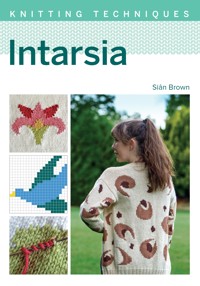
Intarsia is a knitting colourwork technique used to create different areas of colour to form a pattern or image on the knitted fabric, without having to carry the yarn across the back of the work. This accessible book guides you through the basics of the technique, how to practise your skills and finally to the stage where you can produce your own original designs. It includes twenty charted motifs from the simple to the more elaborate and provides five full knitting patterns to practice your skills and to use as templates for your own intarsia ideas. Supported by over 200 photographs, sketches and knitting charts, it will serve as an invaluable practical guide to the technique but will also act as a springboard for your own original ideas.
Das E-Book können Sie in Legimi-Apps oder einer beliebigen App lesen, die das folgende Format unterstützen:
Seitenzahl: 114
Veröffentlichungsjahr: 2021
Ähnliche















Intarsia
Intarsia
Siân Brown
First published in 2021 by The Crowood Press Ltd Ramsbury, Marlborough Wiltshire SN8 2HR
This e-book first published in 2021
© Siân Brown 2021
All rights reserved. This e-book is copyright material and must not be copied, reproduced, transferred, distributed, leased, licensed or publicly performed or used in any way except as specifically permitted in writing by the publishers, as allowed under the terms and conditions under which it was purchased or as strictly permitted by applicable copyright law. Any unauthorised distribution or use of this text may be a direct infringement of the author’s and publisher’s rights, and those responsible may be liable in law accordingly.
British Library Cataloguing-in-Publication Data A catalogue record for this book is available from the British Library.
ISBN 978 1 78500 948 8
Cover design: Sergey Tsvetkov
Acknowledgements
A big thank you to the staff at Crowood Press for making this book possible.
Thanks to my friend and star knitter, Helen, for doing a lot of the knitting, and to Jenny Shore, for knitting the Sailboat Jumper.
To the lovely models Beth and Greyson, for the garment and wrap photos, and Rhiannon, for the glove photos. Well done to Greyson’s family for persuading a two-year-old to model. To Dee and Rich, for the photo of their baby daughter Evie on the Little Houses Cot Blanket.
To Penny Hill, for writing the patterns for the garments, and to Bronagh Miskelly, for writing the pattern for the gloves.
To Simon Booth, for the photography with models.
For yarn support, thanks to Rico Design, Scheepjes, Sirdar Sublime, Rowan and Paintbox Yarns, and thanks to the yarn companies and magazines that have allowed me to use their pattern images.
Thanks as always to my daughters, Hannah and Rhiannon, for their ongoing interest and support and for doing some of the animal sketches.
Contents
Abbreviations
Introduction
1 Starting Out with Intarsia
2 Motif Library
3 Projects
4 Design Your Own
Information
Index
When I first learned to knit, Fair Isle repetitive motifs seemed to be the only way to introduce colour. Someone showed me how to do intarsia and my sudden ability to explore pools of colour burst on my designing imagination and I’ve never looked back!
Kaffe Fassett
Kaffe Fassett’s Halo Spots.
There seems to be some misgivings about intarsia being more difficult to manage than Fair Isle knitting. WRONG! It is so the other way. Intarsia is basically incorporating one stitch of the Fair Isle technique to lock down the yarn when moving from one colour to the other. Work with manageable lengths of yarn too, cut those balls off and clattering bobbins. Get a handle on intarsia – you’ll feel liberated.
Brandon Mably
Kaffe Fassett’s Sunset Sails.
Brandon Mably’s Porthtowan Blanket.
I developed the Sasha Kagan ‘woven in’ version of the intarsia technique for my third book of knitwear designs Country Inspiration (Taunton Press, 2000). I felt that the motifs needed to be liberated from the constraint of using two or three colours per row as I had done previously. I find that being able to place a motif wherever I like gives a light relaxed feel to the garment, uses far less yarn and lets me use the knitted fabric as a painter would a canvas.
Sasha Kagan
Sasha Kagan’s Lichen Bolero.
Abbreviations
beg
begin
cont
continue
foll
following
inc
increase
k
knit
m1
make 1 stitch: from front of work to back, insert tip of left-hand needle under the bar of yarn between the st just worked and the next st on left-hand needle and knit into back of loop created. (1 st increased)
m1 purlwise
make 1 stitch purlwise: from front of work to back, insert tip of left-hand needle under the bar of yarn between the st just worked and the next st on left-hand needle and purl into back of loop created. (1 st increased)
m1R
make 1 stitch: from back of work to front, insert tip of left-hand needle under the bar of yarn between the st just worked and the next st on left-hand needle and knit into front of loop created. (1 st increased)
p
purl
patt
pattern
pm
place marker
rem
remaining
RS
right side
skpo
slip the next st on left-hand needle as if to knit it, knit the next st on left-hand needle and pass the slipped st over the st just worked. (1 st decreased)
sm
slip marker
st/sts
stitch/stitches
WS
wrong side
yo
yarn over
Introduction
I first discovered the world of intarsia during the final year of my degree course in fashion and textiles. I had become interested in knitwear design since working on a second-year project set by a visiting tutor. I found it exciting to be able to create the fabric to work with rather than using a woven fabric that had already been designed. I had always loved art, and, for my final collection, it seemed like a natural step to combine knitting and artwork. I designed a collection of knitted garments based on five of the artist Joan Miro’s colourful and playful abstract paintings. The only way to achieve this was to use intarsia, with embroidery added for details for the drawn fine lines. There was a freedom in the technique and working on the large-scale pieces, which I did without the use of charts; letting each piece evolve felt close to producing a painting. If Fair Isle is seen as a way of producing regular small-scale pattern repeats then intarsia allows you to paint on a large canvas.
This book will cover getting you started with intarsia. Chapter 1 covers how to prepare the yarn and follow a chart and how to knit using the technique. It moves on in Chapter 2 with twenty motifs for you to knit, shown as charts and the finished knitted motifs, and gives examples of how to use the motifs in designs for various projects presented as sketches. Chapter 3 has five projects presented as full patterns with charts: a cot blanket, a pair of fingerless gloves, a wrap, a child’s jumper and an adult’s cardigan. All of these patterns can be used as templates for you to add your own motifs if you wish. Chapter 4 then takes you through the process of working on your own designs. This includes finding inspiration, by looking at different sources that you can explore to come up with your own ideas. Also in this chapter, as an example, is a look at the way that I work, including the technical part of working on measurements and charts and where to place motifs.
I hope that this book encourages you to experiment with this versatile technique and provides a springboard to start your own journey of creativity with intarsia.
CHAPTER 1
Starting Out with Intarsia
In this chapter, we will look at the origins of intarsia, when it has been popular, and what it involves as a technique, including preparing the yarn, combining intarsia with other techniques, working from a chart, and what to do throughout the knitting process.
ABOUT INTARSIA
Intarsia is a knitting technique used to create different areas of colour to form a pattern or image within the knitted work. Its name comes from a woodworking technique, where pieces of wood are laid together in a similar way to pieces of a jigsaw or a mosaic. This knitting technique uses separate lengths of yarn for each colour section, to form blocks of colour, with no yarn being taken across the back of the work, which is the method used in Fair Isle knitting.
Intarsia is thought to have been used in knitting as early as the 1500s, for kilts and socks, with an unclear history following that. As a technique, it has been used throughout the decades, gaining and declining in popularity. It appears in the 1940s and 1950s in vintage knitting patterns often featuring traditional argyle patterns with a preppy look. For some time, intarsiaworked golfing motifs have also been popular for men’s knits, featuring golfing figures, or large-scale geometric shapes, especially diamonds.
Group of vintage patterns.
Intarsia had a big revival in the 1980s, with patterns featuring bold geometric designs, flowers, animals and any other large-scale motifs that the designers could think to create. The large-scale picture knits needed big charts, which would often take days to complete. Designers at all levels used the technique and became adept at translating a large picture, such as a landscape, into a knitted garment. Some of the well-known designers using this technique were Kaffe Fassett, Patricia Roberts, Artwork, Bodymap, Susan Duckworth, Annabel Fox and Sasha Kagan. All of the yarn companies producing patterns for their yarns will have used intarsia at this time.
Although there was a big intarsia revival in the 1980s, it is a common misconception that anything using this method will have a 1980s look. The novelty Christmas jumpers that we are all familiar with, with motifs such as snowmen, penguins, deer and other winter or Christmas elements, are often knitted using the technique, sometimes combined with traditional Fair Isle patterns.
Frosty’s Christmas. Drops Design.
Children‘s Christmas Jumpers. Stylecraft.
Intarsia has an ongoing popularity today for use in children’s garments and home knits; For example, throws, blankets and cushion covers often feature the technique as a way of producing large areas of colour. It can be used either to form repeating patterns such as argyles or single motifs, anything from a simple geometric shape to an elaborate landscape. It is used whenever the yarn not in use being taken across the row at the back of the work would cover too many stitches to be done with the Fair Isle technique.
WHAT INTARSIA INVOLVES
Intarsia is normally worked flat by using two needles and most commonly with stocking stitch. Each area of colour requires a separate length or ball of yarn, but there is only one yarn being used (the ‘active’ yarn) at any one time. It differs from Fair Isle knitting in this way, which has the second colour not in use being taken across the current row at the back of the work. In addition, Fair Isle is normally knitted by using two colours in each row, whereas intarsia can be worked with any number of colours. This makes intarsia a flatter and lighter way of working, with only a single depth of yarn being present on each row, so the yarn weights used can be quite varied, as long as the weights are the same throughout a motif. Each time an area of colour is completed, the yarn is left in position on that row to be picked up and used on the next row.
Children’s Elephant Intarsia Jumpers. Sirdar.
Children’s Kite Jumper. Sirdar.
Robot Blanket. Cascade.
Children’s Truck Jumper. Elizabeth Smith Knits.
Off to the Races Jumper. Cascade.
Keeping the yarn from becoming tangled is an important part of intarsia knitting. There are a few ways to do this, which are covered in the section ‘Preparing the yarn’ later in this chapter. For a beginner, it would be best to start by doing some swatches using a very simple motif, to get used to the technique.
Charts are the main part of intarsia patterns and show where to work stitches of each colour, resulting in the written patterns themselves often being quite simple. This is the opposite of a pattern using textured stitches, such as cables or lace, where these stitches are the main part of the pattern.
INTARSIA AND FAIR ISLE
Intarsia and Fair Isle are both colourwork techniques and require the use of charts. Fair Isle is a more traditional method of colourwork knitting and the one that most people think of in connection with colourwork. Here, two colours are used in one row, and colour changes occur are over a small number of stitches. These patterns are smallscale repeats, and the yarn not in use is taken across the back of the work as a float, ready to be in place for the next time that this yarn is needed.
Back of an intarsia section.
Back of an all-over Fair Isle section.
Intarsia is used for producing larger areas of colour and can have any number of colours in each row. As it produces a single-thread depth of fabric, it is more flexible and uses less yarn than does Fair Isle knitting. Intarsia is a technique that often makes knitters nervous, because of working with a lot of yarns at once and having to follow large-scale charts, and also the time that it takes to finish the multiple yarn ends. However, once the technique is mastered, it can produce unlimited and creative results and is most commonly worked using only knit and purl stitches.
COMBINING INTARSIA WITH OTHER TECHNIQUES
If you are mixing large and smaller, more detailed areas of colour then you can use the Fair Isle technique for the parts that have a colour change over only a small number of stitches. Some knitters prefer to work even small numbers of stitches in intarsia, as Fair Isle will produce floats of yarn at the back of the work, which will give the knitting an extra layer of yarn in those places. Whether you use intarsia or Fair Isle will depend on how many separate yarns you are willing to have in use at any one time.
Cables and intarsia cushion cover. Simply Knitting.




