


11,49 €
Mehr erfahren.
- Herausgeber: Atlantic Books
- Kategorie: Lebensstil
- Sprache: Englisch
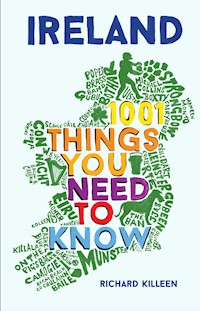
A fascinating cornucopia of facts about Ireland and the Irish, covering its history, culture, land and people. In this enthralling celebration of the places and people that make the country unique, Richard Killeen takes the reader on a tour of Ireland that reveals its rich and surprising history, including its heroes and villains, legends and folklore. As well as exploring the nation's rich literary and sporting heritage, Ireland: 1,001 Things You Need to Know also reveals the best of the country for those visiting today, from Dublin pubs to the nation's finest beaches. This captivating miscellany holds a treasure trove of information that tells the story of this alluring and bewitching country anew.
Das E-Book können Sie in Legimi-Apps oder einer beliebigen App lesen, die das folgende Format unterstützen:
Veröffentlichungsjahr: 2017
Ähnliche



















IRELAND
ALSO BY THE SAME AUTHOR
A Brief History of Ireland
A Short History of Dublin
A Short History of the 1916 Rising
A Short History of the Irish Revolution
A Short History of Ireland
IRELAND
1,001 Things You Need to Know
RICHARD KILLEEN
First published in Great Britain in 2017 by Atlantic Books,an imprint of Atlantic Books Ltd.
Copyright © Richard Killeen, 2017
The moral right of Richard Killeen to be identified as the author of this work has been asserted by him in accordance with the Copyright, Designs and Patents Act of 1988.
All rights reserved. No part of this publication may be reproduced, stored in a retrieval system, or transmitted in any form or by any means, electronic, mechanical, photocopying, recording, or otherwise, without the prior permission of both the copyright owner and the above publisher of this book.
1 2 3 4 5 6 7 8 9
A CIP catalogue record for this book is available from the British Library.
Lines from ‘Dublin’ by Louis MacNeice, from Selected Poems, Faber & Faber, 2007, reproduced by kind permission of David Higham Associates Ltd.
Map artwork by Jeff Edwards
Hardback ISBN: 978-1-78649-158-9
E-book ISBN: 978-1-78649-1-596
Paperback ISBN: 978-1-78649-1-602
Printed in Great Britain
Atlantic Books
An Imprint of Atlantic Books Ltd
Ormond House
26–27 Boswell Street
London WC1N 3JZ
www.atlantic-books.co.uk
This book is for Richard, my son.
CONTENTS
Map
Acknowledgements
1. Land, Landscape and Society
2. People: From pre-Celts to Polish plumbers
3. National Characteristics
4. Heroes and Villains
5. Nation, State and Parish Pump
6. Irish English / English Irish
7. One to Ten
8. Literature and Language
9. Food and Drink
10. Places to See and Things to Do
11. Not Literature
12. Sport
13. Institutions of the State(s)
14. Religion
15. Education
16. Army, Navy and Police
17. The Public Sphere
18. Ten Success Stories
19. Whimsy
Index
This lovely land that always sent
Her writers and artists to banishment
And in a spirit of Irish fun
Betrayed her own leaders, one by one.
’Twas Irish humour, wet and dry,
Flung quicklime into Parnell’s eye;*
’Tis Irish brains that save from doom
The leaky barge of the Bishop of Rome
For everyone knows the Pope can’t belch
Without the consent of Billy Walsh.†
James Joyce, from Gas From a Burner
I live in Ireland by choice, after experience of living many other places, and I am happy here. Our neighbours are friendly, our view is beautiful, my political friends are fine upstanding people, my political enemies fascinating in their own way. I don’t mind the gossip any more than the rain. The censors are no longer eating writers in the street. We are not as bad as we are painted, especially by ourselves. In fact I love Ireland, as most Irish people do, with only an occasional fit of the shudders.
Conor Cruise O’Brien, States of Ireland (1972)
What ish my nation? Ish a villain anda bastard and a knave and a rascal.
The Irishman Macmorris inShakespeare, Henry V, act 3, scene 3
* An incident in a heated by-election campaign in 1891.
† The contemporary (1912) Archbishop of Dublin. Walsh is often pronounced ‘Welsh’ in Ireland, which makes the rhyme.
ACKNOWLEDGEMENTS
I am grateful to the staffs of the National Library of Ireland, the National Archives of Ireland and Dublin City Libraries. The press offices of the Gaelic Athletic Association and An Garda Síochána were efficient and helpful. My friends Pat Cooke, Sandra D’Arcy, Tony Farmar, Jennifer Brady, Michael Fewer, Andrea Martin, Terence Brown and Eric Dempsey all made helpful suggestions, provided me with information that I might have struggled to come by otherwise and corrected my mistakes. I appreciate the help and advice of my agent Ivan Mulcahy. It has been a pleasure to work with Will Atkinson and James Nightingale at Atlantic Books. Beth Humphries has been an exemplary and scrupulous copy-editor, for whose professionalism I am extremely grateful.
1
LAND, LANDSCAPE AND SOCIETY
——
Ireland at a Glance
——
Population: The 2016 census in the Republic of Ireland (ROI) recorded 4,747,976 persons in its preliminary results. The best current estimate (2016) for Northern Ireland (NI) is 1,851,600, split 46 per cent Protestant (effectively Unionist, wishing to remain in the UK) to 44 per cent Catholic (Nationalist, wishing – at least rhetorically – to join ROI). For the first time, the percentage of respondents declaring no religious affiliation has crept into double figures, if only just at 10 per cent. This narrowing of the traditional gap between the two religious affiliations is not progressive: while those who declare themselves Protestant are no longer the majority, there is no indication of a Catholic majority in the foreseeable future. There is what appears to be demographic deadlock.
Area: 84,421 sq. km / 32,595 square miles. That’s a little smaller than the state of Maine but a bit bigger than that of West Virginia. Near enough, it’s about the same size as South Carolina. In European terms, that makes the island about the same size as the Nouvelle-Aquitaine, the south-western region of France between Bordeaux and the Spanish border. It’s a bit bigger than Bavaria, about the same size as Austria and about two-thirds the size of England. It’s the third-largest island in Europe after Great Britain and Iceland and well ahead of all the Mediterranean islands.
Highest point: Carrantuohill, in the Macgillycuddy’s Reeks in Co. Kerry, 1,038 metres/3,406 feet. Not exactly Alpine, but try climbing it in Irish weather. Actually, don’t: it’s very dangerous in bad weather.
Lowest point: North Slob, Co. Wexford, a wildfowl reserve that was created in the nineteenth century at the estuary of the River Slaney in the south-east of the island.
Most northerly point: Ballyhillin, Malin Head, Co. Donegal
Most southerly point: Brow Head, Mizen Peninsula, Co. Cork
Most westerly point: Dunmore Head, Dunquin, Co. Kerry
Most easterly point: Burr Point, Ards Peninsula, Co. Down
Length of coastline: 3,171 km / 1,970 miles
Furthest point from the sea: Close to the village of Lecarrow, Co. Roscommon
Largest lake: Lough Neagh, which borders five of the six counties of Northern Ireland (Co. Fermanagh being the exception), 383 sq. km / 148 sq. miles); the largest freshwater lake in the British Isles
Longest river: the Shannon, 386 km / 240 miles. It rises at Shannon Pot, Co. Cavan and with its tributaries, drains much of the centre of the island as it flows south and then west to enter the Atlantic between Co. Clare and Co. Kerry
Highest and lowest recorded temperatures: 33.3°C at Kilkenny, 26 June 1887; -19.1°C at Markree Castle, Co. Sligo, 16 January 1881
Principal economic activities: agriculture, information technology, financial services, medical and pharmaceutical
Numbers in education: (ROI) primary, 544,696; secondary, 372,296; tertiary, 173,649. The aggregate figure of 1,090,641 represents about 23 per cent of the ROI population in the education system. In NI, there are 168,669 pupils in primary schools; 141,112 in secondary; and 56,445 in tertiary. This represents just under 20 per cent of NI’s population, although it does not account for NI students who attend third-level institutions in either ROI or Great Britain.
——
Divisions, Provinces and Counties
——
The island is partitioned under the terms of the Government of Ireland Act 1920, which began the process whereby the Act of Union of 1801 was unravelled. In its place, devolved government was established. The six north-eastern counties of Ulster, which had a local Protestant majority, wished to remain part of the United Kingdom, unlike the remaining twenty-six counties on the island which were overwhelmingly Catholic and which now comprise the Republic of Ireland.
There are four historic provinces: Ulster, having nine counties – six of which are in Northern Ireland (NI) and three in the Republic (ROI); Leinster, comprising twelve counties; Munster, six and Connacht five.
Ulster counties: Antrim, Down, Armagh, Londonderry, Tyrone, Fermanagh (NI), Cavan, Monaghan, Donegal (ROI)
Leinster counties: Dublin, Louth, Meath, Westmeath, Longford, Laois, Offaly, Carlow, Kilkenny, Wexford, Wicklow, Kildare
Munster counties: Cork, Kerry, Limerick, Tipperary, Waterford, Clare
Connacht counties: Galway, Mayo, Sligo, Leitrim, Roscommon
——
Principal Cities by Population
(urban area only)
——
Dublin
1,110,627
Belfast
483,418
Cork
198,582
Limerick
95,854
Derry
93,512
Galway
76,778
The most densely populated counties are Dublin and Antrim; the most sparsely populated is Co. Leitrim.
——
Nomenclature
——
The Roman geographer Ptolomy (fl. AD 150) called the island Iouernia, which is the likely root of the word Ireland. The more usual Latin word for Ireland was Hibernia (wintry land) which survives in the modern adjective Hibernian. In Old English or Anglo-Saxon, the word for the inhabitants of the island was Iras, the most likely root of the adjective Irish and possibly, by extension, of the word Ireland itself.
The Gaelic name is Éire, derived from Ériu, an ancient pre-Celtic goddess. Alternative poetic names – Banba and Fódla – derive from the names of similar goddesses.
——
World Heritage Sites
——
Brú na Bóinne, series of Bronze Age, pre-Celtic burial sites in Co. Meath, of which the most famous and most fully excavated is Newgrange
Skellig Michael, a spectacular triangular sea stack off the coast of Co. Kerry, a monastic anchorite site dating from the seventh century
Giant’s Causeway, Co. Antrim, an area of about 40,000 hexagonal basalt columns on the northern Atlantic coast near the village of Bushmills
——
Other Sites of Outstanding Natural Beauty
(a personal list)
——
Torr Head, Co. Antrim is at the northern end of the beautiful Antrim Coast Road. You can drive up to the top and find yourself looking down on the Mull of Kintyre, for Scotland is barely 14 miles away across the North Channel.
Slea Head, Co. Kerry, at the western tip of the Dingle Peninsula. If you hug the tiny coast road to the village of Dunquin, you suddenly round a bend and there lie the Blasket islands offshore: the Great Blasket nearest and looking like a sleeping lion.
Glenmacnass, Co. Wicklow. The Wicklow Mountains, just to the south of Dublin, are not particularly high but they constitute a splendid wilderness. The British built a military road through these mountains after the 1798 rebellion, to help flush out fleeing rebels and to penetrate a region that had harboured them. Where the road begins the long drop into the valley of Glendalough, it bends left to avoid the Glenmacnass Waterfall. It’s not the highest waterfall in the country: that’s at Powerscourt in the same county; it drops 106 metres/350 feet and is the third tallest in the British Isles. But Glenmacnass, with its view down the valley, is the more dramatic.
Lough Cullin, Co. Mayo, of which the author Desmond Fennell wrote: ‘The sunlight, falling from an unsettled sky, showed the water luminous and leaden, and a patch of hillside very green. Then the light moved over the hillside and a touch of blue appeared in the lake. It was like a shot being set up for some celestial camera. With that surprise which Irish people sometimes experience when they travel in Ireland, I understood why an Englishman or a German, coming here to fish, would think this paradise.’
Slieve League, Co. Donegal. The sea cliffs here are the tallest on the Irish mainland at 601 metres / 1,972 feet. The cliffs at Croaghaun on Achill Island are taller but there is no viewing or vantage point. The Cliffs of Moher in Co. Clare are more famous but it’s Slieve League for me – and for many others. While size may not be everything, it’s worth noting that the height of the Eiffel Tower is 324 metres / 1,063 feet.
Lough Derg, Co. Tipperary. This is the largest lake in the Shannon system and is best seen from a viewing point on the R494 road between Nenagh, Co. Tipperary and Killaloe, Co. Clare. The viewing point is just beyond the village of Portroe.
——
Best Beaches
(a personal list)
——
Inch, Co. Kerry
Curracloe, Co. Wexford
North Bull Island, Dublin
Keem Bay, Achill Island, Co. Mayo
Gurteen Bay, Co. Galway
Inchydoney, Co. Cork
Brittas Bay, Co. Wicklow
Magheroarty, Co. Donegal
Mulranny, Co. Mayo
Laytown & Bettystown, Co. Meath
——
Ten Longest Rivers
——
km
Shannon
360
Barrow
192
Suir
184
Blackwater
168
Bann
159
Nore
140
Suck
133
Liffey
132
Erne
129
Foyle
129
——
Highest Mountains
——
The Macgillycuddy’s Reeks in Co. Kerry contain the eight highest mountains in Ireland, ranging from Carrantuohill (1,038 metres/3,406 ft) to Cruach Mhór (932/3,058). The remaining ten highest peaks, other than those in the Reeks, are as follows:
metres / feet
Mount Brandon
Dingle Peninsula, Co. Kerry
951 / 3,120
Lugnaquilla
Co. Wicklow
925 / 3,035
Galtymore
Co. Tipperary
917 / 3,009
Slieve Donard
Co. Down
852 / 2,795
Baurtregaum
Dingle Peninsula, Co. Kerry
851 / 2,792
Mullaghcleevaun
Co. Wicklow
849 / 2,785
Mangerton
Co. Kerry
839 / 2,753
Caherconree
Co. Kerry
835 / 2,740
Purple Mountain
Co. Kerry
832 / 2,730
Beenoskee
Co. Kerry
826 / 2,710
In short, Co. Kerry is well supplied with mountains.
——
Ten Most Common Native Trees
——
Oak
Aspen
Elm
Willow
Birch
Rowan
Alder
Whitebeam
Cherry
Crab apple
——
Most Common Birds of Ireland
——
RESIDENT SPECIES
Chaffinch
Jackdaw
Robin
Rook
Wren
Blackbird
Dunnock
Starling
Wood pigeon
Magpie
WINTER VISITORS
Dunlin
Fieldfare
Knot
Black-tailed godwit
Wigeon
Brent goose
Teal
Scaup
Redwing
Lapwing
SUMMER VISITORS
Swallow
Sand martin
Willow warbler
Common tern
Chiffchaff
Storm petrel
Sedge warbler
Arctic tern
House martin
Sandwich tern
——
Ten Most Common Irish Mammals
——
Fox
Badger
Hedgehog
Hare
Stoat
Deer
Otter
Pine marten
Pygmy shrew
Rabbit
——
Bogs and The Burren
——
About 5 per cent of the island is bogland, formed by dead plants decomposing and compressing over millennia in the wet Irish climate. There are two types: blanket bogs which are generally shallow and found on mountainsides that attract heavy rainfall; and larger bogs, mainly found in the midlands, which are ‘raised’ and flat, having a depth of up to eight metres. These are the bogs that can be harvested for fuel in the form of peat briquettes for domestic heating together with ancillary products that can be used as fertilizers.
As with any other unique habitat, the bogs are home to wild flora that are seldom if ever found in other locales. A similar condition affects the remarkable karst landscape of Co. Clare known as the Burren (p. 169) which is host to alpine flora found nowhere else in Ireland (or most other places in north-west Europe).
——
Most Common Native Irish Plants
——
Broom
Dog rose
Wild cherry
Bird cherry
Elder
Ragged Robin
Aspen
Strawberry tree
2
PEOPLE
From pre-Celts to Polish plumbers
——
Pre-Celts
——
Of these peoples, we know almost nothing. We don’t know what they looked like or what languages they spoke or where they originated. Gaelic mythology later proposed a succession of invading peoples but until the Celts themselves arrived around 300 BC and overran the island all is conjecture. But we know that there was a long history of pre-Celtic settlement. The oldest archaeological site is at Mount Sandel, Co. Londonderry, near the mouth of the River Bann. It has been dated to 5935 BC. Then there is the Boyne Valley complex in Co. Meath, centred on Newgrange, which dates from about 2500 BC.
Newgrange is a large circular cairn, more than 100 metres in diameter, containing a central burial chamber. It was built with the greatest care and skill. The roofing stones were provided with shallow, concave channels to act as gutters, carrying rainwater to the outside of the cairn and away from the burial chamber. Most famous is the carefully positioned light box over the entrance, aligned so that on the morning of the winter solstice – and on that morning only – the rays of the rising sun penetrate the full distance of the passage into the burial chamber itself.
The Neolithic people who built this extraordinary structure were not just simple farmers. They were skilled in construction techniques, in lapidary design and in astronomical observation.
——
Celts
——
The word Celt is used rather loosely, not least by English people who badge the other three nations of the British Isles as Celtic. This is inaccurate, or at least exaggerated, in respect of Ireland and Scotland although it has more merit with reference to Wales. Basically, Celtic denotes a pair of linguistic divisions. The so-called P-Celtic languages are Welsh, Cornish and Breton; the Q-Celtic languages are Irish, Scots Gaelic and Manx. Both are descended from a lost Ur-Celtic language. By extension, the word Celt is then used as an ethnic category to describe countries where these languages are – or once were – spoken. That’s where the problem lies: the word properly describes a language group, not an ethnic one.
The Celts were a central European Iron Age people whose migrations covered much of the continent. In Britain, they were displaced by the Angles and Saxons and pushed west into what is now Wales. They first arrived in Ireland around 300 BC. Successive waves of Celtic invaders overran the island, completely obliterating or absorbing the existing population. The last of the major Celtic groups to arrive were the Gaeil and it was they who effectively took possession of the entire island. It is from them that we get the word Gaelic.
Unlike in Britain, they remained undisturbed by foreign invasion for almost 1,000 years. In the fifth century AD, they adopted Christianity. Gaelic Ireland was a pastoral, warlord society with no central government or capital city. Indeed, there were no towns or cities at all. But there was a common language, a common legal system, and a common currency based on the value of cattle. It was not remotely egalitarian. Rather it was highly stratified, with regional or local kings at the top along with lawyers and poets. The latter were important because they memorized royal genealogies.
Late Gaelic Ireland, up to the end of the eighth century, was one of the beacons of Western Christianity at a time when the continent was still recovering from the collapse of the Roman Empire. However, Ireland’s happy isolation could not last for ever; the wonder is that it lasted as long as it did. When it was eventually disturbed, it was at the hands of violent seaborne warriors from Scandinavia.
——
The Vikings
——
Viking raiders first appeared off the east coast of Ireland in 795, less than a decade after their first attack on Britain. Irish monasteries, with their precious ornaments and vessels, offered tempting targets. Over time, the raids increased and the Vikings established trading settlements, which gradually developed into the first Irish towns. Dublin’s foundation date is 841. Wexford, Waterford, Cork and Limerick are likewise all of Viking foundation.
Such permanent settlements meant displacing local Gaelic sub-kings and naturally invited counter-attack. The tenth and eleventh centuries saw a pattern of intermittent warfare between Vikings and Gaels. Occasionally Vikings allied themselves with one side or the other in a dispute between Gaelic warlords. This pattern reached its peak in 1014 at the Battle of Clontarf, on the north shore of Dublin Bay. This was a kind of Gaelic civil war in which Brian Ború – the effective ruler of the southern half of the island – was attempting to assert his claim to the high kingship of the entire island. Both Brian and those resisting him had Viking allies to assist them. Brian won a Pyrrhic victory, at the cost of his own life, but thereafter the island reverted to its traditional chequerboard of provincial kingdoms and sub-kingdoms. There was no insular unity.
The Vikings left an indelible mark on Ireland by establishing its first towns and developing its early structures of seaborne commerce. Their legacy is also there in place names – Leixlip near Dublin, for example, means salmon leap. Even more so, it’s there in surnames. The common Irish surname Doyle is derived from the Gaelic dubh ghaill meaning dark foreigner, a reference to the dark-haired Danes as distinct from the fair-haired Norwegians. That said, the Viking impact was nothing compared to what came next.
——
The Normans
——
The Normans were the descendants of Vikings who had settled in what is now Normandy in north-west France and were vassals of the King of France. As the world knows, they conquered England in 1066. In 1169, a Norman invasion force came to Ireland at the invitation of the provincial king of Leinster, who had lost his kingdom in a matrimonial dispute and needed military muscle to recover it. This was provided by a body of Normans based in Wales. Their military superiority soon established and consolidated their position, especially in the south-eastern quadrant.
In the wake of the Normans came continental developments in architecture, in the spread of new religious orders, in new legal systems and the further development of towns. Most fatefully of all, it inserted the royal power of England into Irish affairs. King Henry II was so concerned that Norman success might lead to the establishment of an independent kingdom on his western flank that he came to Ireland in 1171 with a formidable military force and accepted the submission of the Norman colonists and most of the Gaelic kings as well. Ireland was now deemed to be a lordship of the English crown.
The effect of the Norman presence has been permanent and profound. It is clearly visible to this day. The Normans never conquered the entire island, although they were extremely good at settling themselves on the most fertile land. Throughout the medieval period, Norman lordships coexisted with Gaelic kingdoms in a see-saw relationship in which neither side ever totally dominated the other. It was into this world that the next significant group inserted themselves in the middle of the sixteenth century.
——
The New English
——
King Henry VIII’s religious break with Rome and his urge towards greater centralization were inextricably mixed up. In the 1530s, he broke the magnate power of the greatest Hiberno-Norman family, the Fitzgeralds of Kildare. In 1541, he abolished the lordship and established Ireland as a separate but sister kingdom. In the wake of this there came to Ireland a new cohort of governors, administrators and military men whose aim was a more complete conquest of Ireland for the crown.
These are known to history as the New English. Their most distinctive characteristic was their Protestantism, for the Reformation failed in Ireland: Normans (now called Old English to distinguish them from the new interlopers) and Gaels alike remained Catholic. The next century brought a series of wars together with plantations of New English on conquered Irish lands until the final, complete English conquest of Ireland under Cromwell in the 1650s. There then followed a massive dispossession of Catholic landowners and their replacement by further New English planters, whose descendants would in time become known as the Protestant Ascendancy. But first, we need to back-track a little to the early 1600s and the Plantation of Ulster.
——
Ulster Protestants
——
Ulster was the province least penetrated by the Normans. In the face of ever-expanding English power under Elizabeth I, the Gaelic lords of Ulster rebelled in 1593 and, despite Spanish military aid, were finally defeated ten years later. The principal Ulster chiefs, O’Neill of Tyrone and O’Donnell of Donegal, fled to the continent. Their vast lands were forfeit to the crown and a huge plantation scheme – by far the biggest yet – was effected. The planters were all Protestant, although there was an important distinction between English Anglicans and Scots Presbyterians, a distinction still visible today.
So Ulster went from being the most to the least Gaelic province in the course of a century. It had always been a distinct place and it was now marked off by religious and ethnic differences from the three southern provinces.
——
The Protestant Ascendancy
——
The term did not come into use until the 1790s but it describes the ruling elite descended from the Cromwellian land plantation. The ascendancy were not just Protestant – they were Anglican. The Church of Ireland, an Anglican sister of the Church of England, was established by law and only those conforming to it could sit in parliament, vote or enter the higher professions. Final Catholic resistance – by now the distinction between Gaels and Old English had been elided if not quite eliminated – was only overcome in the 1690s.
From then until the late nineteenth century, the ascendancy were the key power in the land. In common with all contemporary dominant religious groups, they discriminated against other confessions, in this case Catholics and Dissenters. The disabilities were more severe in the former than the latter. What made Ireland unusual, however, was that the ascendancy were a minority rather than a majority group. They constituted barely 10 per cent of the Irish population. The contrast with contemporary England and France was stark: there, legal disabilities were directed by a confessional majority against dissenting minorities. In Ireland, it was the other way round.
What does Ireland owe the ascendancy? Most visibly, the wonderful Georgian architecture of Dublin and other cities together with some magnificent country houses. Being Anglo-Irish, they facilitated the gradual spread of the English language and the retreat of Irish, although the disastrous famine of the mid nineteenth century accelerated that process. The various institutions of higher learning and scholarship were largely an ascendancy preserve until the twentieth century.
A series of Land Acts in the last quarter of the nineteenth century gradually saw the break-up of the ascendancy estates and the replacement of the landlords by a new class of owner-proprietors, who had previously been tenants. These are the modern Irish farming class.
——
Recent Immigrants
——
The huge expansion of the Irish economy from the early 1990s to the financial and property collapse of 2008 turned Ireland from a nation of emigrants to one of immigrants. In particular, free movement of people within the EU facilitated the arrival of many from the eastern accession states. There was at one stage a weekly bus service between Warsaw and Dublin. Many worked in the construction boom until the crash. The more footloose left as the construction industry contracted violently but those who were married – and especially those who had children in the school system – had a strong incentive to stay. As I write (2016) it is still a commonplace to find Poles, Lithuanians, Croats and even Russians working in bars and restaurants. They are the New Irish.
TEN IMMIGRANTS WHO MADE A DIFFERENCE
St Patrick(s)
the national apostle(s)
Sitric Silkenbeard
Norse King of Dublin who founded Christ Church Cathedral (1038)
William Marshall (c.1146–1219)
consolidated the Norman conquest of Ireland
Sir William Davies
key member of the New English elite: attorney-general and speaker of the Irish parliament (early 17th century)
Richard Boyle, 1st Earl of Cork (1566–1643)
dynast and New English adventurer
Sir Arthur Chichester (1563–1625)
promoter of the Ulster Plantation; founder of Belfast
James Gandon (1742–1823)
principal architect of Georgian Dublin
Samuel Louis Crommelin (1652–1717)
founder of the Ulster linen industry
Maud Gonne (1866–1953)
revolutionary and muse of W.B. Yeats
Thom McGinty (1952–95)
The Diceman, beloved Dublin street artist, self-styled stillness artist and human statue
3
NATIONAL CHARACTERISTICS
In general, this is a dubious area – for two reasons. First, what are called national characteristics are more often national caricatures projected on to a community by outsiders (thus parsimonious Scots, sexually inept English, Welsh men not to be left alone with sheep). Second, even to the extent that some characteristics may be more or less true, they can change over time. What follows in this section comes with a mixture of scepticism and levity.
——
Eloquence: the Gift of the Gab
——
The English hoard words like misers. The Irish spend them like drunken sailors.
Kenneth Tynan
You might be forgiven for thinking that this is a myth if you spent time listening to debates in the Dáil, the lower house of the Irish parliament. The standard of debate is often lamentable and very few of the deputies would ever be suspected of kissing the Blarney Stone. This practice, in which a person is held upside down by the heels to kiss part of the stonework on Blarney Castle in Co. Cork, is reputed to convey the gift of eloquence. It is very popular with tourists.




