


8,99 €
Mehr erfahren.
- Herausgeber: The O'Brien Press
- Kategorie: Lebensstil
- Sprache: Englisch
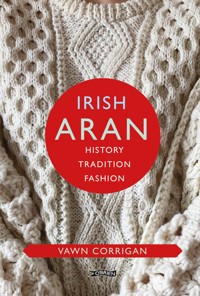
Irish Aran knitting is a living tradition with a worldwide reach. Arans communicate warmth, comfort and a sense of home, which people the world over continue to respond to, even though the connection to our rocky outcroppings in the Atlantic Ocean may be long forgotten. Aran grew up in the harsh environment of the Aran Islands where everyday wear consisted of home-spun fabrics and knits. Today Aran survives as part of a rich craft heritage and as high and slow fashion on the catwalks of the world. Vawn Corrigan explores the history, mythology and growth of this iconic design in this beautiful and informative hardback book.
Das E-Book können Sie in Legimi-Apps oder einer beliebigen App lesen, die das folgende Format unterstützen:
Veröffentlichungsjahr: 2019
Ähnliche


















Dedication
For all the makers; blessings to your dreaming hands that shape the world! And for those whose love shapes mine; my mother Barbara and my son Loman.
Contents
Chapter 1
What Is Irish Aran?
Design innovations come and go, what stays to become part of a country’s heritage is that which the people’s hearts resonate with.
In 2017 a traditional Aran sweater travelled from Ireland’s National Folklife Collection to New York’s Museum of Modern Art (MoMA), where it was presented as part of an exhibition, alongside over 100 items from around the world. Each had been selected for the story that they told. Objects such as the Indian sari or the American baseball cap carry a cultural charge that gives them an iconic status. The unknown knitter who made that particular Aran sweater on the Aran Islands in the 1930s could never have imagined just how far and wide Aran knit would travel. Casting off from its island origins, the Aran sweater has become far more than a garment; it is a tangible symbol of Irishness recognised the world over.
Considering the global impact of the Aran knit, it would be understandable if knitters from other traditions asked, ‘Just what is so special about Aran?’ Latvian knitting, for example, plays an important social role in its country of origin; the old custom of exchanging mittens to acknowledge respect and love continues to this day, and when the country was under Socialist rule wearing traditional, brightly coloured patterned knits was one of the only safe ways to show political defiance.
Handmade traditional Irish clothing and crafts outlet Cleo, Dublin (est.1932), commissioned Donegal woman Elaine McBride to knit a replica of the original Aran sweater that travelled to MoMA. She worked out the pattern from photographs. Elaine has been knitting virtually her whole life, as did her mother before her. Her work remains highly sought after.
Outside Norway, the country is represented by the selburose, a traditional geometric rose knitting design. The pattern originated in 1897, when Marit Guldsetbrua Emstad created a pair of mittens, drawing her inspiration from the country’s folk art.
A replica of MoMA Aran sweater.
For these countries their beautiful national knits are redolent with meaning. And yet, it is Aran that enjoys the highest profile of all.
Today, the term ‘Aran’ is a tarpaulin term covering a variety of designs. The patterns have made their way into areas as diverse as wedding dresses, designer homeware, interiors and fine art. Aran emerges dramatically transformed by the vision of designers – deconstructed, supersized, and yet clearly identifiable in its geometric elements and bold movement of line.
Internationally, Aran has had fans which read like a who’s who of design illuminati: Ralph Lauren, Jean Paul Gaultier, Tommy Hilfiger, Marc Jacobs, Alexander McQueen, Stella McCartney and Michael Kors. Season after season Irish designers have drawn from it and expanded its language. Aran has an extraordinary ability to be refashioned in many ways and yet retain its appeal as a simple classic. It manages to straddle both the traditional and the modern.
As fashion garments, Aran knits are subject to changes in styles, yarns and colours. Those who produce Arans for the market face the same pressures as everyone else in the fashion business; these realities have changed the garment. Despite this, Arans seem to inhabit a timeless space. The designs live on as though they had been carved into the country itself. Aran has graced the bodies of an impressive assortment of image makers those familiar stiches have moved through the hands of countless knitters from Ohio to Tokyo. Yet, regardless of how far it travels, it keeps its Irish accent. Arans are deeply connected to the Irish psyche. An informal online survey done for this book (120 Irish people) showed that 86 per cent believed the Aran sweater to be an identifiable component of Irish identity, on a par with iconic things like Guinness or hurling. Eighty-eight per cent either had an Aran sweater in the past or recalled someone in their family wearing one.
Irish Aran’s associations of comfort and home make it well-suited to interiors. It plays a starring role in Irish designer homeware, where its structures are expanded into supersized cables or scaled-down for subtle interest. It features on everything from cushions and throws to wallcovering and floors. Pure wool Aran throw by Ireland’s Eye Knitwear.
Far from the catwalk, like many informal national and regional costumes, it lives quietly on as a symbol of home and comfort for millions of people.
BÁINÍN GEANSAÍ
Aran sweaters were originally made using local wools that were stouter and coarser than the wools commonly used in knitwear today. The original use of the term ‘Aran knit’ refers to the undyed woollen hand-knit known to the Irish speakers of the Aran islands as báinín geansaí (pronounced ‘bawneen gansee’). The name comes from the Irish bán which means white, a colour that traditionally symbolises spiritual and physical purity in Ireland. Children wear white for their First Holy Communion, a Catholic ritual that takes place at around the age of seven years. They also wore the gansey for Confirmation. Báinín is the term for a traditional Irish fabric woven using undyed wool. Geansaí translates as sweater or jumper; the word gansey is still used generically to describe a sweater or jumper in Ireland.
Irish Aran is predominantly either monochrome or marled (streaked two-tone wool) as coloured patterns interfere with the impact of the texture. Classic báinín (undyed white) remains a favourite. Increasingly, a spectrum of lush colours have saturated the knits and broadened their appeal. The New Aran is a collaboration between knitwear designer Pearl Reddington and Maireád Uí Fhlátharta of Inis Oírr. By adding colour and the small detail of the contrast neon cuff the garment was changed to a contemporary piece.
ISLAND ORIGINS
The ancestral home for the Aran knit is a cluster of three rocky islands, Inis Oírr, Inis Meáin and Inis Mór, which stretch across the mouth of Galway Bay in the Atlantic sea. The biggest island, Inis Mór (pronounced ‘inish more’) is regarded as the capital.
The islanders were traditionally fishing communities, known for their self-sufficiency and resourcefulness. Fortified by close-knit family ties and religious faith, islanders looked to one another in times of need rather than to the mainland. Island land consists of rocky limestone ledges and minimal soil; the islanders literally built their fields by hand. They hauled baskets of seaweed from the seashore on their backs and mixed it into sand to create soil. The islander’s economy was based primarily on fishing. Traditionally they built their own canoes, known as curraghs (pronounced ‘currocks’) which were constructed of a wooden frame covered in tarred skins.
Because they had no peat or wood for fuel, trips to the mainland were always a feature of life, but the islands are surrounded by a shelving bed which makes for treacherous seas during Atlantic storms. Before the nineteenth century there were no proper piers and so, in the past, the islanders were frequently cut off from the outside world for weeks on end. Their rich culture of storytelling, music and craft was developed in response to their isolation. It was one of the very last places to be anglicised (speaking the English language). Traditional customs, crafts and style of dress lived on among the islanders long after they had vanished elsewhere.
Remains of the Bronze Age fort Dún Aonghasa (Dun Aengus), c1100BC, stand on a one-hundred-metre cliff on Inis Mór. The archaeological heritage of the Aran Islands is astoundingly rich. There are megalithic tombs on the islands which suggest that the first people settled in the Stone Age, sometime before 4000BC, and successive generations have layered the land with a surfeit of treasures ranging from Bronze Age forts with massive dry-stone walls to early Christian high crosses.
Chapter 2
Through the Women’s Hands
‘The Irish don’t just write poetry, they knit it.’
J. Peterman, Cleo Arans
The island knitters did not use written patterns; their response was more immediate. Whatever appealed aesthetically was studied visually, to break it down into design elements, which were translated directly through the knitters’ hands. This is still common practice. A parallel is found in traditional Irish music; written scores are not circulated; instead, musicians cultivate their listening abilities, working out the structures of complex reels and airs before responding with their unique voice. This results in exuberantly individual work.
ARTFUL STITCHES
Hundreds of stitches are known to the Islanders. Shaped by the tastes of the market, certain ones prevailed while others fell into disuse. Aran islanders still have many more stitches in their repertoire than you will find in Aran stitch books, and they retain slightly different ways of doing things than their mainland peers. For example, on Inis Oírr (pronounced ‘inish ear’), the diamond stitch is done as a fivestitch rather than four-stitch. This gives the common Aran diamond pattern quite a different look.
‘The diamond base is often a four-stitch base possibly for ease of hand looming on machines or for more modern versions of elongated Diamond patterns. Like the foundation stone in the traditional gap of the dry-stone wall, the centre stitch continues up through the diamond pattern, making that diamond shape more defined.’
Aran island knitting tutor Úna Mc Donagh
Multiple names exist for many of the stitches, but as the island knitters work visually, language is less relevant. Aran is dominated by three particular patterns: cables, honeycomb and diamonds. There are almost an infinite amount of cables, including plaited cables, lobster claws, trellis stitches and varieties of Celtic knotwork. Some of the other most familiar Aran stitches are: the tree of life, blackberry (also known as Trinity), bobbles, zigzags and double zigzags. The twist stitch is a favourite divisional stitch which is used to frame more complex stitches. Plainer backgrounds of moss stitch, also known as carrageen moss (after the edible seaweed found on the shoreline) or varieties of plains and purls around and between raised stitches highlight Aran’s characteristic three-dimensional effect.
‘There are many patterns and designs but mostly they derive their origins from simple cables and twists. Patterns were passed on and read visually rather than written down. Pattern names have changed, but there are also many different names for the same pattern. For example, the honeycomb is also known as bollán (rock pool) by the knitters on the Aran Islands. There are many variations of this when used as a base pattern.’
Úna Mc Donagh
The garment has become a fashion piece rather than a winter wear essential, and it has changed to reflect the tastes and times it has found itself in. Just as in music, where phrases can be omitted without destroying a song, Aran can be deconstructed, its elements used to a greater or lesser degree while still retaining its classic beauty.
SYMBOLISM
In contrast to fine art, folk art usually has a function above pure aesthetics. It is of the people and reflects their shared culture in the broadest possible sense. In many cash-poor societies the concept of ‘art for art’s sake’ is an alien one and the urge towards beauty is satisfied by bringing artistry to the creation of functional objects. Clothing is a natural outlet for creativity. Irish weavers acknowledge that the colour palettes for their tweeds feature the hues of the bog flowers, gorse-covered mountainsides and the Atlantic skies that surround them. Similarly, island women took design inspiration for their sculptural woollen art from their everyday lives. Like other forms of folk art, such as pottery and quilting, Aran is replete with abstracted symbols related to the abundance of nature.
Aran stitches have been used to provide inspiration in entirely different spheres. Anne Kerr has run the Aodh Ruadh School of Irish Dancing in Donegal for three decades. Her students perform in shows such as Riverdance and Lord of the Dance. Kerr used the diamond, cable, honeycomb and Trinity (or blackberry) stitches as her inspiration for a dance, which she titled ‘The Fisherman’s Weave’. The dancers, in three-hand or four-hand reels, cross one another, travelling under each other’s arms, or move forwards and backwards, creating the shapes with their steps.




