


Erhalten Sie Zugang zu diesem und mehr als 300000 Büchern ab EUR 5,99 monatlich.
- Herausgeber: Salt
- Kategorie: Lebensstil
- Sprache: Englisch
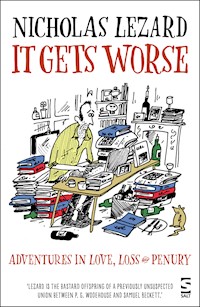
It Gets Worse is the second instalment of Nicholas Lezard's rueful, dissolute life. Beginning where his first volume, Bitter Experience Has Taught Me, ended, Nick's fortunes have not improved. At home in the Hovel, his bachelor existence makes a further descent into chaos, yet the misadventures are faced with sardonic wit, pathos and something like dissident wisdom.
Sie lesen das E-Book in den Legimi-Apps auf:
Seitenzahl: 424
Veröffentlichungsjahr: 2019
Das E-Book (TTS) können Sie hören im Abo „Legimi Premium” in Legimi-Apps auf:
Ähnliche



















IT GETS WORSE
NICHOLAS LEZARD
For L. S.
CONTENTS
INTRODUCTION
THIS IS THE second volume of columns culled from my weekly “Down and Out” column in the New Statesman, which has now, incredibly, been running for ten years or so. The first volume, Bitter Experience Has Taught Me (published by Faber and Faber; I’m pretty sure you can find a copy somewhere), told the weekly adventures of a dissolute, or let us say under-disciplined, middle-aged man of slender means who had been kicked out of the family home by his wife. This man drinks far more than the recommended guidelines; he spends somewhere between 110 and 120% of what he earns, however much he earns; he falls in love; he gets his heart broken; he is devoted to his children and his friends; he gets into all sorts of scrapes, some of which, like the case of Sherlock Holmes’s Giant Rat of Sumatra, the world is still not yet prepared for. This is more or less all you have to know, and this book more or less picks up where the last one ended, on a note of cautious hope.
In one sense, the title of this book is slightly dishonest: for a large part of it, things got better, rather than worse. This was thanks to a brief period of domestic happiness, five or six years ago, in which my then-girlfriend moved in with me. I was worried at first that I had become feral, or like one of those wild children who used to get discovered in German forests and who never really managed to fit in with civilisation. But it turned out fine, for a while; and only when the woman concerned got a job in another country did this period of happiness end. (Readers may be slightly confused at the off-and-on-again status of the relationship. Believe me, it was even more confusing at this end.) Since then, things have got much worse, and if there are subsequent volumes in this series – and there’s enough material for two or three more, at least – you’ll be able to see just how bad things can get. (At the moment, I am technically homeless.)
There’s another aspect to this book: the pieces collected here were written in gentler times. There are contemporary references which may remind you of that. But there are rumblings, which many noticed at the time, of a new, more disgusting age to emerge: the rise of Johnson (Alexander de Pfeffel) and Farage (Nigel); and although it needed no great clairvoyance to see that they were destined to poison public life, I don’t think even I could tell just how much destruction they would cause. Also, I was conscious that my brief was not to take weekly snapshots of the political life of the country: the rest of the magazine did that very well; is indeed its chief raison d’être.
Which leads me to thank the editor of that magazine, Jason Cowley, who invited me to start the column and who still, as I write these words, allows it to continue. Without him, nothing. (Every so often I wonder whether my writing a column about – as it says on the cover – love, loss and penury actually contributes to my chaotic existence or is simply a reflection of it. However, that is the kind of existential question which is more or less meaningless whenever I contemplate my bank balance.)
Before I get onto individuals, I’d like to thank, after my editors (as well as Mr Cowley, there is Kate Mossman, to whom I file every week, and who is as wonderful at her job as anyone I have ever met, and who only very rarely asks me to rewrite anything. When she does ask, she’s always right), I’d like to bow to my readers, the vast majority of whom seem to be fine, upstanding, decent and sympathetic people. Without the editor, nothing; but also, without the reader, nothing, and I hope they don’t mind my cheek in asking them to pay a second time for what they have already read – although I have added quite a few footnotes, taken out some of the more obscure references and verbal tics and infelicities (including about three thousand instances where I used the word “anyway” to begin a paragraph), and generally gone through the pieces in order to give some kind of impression of narrative coherence.
That said, I think this book is best read in small doses. A weekly column of 850 words or so has a different rhythm to two and a half pages in a longer narrative (cf. Karl Ove Knaussgard. Some readers may think my columns deal in banalities, so imagine how cross they’d be if I wrote 850 words each week on eating breakfast cereal or something. Incidentally, my standard joke about Knaussgaard when people ask me what I think about him is that I despise writers who mine their personal lives for financial gain), and I worry that if you read too much of it in one go you might feel something like a kind of literary seasickness. The ideal place for it is the bog, actually. There is no shame in this. Ten minutes at a stretch and then wait until tomorrow. Also, the bedside table, and if it slips from your fingers as you pass into sleep then I will consider at least some of my job to have been done properly.
Thanks are first due to Jen and Chris Hamilton-Emery, the good people at Salt Publishing who decided to take on this venture; and Grizelda Grizlingham, the cartoonist who I insisted draw the cover both to this and the previous book, because she gets me. I’d also like to thank my retired agent, Derek Johns, who said “yeah, that’s fair enough, I suppose” when I told him how much Salt were paying me. As for the friends who helped, many of them are mentioned by name here, but of course there are some people who do not like to be mentioned in the column, for reasons which I do not understand but I do respect. Chief among the cast of characters I’d like to thank, whether they’ve been named or not, or never even appeared, is my Estranged Wife, Siân (yes, we are still married, at time of going to press, which is weird, I know, after twelve years of separation, but there you have it: we don’t like lawyers), who has done such a good job of doing the heavy lifting when it comes to raising our astonishingly cool and clever children. Other people who have kept my heart and soul above the waterline include (in not entirely, but partly, arbitrary order) Toby Poynder, Kevin Jackson, Louise and Paul Ramsay, John Moore, Hannah Griffiths, Will Self, James Spence, Anna Prygodzicz, Saga Lynd, Alison Alexanian, Katie Ray, Louisa Young, Alison Finch, Katy Evans-Bush, Maggie Ryan, Miriam Holland, Laurie Penny (in whose flat I am now writing these words), Linda Grant, Alba Arikha, Deborah Ronane, Howard Jacobson, Richard Coles, Linda Lawton and Stephen Israel. If I’ve forgotten anyone, forgive an ageing brain, buy the book, waggle it angrily in my face, and I will sign it, and, if you have a plausible case and I am in funds, reimburse you.
NICHOLAS LEZARD September 2019




