


5,99 €
Mehr erfahren.
- Herausgeber: MGS Press
- Kategorie: Lebensstil
- Sprache: Englisch
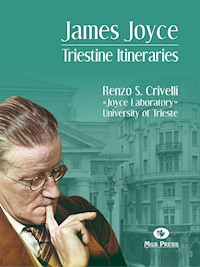
In reconstructing Joyce’s Triestine years, 1904-1915 and 1919-1920, so crucial to his literary growth, this book also avails of unpublished sources, of documents, of newly-checked data from the registry offices, and offers itself as a useful guide to the places most relevant to the great writer’s daily life, his work, his social and “recreational” relationships. Maps and routes trace a geography at once physical and spiritual to help the interested party in his search for an emotional self-identification with the Trieste of the beginning of this century, the Trieste where A Portrait of the Artist as a Young Man was finished, the play Exiles was written, Ulysses was conceived, and the prose-poem Giacomo Joyce first saw the light, the only Joycean work set in Trieste.
Das E-Book können Sie in Legimi-Apps oder einer beliebigen App lesen, die das folgende Format unterstützen:
Veröffentlichungsjahr: 2014
Ähnliche














Sommario
Copertina
Colophon
Titolo
Introduzione alla quarta edizione
1
2
3
4
5
I Percorsi
Passeggiando nella Trieste di Joyce
Percorso A
Percorso B
Percorso C
Percorso D
Percorso E
Percorso F
Percorso G
Percorso H
Opere citate
Bibliografia
Fine
ISBN 978-88-89219-91-1 © 1996-2001-2008 UNIVERSITÀ DEGLI STUDI DI TRIESTE Piazzale Europa 1 – 34100 TRIESTE © 2014 Mgs Press S.a.s. Via Sara Davis 101 – 34135 Trieste Tel. / fax: 040 44968 e-mail: [email protected] Consultant Carlo GiovanellaTranslation John Mc Court Eric SchneiderDesign Layout, Cover and Maps Claudia OliosiPhotographs Giovanni Montenero Civici Musei di Storia ed Arte di TriesteCover Photograph Gisèle Freund © Agenzia Grazia Neri MilanoDigital EditionValerio VecchiaFirst Digital Edition June 2014
Copyright © 2014 MGS PRESS. All rights reserved. This Work is Copyright protected. By payment of the required fees, you have been granted the nonexclusive, nontransferable right to access and read the text of this ebook on-screen. No part of this text and images may be reproduced, transmitted, downloaded, decompiled, reverse-engineered, or stored in or introduced into any information storage and retrieval system, in any form or by any means, whether electronic or mechanical, now known or hereinafter invented, without the express written permission of the Publisher.
Renzo S. Crivelli «Joyce Laboratory» • University of Trieste
James Joyce
Triestine Itineraries
Introduction to the fourth Edition
In what now seems a far off 1994, the Joyce Laboratory was founded at the University of Trieste with the aim of ‘re-evaluating’ James Joyce’s presence in Trieste between 1904-1915 and, following his brief return after WWI, from 1919-1920. The Laboratory, which was made up of students from the Faculty of English Literature (with Massimo Soranzio responsible for compiling the individual researches), followed in the wake of the first Joycean Festival held at the Miela Theatre of Trieste where, thanks to the good offices of Cesare Piccotti and Rosella Pisciotta, numerous events took place over the course of an entire month, including the first non-stop reading ofUlysses, which lasted 37 hours and involved 80 actors and local Joyce enthusiasts.
As is known, in the 11 years he spent in Trieste (if we subtract his stays in Pola, Rome, Ireland and Zurich), Joyce wroteA Portrait of the Artist as a Young Man, completed the collection of short storiesDubliners, set down his only playExiles, and wrote the short prose-poemGiacomo Joycewhich, with the exception of a few miscellaneous poems, is the only work by Joyce set entirely in Trieste. It was during this period that the Irishman consolidated himself as a writer of powerful, incisive prose, a process of literary and personal growth that occurred between 22 and 38 years of age, generally considered the most important period of an individual’s life and which, in Joyce’s case, coincided with the fecund Triestine period. In fact, Trieste was perfectly suited to the needs of the Irish writer, whose aim was the development of ‘European’ themes linked to the linguistic stratification of western culture. As the main seaport of the Austro-Hungarian Empire, the city attracted people of many different nationalities and origins, endowing it with an extraordinary diversity.
Joyce arrived in Trieste by chance, sent here by the Berlitz School in Zurich which had no teaching post available, a fortuitous event that would prove decisive for the Irish writer. Despite enormous difficulties, especially between 1905-1912 when, as Joyce later wrote, in Trieste he ‘ate his liver’, and the recurrent financial problems that forced him to change addresses frequently and live by expedients and continuous loans (especially from his brother Stanislaus, but also from his more affluent students) he soon came to consider the Adriatic city as his second homeland.
Before the founding of the Joyce Laboratory in 1994, the matrix of Trieste and its capillary penetration in Joyce’s works (down to the least details of daily life, in a constant interplay and mirroring of real and imaginary, of local reality and the distant context of Dublin) had received little attention. Of course, the Trieste years had been cited by the great biographer of Joyce, Richard Ellmann who had visited the city briefly in the 1950’s during his own research, though he would ultimately rely on the often biased recollections and opinions of Stanislaus. But in his monumental biography those years appear as a sort of enclave around which the much more significant matrices of Dublin and Paris rotate. And yet if from Joyce’s 22 years in Dublin, we deduct those in which an individual’s discernment is generally still immature and undeveloped, we have a net of 12-14 years, as opposed to the 19 years spent in Paris, which Joyce would leave only with the outbreak of WWII, shortly before his own death in Zurich.
And while it’s true that Joyce ‘ate his liver’ in Trieste, it’s also true that this was the ‘only city in which he could write’ (as he would assure his brother in 1907, after the disastrous experience in Rome). As he wrote to Nora on one of his return visits to Ireland, here he had ‘left his soul’, and longed always to return to ‘our beautiful Trieste’. The relationship between Joyce and the Adriatic city is thus far different and more complex than the one known before 1994. It was indubitably the Joyce Laboratory which, with its meticulous researches into the writer’s Triestine years, blazed a trail which has since been followed by many other scholars. Capillary researches in the city archives, public records office and land registry office yielded precious information, while the surviving documents in the archives of the University of Trieste (the historical nucleus of which was constituted by the Pasquale Revoltella Upper Business School, where Joyce taught from 1913-1915) resulted in a monograph on Joyce’s career as English teacher in Trieste (see R.S. Crivelli,Una rosa per Joyce/A Rose for Joyce, MGS Press, 2004).
This research made it possible to correct a number of errors in Ellmann and added significantly to our knowledge of Joyce’s Trieste years. It became possible to reconstruct Joyce’s entourage, identifying his friends and acquaintances and, thanks to the Trieste City Directory of the period, discovering where they lived and even their occupations.
This book is the result of the researches carried out by the Laboratory, which during its first two years also benefited from the precious advisory role of Claudio Magris and Elvio Guagnini (to whom I owe a special thanks for having introduced me to Trieste’s culture, shortly after my arrival from Turin University). Working under my supervision, the research was carried out by the students of the academic years 1994-1995 and 1995-1996 (many of whom continue to be dedicated Joyceans), and whom I should like to remember here: Federica Causin, Veronica Dall’Osso, Richard de Felice, Anna Manicardi, Monica Randaccio, Massimiliano Turinetti di Priero, Camilla Verani and Pamela Volpi. The first volume ofItineraries, reprinted in 2001, was subsequently joined by two volumes dedicated to the personal and literary itineraries of two other great Triestine and international literary figures:Italo Svevo. Itinerari triestini/Triestine Itineraries(ed. Renzo S. Crivelli and Cristina Benussi, Mgs Press, Trieste 2002) andUmberto Saba. Itinerari triestini/Triestine Itineraries(ed. Renzo S. Crivelli and Elvio Guagnini, Mgs Press, Trieste 2008).
The first edition ofJames Joyce. Itinerari triestini/Triestine Itinerariesappeared in 1996, the same year in which the University inaugurated the Trieste Joyce School, cofounded by Renzo S. Crivelli and John McCourt. In 2014, the School completes its 18th year, and has hosted more than 1000 students and 150 leading scholars from around the world. The second edition appeared in 2001 in order to meet a growing international demand, due to its bilingual, Italian-English format. The third edition, appeared in 2008, testifies to the fortune of this book, which is meant to be used in conjunction with the 45 plaques, placed by the City of Trieste, that trace a series of primary and secondary itineraries throughout the city. Together with the two volumes dedicated to Svevo and Saba, these itineraries create an open-air Literary Museum that attracts scholars and enthusiasts from around the world.
I should like to conclude by extending my heartfelt thanks to the University of Trieste and to the many others who with their generosity, testimony and advice have made this work possible: the much lamented Fulvio Anzelotti, Renzo Arcon, Claudio Bianchi, Flavio Benussi, Giorgio Grisilla of the Trieste Railway Museum, Massimo De Grassi (for the profiles of the buildings), Piero Delbello, Bianca de Toma, Pierpaolo Dorsi, Assistant Director of the Trieste State Archives, Adriano Dugulin, Director of the Civic Museums of History and Art and curator of the Schmidl Theatre Museum of Trieste, Renata Grim Vida, the lamented Aurelia Gruber Benco and Nora Franca Poliaghi, Edoardo Marini, Stelio Mattioni, Ondina Ninino, the vulcanic Cesare Piccotti, Zora Koren Skerk, the former and current directors of the Trieste Public Library, Anna Rosa Rugliano and Bianca Cuderi, Eddy Schleimer, Maria Tiziani and Teresita Zajotti.
This e-book edition is dedicated to the memory of Giorgio melchiori, the most famous Italian scholar of Joyce, and Giorgina Masi, the shyest and dearest of Joyceans. They will be much missed.
Renzo S. Crivelli
1
A “Placentary” City
“Dear Pound, I went to the station this morning to start at 7.30. On my arrival there, I was told that a passenger train which had left some hours before had collided with another, result as per enclosed cutting. Luckily I was not on it...”1. With these words James Joyce justified, in a letter not clearly dated, yet another missed appointment with Ezra Pound, the American writer who then was living at that time in Sirmione. Pound had been anxious, for some time, to get to meet his Irish contemporary, for whom he had been carrying out a commendable promotional campaign in the intellectual circles of both London and Paris. This was in 1920 and Joyce, having returned from Zurich to Trieste after the Great War (his first stay had lasted from 1904 to 1915), was still trying to manage what was, to say the least, a complicated family situation. Because of a lack of affordable housing which did not necessitate the payment of a large deposit, Joyce was forced to share a flat in via della Sanità 2 (today via Diaz 2) with ten other people: his wife Nora and their children Lucia and Giorgio, his brother Stanislaus, his sister Eileen and her husband Frantisek (Frank) Schaurek and their two little daughters Eleonora and Bozena Berta (not Bertha as in English), a cook and a babysitter (Ivanka and Loiska).
Lesen Sie weiter in der vollständigen Ausgabe!
Lesen Sie weiter in der vollständigen Ausgabe!
Lesen Sie weiter in der vollständigen Ausgabe!
Lesen Sie weiter in der vollständigen Ausgabe!
Lesen Sie weiter in der vollständigen Ausgabe!
Lesen Sie weiter in der vollständigen Ausgabe!
Lesen Sie weiter in der vollständigen Ausgabe!
Lesen Sie weiter in der vollständigen Ausgabe!
Lesen Sie weiter in der vollständigen Ausgabe!
Lesen Sie weiter in der vollständigen Ausgabe!
Lesen Sie weiter in der vollständigen Ausgabe!
Lesen Sie weiter in der vollständigen Ausgabe!
Lesen Sie weiter in der vollständigen Ausgabe!
Lesen Sie weiter in der vollständigen Ausgabe!
Lesen Sie weiter in der vollständigen Ausgabe!
Lesen Sie weiter in der vollständigen Ausgabe!
Lesen Sie weiter in der vollständigen Ausgabe!
Lesen Sie weiter in der vollständigen Ausgabe!
Lesen Sie weiter in der vollständigen Ausgabe!
Lesen Sie weiter in der vollständigen Ausgabe!
Lesen Sie weiter in der vollständigen Ausgabe!
Lesen Sie weiter in der vollständigen Ausgabe!
Lesen Sie weiter in der vollständigen Ausgabe!
Lesen Sie weiter in der vollständigen Ausgabe!
Lesen Sie weiter in der vollständigen Ausgabe!
Lesen Sie weiter in der vollständigen Ausgabe!
Lesen Sie weiter in der vollständigen Ausgabe!
Lesen Sie weiter in der vollständigen Ausgabe!
Lesen Sie weiter in der vollständigen Ausgabe!
Lesen Sie weiter in der vollständigen Ausgabe!
Lesen Sie weiter in der vollständigen Ausgabe!
Lesen Sie weiter in der vollständigen Ausgabe!
Lesen Sie weiter in der vollständigen Ausgabe!
Lesen Sie weiter in der vollständigen Ausgabe!




