


8,49 €
Mehr erfahren.
- Herausgeber: Robert Hale
- Kategorie: Geisteswissenschaft
- Sprache: Englisch
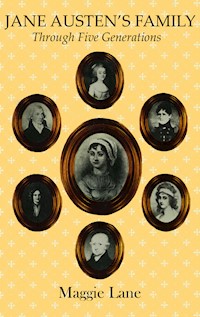
This book offers an intimate and intriguing account of Jane Austen's relations, from 1704, when her great-grandmother was left a widow with six children to support, through to 1870, and the destinies of her many nephews and nieces. Drawing extensively on letters and memoirs written by the Austen family over a period of 150 years, this book traces the development of the family from vigorous Georgian opportunism to respectable Victorian gentility.
Das E-Book können Sie in Legimi-Apps oder einer beliebigen App lesen, die das folgende Format unterstützen:
Veröffentlichungsjahr: 2014
Ähnliche




















JANE AUSTEN’S FAMILY
Through Five Generations
Maggie Lane
Contents
Acknowledgements
To the delight of dwelling in the Austens’ world, which has constituted my primary satisfaction in writing this book has been added another, quite unlooked-for gratification: the generosity and friendly interest with which my enquiries and pleas for help have invariably been met. Books, like babies, bring out the best in people; it seems that everybody takes pleasure in contributing towards a safe delivery.
I would like to record my sincere gratitude to Brian Southam, for his early advice and encouragement; to G.P. Hoole, local historian of Tonbridge, for so generously putting his researches at my disposal; to Lt-Col J.H. Smart, Clerk to the Governors of Sevenoaks School, for lending me his only copy of the school’s history; and to the Reverend Mervyn Smith, Rector of Horsmonden for sharing his knowledge and parish.
Among the descendants of the Austen family, I am warmly grateful to Diana (née Hubback) and David Hopkinson for their friendly assistance and hospitality and for allowing me to read and make notes from their manuscript biography of Catherine Hubback and other family papers; to Mr and Mrs Lawrence Imprey for showing me many family documents, and allowing me to quote from the AustenPapers; and to Joan Austen-Leigh (Mrs Mason Hurley) for supplying me with much useful information, and for instigating a correspondence that is an unfailing inspiration. I am also grateful to the descendants of Sir Francis Austen for allowing me to quote from his Memoirs.
For permission to use and quote from her invaluable work Jane Austen’sKindred I am deeply indebted to Joan Corder. Quotations from JaneAusten’sLetters and MinorWorks are made by kind permission of the Oxford University Press.
I would like to thank the Jane Austen Memorial Trust for permission to quote from Caroline Austen’s Reminiscences and MyAuntJaneAusten. Sir Hugh Smiley, Honorary Secretary of the Jane Austen Society, deserves my special thanks for the unwearied way he has answered all my correspondence.
The manuscript poem of James Austen is quote with kind permission of the Warden and Fellows of Winchester College, and I am grateful to the Librarian, Paul Yeats-Edwards, for his assistance. I would also like to record my thanks to Susan Garland of Kent County Archives for transcribing parish register entries and to the staff of Bristol Central Library for acquiring rare books and helping direct my researches.
An elegant sufficiency, content,
Retirement, rural quiet, friendship, books,
Ease and alternate labour, useful life,
Progressive virtue, and approving Heaven!
Thomson, TheSeasons: ‘Spring’, 1.1161
Introduction
Few detailed records exist of ordinary family life in the century and a half which can roughly be said to comprise the Georgian age. Before the explosion of middle-class numbers and the spread of education which occurred in Victorian times and which resulted in a rich crop of letters and memoirs of that period, such documents as survive tend to concern only families who were aristocratic or otherwise famous.
The Austen correspondence, tracing the lives of five or six generations, from the beginning of the eighteenth century to the middle of the nineteenth, therefore possesses a rarity value in addition to its intrinsic interest. No comparable record remains which is at once so early, so continuous and so descriptive of everyday matters for the ‘middling people’ of Georgian England, to use Walpole’s phrase. Their surviving letters, though only a fraction of what must have passed between the many members of this highly literate and affectionately united family, are so fortunately spread over a span of 150 years that they succeed in bringing vividly to life a whole saga of shifting generations and subtly changing fortunes. From them, and other evidence, we gain a composite picture of talented, vigorous and attractive individuals, and a unique insight into the age in which they lived.
The Austens were not an over-worldly or ambitious race. They did not seek to found a great dynasty or to achieve power or public honours. Simple private happiness, a set of duties marked out and performed, and sufficient income to enjoy a fair share of the comforts and elegancies of life in which their period so much excelled, formed the height of Austen ambition.
Few of them were born to ease and affluence. Mostly they had to make their own ways in a world which they did not see as owing them a living; for some there were long struggles, for others moments of panic. A bank failure, a threatened lawsuit, a disappointing will, the premature death of a parent: all these things could and did bring disaster very close, and with no state safety-net, only the solidarity of the extended family gave the individual any protection.
So it was with a mixture of mutual help and self-reliance that the Austens succeeded not only in creating agreeable lives for themselves, but, in their various roles – as doctor and lawyer, banker and clergyman, soldier and sailor, farmer and landowner – in contributing significantly to the safety and prosperity of their country.
They were a remarkably united family. Not only prudence but real attachment bound them together. They lived in times of increasing mobility; during the Georgian period the Austens spread from Kent, where they had long been settled and from which they are never known to have ventured before, to seek their livings and their pleasures in Hampshire and Bath, London and Paris, in India and on the high seas of Nelson’s navy. Yet even when separated by long distances, they kept in touch with each other, despite the difficulties of travel and communications: embarking on family visits, writing affectionate letters and assisting one another financially according to their various circumstances.
In their snug parsonages, their improved cottages, their elegant town houses and their tranquil country estates, they led what may seem to us an idyllic existence. The poverty of the majority of the people and the exploitation of their labour which enabled the few to live in comfort, they were happily able to view in all sincerity as the God-given order of things. This is not to say that they were negligent in relieving distress; they took their obligations to those less fortunate than themselves very seriously, and treated their own servants with uncommon humanity. But they could enjoy their privileges, having worked hard to secure them, untroubled by what we should today call a social conscience. In any case, though bad enough, conditions for the labouring poor before the Industrial Revolution was underway were not so horrifying as they were later to become.
Both the man-made and the natural world were at the height of their beauty and their harmony one with the other. Builders and craftsmen seemed incapable of producing anything ugly, and the countryside was tamed but not despoiled. Dr A.L. Rowse has said that the England of this time ‘makes the heart ache to think of’. The tyranny of nature was at last becoming sufficiently subdued for her glories to be appreciated, rather than her caprices endured; for the first time a sizeable proportion of the population had the leisure and the learning to lead truly cultivated lives. Not many can have been better mentally equipped to do so than the Austens.
There was a refreshing intellectual liberty in the air. The eighteenth-century way of thinking was balanced, rational, robust. Free alike from the bigotry and coarseness of the preceding ages, and the hypocrisy and repression of the one which followed, the Georgian period had also the advantage over our own of looking with cheerful confidence to the future. Individual life may have been more precarious, but the continuity of society as a whole was unquestionable, whilst their belief in the benefits of gradual progress must have conferred a peace of mind which we today can only yearn for.
Against this background, then, successive generations of the Austen family lived out their lives, uniting, we may well feel, ‘some of the best blessings of existence’. They were handsome, they were clever, and if only some of them were rich, none of them was very poor. They were happy together, sharing a lively sense of humour, and their circle of friends and acquaintances, not to mention their family ramifications by marriage, was exceptionally large. They were strong and healthy, many of them living into their eighties or nineties, and mercifully few of their children being lost in infancy – an all too common occurrence in, and the darker side of, their age. When one considers that Dr Johnson’s friend Hester Thrale raised only four of her twelve children, it appears all the more remarkable that George and Cassandra Austen, whose marriage occurred the year after the Thrales’, should have seen all eight of their offspring survive to adulthood. Sadly death in childbirth was not so unfamiliar to the Austens, and certainly the barbaric state of medicine is sufficient to cloud for a moment the sunlit picture we have been painting of Georgian life. So too is the harsh state of justice, witness to which is the terrifying ordeal of Jane Leigh Perrot, described in Chapter 7. That a respectable and innocent woman could face the very real threat of transportation is a severe indictment indeed.
But society was mellowing; the early eighteenth-century struggles of the widow Elizabeth Austen to maintain her children, and the frightening experience of her young granddaughter Philadelphia, who was obliged to undertake a hazardous voyage to India uncertain of what awaited her there, were to find no parallels among the Austens of the nineteenth century. In that latter period, it is true, the sea-faring brothers Frank and Charles experienced dangers and privations enough; but these were voluntarily encountered and brought their own rewards. Both rose to the rank of Admiral.
Indeed it could be said that life grew tamer as well as safer. Not to any later Austen was vouchsafed anything comparable to the heady success enjoyed by Eliza Hancock at the glittering French court of Louis XVI. Pleasures were becoming more domestic – more Victorian. Girls were increasingly sheltered from life, and neither Eliza’s indulgences nor Philadelphia’s risks would any more be tolerated for a young woman.
In the matter of educating their sons, too, the period under examination shows a discernible pattern. In the first half of the eighteenth century the Austen boys received the same type of education as Shakespeare had known – that provided by the local grammar school. The next generation was either prepared at home for university or sent at a tender age to begin a career at sea. Towards the end of the eighteenth century and thereafter, however, Austen youths were being sent as a matter of course to one of the famous public schools. The sons of landowners and clergymen alike are to be found attending Winchester and Eton. It is symptomatic of the establishment of the family.
In a history of several generations, as in no study of a single individual, the workings of heredity, the movements up and down the social scale, the reflections of the changing world beyond (which may not appear to be changing at all at the time) become clearly apparent. The opportunity to observe the effects of the passage of a century and a half upon one family is as instructive as it is entertaining. It is hoped that the general reader of biography and social history will find rewarding study in this portrait of the Austens.
At the same time, it attempts to satisfy those admirers of the novelist Jane Austen who wonder ‘who exactly were her forbears’ and ‘what became of the family afterwards’. For Jane, of course, was the one famous member of this large family of fascinating individuals. Since her fame was considerably belated, it in no way diminishes the value of the Austen record as a picture of ordinary Georgian life; its effect, however, has been to cause more papers to be preserved, more reminiscences to be written, more researches to be made, than if none of their number had achieved celebrity.
I have deliberately left mention of her until last because this is not primarily a book about Jane Austen. She figures in the family saga only as one among many, not as the person on whom the spotlight is exclusively trained. Much has been written about her life, and even the lives of her immediate family as they overlap hers; my object has been to take the story back three generations before the one to which she belonged, and to carry it forward fifty years or so after her death. By the close of the Georgian era, the direct descendants of William Austen – whose birth coincided neatly with the start of the eighteenth century – numbered nearly seventy: most of them characterized by the energy and resourcefulness which made their age so enterprising, many of them gifted, charming, witty and agreeable. These people, whose lives were of considerable variety and interest, deserve a full-length study, and the wonder is that one has not been undertaken before.
Several very informative books have been published, but all have been long out of print, and in any case, each has told only part of the story. I am particularly indebted to TheAustenPapers for much source material; but though covering a great deal of ground, there is little attempt in this to provide a continuous and intelligible narrative thread. For the details of the later branches of the family I have relied heavily on ChawtonManoranditsOwners,JaneAusten’sSailorBrothers and AMemoirofJamesEdwardAustenLeigh. These works, which were all published in the early part of the present century, contain much that is invaluable but are somewhat outdated and diffuse in their approach. Particulars of all these books will be found in the bibliography. My task has been to collate and weld together information from these and other sources, including later researches which have not been published before, or at least not in book form. For the sake of clarity, when quoting I have modernized spelling and printed abbreviated words in full.
A certain amount of quotation has been made from Jane Austen’s own letters. Of these every word (naturally) is well worth reading, but I have tried to make sparing use of them for the reasons mentioned above: to avoid giving one member undue prominence in this general study of the Austen family. As all subsequent Austen biographers must be, I am under a great obligation to Dr Chapman for his marvellous elucidation of the family connections, friends and acquaintances contained in the notes to his edition of the letters. His claim for these letters that ‘they yield a picture of the life of the upper middle classes of that time which is surely without a rival’ I would extend to embrace the whole of the Austen correspondence.
For many, including myself, it has been but two short steps from enjoyment of Jane Austen’s novels, to interest in her life, to curiosity about and affection for her entire family. Perhaps certain readers of the present work may make the same steps in the other direction. At all events, I fancy Jane, who would surely be astonished and embarrassed by the quantity of books inspired by herself, would appreciate, for once, having her beloved family take first place.
Map
1
So unkindly dealt with
1701-21
At the very beginning of the eighteenth century, a child was born into the Austen family of west Kent, receiving the name of William at his baptism in Horsmonden church on 18 February 1701. For the infant, as for the infant century, the prospects appeared fair. England was emerging from the civil and religious strife of former ages to begin a long run of stability at home and supremacy abroad; whilst William, whose father was the only son of a wealthy man, seemed born to the comfortable life of the minor English gentry.
William was the fifth child and fourth son of John and Elizabeth Austen, whose home was Broadford, a medium-sized Tudor manor house standing in the scattered parish of Horsmonden, about seven miles to the south-east of Tonbridge, and not far from the county border with Sussex. With its massive oak frame, its many gables, lattice windows and exposed half-timbering, Broadford was typical of the period of its construction and, although by the time of William’s birth already a little old-fashioned in appearance, was still able to boast every comfort which could make life tolerable in those days of difficult supply and transportation. Self-contained and self-sufficient, it was its own little world of production and consumption.
An inventory taken in 17081 details parlour, hall, little parlour, brewhouse, milkhouse, kitchen, pantry, bakehouse, wash-house, small beer cellar, best drink cellar, staircase, best chamber, little parlour chamber, great parlour chamber, brewhouse chamber, men’s garret and stable. Yard, kitchen garden, orchards and meadows sloped away to the pleasant rolling countryside of the Weald of Kent.
As evidence of Broadford’s longstanding prosperity, one principal room was completely panelled in oak, with the Tudor rose carved over the fireplace and elsewhere. As evidence of the source of that prosperity, attached to the ceiling of one of the upper rooms were the old rollers once used in the manufacture of woollen cloth.
For the Austens, like almost all the landowners in the Weald, derived their fortune from the industry which had been established by Edward III in 1331 when he invited a Flemish clothworker, John Kemp, to settle in Kent and to instruct the local workers in his craft. Before this time the native product was of very inferior quality, for the English workers knew ‘no more what to do with their wool than the sheep that made it’.2 As a result of this ignorance, the advantage of having abundant wool was wasted, most of it being sent to the Netherlands to be made up into cloth and re-imported.
Edward’s contrivance to secure this important trade for his own kingdom was successful, and the Austens were among those with the enterprising spirit to profit from it, employing labour and becoming early examples of capitalists. It was a gentle form of capitalism, however, grounded in the cottage industry system, which allowed each skilled worker his measure of independence and dignity and which bound a whole neighbourhood in a community of interest. For each broadloom eighteen women were required to spin a week’s consumption of wool, while twenty-seven craftsmen were occupied in the various stages of production.3
The masters of this trade were known as ‘clothiers’, and there were ‘clothier’ Austens scattered throughout west Kent, allowing for variations in the spelling of their name, which possibly derived from their having once rented lands from the Augustinian order. One such was William Astyn, who was buried in 1522 at Yalding, the next parish north of Horsmonden. His son Stephen had a large family by two wives; it was almost certainly one of his sons, Robert, who was the first Austen to reside at Broadford. Robert’s first two children, John and Stephen, were baptized in the neighbouring village of Goudhurst, in 1560 and 1561 respectively. Between 1561 and 1565 the family took possession of Broadford, and Robert’s subsequent children, Martha, Judith, Elizabeth, Benjamin and Joan, born between 1565 and 1582, were all baptized at Horsmonden.4
On Robert’s death in 1603 John inherited the property, and the following year his own wife, Joan, died in giving birth to twin sons, her eighth confinement. The status of the family is evident from the charming effigy of her, in ruff, hat and gown, which her husband caused to have placed inside the church.
At the time of his own death in 1620, the nine children were all alive, but when the eldest, John, died childless in 1650, he was succeeded by his next surviving brother, the fifth son, Francis. A highly successful ‘clothier’, possessing perhaps the greatest business acumen of any Austen, Francis had already amassed sufficient money by 1647 to purchase for himself another lovely old manor house in the same parish. This was Grovehurst, standing about three quarters of a mile further up the valley from Broadford, and if anything even more imposing. Francis Austen bought it from Henry Whetenhall, a descendant of the de Grofhursts, and adapted it as a ‘hall’ for his trade. When, three years later, his old family home came into his possession too, Francis retained Grovehurst as his principal residence, and Broadford was relegated to the use of a grown-up son or other dependant.
Francis Austen appears to have become sufficiently wealthy to retire from trade altogether towards the end of his long life, or at least to enable his son to do so, since it is uncertain exactly when the Austen homes ceased to function partially as business ‘halls’. Most likely such retirement was a gradual process, the shrewd clothmasters retaining some interest in the trade but growing less and less inclined (as they grew less and less needful) to allow its trappings to intrude into their private lives, which were increasingly being led in the style of the gentry.
On the death of Francis Austen in 1688, all his property passed to his son John, who was William’s grandfather and who was still living at Grovehurst, a crusty and capricious old man of seventy-two, when William was born.
This John Austen had three surviving children: William’s father, John, who had married Elizabeth, daughter of Thomas Weller, gentleman of Tonbridge; Anne, married to John Holman, of Tenterden, and mother of nine daughters and one son; and Jane, whose husband, Stephen Stringer, was the descendant of another ‘clothier’ family. Jane and Stephen Stringer lived at Triggs, in the parish of Goudhurst, and had five daughters, two of whom, through their marriages, were to influence the later history of the Austens.
Meanwhile it was natural that William’s father, John Austen, as the only son of a wealthy gentleman, should look forward confidently to almost certain future affluence. By the terms of his father’s will his two sisters were to inherit the sum of £4,000 apiece; all the remainder of a considerable fortune and extensive property must devolve upon him.
On the strength of such expectations John had contracted debts even before his marriage, incurring the displeasure of his father and beginning a train of events which was to result in much hardship and struggle for his wife Elizabeth and six of her seven children. Whether the whole of the blame should be attached to the young man’s extravagance, or whether some of it was due to the impossibly small allowance his father made him, is arguable. No doubt there were aggravations on both sides. Mr Austen deplored the careless squandering of money his ancestors had painstakingly amassed, whilst John chafed at his protracted state of dependence.
Though his inheritance continued to elude him, his marriage to Elizabeth Weller, which took place in Tonbridge on 29 December 1693, did much to improve John’s situation. His father was obliged to allow him a separate establishment at Broadford and, to clear the slate before the marriage articles were drawn up, promised to pay off all outstanding debts. Overpowered, perhaps, by the generosity of such a promise, and in any case accustomed to having his own way in everything, Mr Austen insisted on dictating the terms of the marriage settlement, whereby Elizabeth’s jointure, should she become a widow, fell short of the interest payable on the amount of her dowry – an injustice to which her father, Thomas Weller, made no opposition, trusting to John’s fairness to set matters straight when he became master of his own concerns.
In addition to her dowry, Elizabeth brought with her wedding gifts from her family and friends including silver plate and linen which were valued at above £50. But most importantly, in his wife John found a fiercely loyal ally, one who was appreciative of his good intentions and who, by providing him with domestic peace and a family of his own to cherish, exercised a steadying influence.
Elizabeth Austen was a woman of remarkable strength of character, as later events were to prove; and although the full measure of her tenacity and courage remained to be called forth, even in the early years of her marriage, when she had nothing worse to contend with than the meddling and meanness of her father-in-law, she possessed a quiet determination and an uncrushable spirit.
Such qualities did nothing to conciliate old Mr Austen, of course, and the two generations lived, within a mile of one another, on uneasy terms. If they thought him bad-tempered and unfeeling, he probably thought them still improvident, for as Elizabeth confesses in a document5 written in 1708 explaining her affairs to her children, ‘I never proposed the saving of money, knowing my father Austen’s estate so large, that I thought, if we could live and enjoy ourselves on that little he allowed us, was sufficient but I was ever uneasy to be in debt, which made my husband keep his debts the more private, and also was not willing his father should know of them, fearing his displeasure, and it seemed most likely the son to be the longest liver.’ However, she adds that she is sure they had no extravagance after they were married and that it was her husband’s debts contracted before the marriage, and still unpaid by his father, despite the promise, which kept him in debt.
Meanwhile the family at Broadford was rapidly increasing. The first child was a daughter, named after her mother and always known as Betty. Six sons followed in quick succession.
But before his seventh child was eight months old, John Austen was dead. His not unreasonable hope of outliving his own father had proved a vain one. He died of consumption on 21 September 1704, after a long illness during which he had been tormented by worry for the future of his wife and children.
Everything he had meant to do for their security when he came into his inheritance must now be left to the mercy of his father, on whose justice and generosity he could place no reliance. Favouritism towards the eldest grandson, another John, was already much in evidence, and John was afraid that the others would not be given a fair share of the family wealth. He considered an estate of £500 a year ample provision for his eldest boy, and about half that figure for all the younger ones, on which, ‘with education and employments’, they could live in modest comfort and be no disgrace to their brother. As for Betty, it was essential that she should have a good dowry to attract a husband of suitable standing.
All the lands which John had brought into the marriage were settled equally among his sons, amounting to very little for each one, and nothing at all for his daughter, whilst, as he was not at liberty to dispose of any property, his own outstanding debts would have to be paid by selling personal effects. Elizabeth assured him that the outdoor goods and stock could be sold without material loss of comfort or convenience to her; but he had reason to fear that she might have to relinquish some furniture and indoor things as well.
On his deathbed John begged his father to ensure that all his children were well provided for, and Mr Austen, not unmoved, promised that he would do more for the younger ones in his will than he had previously intended. He promised too that the debts should be discharged without recourse to the sale of Elizabeth’s household goods.
Much relieved, John made his will, leaving the education of the children in Elizabeth’s hands, the rents from the lands held in trust for them providing for their maintenance until they came into their grandfather’s legacies, with any surplus for Elizabeth’s own use. His sisters’ husbands, Holman and Stringer, were appointed executors, with power to demand yearly accounts of income and expenditure on the children’s behalf from Elizabeth, who, if she remarried, would forfeit her management of their affairs. Some of this sounds like Mr Austen’s conditions; at any rate, he gave his approbation, and John died in the belief that everything was properly and fairly settled.
Disagreement between daughter and father-in-law, however, was not long in arising, and concerned the funeral. Mr Austen was obliged to meet the expense but baulked at paying for mourning clothes for the widow and children. So soon after her bereavement, this was a cruelly distressing predicament for Elizabeth, who had no ready money to call on, and definite ideas about what was and was not respectful to her late husband’s memory. She was driven to contemplate borrowing to keep up appearances, when at last, after great entreaty on the part of the executors, the tight-fisted old man was induced to part with £10 for the purpose. Elizabeth contrived to buy mourning for herself, Betty and all the boys who were old enough to wear it, for the sum of £9.6s.1d.
Shortly afterwards the outdoor goods and stock were offered for sale, and the sum of £522.7s.11d. realized was used to discharge some of John’s debts. Unfortunately, as he had suspected, more remained, and Mr Austen was applied to to fulfil the deathbed promise to his son. With a perversity which must have been very trying to Elizabeth, he replied that, if any of her relations would put up half the money, he would meet the other half.
She writes: ‘I had no relation to expect this favour from, neither indeed would I desire it of any, for I thought my father Austen had the greatest obligation of any person, to lay down the money not only for his promise sake, but in all other respects the greatest obligation to pay his son’s debts, for all knew he must have many hundred pounds by him.’
She offered to have her possessions transferred to his name in return for the advance of money, but still he refused, and the executors felt they had no alternative but to arrange a further sale. They had actually fixed a day, when, on the plea of many friends and in accordance, Elizabeth suspected, with his own secret inclinations, Mr Austen ordered his sons-in-law to stop the sale.
He rode over to Broadford to meet Holman and Stringer and to inspect all Elizabeth’s possessions, which he declared he did not want for his own use but for which after some prevarication he agreed to advance £200, provided they were settled on the eldest son and that Elizabeth continued to take as good care of them, while in her use, as if they had still been her own. Mr Austen would not increase his offer above £200, though Holman and Stringer told him the debts amounted to £20 or £30 more.
The sum of £200, of which the promise had been so painfully extracted, was at present put out to a money-lender at Wadhurst and was ordered in. There was some slight hindrance, and then, in Elizabeth’s own words,
… it pleased God my father Austen was taken ill, but was thought not dangerous, then notice was given the £200 would be brought to Goudhurst the next day, but my father continuing worse, he was not capable of receiving money, but in a day or two more he died: his illness soon seized his brains, so that he never was sensible of his death, which happened the 13th day of the next July after his son.
His housekeeper informed where his will was, which was opened in the presence of his daughter and son Stringer, his daughter and son Holman, and also myself. We heard it read though I think myself the only stranger to any former knowledge of it. My then knowledge I could not bear but with great concern, nay yet I can seldom think on’t without a tear, for as to myself I were never mentioned unless as it seemed necessitated to make me appear as no friend, nay rather an enemy to the family, but that did not so much concern me as to see my children so unkindly, nay I may say unnaturally dealt with…. Now I found my poor husband’s fears concerning his children too unhappily come to pass, one a large estate, the others but as if servants … and as to my daughter … I will own I did not forbear saying ‘sure my father takes her for a bastard’ when I heard how he had cut her off from any prospect of future hopes.
Elizabeth had further cause for alarm when she found that Holman and Stringer were no longer disposed to allow her the £200 out of old Mr Austen’s estate, saying that no mention of it was made in the will or in his handwriting anywhere, and that to fulfil a promise made by word of mouth only might leave them open to legal action, should the young heir, when he grew up, choose to claim that they had been outside their rights in robbing his inheritance of £200.
In vain did Elizabeth protest that her son could never object to having his father’s debts honourably discharged, to the promise made by his grandfather being fulfilled, to his mother’s being spared the humiliation of being forced to sell her furniture. Even the gentleman appointed to audit the accounts, Sir Thomas Roberts, told Holman and Stringer that he would permit the payment, but still they would not make it. Elizabeth was helpless, having no resources to take her case to Chancery.
The circumstance was made even more aggravating from Stephen Stringer’s admitting to her that the younger children’s small legacies had been further reduced by £10 each, after the promise of the advance had been made by Mr Austen, for he declared that by giving away £200 he was depriving his heir of his rightful fortune, so the younger children should be made to pay for it. This wilful bias in favour of young John was unpardonable in Elizabeth’s view, and she could only hope that when he came of age he would see the injustice of it and make his brothers and sisters amends.
Until then she must struggle along as she could. Her total household goods were valued at £203.2s.4d., but if she was to keep a home intact for her young family, not much of this could be spared. In the end she sold most of her silver plate, and her best bed and hangings, raising the sum of £46.10s.11d. Her husband’s debts amounted to £224.1s.6d.; she had £24.5s.0d. in hand from rents received, and the balance of £153.19s.7d. she was forced to borrow.
For three more years she continued at Broadford, managing her affairs to the best of her judgement, keeping careful accounts for the scrutiny of Holman and Stringer, and never free from the worry of being continually in debt. Her chief concern, however, was for the education of her sons, and as they grew older, this pressed more and more on her mind.
Even if her eldest son turned out to be well disposed towards his brothers, he would not be old enough to do anything for them until they were past the age when they must be launched into the world. Deprived by their grandfather’s caprice of their proper position in society, they were entitled at least to the good classical education that would stamp them indisputably as gentlemen, and thereafter to apprenticeships that would enable them to earn their own livings.
There were no schools in Horsmonden, and many of Elizabeth’s well-wishers, and her brother-in-law Holman, advised her to leave Broadford and take up residence in one of the small neighbouring towns which possessed its own grammar school – Tonbridge or Sevenoaks, for example. Willing to do whatever was best for her sons, her only demur was that the cost of living in a town, where all food had to be bought in, would be greater than at Broadford, where she was already finding it difficult enough to maintain the family on the rents which she received for their lands. She was desperately worried about sinking further and further into debt, and could foresee only increasing expense. Beside food, schooling, clothes and pocket money would all cost more as her boys grew older, and though she could let Broadford, they would have to pay rent for a house in town.
It had already occurred to her that she might make some small increase in her income by taking in boarders, once she had removed to a house in town, when a situation came to her notice which seemed particularly suitable to her circumstances. The Master of Sevenoaks School was looking for a housekeeper for the schoolhouse and was prepared to let Elizabeth and her children live there rent free and, most important of all, to give the boys a free education, in return for her looking after him and the other boy boarders. In addition there was the possibility of making a little profit from what these pupils paid for their board.
Elizabeth felt she could not do better than to accept such an offer. It would secure her prime object, a good education for her sons, and although running such a large establishment, and looking after other people’s children, was not what she had been brought up to expect, she was only too thankful to have some honest means of working for her family’s benefit.
She concludes her account:
These considerations with the thoughts of having my own boys in the house, with a good Master (as all represented him to be) were the inducement that brought me to Sevenoaks, for it seemed to me, as if I could not do a better thing for my children’s good, their education being my great care, and indeed all I think I were capable of doing for them, for I always thought if they had learning, they might the better shift in the world, with that small fortune was allotted them. I was also in hopes it might be an inducement for my brothers to let my eldest son live with me, as they paid for his board. I thought it might be a help in my housekeeping, which would have been a great kindness. My brothers at first did seem to say it might be so, but afterwards resolved to put him to another place, which I confess I took unkindly of them, yet I will be content, and hope it may be all for the best.
So Elizabeth left her comfortable and dignified country house, where she had lived for fourteen and a half years, and where all her children had been born – where she had enjoyed the position of lady of the neighbourhood, and mistress of her own home – to live in a town and work for a Master. The removal was made on 27 June 1708, and from the following Michaelmas Broadford was let to one Thomas Yorkton. Elizabeth had hoped to receive £40 per annum for the lease but had to be satisfied with £36.
One of the oldest grammar schools in the country, Sevenoaks School owed its existence to Sir William Sevenoke, a fine example to the Austen boys and other scholars of how far hard work and determination could get an apprentice lad. A foundling who had been given as a surname the name of the town where he was discovered as an abandoned infant by a passing horseman, Sevenoke was apprenticed to a London ironmonger and in 1397 admitted into the Grocers’ Company, becoming Master of that guild in 1408. Seven years later he was elected an Alderman of the City of London, and in 1418 Lord Mayor. Thus ‘the foundling boy became the chief magistrate of the greatest city in the world.’6
He always recalled with gratitude the little town where he had so unpropitiously started life and in his will, made in 1432, stipulated that the rents and profits of certain of his London property should be used to found and maintain a grammar school in Sevenoaks. Subjects to be taught were Greek, Latin, English, writing and arithmetic. Prayers were to be said three times a day; on Fridays the boys were ‘to go orderly to the Parish Church of Sevenoaks, and hear the Litany (or Procession) sung or said, and thank God for the benefits bestowed on them by their benefactors’. From 25 March to 29 September school hours were 6 to 11 and 1 to 6. In the winter months these were reduced to 7 to 11 and 1 to 5, which was just as well, since the boys had to provide their own candles.
When the Austens arrived at the school, the Master was Elijah Fenton, then aged twenty-five and already the author of a volume of poetry. Later he was to distinguish himself by helping Pope to translate the Odyssey and to be mentioned by Dr Johnson in his LivesofthePoets as ‘an excellent versifier and a good poet’.7 It was his influence which brought the school into good repute and in view of the Austens’ residence in his house, it is pleasing to note that his character was as much praised by his contemporaries as his academic abilities. The Earl of Orrery, who was privately tutored by Fenton for six years, says that, ‘He was never named but with praise and fondness, as a man in the highest degree amiable and excellent,’ and other accounts confirm this. Elizabeth must have had a considerate employer, then, and her sons a brilliant teacher. Unfortunately he left the school in 1710, lured by the promises of various high-born patrons impressed by his wit.
Despite the undoubted advantages to the family of the move to Sevenoaks, their meagre finances were perpetually overstretched, and Elizabeth was never to be totally free from debt again. Her annual accounts were meticulously kept. As she had feared, food was expensive, and clothes, books and pocket money were continually rising items, though the rents from which they had to be met were static, whilst any emergency, such as the large amount of ‘physic’ required in 1715 at £11.18s.8d., made a serious impression on her budget.
The cost of Betty’s upkeep rose dramatically when, at the age of nineteen, and now a young woman whose only hope of provision was to attract a husband, she was allocated a separate dress allowance. Thus in the accounts for 1714-15 her clothes cost £8.11s.0d., and in 1715-16 £16.4s.3d. At Michaelmas 1717 Betty was of age to receive her grandfather’s small legacy, and thereafter paid her own board and expenses. Happily, her mother’s fears that she would never marry well were unfounded. Betty eventually made a very respectable alliance with George Hooper, a practising Tonbridge attorney who belonged to the fifth generation of his family’s law firm. Thus Betty’s married status was very much on a par with that of all her younger brothers, though her husband’s future was more assured than theirs, which remained to be made.
Having seen them well taught, Elizabeth’s next duty to her sons was to find the money to launch each one upon a professional career which would support him for the remainder of his life. In January 1714 the second son Francis was bound apprentice to George Tilden, an attorney in Bedford Row, London, for a premium of £140. Unfortunately Francis caught smallpox that year, and the cost of this, together with the clothes required to set him up in his new life, amounted to £29.10s.6d. The following year, too, his clothes and pocket money cost Elizabeth £28.18s.8d.
Such expenses were repeated with all the sons. Just after his sixteenth birthday, on 11 November 1715, Thomas was apprenticed for a fee of £60 to Henry Wells, citizen and haberdasher. Medicine was the profession chosen for William, whose apprenticeship to the surgeon William Ellis of Woolwich on 20 February 1718 cost his mother £115.10s.0d.
No indentures are recorded for Robert, but he left home in the latter half of the year 1718, perhaps to follow some trade at Tenterden, where he died of smallpox in January 1728, unmarried. He was the only one of Elizabeth’s children to have no family of his own.
Finally, £105 was found on 1 June 1719 to bind Stephen apprentice to William Innys, a London stationer. The apprenticeship fees – which interestingly reflect the status, or perhaps the money-making potential, of the various trades and professions chosen, law being regarded most highly, and medicine scarcely above bookselling – were possibly advanced out of each son’s legacy, on the authority of their uncles. Even so, their mounting expense left Elizabeth by 1719 £137 in debt.
John, brought up separately from his brothers and sister and away from his mother’s influence, seems to have inherited something of his grandfather’s disposition and to have guarded against allowing the poorer members of his family to regard him as a soft touch. The same year Elizabeth noted against her accounts: ‘My son John desires the rent at Broadford may be allowed to him as an equivalent for the expenses he has been at this year on his brothers’ account, and repairs, and for his own part in the rents.’ Whilst the other boys were working out their apprenticeships, John was at Pembroke College, Cambridge, where he had been admitted as a fellow commoner on 4 May 1713, preparing to be a gentleman of leisure and squire of Grovehurst and Broadford. Shortly after his return he married his cousin Mary Stringer; he was evidently well in with his uncles, who had possibly set him against his mother.
Less than two years after seeing the last of her sons safely out into the world, Elizabeth died. Her body was taken from Sevenoaks, where she had worked so bravely, back to Tonbridge, where she had been born to very different expectations, and was buried there on 25 February 1721.
Notes
1. AustenPapers
2. Thomas Fuller, AChurchHistoryofBritain (1837)
3. William Page (editor), TheVictoriaHistoryoftheCountiesofEngland, Kent Volume III (St Catherine Press, 1932)
4. Richard Arthur Austen-Leigh, PedigreeofAusten (Spottiswood, Ballantyne & Co Ltd, 1940)
5. AustenPapers
6. John Recker, AShortHistoryoftheSchoolandAlmshousesofSirWilliamSevenoke (1913)
7. DictionaryofNationalBiography, Volume VI
2
A country surgeon
1722-51
Having completed his apprenticeship, William Austen returned to Kent, where he set up as a surgeon in the busy little market town of Tonbridge.1 Here, in East Street, lived his sister Betty with her three small children and her husband, George Hooper, who, as an attorney and a native of the town, was not without influence in local affairs. Here too, occupying the substantial house known as ‘Chauntlers’, was William’s uncle Robert, eldest brother of Elizabeth Austen and head of the long-established and highly respected Weller family, five generations of which are commemorated in Tonbridge parish church.
Such connections were of the utmost value to William in gaining acceptance amongst the townspeople. In a small and mostly static community, who you were was at least as important as what you knew; and the recommendations which his brother-in-law and Weller cousins were able to make helped establish him in his practice.




