


14,39 €
Mehr erfahren.
- Herausgeber: Batsford
- Kategorie: Lebensstil
- Sprache: Englisch
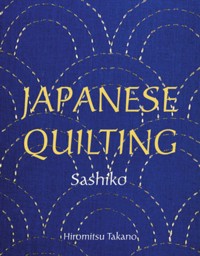
In recent years there has been a great revival of interest in sashiko, the traditional Japanese technique of needlework quilting based on a quick and easy running stitch. Japanese Quilting: Sashiko is a practical introduction to the distinctive patterns and designs of the technique. Whether you are a complete beginner or familiar with sashiko, you will find this a fascinating exploration of an exciting and traditional craft. The book includes an introduction on what materials and equipment you will need, then a guide through the basic technques. Next, the author provides 30 detailed designs, ranging from the Ougi (Fan), Ume (plum blossom), to Shippu (seven treasures) and Sayagata (Buddhist symbols). Each has a full drawing and critically gives the order of working. There is also 10 projects that range from aprons and placemats to cushions and bags. There is everything a reader needs to start the craft but can also expand the repertoire of an experienced quilter and textile artist.
Das E-Book können Sie in Legimi-Apps oder einer beliebigen App lesen, die das folgende Format unterstützen:
Seitenzahl: 54
Veröffentlichungsjahr: 2015
Ähnliche
















Japanese Quilting
Sashiko
Contents
Introduction
1 Materials and equipment
2 Techniques
3 Sashiko designs
4 Quilting, appliqué and patchwork designs
5 Projects
Appendix: Japanese decorative knots
Index
Sayagata (Buddhist symbol). The method of working is illustrated here.
Introduction
The Japanese word sashiko means ‘little stabs’, or running stitch. Originally this simple stitch was used as a practical technique to quilt together several layers of loosely woven fabric for strength and warmth. Early fabrics were made from grass, tree-bark fibres, ramie or silk, but in the fifteenth century cotton was introduced to Japan, where it flourished in the warm southern climate. In the north, hemp is still grown especially for sashiko. Decorative sashiko developed during the eighteenth century, when there was increased prosperity in Japan and cheap cotton fabrics were readily available.
During the second half of the Edo period, private fire brigades were established in Tokyo. Sashiko was used for the firemen’s protective coats, which were drenched with water before they fought a fire. The decorated side was designed to be worn on the inside, except on special occasions, and the patterns often included dragons or warlike human figures. Examples of nineteenth- and early twentieth-century coats can be seen in the Victoria and Albert Museum in London, and in folk museums in Japan.
Different areas of Japan have each developed their own distinctive sashiko techniques and patterns. Sashiko is also often used in combination with patchwork or appliqué to create more complex designs. For example, the Ainu people of Hokkaido Island produce bold, flowing water patterns in intricately worked quilted appliqué, which they overstitch with chain stitch (see here).
In recent years, there has been a revival of interest in these traditional techniques in Japan, as there has been in many Western countries. Modern sashiko designs include the traditional geometric patterns, worked in white stitching on indigo-dyed fabric, as well as figurative images of trees and flowers.
I am delighted to be able to introduce these techniques to readers outside Japan, and to show them some of the many ideas for different designs.
Saikoh Takano Tokyo, 1992
Shippou (Seven treasures). The method of working this traditional design is illustrated here.
Fabrics
Traditional sashiko quilting is worked on indigo-dyed fabric, but any smooth, soft, plain-coloured fabric can be used. Cotton, linen, crêpe de Chine and satin are all suitable.
The fabrics used in patchwork should be the same weight; if the finished piece is to be washable, you will also need to use the same type of fabric, for example, all cotton.
The backing fabric should be the same weight as the top fabric, or finer.
Pre-wash all washable fabrics and test for colourfastness. If the colour runs, soak the fabric in five parts cold water to one part vinegar. Iron the fabric, straightening the grain as you do so.
Interlining
This is not traditionally used in sashiko quilting, but if you wish to make the finished item warmer or thicker you can insert a layer of wadding between the top fabric and the backing. Synthetic wadding is normally used as it is easy to stitch through and dries quickly when washed. It is available in different weights; 70 g (2 oz) is the weight used for most of the projects in this book.
Sewing equipment
Frames
An embroidery frame can be useful, especially if you are couching with gold thread. A frame clamped to a table or floor stand is recommended.
Threads
The choice of threads depends very much on the fabric and the design. For sashiko quilting, a soft, twisted, fine cotton thread (no. 6) or coton à broder is normally used. For patchwork, use cotton threads no. 50 or 60, in colours to match the fabrics.
Surface embroidery can be worked in stranded cotton or coton perlé.
Needles
Choose appropriate needles for the particular fabrics and threads you are using, selecting those with which you feel comfortable.
Pins
Fine dressmaker’s pins or lacemaker’s pins are recommended for medium-weight or fine fabrics. For heavier-weight fabrics, use larger pins with coloured heads so that they do not become ‘lost’ in the fabric.
Thimble
Even if you do not normally use a thimble, you will probably find that you need one to push the needle through layers of quilting.
Scissors
You will need a large pair of scissors for cutting out fabric, a small pair of needlework scissors when you are stitching, and a separate pair of scissors for cutting paper.
Designing equipment
○ tissue paper
○ ruler
○ French chalk, tailor’s chalk or coloured pencils
○ dressmaker’s carbon paper
○ dressmaker’s tracing wheel or Japanese hera (a knife-shaped tool made of bone)
○ pair of compasses, set square and protractor
○ tracing paper
○ graph paper and isometric graph paper
Fig. 1
Methods of working
Transferring the design
There are several methods of transferring designs to the fabric:
1. For simple repeat designs, draw the design directly on the fabric, using a template and French chalk, tailor’s chalk or a water-erasable pen.
2. Draw a geometric design directly on the right side (RS) of the fabric, using tailor’s chalk and a ruler.
3. Trace the design on paper and pin to the right side of the fabric, with dressmaker’s carbon paper between the paper and the fabric. Outline the design with a dressmaker’s wheel, a hera or a sharply pointed pencil (fig. 2a).
4. For thick woollen fabrics, trace the design on tissue paper and pin to the right side of the fabric. Stitch round the outline of the design in small tacking stitches, using a contrast-colour thread (fig. 2b), then carefully tear away the tissue paper. Remove the tacking stitches after the work is completed.
Tacking the layers together
1. Lay the backing fabric wrong side (WS) up on a flat surface. Place the wadding (if required) on top and then the top fabric, right side up.
2. Tack horizontal rows of stitches to hold the three layers in place, working from the centre outwards. Then tack vertical lines of stitching.
Sashiko
As well as being used in quilting, sashiko designs can be worked on top of patchwork and with appliqué, or as embroidery on a single layer of fabric.
Fig. 2a A design outlined with a dressmaker’s wheel.
Fig. 2b The outline of the same design transferred to the fabric by stitching through tissue paper.
Sashiko




