


Erhalten Sie Zugang zu diesem und mehr als 300000 Büchern ab EUR 5,99 monatlich.
- Herausgeber: The Crowood Press
- Kategorie: Geisteswissenschaft
- Sprache: Englisch
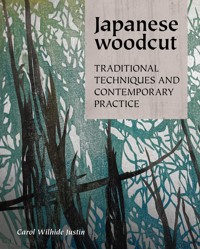
Japanese Woodcut is a complete guide to the art and practice of 'mokuhanga'. It explains the delicate lines, luminous colour and intriguing compositions that first influenced the Impressionists in the nineteenth century, and presents this rich art form as a compelling and diverse technique for the printmaker of today. With over 400 illustrations, this book is a beautiful companion for everyone interested in exploring and understanding the great possibilities of this enduring technique. This book explains the technique which is now acclaimed and practised widely in the West. Its popular success is partly because the process is entirely non-toxic and environmentally friendly, but also because it allies the certainties of woodcut with the nuance of watercolour. In so doing, it has opened up a whole new landscape for contemporary printmakers. As well as explaining the full process from design to cut, it pays particular attention to printing and different methods of achieving specific effects for the more advanced, including printing larger woodblocks. The final chapter features a range of prints from leading practitioners and celebrates the success of this unique art form.
Sie lesen das E-Book in den Legimi-Apps auf:
Seitenzahl: 255
Veröffentlichungsjahr: 2024
Das E-Book (TTS) können Sie hören im Abo „Legimi Premium” in Legimi-Apps auf:
Ähnliche



















CONTENTS
Introduction
1 A History of Japanese Woodcut
2 Materials and Equipment
3 Design
4 Cutting
5 Printing
6 Advanced Traditional Printing Techniques
7 Printing Large Works
8 Contemporary Artists
Glossary
Suppliers
Bibliography
Resources
Artists’ Details
Image Credits
Index
INTRODUCTION
H okusai’s The Great Wave off Kanagawa is arguably among the most famous images in the world, but how much do you know about how it was made?
Japanese woodcut or Mokuhanga is a traditional multi-coloured woodblock printmaking technique with a long cultural history. The prints of the ukiyō-e, translated as Prints of the Floating World, were virtually unknown in the West until the late nineteenth century. They electrified the Impressionist painters in Europe, with their asymmetrical compositions, flat colour and everyday subject matter. You could say that the prints changed the course of modern art.
The beauty of the prints, the luminous colours printed using indigenous dyes, the cursive calligraphic drawn lines, cut with tools whose blades were forged in the same way as samurai swords, the attention to detail and the craftsmanship were second to none.
The MI-LAB residency building at Fujikawaguchiko, Japan.
But it is only in relatively recent years that the technique itself has become acclaimed and practised more widely in the West. Printmakers from across the world are embracing the technique. This is due partly because it is a process that is entirely non-toxic and environmentally friendly, but also allying as it does the certainties of woodcut with the nuance of watercolour, it has opened up a whole new landscape of contemporary printmaking possibilities.
I came to Japanese woodcut entirely by chance. I had a solo exhibition that featured an installation of prints suspended from the ceiling. One day a woman came in and began to handle the prints… I was not particularly pleased, but we got talking and she turned out to be Keiko Kadota who ran the Mokuhanga residency programme in Fujikawaguchiko, Japan. It was set up in order to teach traditional Japanese woodcut to Western printmakers. I applied and travelled to Japan where I encountered the technique of Mokuhanga for the first time and had the privilege of being taught by Japanese sensei with the aid of an interpreter. I was there for nearly three months, in a totally immersive environment with five other printmakers from around the world. It has proved to be one of the turning points of my life.
We have become accustomed to inspiring Japanese design and culture in all parts of our daily lives; from Japanese cuisine, manga, anime, fashion, Zen philosophy to of course electronics. Little did I realise when I went to Japan that its architecture also would be deeply familiar to me. My father had built a house in Canada based on the blueprints of Kenzo Tange’s showhouse in Japan. It was the first house I ever knew.
On my return from Japan I gained a place on the MA Print Programme at the Royal College of Art enabling me to further embed the technique into my own practice.
I now teach Japanese woodcut to enthusiastic students in London, and this book is informed, in a practical way, by my classes. I also lecture for The Art Society on the subject around the UK and I continue to exhibit my Mokuhanga prints both in the UK and internationally.
Chapter 1
A HISTORY OF JAPANESE WOODCUT
J apanese woodcut, or Mokuhanga, is a defining element of Japanese culture and national identity. This chapter outlines the key developments and historical context that led to its ultimate refinement, the beautiful, luminous ukiyō-e prints that first appeared in the mid eighteenth century.
Ukiyō-e print by unknown artist, part of author’s collection.
ORIGINS
The Japanese woodcut tradition dates back well over a thousand years, when the Empress Shotoku commissioned the printing of a million Buddhist sutras, or prayers, in 770 CE. These were rolled into scrolls, placed into wooden pagodas and distributed to temples around the country.
Hyakumanto Dhāranī. The oldest known printed text in Japan from 770 CE. It forms part of a set of one million Buddhist sutras or prayers. The original text was in Sanskrit; this was transliterated into Chinese and then Japanese characters.
Wooden pagoda. The printed texts were rolled up into small scrolls and placed inside the wood pagodas and distributed to temples across Japan. They were originally painted in white clay.
The Empress’s intention, to convert the Japanese people to Buddhism, is an early instance of the woodcut being used as a vehicle for mass propaganda. Buddhism, woodcut, papermaking and calligraphy were originally all imports from China, but were altered as they were incorporated into Japanese cultural life.
Japanese script developed a more flowing and cursive line than the squarer Chinese characters. To translate Japanese brush calligraphy into a woodcut while retaining the grace of the original required great skill and set in train what was to become a long tradition of highly skilled woodcarving. It is important to remember that these characters were also cut in reverse.
CIVIL WAR
In 1467, Japan descended into a state of devastating civil war, suffering almost continual unrest and outright conflict for approximately the next two centuries.
This so-called ‘Sengoku period’ coincided with the age of global exploration and colonial expansion by Western powers. The Philippines had been invaded and conquered by the Spanish in 1521. Japan, already weakened and divided by internal strife, was highly vulnerable to invasion. In 1543, Portuguese merchants blown off course landed at the southern tip of Tanegashima, where they quickly established a toehold, founding the port of Nagasaki. Catholic Jesuit soldier priests swiftly followed and began their mission to forcibly convert the local population. Many Japanese were sold as slaves and sent to the West.
Utagawa Kuniyoshi, 1797–1861. Yamamoto Kansuke Haruyuki, from the series ‘Mirror of Heroes of Our Country’, 1858. Colour woodblock print (34.29 × 20.8cm). The print shows Haruyuki in his dying moments during the fourth battle of Kawanakajima, 1561, one of the great battles of the Sengoku period.
The Portuguese ambassador and his entourage arrive in Japan in 1600. Japanese painting depicting a group of Portuguese Nanban, or foreigners, in Japan in the seventeenth century. Unknown painter.
Kanō Tan’yū, 1602–1674. Portrait of Tokugawa Ieyasu. Early Edo period.
In 1615, the Shōgun Tokugawa Ieyasu defeated the remaining opposition and ended the civil war. Under his Shōgunate, a unified Japan was to remain at peace for nearly 250 years. The Portuguese and the Jesuits were expelled along with Japanese Christian converts.
ISOLATION
After the civil war, Japan’s borders were closed. While the Sakoku, Japan’s long period of isolation (1639–1853), kept the country closed off from the world, it also enabled Japan to flourish undisturbed and grow wealthy. Only ten ships from China, and two from Holland, were allowed to dock per year. The Dutch, permitted because they were Protestant and therefore judged to be less proselytising than the Catholic Spanish, occupied the tiny artificial island of Dejima in Nagasaki harbour (‘Exit Island’ in Japanese). Nevertheless, a close watch was kept on them; on arrival their belongings were searched for religious tracts and they were not permitted, except on special occasions, to leave for the mainland.
Painting on silk of Japanese and Dutch trade on Dejima (in Nagasaki), 1820. The view includes two Dutch ships and numerous Chinese trading junks.
Dutch Delftware vase in a Japanese style, c.1680.
Nabeshima ware bowl, Kyōhō era, 1716–1736.
The Dutch traders bought up silks, but especially porcelain, which rapidly became all the rage in Europe. When the demand for these fine ceramics, known as ‘white gold’, exceeded supply, imitators soon sprang up. Delftware, blue and white tin-glazed earthenware tiles and other products, was the Dutch version. Porcelain manufacture remained a closely guarded secret and unknown in the West until the early eighteenth century when German scientists finally cracked the formula, founding the Meissen factory at Dresden.
EDO PERIOD 1603–1868
While the Emperor remained in Kyoto as the ceremonial head of state, the Shōgunate moved the central, administrative and political capital to Edo, the location of Tokugawa Ieyasu’s ancestral castle, at that time a small fishing village. Edo (later to become Tokyo) soon developed into a busy city. Here, the court were expected to live for considerable periods of time under the Shōgun’s watchful eye.
View of Edo (Edo zu). Pair of six-panel folding screens (seventeenth century). Artist unknown.
Landscape in the style of Fan Kuan. Chinese Yuan Dynasty (fourteenth century). Album leaf, ink and colour on silk (26.35 × 21.59cm).
Sesshū Tōyō, 1420–1506.Haboku-Sansui, 1495. Splashed ink style landscape (148.6 × 32.7cm, full scroll).
At this time Japan was a feudal state, governed by strict rules of conduct and manners, where the classes did not mix and travel was strictly controlled. (Given that 70 per cent of Japan is mountainous, travel was difficult anyway.) Artists wishing to become established painters attended the Kano Academy, where guidelines were rigidly enforced about what was considered to be good taste, dictating what the artist could or could not paint. Fine art was largely inspired by Chinese painting and usually displayed at intimate gatherings of the well-educated elite, inaccessible to common people.
Tōyō Sesshū (1420–1506) was a Buddhist monk and one of the great masters of sumi-e, or black and white ink painting. He adapted Chinese painting into a more Japanese aesthetic, employing an energetic, calligraphic brushstroke, with subtle tonal variations, giving depth and beauty to his work.
REMBRANDT VAN RIJN
It is interesting to speculate as to whether Rembrandt would have seen Tōyō Sesshū’s paintings, as there are striking similarities between the two artists in their way of handling a brush. Both employ the use of fluent, economic and expressive brushwork. It is possible that Rembrandt, as a Dutchman, would potentially have had access to dealers in Japanese artworks and it is known that he printed his etchings on Japanese paper.
Rembrandt van Rijn, 1606–1669. A Young Woman Sleeping, 1654. Brush and brown ink, pen and brown ink, brown wash and white gouache on paper (24.6 × 20.3cm).
POPULAR BOOKS
Ukiyō-e prints, a unique part of Japan’s cultural heritage, did not develop from a fine art tradition. Instead, over time, the centuries-long woodcutting tradition developed into book production. The blocks were Japanese wild cherry sakura, a hardwood that could deal with multiple printings and at the same time hold the finely cut detailed lines.
Chisels and mallets were used to cut broader sections of the wood. By the late seventeenth century illustrated books known as e-hon were being published cheaply for the mass market, and could be borrowed from ‘lending libraries’ for the price of a bowl of noodles.
Unknown artist. Tale of the Forty-Seven Ronin. E-hon or Japanese picture book, c.1800. Stab-bound library book showing the hand-carved text.
Unknown artist. Tale of the Forty-Seven Ronin. E-hon or Japanese picture book, c.1800. Stab-bound library book showing the asymmetrical compositions and fine detail.
Keyblock for print, Utagawa Yoshiiku, 1862. Sakura (cherrywood) block (10.55 × 15.36cm).
Unknown artist. E-hon or Japanese picture book, c.1840. Stab-bound library book showing the text and image cut at the same time.
There was consequently a high literacy rate, some sources putting it as high as 80 per cent of the male population, double that of the West. The writing and illustrations were cut at the same time (where modern Manga originates).
The main publishing houses were located in Osaka, Kyōto and Edo. The style of ukiyō-e from each of these centres differed: Osaka ukiyō-e mostly portrayed actors of the kabuki theatre; in Kyōto printmaking grew from pattern samples for the flourishing textile trade and used softer colours (often mixed with gofun, a white pigment made from crushed shells); in Edo the colours tended to be stronger and brighter with the subject matter more urban in nature.
KENTŌ REGISTRATION
By the early 1700s woodcut illustrations were being sought after as artworks in their own right. Publishers wishing to capitalise on the popularity of their books began to focus on selling individual prints of the black and white illustrations, with artists painstakingly hand-painting them in watercolour to give them extra commercial value. These proved to be very successful, but demand soon outstripped supply and the publishers began to look for a way to step up the production rate.
Torii Kiyonobu. Beauty in a Black Kimono, c.1710. Tan-e hand-coloured print.
Kentō registration. Showing the printing paper being slotted into the notches cut for the kagi kentō, and resting on the hikitsuke kentō. This simple device revolutionised the way colour prints could be made.
Suzuki Harunobu, 1725–1770. Courtesan with her Poem. Colour printed woodblock using kentō registration (13.50 × 13.65cm).
The artist Suzuki Harunobu is generally accepted as the inventor, in 1765, of the kentō registration system. His simple solution to making multi-coloured prints was to have the master carver cut registration notches directly into the key block and each colour separation block. This meant that the printing paper could be slotted into the notches on each colour separation woodblock and the print would be exactly registered on each one.
It was not unknown for as many as 30 different colours to be used per print in this way. This was to revolutionise the way that multi-colour prints could be made and paved the way for the glorious ukiyō-e prints to come. It meant that the publishers were able to offer attractive multi-coloured prints inexpensively to the merchant classes, who were eager to buy them.
CHINESE METHOD
The kentō system is unique to Japan. In the Chinese method, two tables were used, the printing paper stacked and clamped on one in alignment with the inked block on the other. The problem with this process was that it required a skilled person to set the paper and block in correct alignment for each printing session. There also needed to be premises to house the tables.
Kentō registration on the other hand was highly portable. The notches would be cut by the most skilled carver in the studio directly into the wood so no calculations were required by the printer. The woodblocks themselves could be transported and printed anywhere, which also gave a greater freedom to the production of prints.
Chinese method of printing using two tables.
UKIYŌ-E
By the mid eighteenth century Edo had a population of around a million people and was the largest city in the world. All the daimyo or feudal noblemen and their families were forced to stay at court where the Shōgun could keep an eye on them, virtually held hostage. At this time there was a formal hierarchy in Japanese society: after the Emperor, Shōgun and the aristocracy there were four classes: warriors, farmers, artisans and merchants.
Andō Hiroshige. Daimyo Procession at Kasumigaseki in Edo. Colour woodblock print triptych (36.83 × 74.3cm). The Joan Elizabeth Tanney Bequest.
Utagawa Toyoharu, 1735–1814. Nakano-chō Street in the Shin Yoshiwara Entertainment Quarter, c.1770. Colour woodblock print (25 × 37.4cm).
Tōshūsai Sharaku, active 1794–5. Kabuki Actor Ōtani Onjii as Yakko Edobei, 1794. Colour woodblock print and white mica (38 × 25cm).
Kitagawa Utamaro, 1753–1806. Saishutsu Naniwaya Okita. From the series ‘Renowned Beauties Compared to the Six Poetic Immortals’, 1795–6. Colour woodblock print (23.8 × 38cm).
A vast entertainment industry of tea rooms, courtesans, kabuki actors and riverside gardens, a cultural demi-monde, consequently sprang up to cater for these bored noblemen, and the merchant classes who supplied these services grew wealthy themselves. These merchants, unable to access the Kano Academy style of fine art, wanted an art form that they could use to decorate their homes, one that reflected their tastes and the vibrant city life that they encountered every day.
The resulting prints, called ukiyō-e (translates as ‘Pictures of the Floating World’) represented a graphic record of popular life. Ukiyō-e was a derogatory term given to the art form, as it was seen by the aristocratic class as vulgar. In Buddhism all life is ephemeral and pleasure only fleeting, therefore the only true value in this life was to be found in religious meditation. The prints of courtesans and kabuki actors were anything but religious in tone. They were an immediate sensation and wildly popular. They could be bought for a few yen and pasted up like posters on walls, even decorating fire screens. Each season they would be replaced with new prints, the old discarded as ephemera.
HANMOTO SYSTEM
By around 1790 there were around 700 publishers principally active in Osaka, Kyōto and Edo. In the hanmoto system the publisher would commission the artist, say Hokusai or Hiroshige, to produce a fine brush line drawing on thin mino washi paper, known as the shita-e. These drawings were not ostensibly for artistic expression, but marketable commodities owned by the publisher. The subject, format, number of designs, series title and individual print titles would all be agreed in advance including the number of blocks to be used. Prints were made as triptychs or diptychs, less commonly as single sheet prints. Pillar prints or hanshira-e were also popular with their tall formats, often sold mounted on decorative paper and wooden rollers, to simulate the expensive hand-painted silk scrolls kakemono-e given pride of place in the family home.
Utagawa Kunisada, 1786–1865. An Up-to-Date Parody of the Four Classes, 1857. Colour woodblock triptych (each print measuring 37.8 × 25.7cm).
Detail showing the horishi, or master carver cutting the key block.
Detail showing the colour blocks being cut with a chisel and mallet.
Detail showing the surishi, or printer at the suridai print table.
From 1791 it was decreed that publication could not go ahead without the censor’s approval. The official seal would be stamped onto the drawing itself and this would be cut along with the drawing into the key block, appearing on all of the prints made from the block. The British Museum’s 2021 exhibition ‘The Book of Everything’ showed Hokusai’s original drawings for the eponymous book. It is rare to have surviving drawings intended for book production, as usually the drawings would be destroyed in the process of making the key block.
This shita-e, or artist’s drawing, would be sent to the Mokuhanga studio, where it would be pasted face down onto a wild Japanese cherrywood block sakura as a hanshita. The thin paper would be rubbed with camelia oil, to make it transparent, so that the details could be seen ready for cutting. The fine black outlines would be cut using very sharp tools, through the paper drawing, into the wood by the master carver, the horishi.
Then depending on the number of colour separations (and it could be as many as 30), the key block would be printed and the resulting black outline prints in their turn would be pasted down onto the sakura blocks, known as iroita or colour blocks. At this point the artist would arrive at the studio to oversee the choice of colours and fabric patterns to be printed. The sakura is a very hard wood enabling the retention of very fine raised lines; importantly, because of this hardness many thousands of prints could be printed before the edges would begin to erode, making the blocks very profitable for the publisher. Clearing large areas was done with a chisel and mallet.
The surishi, or printer, would work like the others in the studio, seated on a cushion on the floor at a low table, called a suridai. The table is angled down away from the printer; this angle helped to avert backache in the lumbar spine. Finely ground pigments mixed with water and nori paste were brushed into the block with the te bake or hand brush. Dampened kōzo paper was slotted into the kentō registration notches and the back of the paper would be rubbed down with a baren.
CENSORSHIP
When the authorities were alerted to the popularity of ukiyō-e prints they were concerned; an artform that was hugely popular and cheap to produce in large quantities had the potential for political sedition or subversion. As a result, after 1791 all ukiyō-e prints had to have the stamp of approval from the guild censor to prove that they were apolitical before production could begin.
Reading a ukiyō-e print. Prints had to be authorised by the censor, and stamped with a seal before publication.
Utagawa Kunisada, 1786–1865. Tale of Genji, 1853. Colour woodcut, triptych (36.8 × 76.1cm). Triptychs were the most common format for ukiyō-e prints.
Katsushika Hokusai, 1760–1849. South Wind, Clear Sky, c.1830. From the series ‘Thirty-six Views of Mount Fuji’. Colour woodcut 26.2 × 38.7cm. This is an early version that was made in Hokusai’s lifetime, sometimes called Pink Fuji.
Katsushika Hokusai, 1760–1849. South Wind, Clear Sky, also known as Red Fuji. From the series ‘Thirty-six Views of Mount Fuji’. Colour woodcut (26.2 × 38.7cm). This is another version of the same print, and much more famous.
In 1842 this system was replaced by the e-nanushi, or government appointed censor. Prints could depict no aspect of Christianity, no images of the Imperial court, no commentary on the Shōgun’s government or the aristocracy, no images of contemporary events or gossip. (Shunga, or erotic prints, avoided censorship by printing images in book or album form for private collectors and not for the general public.) The censor’s stamp kiwame, which translates as ‘approved’, has been very useful for collectors of ukiyō-e prints, as it also included the date: if the print was made during the artist’s lifetime this makes the print more valuable. The censor also limited the size of the prints to restrict their visibility and potential implementation as a focus for political unrest. The publishers managed to circumvent restrictions in size to some extent by making prints that were double or triple height, or displayed as triptychs or even polyptychs.
Despite the tight constraints on ukiyō-e printmakers there was an unforeseen consequence of the success and popularity of the prints. They did change Japanese society in an unanticipated way: prints were sold for money, making the publishers and merchants cash-wealthy. (Samurai, above the merchant class in status, were at this time still paid for their services in rice.) The cash economy eventually changed the feudal system and propelled Japan into the modern era.
Blocks of the prints by popular artists were a valuable commodity owned by the publisher. Blocks might be remodelled to suit current fashions, or to reflect a change in theatrical casting, even recutting the features of an actor. The blocks were used as collateral for loans or sold for profit. If the prints were not selling well, or if the block began to lose its crisp edges due to overproduction, the block’s surface would be planed down and the key block and separations would simply be recut, in this way extending the profitable life of the print run. The block would over time get thinner and thinner until it was too thin to be used; there was very little wastage. The life of an image could last well beyond the artist’s lifetime.
At the British Museum’s Hokusai Exhibition of 2017, ‘Beyond the Great Wave’, there was a surprising example of this. Hokusai’s Fine Wind, Clear Sky made during his lifetime, with colours selected by him to show the delicate light of dawn touching Mount Fuji, was translated after his death into the graphic print known as ‘Red Fuji’, famous around the world, but not perhaps the nuanced print that Hokusai intended.
A LUCKY FIND
I found a print at an ephemera fair in London that I excitedly recognised as an Utamaro. The stallholder thought that it was a reproduction from a book, but looking at the back of the paper I could see unmistakeable evidence of pigment, showing that it was indeed a real print. I paid £3.00 for it, far less than it was worth, but not nearly as much as it would have been had the print been made in Utamaro’s lifetime. Tell-tale indications were that it had no censor stamp that would have given the date, also comparing the colour palette of my print with the authenticated print held in the British Museum collection, there were obvious differences, showing that the colours were not selected by Utamaro in his lifetime, but they are still the indigenous pigments used before 1868. It is an old print but not a valuable one; I love it nevertheless. Ukiyō-e prints continue to be made today mainly for the export market.
Kitagawa Utamaro, 1753–1806. Hitsuji no koko, ‘The Hour of the Goat’ (about 2pm) from the series ‘Seiro juni toki tsuzuki’, 1790. Colour woodblock print. This print is however from an unknown but later date.
Kitagawa Utamaro, 1753–1806. Hitsuji no koko, from the series ‘Seiro juni toki tsuzuki’, 1790. Detail of the wonderful fine detailing of hands, showing the apprentice reading the palm of the servant.
UKIYŌ-E ARTISTS
The golden era of ukiyō-e lasted for about a century from 1765– 1868. The details of many of the earliest ukiyō-e practitioners are unknown due to the ephemeral nature of the prints and the low social status of the artists.
Bankei Yōtaku, 1622–1693. A Gatha (Contemplative Verse) by Fu Daishi. Hanging scroll, ink on paper (126 × 51.8cm).
Students would be apprenticed at an early age and the right to incorporate the studio name into their own was a privilege to be earned. They would eat and sleep at the studio, learning all the menial tasks such as sweeping the floor, fetching and carrying, before embarking on tool sharpening, paper dampening, dosa preparing (brushing size onto the paper), pigment grinding and only then would they start cutting wood. Calligraphy was taught at the same time as drawing, using the same brushes and sumi ink.
There were strict hierarchies within the carving process: at the bottom the novices would start on kimono patterns; hands and feet, face and hairline would be for more experienced carvers, with the master carver in charge of the all-important key block and kentō registration.
Most artists aspired to run their own studio, or inherit their master’s studio on his death. Rather surprisingly, printing was often seen as a lesser accomplishment, often carried out by itinerant workers and not necessarily in the main studio, with the exception of bokashi printing (graduated shading) that was accorded to the most skilled printer.
ARTIST SIGNATURE
The ‘signature’ of the artist on the ukiyō-e print is not handwritten and was also probably not his actual signature. It was instead cut into the wood and printed on the completed print. It was there not as a proof of genuineness, but merely to show who had designed the image. In Western printmaking tradition, the handwritten signature of the artist is a vital component to the work adding considerably to a print’s value for the collector.
Okumura Masanobu 1686–1764
Masanobu was born and worked his whole life in Edo. He started his career as a painter and book illustrator, notably The Tale of Genji, and then took the unusual step of abandoning his publisher, setting up his own wholesale business, Okumura-ya. His trademark style was called urushi-e, where thick lines were printed with brass powder, dusted onto the ink to make a lacquer effect.
Okumura Masanobu, 1686–1764. Shōki zu (Shōki Striding) c.1741. Colour woodcut (69.2 × 10.1cm).
He was said to have been the inventor of the hashira-e or pillar prints (70 × 12cm), that were in vogue in the mid eighteenth century. They came to be used to decorate the interior supporting beams of the traditional Japanese house. It is thought that Masanobu had been experimenting with the more usual hanging scroll picture format, where two pieces of cherrywood were joined together. Apparently, Masanobu used wood of an inferior quality, that split when dampened and so rather than waste the wood, he cut them lengthwise making a long, thin matrix. The compositional possibilities of this unusual format gave rise to the most interesting prints, where figures appear to be walking off the picture plane.
Suzuki Harunobu 1724–1770
Harunobu was born into a samurai family, probably in Kyoto. Unlike other ukiyō-e artists he kept his family name rather than taking the name of the artist’s studio. He was an innovator, using cherrywood for his prints instead of the catalpa that had been used before. He also printed with thicker inks, to give a more opaque effect, moving ukiyō-e away from being a mere facsimile of watercolour painting. Most importantly, however, in 1765 he instigated the kentō registration system, where notches were cut into the print block itself, so that printing became a simple matter of sliding the paper into the cut depressions. This made registration simple and quick to achieve and therefore many more colours could be employed for a single print. His prints were known as nishiki-e, or brocade pictures, for their use of many bright colours and they heralded the start of the golden era of ukiyō-e (1765–1868).
Suzuki Harunobu, 1724–70. Parading Courtesans with Attendants, 1760. Colour woodcut, an example of a nishiki-e print.
Kitagawa Utamaro 1753–1806
Utamaro was born Kitagawa Nebsuyoshi in the Musashi province and after his father’s death he moved to Edo, where he was apprenticed to Sekien, the townscape painter. He produced illustrations for poems and plays under the name Toyoaki.
Kitagawa Utamaro, 1753–1806. Two Women, 1790. Colour woodcut (39.1 × 25.7cm).
Kitagawa Utamaro, 1753–1806. Woman Reading a Letter Under a Mosquito Net, c.1798. The fine lines of the mosquito net are achieved by cutting all the horizontal lines on one block and all the vertical on another, then printing them in succession.
Kitagawa Utamaro, 1753–1806. Uta makura/Poem of the Pillow, 1788. Shunga or erotic print.
In 1780 he moved into the house of the leading publisher of the day, Tsutaya Jūzaburō, and changed his name to Utamaro. He began to depict bijin-ga, or prints of beautiful women and quickly became very successful.
He experimented with scale and prints of single portraits of women, rather than in groups, women engaged in their everyday business, bathing, arranging their hair, or with children in a garden. His skill at sophisticated composition and use of different printing processes, such as mica powder and gold dust, added to the nuance of his prints.
He produced many albums, among them his well-known nature studies book Gahon chūsen on insects. His pillow book of erotic shunga, E-hon Utamakura, displays a sensuality of flowing composition, partially revealed skin and tactile cloth that is quite extraordinary.
In 1804 he made a major miscalculation by producing a triptych depicting the Shōgun Toyotomi Hideyoshi and his life at court, a subject that was forbidden according to the strict censorship of the day. He would have known this, but was perhaps overconfident due to his popularity and it was probably because of this popularity that Utamaro was placed under house arrest for 50 days in handcuffs, as an example to all who dared to insult the Shōgun.




