


27,99 €
Mehr erfahren.
- Herausgeber: John Wiley & Sons
- Kategorie: Fachliteratur
- Serie: Bloomberg
- Sprache: Englisch
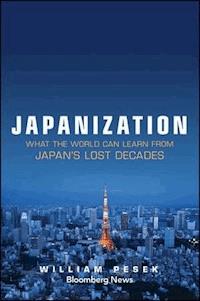
An in-depth look at Japan's economic malaise and the steps it must take to compete globally In Japanization, Bloomberg columnist William Pesek--based in Tokyo--presents a detailed look at Japan's continuing twenty-year economic slow-down, the political and economic reasons behind it, and the policies it could and should undertake to return to growth and influence. Despite new Prime Minister Shinzo Abe's promise of economic revitalization, investor optimism about the future, and plenty of potential, Japanization reveals why things are unlikely to change any time soon. Pesek argues that "Abenomics," as the new policies are popularly referred to, is nothing more than a dressed-up version of the same old fiscal and monetary policies that have left Japan with crippling debt, interest rates at zero, and constant deflation. He explores the ten forces that are stunting Japan's growth and offers prescriptions for fixing each one. * Offers a skeptical counterpoint to the popular rosy narrative on the economic outlook for Japan * Gives investors practical and detailed insight on the real condition of Japan's economy * Reveals ten factors stunting Japan's growth and why they are unlikely to be solved any time soon * Explains why most of what readers believe they know about Japan's economy is wrong * Includes case studies of some of the biggest Japanese companies, including Olympus, Japan Airlines, Sony, and Toyota, among others For many investors, businesspeople, and economists, Japan's long economic struggle is difficult to comprehend, particularly given the economic advantages it appears to have over its neighbors. Japanization offers a ground-level look at why its problems continue and what it can do to change course.
Sie lesen das E-Book in den Legimi-Apps auf:
Seitenzahl: 414
Veröffentlichungsjahr: 2014
Ähnliche


















Contents
Preface
Acknowledgments
Chapter 1: How Japan Papers Over Economic Cracks with Monetary and Fiscal Policy
Chapter 2: The Female Problem
Chapter 3: The 1,000,000,000,000,000 Yen Monster
Chapter 4: The Fukushima Effect
Chapter 5: Galapagos Nation
Chapter 6: Hello Kitty Isn’t a Foreign Policy
Chapter 7: Will Abenomics Save the World?
Bibliography
About the Author
Index
End User License Agreement
Pages
ii
iii
iv
v
vi
ix
x
xi
xii
xiii
xiv
1
2
3
4
5
6
7
8
9
10
11
12
13
14
15
16
17
18
19
20
21
22
23
24
25
26
27
28
29
30
31
32
33
34
35
36
37
38
39
40
41
42
43
44
45
46
47
48
49
50
51
52
53
54
55
56
57
58
59
60
61
62
63
64
65
66
67
68
69
70
71
72
73
74
75
76
77
78
79
80
81
82
83
84
85
86
87
88
89
90
91
92
93
94
95
96
97
98
99
100
101
102
103
104
105
106
107
108
109
110
111
112
113
114
115
116
117
118
119
120
121
122
123
124
125
126
127
128
129
130
131
132
133
134
135
136
137
138
139
140
141
142
143
144
145
146
147
148
149
150
151
152
153
154
155
156
157
158
159
160
161
162
163
164
165
166
167
168
169
170
171
172
173
174
175
176
177
178
179
180
181
182
183
184
185
186
187
188
189
190
191
192
193
194
195
196
197
198
199
200
201
202
203
204
205
206
207
208
209
210
211
212
213
214
215
216
217
218
219
220
221
222
223
224
225
226
Guide
Cover
Table of Contents
Begin Reading
Since 1996, Bloomberg Press has published books for financial professionals, as well as books of general interest in investing, economics, current affairs, and policy affecting investors and business people. Titles are written by well-known practitioners, BLOOMBERG NEWS® reporters and columnists, and other leading authorities and journalists. Bloomberg Press books have been translated into more than 20 languages.
For a list of available titles, please visit our Web site at www.wiley.com/go/bloombergpress.
Japanization
What the World Can Learn from Japan’s Lost Decades
William Pesek
Cover image: © iStockphoto.com/kokouu
Cover design: Wiley
Copyright © 2014 by William Pesek.
Published by John Wiley & Sons Singapore Pte. Ltd. 1 Fusionopolis Walk, #07-01, Solaris South Tower, Singapore 138628
All rights reserved.
No part of this publication may be reproduced, stored in a retrieval system, or transmitted in any form or by any means, electronic, mechanical, photocopying, recording, scanning, or otherwise, except as expressly permitted by law, without either the prior written permission of the Publisher, or authorization through payment of the appropriate photocopy fee to the Copyright Clearance Center. Requests for permission should be addressed to the Publisher, John Wiley & Sons Singapore Pte. Ltd., 1 Fusionopolis Walk, #07-01, Solaris South Tower, Singapore 138628, tel: 65-6643-8000, fax: 65-6643-8008, e-mail: [email protected].
Limit of Liability/Disclaimer of Warranty: While the publisher and author have used their best efforts in preparing this book, they make no representations or warranties with respect to the accuracy or completeness of the contents of this book and specifically disclaim any implied warranties of merchantability or fitness for a particular purpose. No warranty may be created or extended by sales representatives or written sales materials. The advice and strategies contained herein may not be suitable for your situation. You should consult with a professional where appropriate. Neither the publisher nor the author shall be liable for any damages arising herefrom.
Other Wiley Editorial Offices
John Wiley & Sons, 111 River Street, Hoboken, NJ 07030, USA
John Wiley & Sons, The Atrium, Southern Gate, Chichester, West Sussex, P019 8SQ, United Kingdom
John Wiley& Sons (Canada) Ltd., 5353 Dundas Street West, Suite 400, Toronto, Ontario, M9B 6HB, Canada
John Wiley& Sons Australia Ltd., 42 McDougall Street, Milton, Queensland 4064, Australia
Wiley-VCH, Boschstrasse 12, D-69469 Weinheim, Germany
Library of Congress Cataloging-in-Publication Data
ISBN 978-1-118-78069-5 (Hardcover)
ISBN 978-1-118-78070-1 (ePDF)
ISBN 978-1-118-78072-5 (ePub)
For Eriko. Of course.
Preface
Few words strike greater fear in the hearts of economists and politicians than Japanization. That specter of chronic malaise, deflation, crushing debt, and political paralysis drove central bankers from Ben Bernanke in the United States to Mario Draghi in Europe to flood markets with liquidity as never before in an all-out effort to avert their own lost decades.
Decades ago, the fear was of Japanese dominance. Ezra Vogel’s 1979 bestseller, Japan as Number One, was emblematic of passions across the Pacific. The Harvard University social sciences professor sketched out a scenario of a tiny island nation with no natural resources dominating the economic world that seemed as plausible as frightening to the American and Europe business elites.
Subsequent years would see entire generations of editors rushing Japanese-are-coming scare pieces into print. Time magazine’s March 30, 1981, Japan cover, “The World’s Toughest Competitor,” was illustrative of the hysteria, as was the timing. Amid oil shocks, stagflation, fiscal crises, and the Iran hostage crisis, Japan’s meteoric rise was an existential blow to an America whose main business was doing business better than anyone.
Over the next decade, Japan was just as exciting and feared in world economic terms as China is today. Its companies and banks dominated top-10 lists, while once-proud U.S. automakers were eating Japan’s exhaust. If you wanted to see some of your favorite Van Gogh, Picasso, or Warhol paintings, you had to visit Tokyo or Osaka. As jewels like Rockefeller Center, Universal Studios, Pebble Beach golf course, and myriad skyscrapers fell into Japanese hands, commentators screamed about the commercial equivalent of Pearl Harbor. Japan-bashing was sweeping Capitol Hill, too. In 1990, Congresswoman Helen Bentley said the United States “is rapidly becoming a colony of Japan.”
By 1992, when Michael Crichton’s jingoistic novel, Rising Sun, about economic imperialism, hit bookshelves, it was already over. By the time the film version of Rising Sun, starring Sean Connery and Wesley Snipes, began in theaters in 1993, the Nikkei was plunging and Japan’s fabled banks were in need of government bailouts. The Nikkei 225 stock average—which peaked at 38,957—was in freefall and taking Japan’s once-limitless confidence down with it.
Since then, Japan has ricocheted from one hapless government to the next (it’s had 16 prime ministers since 1990 to America’s four presidents), rolled out trillions of dollars of stimulus packages, cut interest rates to zero and below, and done battle with currency markets to weaken the yen countless times, and still deflation has deepened and growth has remained negligible. This noxious mix of trifling growth, high debt, falling consumer prices, waning confidence, and political dysfunction has come to be known as Japanization.
It should worry China, then, that experts on this dreaded scenario are turning their attention to Beijing. Take Brian Reading, whose quest to understand what the world can learn from Tokyo’s mess dates back to his 1992 book, Japan: The Coming Collapse. In July 2013, he wrote a 40-page report with Lombard Street Research Ltd. colleague Diana Choyleva, titled “China’s Chance to Avoid Japan’s Mistakes.”
Over in Hong Hong, investor inquiries on the similarities between China and Japan also drove JPMorgan Chase & Co. economist Grace Ng to revisit the topic. Her warnings that China today and Japan in the 1980s share an uncannily similar build-up in broad measures of credit to almost double the economy’s size brought furrows to many a brow in Beijing.
So, just how susceptible is China to Japanization? How vulnerable, for that matter, are the much larger economies of the United States and the European Union? The answer, at least to varying degrees, is quite a bit. The same could be said for India, Indonesia, Thailand, and other developing economies if national leaders aren’t careful.
In February 2009, none other than U.S. President Barack Obama cited Japan’s “lost decade” as something his presidency would seek to avoid. In July 2010, James Bullard, president of the Federal Reserve Bank of St. Louis, warned that America could be “enmeshed in a Japanese-style deflationary outcome within the next several years.”
When economist Lawrence Summers warned of a “secular stagnation,” an economic rout that has more or less become permanent, on November 8, 2013, he was indeed hinting at such an outcome. As the world emerges from the wreckage of Wall Street’s 2008 crash and Europe’s own crisis deepens, few lessons are more timely or critical than those offered by Japan, a once-vibrant model for developing economies that joined the world’s richest nations, lost its way, and has been struggling to relocate it ever since. Its deflation, tepid growth, waning consumer spending, and monumental debt buildup were met with timidity at the government’s highest levels, compounding Japan’s pain. Conventional tools like fiscal spending and lower borrowing costs did little to revitalize growth and have lost potency.
Why? Tokyo’s biggest sin, aside from being slow to act, was hiding myriad structural problems with macroeconomic largess. Beginning in the early 1990s, Japan avoided a wholesale cleansing of the excesses from the 1980s by engaging in endless rounds of Keynesian-style fiscal inducements and ultraloose central bank policy. Instead of breaking ties between the government, banks, and companies, deregulating industries, and letting any of the forces of creative destruction championed by economist Joseph Schumpeter play out, officials maintained the status quo. Rather than encourage entire industries to modernize or rekindle the entrepreneurial spirit needed to raise the nation’s game, the government doubled down on the export-led models of the past. In place of innovative changes to the tax, education, and social-welfare systems, the government poured untold trillions of dollars into public works projects to avoid changes to the micro-economy, leaving Japan with the world’s biggest public debt and a credit rating on par with Bermuda, the Czech Republic, Estonia—and China.
In this book I explore what the world can learn from a Japanese economic funk that began more than 20 years ago and has never really ended. That means exploring where Japan went wrong, how it sank under the weight of hubris and political atrophy, and missed opportunity after opportunity to scrap an insular model based on overinvestment, export-led growth, and excessive debt.
This argument will seem decidedly at odds with what we read in the international media in 2013. The story has been one of Japanese revival, of reformist Prime Minister Shinzo Abe taking on the political and corporate establishments, of a newly confident nation reclaiming the mantle of innovative powerhouse and diplomatic authority, of an economic power that is, to use Abe’s own description, “back.” I will counter this conventional wisdom and detail how Abenomics is largely the same old mix of fiscal and monetary excess that left Japan with a public debt it may never be able to pay off, zero interest rates indefinitely, and little to show for it—jazzed up as something new and different. Abenomics is a brilliant marketing campaign in search of a product.
This book will explore the forces stunting Japan’s evolution into a more vibrant, creative, and competitive economic species and what the world can learn from each of them. They include: how Japan papers over economic cracks with monetary and fiscal policy; when the bond market becomes a monster; how institutionalized sexism kills growth; how the rampant cronyism the created the Fukushima nuclear crisis holds Japan back; how isolation, known as the Galapagos effect, stunts Japan’s evolution; how amateurish diplomacy undermines Japan’s global soft power; and whether Abenomics can save the world, as no less an authority than Nobel laureate Paul Krugman argues.
Acknowledgments
Thanks to my parents for their unwavering love and teaching me to be always and everywhere curious. To my sisters and brothers for being my loyal companions in this adventure called life. To Ochiais near and far for their encouragement and support. And to the following people for their advice, inspiration, and assistance: Shamim Adam, Jake Adelstein, Marco Babic, Terrence Barrett, Kler Batino, Stuart Biggs, Kevin Carroll, Chrisanne Chin, Kyung Bok Cho, John Connor, Michael Forsythe, Brian Fowler, Phil Gibb, James Greiff, Nisid Hajari, Patrick Harrington, Nick Hayward, Peter Himmelman, Barry Horowitz, Momoe Ikeda, Netty Ismail, Aki Ito, Tony Jordan, Adrian Kennedy, Simon Kennedy, Jeff Kingston, Walter Krumholz, Miho Kurosaki, Peter Langan, Yoolim Lee, Roger Lewis, Adam Majendie, Kanoko Matsuyama, Jim McDonald, Damian Milverton, Joe Mysak, Elio Orsara, Tomoko Sato, David Shipley, Rocky Swift, Chian-Wei Teo, Tomoko Tsuchiya, Peter Vercoe, Matthew Winkler, and, of course, Nick Wallwork and the terrific folks at Wiley for taking on this project. Finally, a shout-out to my old friend, the late Daniel Pearl: It was the last time I saw you, 13 years ago, in that smoky bar in Mumbai, when you encouraged me to write a book about Japan. Well, sir, here you go.
Chapter 1How Japan Papers Over Economic Cracks with Monetary and Fiscal Policy
On November 24, 1997, Lawrence Summers was having an unusually busy Monday morning on a trip to Vancouver, and things were about to get steadily worse. The Asian financial crisis was ricocheting around the globe, and at that very moment claiming its biggest victim yet. South Korea, then the world’s eleventh-largest economy, was days away from receiving a $57 billion international bailout. But on that day, the deputy U.S. Treasury secretary had a far bigger problem on his hands, not in Seoul but in Tokyo: the collapse of 100-year-old Yamaichi Securities Co., an event that sent the Dow Jones Industrial Average down 113 points nearly one month to the day after Asia-crisis worries drove the index down 554 points in a single day, the largest drop ever.
Lesen Sie weiter in der vollständigen Ausgabe!
Lesen Sie weiter in der vollständigen Ausgabe!
Lesen Sie weiter in der vollständigen Ausgabe!
Lesen Sie weiter in der vollständigen Ausgabe!
Lesen Sie weiter in der vollständigen Ausgabe!
Lesen Sie weiter in der vollständigen Ausgabe!
Lesen Sie weiter in der vollständigen Ausgabe!
Lesen Sie weiter in der vollständigen Ausgabe!
Lesen Sie weiter in der vollständigen Ausgabe!
Lesen Sie weiter in der vollständigen Ausgabe!




