


23,99 €
Mehr erfahren.
- Herausgeber: Packt Publishing
- Kategorie: Fachliteratur
- Sprache: Englisch
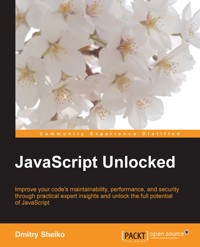
JavaScript stands bestride the world like a colossus. Having conquered web development, it now advances into new areas such as server scripting, desktop and mobile development, game scripting, and more. One of the most essential languages for any modern developer, the fully-engaged JavaScript programmer need to know the tricks, non-documented features, quirks, and best practices of this powerful, adaptive language.
This all-practical guide is stuffed with code recipes and keys to help you unlock the full potential of JavaScript. Start by diving right into the core of JavaScript, with power user techniques for getting better maintainability and performance from the basic building blocks of your code. Get to grips with modular programming to bring real power to the browser, master client-side JavaScript scripting without jQuery or other frameworks, and discover the full potential of asynchronous coding. Do great things with HTML5 APIs, including building your first web component, tackle the essential requirements of writing large-scale applications, and optimize JavaScript’s performance behind the browser. Wrap up with in-depth advice and best practice for debugging and keeping your JavaScript maintainable for scaling, long-term projects. With every task demonstrated in both classic ES5 JavaScript and next generation ES6-7 versions of the language, Whether read cover-to-cover or dipped into for specific keys and recipes, JavaScript Unlocked is your essential guide for pushing JavaScript to its limits.
Das E-Book können Sie in Legimi-Apps oder einer beliebigen App lesen, die das folgende Format unterstützen:
Seitenzahl: 189
Veröffentlichungsjahr: 2015
Ähnliche


















Table of Contents
JavaScript Unlocked
JavaScript Unlocked
Copyright © 2015 Packt Publishing
All rights reserved. No part of this book may be reproduced, stored in a retrieval system, or transmitted in any form or by any means, without the prior written permission of the publisher, except in the case of brief quotations embedded in critical articles or reviews.
Every effort has been made in the preparation of this book to ensure the accuracy of the information presented. However, the information contained in this book is sold without warranty, either express or implied. Neither the author, nor Packt Publishing, and its dealers and distributors will be held liable for any damages caused or alleged to be caused directly or indirectly by this book.
Packt Publishing has endeavored to provide trademark information about all of the companies and products mentioned in this book by the appropriate use of capitals. However, Packt Publishing cannot guarantee the accuracy of this information.
First published: December 2015
Production reference: 1011215
Published by Packt Publishing Ltd.
Livery Place
35 Livery Street
Birmingham B3 2PB, UK.
ISBN 978-1-78588-157-2
www.packtpub.com
Credits
Author
Dmitry Sheiko
Reviewer
Durgesh Priyaranjan
Commissioning Editor
Wilson Dsouza
Acquisition Editor
Meeta Rajani
Content Development Editor
Priyanka Mehta
Technical Editor
Mohita Vyas
Copy Editor
Kausambhi Majumdar
Project Coordinator
Izzat Contractor
Proofreader
Safis Editing
Indexer
Tejal Soni
Graphics
Abhinash Sahu
Production Coordinator
Aparna Bhagat
Cover Work
Aparna Bhagat
About the Author
Dmitry Sheiko is a passionate blogger and the author of Instant Testing with QUnit.
Dmitry got hooked to computer programming in the late '80s. For the last 18 years, he has been in web development. His very first open source contribution was an XSLT-based CMS in 2004. Since then, he has been contributing quite a lot to FOSS. You can find Dmitry's latest works at https://github.com/dsheiko. Currently, he is working as a web developer in the lovely city of Frankfurt am Main at Crytek GmbH.
First, I would like to thank my family for the continuous support and letting me to realize my potential. A special thank you to my father, who took me to an industrial computer center when I was 3 years old. In I decade after this, with the advance in PCs, I realized that computers mean games, and after a while, I became curious enough to understand how the games are built. This is how I started learning programming.
Thank you to my team at Crytek, who compliantly follow all the practices described in the book and adapt to the constantly evolving technologies to keep up with the pace I set.
About the Reviewer
Durgesh Priyaranjan is a senior software developer who has been working on various technologies. However, he loves JavaScript programming and interaction design the most. He is currently based in Bengaluru (India) and is working as a UI engineer for one of the Indian e-commerce giants, Flipkart.
He loves trying out different technologies without any bias. Of late, he can be found tinkering around with Raspberry Pi.
I'd like to thank my loving wife for her continuous support of my work and work-related hobbies.
www.PacktPub.com
Support files, eBooks, discount offers, and more
For support files and downloads related to your book, please visit www.PacktPub.com.
Did you know that Packt offers eBook versions of every book published, with PDF and ePub files available? You can upgrade to the eBook version at www.PacktPub.com and as a print book customer, you are entitled to a discount on the eBook copy. Get in touch with us at <[email protected]> for more details.
At www.PacktPub.com, you can also read a collection of free technical articles, sign up for a range of free newsletters and receive exclusive discounts and offers on Packt books and eBooks.
https://www2.packtpub.com/books/subscription/packtlib
Do you need instant solutions to your IT questions? PacktLib is Packt's online digital book library. Here, you can search, access, and read Packt's entire library of books.
Why subscribe?
Free access for Packt account holders
If you have an account with Packt at www.PacktPub.com, you can use this to access PacktLib today and view 9 entirely free books. Simply use your login credentials for immediate access.
Preface
JavaScript was born as a scripting language at the most inappropriate time—the time of browser wars. It was neglected and misunderstood for a decade and endured six editions. And look at it now! JavaScript has become a mainstream programming language. It has advanced literally everywhere: in large-scale client-side development, server scripting, desktop applications, native mobile programming, game development, DB querying, hardware control, and OS automating. JavaScript acquired a number of subsets such as Objective-J, CoffeeScript, TypeScript, and others. JavaScript is marvelously concise and an expressive language. It features prototype-based OOP, object composition and inheritance, variadic functions, event-driven programming, and non-blocking I/O. However, to exploit the true power of JavaScript, we need to have a deep understanding of language quirks. Moreover, while developing in JavaScript, we will become aware of its numerous pitfalls, and we will need a few tricks to avoid them. The project formerly known as EcmaScript Harmony, was just recently finalized in the specification named EcmaScript 2015, which is more often referred to as ES6. This not only brought the language to the next level, but also introduced a number of new technologies that require attention.
This book aims to guide the reader in understanding the upcoming and existing features of JavaScript. It is fully packed with code recipes that address common programming tasks. The tasks are supplied with solutions for classical JavaScript (ES5) as well as for the next generation language (ES6-7). The book doesn't focus only on in-browser language, but also provides the essentials on writing efficient JavaScript for desktop applications, server-side software, and native module apps. The ultimate goal of the author is not just to describe the language, but also to help the reader to improve their code for better maintainability, readability, and performance.
What this book covers
Chapter 1, Diving into the JavaScript Core, discusses the techniques to improve the expressiveness of the code, to master multi-line strings and templating, and to manipulate arrays and array-like objects. The chapter explains how to take advantage of JavaScript prototype without harming the readability your code. Further, the chapter introduces the "magic methods" of JavaScript and gives a practical example of their use.
Chapter 2, Modular Programming with JavaScript, describes the modularity in JavaScript: what modules are, why they are important, the standard approaches for asynchronously and synchronously loaded modules, and what ES6 modules are. The chapter shows how CommonJS modules are used in server-side JavaScript and how to pre-compile them for in-browser use. It elaborates how asynchronous and synchronous approaches can be combined to achieve a better application performance. It also explains how one can polyfill ES6 modules for production by the means of Babel.js.
Chapter 3, DOM Scripting and AJAX, introduces Document Object Model (DOM), shows the best practices to minimize browser reflow, and enhance application performance while operating with the DOM. The chapter also compares two client-server communication models: XHR and Fetch API.
Chapter 4, HTML5 APIs, considers the persistence APIs of the browser such as Web Storage, IndexDB, and FileSystem. It introduces Web Components and gives a walk-through of the creation of a custom component. The chapter describes server-to-browser communication APIs such as SSE and WebSockets.
Chapter 5, Asynchronous JavaScript, explains the nonblocking nature of JavaScript, elaborates the event loop and the call stack. The chapter considers the popular styles of chaining asynchronous calls and handling errors. It presents the async/await technique of ES7 and also gives examples of running tasks in parallel and in sequence using the Promise API and the Async.js library. It describes throttling and debouncing concepts.
Chapter 6, A Large-Scale JavaScript Application Architecture, focuses on code maintainability and architecture. The chapter introduces the MVC paradigm and its derivatives, MVP and MVVM. It also shows, with examples, how concern separation is implemented in popular frameworks such as Backbone.js, AngularJS, and ReactJS.
Chapter 7, JavaScript Beyond the Browser, explains how to write command-line programs in JavaScript and how to build a web server with Node.js. It also covers the creation of desktop HTML5 applications with NW.js and guides the development of native mobile applications with Phongap.
Chapter 8, Debugging and Profiling, dives into bug detection and isolation. It examines the capacities of DevTools and the lesser-known features of the JavaScript console API.
What you need for this book
It's enough if you have a modern browser and a text editor to run the examples from the book. It maybe helpful, however, to use a browser tool similar to Firefox Scratchpad (https://developer.mozilla.org/en-US/docs/Tools/Scratchpad) to edit the sample code directly in the browser. The books also contains ES6/ES7 code examples that rely on features not yet available in browsers. You can run these examples in Babel.js's online sandbox available at https://babeljs.io/repl/.
You will find detailed instructions of how to set up your development environment and install the required tools and dependencies in the chapters where we refer to Node.js, NW.js, PhoneGap, JavaScript frameworks, and NPM packages.
Who this book is for
This book is for the developers who are already familiar with JavaScript and want to level up their skills to get the most out of the language. The book is practice-oriented and would be helpful for those who are used to the "learn by doing" approach, as the topics are thoroughly covered with real-life examples and tutorials.
Reader feedback
Feedback from our readers is always welcome. Let us know what you think about this book—what you liked or disliked. Reader feedback is important for us as it helps us develop titles that you will really get the most out of.
To send us general feedback, simply e-mail <[email protected]>, and mention the book's title in the subject of your message.
If there is a topic that you have expertise in and you are interested in either writing or contributing to a book, see our author guide at www.packtpub.com/authors.
Customer support
Now that you are the proud owner of a Packt book, we have a number of things to help you to get the most from your purchase.
Downloading the example code
You can download the example code files from your account at http://www.packtpub.com for all the Packt Publishing books you have purchased. If you purchased this book elsewhere, you can visit http://www.packtpub.com/support and register to have the files e-mailed directly to you.
Errata
Although we have taken every care to ensure the accuracy of our content, mistakes do happen. If you find a mistake in one of our books—maybe a mistake in the text or the code—we would be grateful if you could report this to us. By doing so, you can save other readers from frustration and help us improve subsequent versions of this book. If you find any errata, please report them by visiting http://www.packtpub.com/submit-errata, selecting your book, clicking on the Errata Submission Form link, and entering the details of your errata. Once your errata are verified, your submission will be accepted and the errata will be uploaded to our website or added to any list of existing errata under the Errata section of that title.
To view the previously submitted errata, go to https://www.packtpub.com/books/content/support and enter the name of the book in the search field. The required information will appear under the Errata section.
Piracy
Piracy of copyrighted material on the Internet is an ongoing problem across all media. At Packt, we take the protection of our copyright and licenses very seriously. If you come across any illegal copies of our works in any form on the Internet, please provide us with the location address or website name immediately so that we can pursue a remedy.
Please contact us at <[email protected]> with a link to the suspected pirated material.
We appreciate your help in protecting our authors and our ability to bring you valuable content.
Questions
If you have a problem with any aspect of this book, you can contact us at <[email protected]>, and we will do our best to address the problem.




