


Erhalten Sie Zugang zu diesem und mehr als 300000 Büchern ab EUR 5,99 monatlich.
- Herausgeber: The History Press
- Kategorie: Lebensstil
- Sprache: Englisch
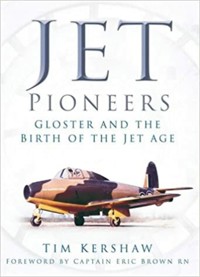
In April 1941 Britain's first jet left the ground at a grass airfield 4 miles from Gloucester Cathedral. It was the start of a revolution in air travel, military and civilian. During the 1940s Britain's first-ever jet aircraft, the world's first jet fighter in squadron service and the first jet to hold the world air-speed record were all designed, built and flown in the Gloucester and Cheltenham area. The story of Frank Whittle's invention and dogged development of the jet engine is well known. But the account of how his invention was put into the air has never been fully told. This book tells the story of how the men and women of north Gloucestershire made Whittle's engine fly.
Sie lesen das E-Book in den Legimi-Apps auf:
Seitenzahl: 216
Veröffentlichungsjahr: 2004
Das E-Book (TTS) können Sie hören im Abo „Legimi Premium” in Legimi-Apps auf:
Ähnliche



















JET
PIONEERS
GLOSTER
AND THE BIRTH OF THE JET AGE
TIM KERSHAW
First published in 2004 by Sutton Publishing Limited
The History Press
The Mill, Brimscombe Port
Stroud, Gloucestershire, GL5 2QG
www.thehistorypress.co.uk
This ebook edition first published in 2013
All rights reserved
© Tim Kershaw, 2004, 2013
The right of Tim Kershaw, to be identified as the Author of this work has been asserted in accordance with the Copyrights, Designs and Patents Act 1988.
This ebook is copyright material and must not be copied, reproduced, transferred, distributed, leased, licensed or publicly performed or used in any way except as specifically permitted in writing by the publishers, as allowed under the terms and conditions under which it was purchased or as strictly permitted by applicable copyright law. Any unauthorised distribution or use of this text may be a direct infringement of the author’s and publisher’s rights, and those responsible may be liable in law accordingly.
EPUB ISBN 978 0 7524 9499 9
Original typesetting by The History Press
CONTENTS
FOREWORD
ACKNOWLEDGEMENTS
INTRODUCTION
ONE
Why Gloster?
TWO
Designing and Building the E28
THREE
It Flies – Unofficially
FOUR
Flying at Cranwell
FIVE
The E28’s Later Flights
SIX
Meteor and Gormless
SEVEN
The Designers
EIGHT
Gloster’s E28 Pilots
NINE
Commemorating the Pioneers
TEN
Afterword
APPENDICES – The E28 in Detail
A The E28’s Vital Statistics
B The Cockpit
C Bill Baldwin’s Instrument List
D The Cranwell Flights
E Camouflage and Markings
F Plans and Models
G The Missing E28 Records
BIBLIOGRAPHY
In memory of Wilfred George Carter CBE FRAeS, 1889–1969, aircraft designer and jet pioneer
FOREWORD
This is the historic story of Britain’s first jet-propelled aircraft, the Gloster E28/39, and its designer, George Carter. It spans a wide spectrum of the aviation scene in this country from 1914 to 1948, and inevitably it projects the names of many famous aircraft and personalities of that golden era in aeronautics.
The birth of the E28 was the result of the somewhat random selection of the Gloster Aircraft Company to design and build a vehicle to accommodate jet pioneer Frank Whittle’s first flight engine. Fortune smiled on this arrangement, for it brought together two kindred spirits in Whittle and Carter. The saga of conducting such a project in utmost secrecy in wartime conditions makes enthralling reading, and involves almost in parallel the evolution of Britain’s first operational twin-jet Meteor fighter from the same stable.
The biographical insight into George Carter reveals a good team man, who quietly inspired loyalty from his workers on the shop floor through to his test pilots in the air. The book is indeed a fitting tribute to a modest but superb engineer, and to the pioneering aeroplane he helped to create.
I had the great good fortune to know both man and machine, as well as the mighty Frank Whittle, and experience the thrill and privilege of working with such unforgettable engineers and the products of their genius.
Capt Eric Brown CBE DSC AFC MA FRAeS RN Former Commanding Officer High Speed Flight and Aerodynamics Flight, Royal Aircraft Establishment, Farnborough
ACKNOWLEDGEMENTS
Many individuals and organisations have made this book possible, but above all I could not have considered embarking on the project without the resources and contacts of Jet Age Museum. I owe a particular debt of gratitude to the management and members of Jet Age.
I am also especially grateful to the family of George Carter, to his son, Peter, for allowing me to dedicate this book to his father’s memory and to quote from his father’s work, and to Peter’s cousins Sylvia McGhie and Pauline Watson for all their help and encouragement. Thanks, too, to John Patterson for his help with Carter family contacts.
Outstanding contributions to the illustrations in this book were made by Roff T. Jones, saviour of the E28 construction photographs, and Valerie Adams, whose late husband, Russell Adams, was the undoubted pioneer of jet air-to-air photography. The Russell Adams Collection is a fantastic resource and I am delighted that it is now under the management of Jet Age Museum for the joint benefit of the Museum and Russell’s family. I am also grateful to the Crown Copyright Administrator of the Ministry of Defence for permission to publish many photographs, especially those saved by Roff Jones; to Michael S. Daunt for permission to use photographs from his father’s collection; and to Roger Jackson for photographs from the A.J. Jackson Collection.
Thanks, too, to technical illustrator Philip Moss and aviation historian Tony Buttler, two Jet Age Museum stalwarts. Thanks to Phil for his outstanding cutaway drawing of the E28, which I believe to be the first of its kind. There simply was not enough information available before to show the E28’s insides. It has been made possible by access to the original glass plate negatives of the company’s general arrangement drawings, the once-secret Prototype Notes and the construction photographs referred to above. And thanks to Tony for sharing the fruits of his impressive research at the Public Record Office (now the National Archives) on early Gloster jets, for the loan of photographs and for his tremendous support throughout.
Eyewitness accounts and records have been contributed above all by Sid Dix, Dr Robert Feilden and Capt Eric Brown RN. Dix and Feilden saw the E28 leave the ground at Brockworth on 8 April 1941, and all three were present at the first flight at Cranwell in the following month. Sid Dix is the last survivor of the team which built the two E28s; Bob Feilden is a distinguished former member of Frank Whittle’s Power Jets team who supervised the installation of the engine for the first taxiing trials; and Eric Brown is the last survivor of the twenty-five men who flew the two aircraft. I am also especially grateful to Eric Brown for his foreword.
Thanks, too, to Ian Whittle for permission to quote his father’s words from various sources, to A.K. Walker and John Walker for access to the late Richard Walker’s notes and photographs, and to Brian Riddle of the Royal Aeronautical Society. I have also drawn on Jet Age Museum archive material from former Gloster personnel Bill Baldwin, Basil Fielding, John Cuss and Sidney Hill. Other contributions have come from correspondence or conversations over the years with Janet Ashton, Les Comfort, Michael S. Daunt, Roff T. Jones, Cyril Richardson, Maurice Summers, Joe Tedaldi, Don Tombs and John Whitaker.
Published sources have been used extensively to provide the main narrative. I have relied in particular on Gloster test pilot John Grierson’s classic, Jet Flight of 1946. Many other sources have been used, both published and unpublished, and they are listed in the bibliography.
Help and encouragement have made this book possible and I am especially grateful to Jet Age Museum chairman John Lewer, my editor Sarah Bryce and the Sutton Publishing team (Clare Jackson, Bow Watkinson, Michelle Tilling, Joanne Govier, Mary Critchley, Catherine Watson and Martin Latham), my wife Nicky and my daughter Kate. Thank you all. Writing the book would have been far harder without your support.
While every effort has been made to obtain copyright clearance and consent, if I have missed anyone I would very much like to hear from them so that I can put this right. Finally, I would like to make it clear that any errors are my own and any corrections or new information will be gratefully received.
INTRODUCTION
Jet flight has changed the world we live in, as surely as the telephone, the car or the internet. Each of them has expanded the network of communications which links us all. Powered flight has been with us for a hundred years: we celebrated the centenary of the Wright brothers’ first flight in 2003. Their Flyer was powered by a petrol engine driving twin propellers. This combination of internal combustion engine and propeller prevailed for forty years or more, with increasing power and sophistication, but it had its limitations – and they were recognised as far back as 1928 by a young Royal Air Force cadet named Frank Whittle. His dogged determination and the essential rightness of his vision produced a quantum leap in aircraft performance unlike anything before or since.
Whittle is honoured today as a true British engineering genius and the outstanding pioneer of jet-powered flight. His achievement is well known and the development of the jet engine has been covered thoroughly in print and documentary. This book looks at part of the story from a different angle: the part played by the people of the Gloster Aircraft Company in designing, building and flying the first aeroplane in which Whittle’s revolutionary invention took to the air. It looks at how and why the company became involved in this extraordinary project.
When I was approached to write this book I wondered what I could add to previously published accounts and how on earth I could find enough illustrations. In the event, I was able to find a remarkable amount of new material, including eyewitness accounts and anecdotes, and once-secret documents and photographs. I have also gathered together scraps of information from a wide variety of sources. No one before had attempted, as far as I know, to cover the career of aircraft designer George Carter in any detail, or to assess his place in local and aviation history. I have pieced together fuller accounts than I have been able to find from any other single source of the careers of Richard Walker and the four Gloster test pilots who flew the E28. I have also tried as far as possible to do justice to the many other Gloster personnel who were involved in the project.
Most remarkable and noteworthy of the new material is the extraordinary collection of photographs of Britain’s first jet being built. As far as I am aware, this remarkable record has not been published before. Now, for the first time in more than sixty years, they see the light of day once more. The month in which each was taken is recorded, so we have a good idea of the rate of progress that was made in building the E28s, although it is not always clear which of the two aircraft is depicted.
The survival of the photographs is an extraordinary story in itself. There are 110 in all, of which, I believe, no more than half a dozen are well known. The full set – all with SECRET stamped on the reverse – was pasted into an album issued by the Gloster Aircraft Company Stationery Department and each page is stamped ‘RTO Gloster Aircraft Co. Ltd, Hucclecote, Glos’. The RTO was the resident technical officer, the Air Ministry’s permanent representative with the company.
The album found its way in due course to the bottom of a filing cabinet drawer where it languished until the company closed down in 1963. Designer Roff T. Jones was the last man out of the design office. He was told that two lorries would come from Coventry to take the design office records away; it was his job to supervise the loading. For whatever reason, only one lorry arrived. Jones was told to take everything that was left to the bottom of the airfield and burn it. Before doing so he looked to see what was about to be destroyed. There was the photograph album, which he kept safe for forty years.
Tim Kershaw
ONE
WHY GLOSTER?
Bushley, Tewkesbury February 2004
Unable to attract official support, Frank Whittle found enough private backing to set up a company, Power Jets Ltd, in 1936 to build a prototype gas turbine engine – a ‘jet’. In April the following year his U-type engine was successfully run for the first time – the first time, indeed, that a jet engine intended for flight had run anywhere in the world.
The Air Ministry, indifferent if not downright sceptical for so long, began cautiously to take notice. Whittle had gone beyond theory, surmounted a host of daunting technical challenges and shown that the thing could work. This was a time when it was commonly and widely believed that the future of air power lay in bombing the enemy’s factories, infrastructure and population centres, that there was no effective defence against bombing aircraft en masse and that ‘the bomber will always get through’.
When it was realised that Germany was rearming and had secretly developed an air force equipped with modern, high-performance aircraft, Britain looked at every possible way of mitigating the impending disaster which it knew it could not prevent: evacuation, air-raid shelters, gas masks for all, anti-aircraft gun and balloon barrages, fire watchers, early warning (including the Observer Corps and the new secret weapon, radar) and interceptor fighters with the greatest possible speed and rate of climb. What Whittle had pointed out back in 1928 was now more widely realised: there was a maximum speed beyond which it was physically impossible for a propeller-driven aircraft to go.
Maybe Whittle’s engine was a possible answer? At least one person thought so where it mattered: Sir Henry Tizard, the far-sighted chairman of the Aeronautical Research Committee and Rector of Imperial College, London. Since 1935 he had chaired a special committee ‘to investigate the possibilities of countering air attacks by utilising the recent progress of scientific invention’.
By 1939 Tizard was encouraging the Air Ministry’s Director of Scientific Research, David Pye, who had reportedly become ‘irritated by Whittle’s importunity in urging that an aircraft should be built to test his engine’. Indeed, later in the year, Pye assured Whittle that ‘the development of both engine and airframe would continue if war occurred’.
At a time when a huge variety of untried devices were competing for official support and financial backing, maximum resources had to be devoted to projects which were known to be cost-effective. The number of new projects which could be afforded financially, or using scarce materials or manpower, was strictly limited, but this one, Tizard believed, showed enough promise to be worth backing.
So, at last, Whittle received the support he had been denied for so long: the official go-ahead to build an engine for flight. Power Jets began to develop what became known as the W1. It had a centrifugal compressor, like its predecessor, but with ten small combustion chambers ringing the main chamber, unlike the single combustion chamber of the U-type. Hand in hand with the development of the W1 itself, thought was now given to the best way to test the new engine in flight. Adapting an existing airframe as a flying test bed was rejected early on. The next step was to call in all projects within certain parameters from design offices across the aircraft industry to see if any looked suitable. One in particular looked promising, a highly original design by the Gloster Aircraft Company.
With one of the most evocative names in British aviation history, the Gloster Company provided the Royal Air Force with front-line fighters from the 1920s to the 1960s: Grebe and Gamecock, Gauntlet and Gladiator, Meteor and Javelin. Its origins went back to the early years of the First World War, when a Cheltenham firm of specialist high-class woodworkers and architectural craftsmen, H.H. Martyn, began producing aircraft components in 1915. As subcontractors to the Aircraft Manufacturing Company – Airco, as it was known – Martyn soon acquired a reputation for quality, and in 1917 the two companies set up the Gloucestershire Aircraft Company (GAC) as a joint venture. By the end of the war they had built more than 300 Airco DH6 trainers and Bristol F2B fighters. The five founding directors included Hugh Burroughes of Airco, who was to serve as a director of the company until it closed down almost fifty years later, and A.W. Martyn of the Cheltenham firm. Martyn later backed George Dowty when he left Gloster to set up his own business, and became the first chairman of Dowty’s new company.
Aircraft production slid rapidly into the doldrums after the Armistice of 1918 and many aircraft companies went under. GAC survived on government orders for Bristol Fighters for another couple of years and the directors bravely decided to continue as planemakers, buying the business from the liquidators when Airco was closed down in 1920. They had started on a contract to build the Nighthawk fighter, a successor to one of the First World War’s best and most successful fighters, the Royal Aircraft Factory’s SE5A. The Nighthawk would have become Britain’s front-line fighter if the war had continued. It was a superb design, let down by the disastrous ABC Dragonfly engine which had been ordered in huge numbers as the main power plant for the RAF of 1919.
When the contract was cancelled, GAC bought the design rights and the completed and uncompleted airframes. Re-engined versions were trialled with the RAF – its first radial-engined fighter – and were built for the Fleet Air Arm, the Royal Hellenic Air Force and in quantity for the Imperial Japanese Navy. GAC also engaged Henry Folland, the designer of the SE5A and the Nighthawk. Folland proceeded to put the fledgling company on the map with a series of racing landplanes and seaplanes derived from his fighter. The Nighthawk led to the Grebe fighter of 1923, followed by the beefier Gamecock of 1925, both ordered in quantity for the RAF.
Foreign orders were coming in, too, and in 1926 the company changed its name to Gloster Aircraft – the word ‘Gloucestershire’ was too much for many overseas customers to pronounce. The company was riding high, and Folland’s beautiful racing seaplanes, the Gloster IV and the Golden Arrow, featured in the thrilling international Schneider Trophy contests. Production of all other types had been transferred by now to Gloster’s new factory at Hucclecote and the adjoining Brockworth airfield, just east of Gloucester.
But the trend now was for all-metal construction, and Gloster soon lost out to Armstrong-Whitworth’s Siskin, Bristol’s Bulldog and Hawker’s Fury. A succession of experimental types kept the design department busy, and the manufacture of the all-metal Siskin and steel wings for other non-Gloster aircraft kept the company solvent – just. But the 1930–31 slump followed and between 1930 and 1933 Gloster built only five aircraft – not just types, but individual aircraft – of its own design.
Director Hugh Burroughes was determined to keep the company afloat. Underutilised hangars were sublet for storing charabancs, for an indoor tennis court and even for raising pigs and growing mushrooms. Burroughes was also deputy chairman of the industry’s trade association, the Society of British Aircraft Constructors (SBAC), and was in discussion with the Air Ministry, which was taking steps at this time towards reducing the number of companies in the industry. At the same time Hawker was thriving and RAF orders were dominated by its Hart and Fury types. In May 1934 Hawker approached Gloster with a takeover proposal. It was clear to Burroughes that Hawker could provide ‘a prolonged period of full employment for all GAC personnel’. The Gloster board accepted this in June and the firm’s independence was over – but its workforce had survived. Burroughes continued as a director, while the able Frank McKenna was appointed production manager and later became general manager.
Soon afterwards Gloster’s design fortunes were also revived when the company received a production order in 1935 for Folland’s Gauntlet fighter. Its successor, the Gladiator, was ordered in even greater numbers and, as the RAF’s last biplane fighter, went on to win fame in many theatres of war. The Hawker takeover was also followed by substantial extensions to the factory. Between 1935 and 1939 available floor space rose to almost 1 million square feet, largely thanks to the initiative of group managing director Frank Spencer Spriggs and his chairman, Thomas Sopwith.
After his Gladiator had first flown in 1934, Folland stayed on to design a monoplane fighter to specification F5/34 but no orders were forthcoming. It became clear that Hawker’s chief designer, Sydney Camm – lacking Folland’s humour and charm, but with a string of successful designs to his credit – was very much in the ascendant. Folland could not bear the lack of autonomy after the Hawker takeover, and felt that the new parent company would favour Camm’s designs over his own. When his latest design, the F5/34 monoplane, was unsuccessful in winning orders against R.J. Mitchell’s Spitfire and Camm’s Hurricane, he decided to set up his own company. His track record was good enough for him to raise funds to purchase British Marine at Hamble. He left Gloster in 1937, accompanied by H.E. Preston, his trusty stressman since Royal Aircraft Factory days more than twenty years before, to set up the Folland Aircraft Company.
Folland was succeeded as chief designer by George Carter, who had been Camm’s boss at Hawker in the early 1920s; their relationship seems to have been an uneasy one. Camm took over as chief designer at Hawker in September 1925 and Carter went on to Short Brothers and de Havilland before transferring to Gloster in 1931. Carter was at Gloster when it was taken over by Hawker in 1934. The following year he was transferred to Avro in Manchester, by then another member company of the Hawker Siddeley group. He returned to Gloster in December 1936. For his part, Camm wanted to close down the Gloster design office, but Carter was now back at Gloster from Avro. According to his son Peter, he told Hawker that he would resign if he was not made chief designer. He got the job.
Speaking in 1967, Hugh Burroughes said that in retrospect it seemed obvious from a national viewpoint that the Gloster board did the right thing in joining forces with Hawker ‘although it led to Folland leaving us’. The rightness of the decision, he said, ‘became even more apparent when only a year or so later Hawker took over Armstrong Siddeley, A.V. Roe, Armstrong Whitworth Aircraft, Armstrong Siddeley Motors, High Duty Alloys and Air Service Training. The combine was undoubtedly of greater service to the war effort than the individual units would have been.’
Indeed, between 1937 and 1945 Gloster went on to build 746 Gladiators and a staggering 6,250 Hawker types in its main factory (200 Henleys, 2,750 Hurricanes and 3,300 Typhoons), as well as the Albemarles which were built in the Shadow Factory on No. 2 Site. At the peak of production, Gloster was producing a Hurricane every four hours, day and night, as well as sending some twenty to twenty-five sets of Hurricane wings a week to the parent company, Hawker. Employment at the factory rose from fewer than 2,500 in 1937 to 7,229 in 1940 and 10,968 in September the following year.
It was in 1934, the year of the Hawker takeover, that Sid Dix joined Gloster. Speaking in 2003, at the age of eighty-four, he recalled joining the company as a fifteen-year-old ‘shop boy’ working with the ‘chippies’ (the woodworkers). His job involved getting to work half an hour before the men ‘to get the glue pots going’ when the animal-based glue had to be heated before use. He worked in No. 2 Hangar, an erecting shop and flight shed which was also used for wing-building, under a bowler-hatted foreman, Joe Pinions. ‘Most of the chippies were Martyn’s people,’ he said – men who had come to Gloster from H.H. Martyn in Cheltenham, the company which had co-founded the aircraft company in 1917 – and Pinions too was ‘an ex-Martyn man’.
‘As a boy I was at everybody’s beck and call,’ Dix remembered. He moved on to helping fit gun-mounting rings to Gloster-built Hawker Hart and Audax two-seaters, working with Don Carr, who later became flight shed manager. Dix became an apprentice in 1935 and transferred to No. 1 Hangar, the fitting shop, where he spent a year or so working on detail components with Bill Drew and Norman Sarson. That and the following year also saw him working in No. 4 Hangar, the sheet metal shop, on ‘a lot of rebuilds’, in No. 5 (the erecting shop) and No. 6 (the fitting shop). Late in 1936 and through the next year he was in the tool room in No. 7 Hangar, which also housed the machine shop. Then, in 1938, he transferred to the experimental department in No. 3 Hangar, where two years later he was to start to build Britain’s first jet.
Looking back, Dix described his time in the experimental shop as ‘the happiest days of my working life’. Initially he was assigned to George Carter’s F9/37 twin-engined fighter – ‘I worked all hours on that’ – preparing the Taurus and the Peregrine (the two versions of the F9/37, named after the engines which powered them) for test flights under the leadership of ‘Chiefy’ Mills, a veteran of the First World War.
One of Dix’s jobs was removing the gun turret from the Taurus-engined version of the F9/37 in order to fit a second seat. This was flown by Jerry Sayer with test pilot Jack Hathorn on board to operate Taurus test equipment. Both F9/37s were subsequently used for aileron testing at Brockworth and with the Royal Aircraft Establishment (RAE). Dix was one of the ‘aileron change gang’ which had the task of fitting the interchangeable fabric-, aluminium- and magnesium-covered ailerons.
Also in the experimental hangar at the time of the F9/37 testing, hidden behind shuttering, was a full-size wooden mock-up of a big twin-boom fighter designed by George Carter, complete except for having stub wings, which had been built by the chippies under an ex-Martyn foreman called Stait. This was Gloster’s submission for Air Ministry specification F18/37 – the eighteenth specification of 1937, issued in March 1938, with the prefix F denoting fighter – for a 400mph singleseat fighter with no fewer than twelve Browning machine-guns ‘capable of operating anywhere in the world . . . as a replacement for the Spitfire and Hurricane’. Dix understood that it had been designed for long-range desert warfare.




