


1,49 €
Mehr erfahren.
- Herausgeber: Maria Tsaneva
- Kategorie: Geisteswissenschaft
- Sprache: Englisch
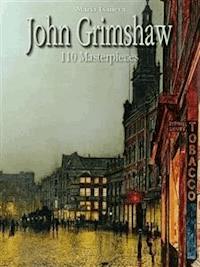
John Atkinson Grimshaw was a Victorian-era artist, a "remarkable and imaginative painter" known for his city night-scenes and landscapes. His primary influence was the Pre-Raphaelites. He painted landscapes that typified seasons or a type of weather; city and suburban street scenes and moonlit views of the docks in London, Leeds, Liverpool, and Glasgow also figured largely in his art. His careful painting and skill in lighting effects meant that he captured both the appearance and the mood of a scene in minute detail. Grimshaw painted more interior scenes, especially in the 1870s, when he worked under the influence of James Tissot and the Aesthetic Movement. His later work included imagined scenes from the Greek and Roman empires, and he painted literary subjects from Longfellow and Tennyson. Grimshaw's paintings depicted the contemporary world but eschewed the dirty and depressing aspects of industrial towns.
Das E-Book können Sie in Legimi-Apps oder einer beliebigen App lesen, die das folgende Format unterstützen:
Veröffentlichungsjahr: 2014
Ähnliche




John Grimshaw: 110Masterpieces
By Maria Tsaneva
First Edition
Copyright © 2014 by Maria Tsaneva
*****
John Grimshaw: 110 Masterpieces
*****
Foreword
John Atkinson Grimshaw (1836 –1893) was a Victorian-era artist, a "remarkable and imaginative painter" known for his city night-scenes and landscapes.Grimshaw's primary influence was the Pre-Raphaelites. True to the Pre-Raphaelite style, he created landscapes of accurate colour, lighting, vivid detail and realism. He painted landscapes that typified seasons or a type of weather; city and suburban street scenes and moonlit views of the docks in London, Leeds, Liverpool, and Glasgow also figured largely in his art. His careful painting and skill in lighting effects meant that he captured both the appearance and the mood of a scene in minute detail. Grimshaw painted more interior scenes, especially in the 1870s, when he worked under the influence of James Tissot and the Aesthetic Movement.
On Hampstead Hill is considered one of Grimshaw's finest works, exemplifying his skill with a variety of light sources, in capturing the mood of the passing of twilight into night. In his later career his urban scenes under twilight or yellow streetlighting were popular with his middle-class patrons.
His later work included imagined scenes from the Greek and Roman empires, and he painted literary subjects from Longfellow and Tennyson—pictures including Elaine and The Lady of Shalott.
In the 1880s, Grimshaw maintained a London studio in Chelsea, not far from the studio of James Abbott McNeill Whistler. After visiting Grimshaw, Whistler remarked that "I considered myself the inventor of Nocturnes until I saw Grimmy's moonlit pictures." Unlike Whistler's Impressionistic night scenes Grimshaw worked in a realistic vein: "sharply focused, almost photographic," his pictures innovated in applying the tradition of rural moonlight images to the Victorian city, recording "the rain and mist, the puddles and smoky fog of late Victorian industrial England with great poetry."
Grimshaw's paintings depicted the contemporary world but eschewed the dirty and depressing aspects of industrial towns. Shipping on the Clyde, a depiction of Glasgow's Victorian docks, is a lyrically beautiful evocation of the industrial era. Grimshaw transcribed the fog and mist so accurately as to capture the chill in the damp air, and the moisture penetrating the heavy clothes of the few figures awake in the misty early morning.
Grimshaw left behind no letters, journals, or papers; scholars and critics have little material on which to base their understanding of his life and career.
Grimshaw died on 13 October 1893 of tuberculosis and is buried in Woodhouse Cemetery, Leeds.
Paintings
A Dead Linnet, 1862
oil
Blea tarn at first light, Langdale pikes in the distance, 1865
oil
Wimbledon Park, Autumn after Glow, 1866
Oil
A Mountain Road, Flood Time, 1868
Oil
Landscape with a winding river, 1868
Oil
Autumn Glory: The Old Mill, 1869
Oil
Colwith Force, 1869
Oil




