


Erhalten Sie Zugang zu diesem und mehr als 300000 Büchern ab EUR 5,99 monatlich.
- Herausgeber: The History Press
- Kategorie: Geisteswissenschaft
- Sprache: Englisch
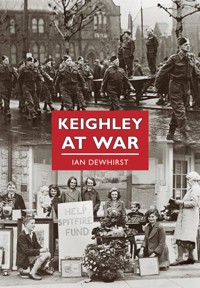
In Keighley at War, Ian Dewhirst vividly describes life in a West Riding industrial town during the Second World War. It includes subjects, such as morale-boosting and fund-raising organisations, the Home Guard and regular forces billeted in the area, wartime industries, evacuees and the minutiae of everyday living conditions. Although not bombed, Keighley had its air-raid warnings, fears of enemy infiltrators and nearby aircraft crashes. The author has used a wide range of sources, including police records, school logbooks, diaries and letters, to reveal much that was not made public during the war. He also describes the wide range of cultural events that took place throughout the war years, despite the difficult conditions. With its wealth of illustrations Keighley at War will bring back memories for some and be an eye-opener for anyone who lives near this Yorkshire town.
Sie lesen das E-Book in den Legimi-Apps auf:
Seitenzahl: 186
Veröffentlichungsjahr: 2009
Das E-Book (TTS) können Sie hören im Abo „Legimi Premium” in Legimi-Apps auf:
Ähnliche




















Keighley in the Second World War
Keighley in the Second World War
Ian Dewhirst
First published 2005
The History Press
The Mill, Brimscombe Port
Stroud, Gloucestershire, GL5 2QG
www.thehistorypress.co.uk
This ebook edition first published in 2013
All rights reserved
© Ian Dewhirst, 2005, 2013
The right of Ian Dewhirst to be identified as the Author of this work has been asserted in accordance with the Copyright, Designs and Patents Act 1988.
This ebook is copyright material and must not be copied, reproduced, transferred, distributed, leased, licensed or publicly performed or used in any way except as specifically permitted in writing by the publishers, as allowed under the terms and conditions under which it was purchased or as strictly permitted by applicable copyright law. Any unauthorised distribution or use of this text may be a direct infringement of the author’s and publisher’s rights, and those responsible may be liable in law accordingly.
EPUB ISBN 978 0 7509 5137 1
Original typesetting by The History Press
Contents
Introduction
1
‘A War to Stagger Humanity’
2
‘Civil Defence – Urgent!’
3
‘To Stick it at all Costs’
4
‘Don’t Turn away the Cameronians!’
5
A Churchill Tank Called ‘Worthy’
6
‘A Tendency to Damp one’s Ardour’
7
‘A Body of Disciplined and Interested Young Men’
8
‘More Jam, More Jam, More Jam, More Jam’
9
‘A Record the School should be Proud of’
10
‘The Victor’s Crown’
A wartime child – the author in 1943, sporting his toy National Fire Service tin hat. The belt was a relic from an uncle’s First World War service with the Royal Naval Division. (Author’s collection)
Introduction
On the eve of the Second World War Keighley was a not untypical West Riding industrial Municipal Borough, standing on the North Beck and the River Worth, adjacent to the River Aire and the Leeds and Liverpool Canal, and served by both the London, Midland and Scottish and the London and North-Eastern Railways. Developing its textiles, engineering and foundries from the Industrial Revolution onwards, by the twentieth century its manufactures included worsted, machinery and machine tools, gas and oil engines and wringing machines.
The Borough population at the 1931 Census had been 40,441, but a boundary extension in 1938, which brought in Oakworth, Haworth and Oxenhope Urban Districts, together with the East and West Morton portions of a former Keighley Rural District, boosted this to an estimated 58,000. At a stroke, too, the Borough acreage multiplied sixfold, from 3,902 to 23,611, though much of this was empty moorland sharing a westward boundary with Lancashire. There was no census in 1941, but the 56,000 ration books distributed by the Keighley Food Control Committee late in 1939 offer a clue as to the early shifting wartime population.
In so far as it was never actually bombed, Keighley itself did not have an especially dramatic or tragic war, although local aircraft crashes brought its reality much nearer than most townspeople were told at the time. Nevertheless, the town and district had to face all the changing circumstances and related problems experienced by every community at war. This book accordingly is an impression of life on the Home Front, and emphatically is not intended as a history of the Second World War itself.
Naturally the weekly Keighley News has proved invaluable. But during a period of restrictions, censorship and the need to bolster public morale, no newspaper can hope to present a full picture, so I have also used many original contemporary sources – Town Council and local societies’ minutes, school logbooks, annual reports, diaries, some of them confidential at the time – that over the last forty years or more individuals and organisations have either lent to me or added to the Local Collection at Keighley Reference Library. I have also, though to a much smaller extent, drawn on some later reminiscences.
Wartime photography poses another problem. The case of three respectable members of the Keighley and District Photographic Association, who in 1942 were brought to court and had their films confiscated for innocently taking snapshots of a Warship Week procession, highlights both the zeal of the local constabulary and the dangers of pointing a camera in an unauthorised direction. Newspapers, when they published photographs at all, tended to confine themselves largely to cheerful worthy causes and fund-raising events.
A regular contributor to the Keighley News in the inter-war years was George A. Shore, who combined photography with a carpet and linoleum warehouse in Keighley Market. A member of the British Press Photographers’ Association, he specialised in weddings and social functions. When wartime restrictions reduced his newspaper outlets, he continued to photograph groups – munitions workers, special constables, Home Guards – then sold prints to his subjects. He was obviously successful in this, as testified by the number and extent of his surviving work. The majority of the photographs in this book are probably by George A. Shore. Others are by William Speight, an engineer-turned-photographer who reached a similar arrangement with the local press and public. It has been doubly satisfying to find several illustrating social events that were originally reported without pictures.
The Keighley News must be thanked, not only for recording the local war as far as was allowed, but also for publishing for the past twelve years my weekly ‘Down Memory Lane’ feature, which has encouraged many readers to supply photographs and information. I thank editors Malcolm Hoddy of the Keighley News and Winston Halstead of the Yorkshire Ridings and Lancashire Magazine, in which some of my material first appeared; also the very many individuals who over the past four or five decades have lent or given me a variety of sources; and perhaps most of all the Keighley Reference Library archives, among which so much of my life, both at work and in retirement, has been spent.
This is the first time that a book of this nature about Keighley has been attempted, and I have been deeply conscious of ploughing a pioneer furrow, as regards both research and presentation, through a complex subject. To the best of my knowledge the facts are correct according to my sources, but any interpretations I put upon them are my own.
Ian Dewhirst
Keighley
October 2004
Chapter One
‘A War to Stagger Humanity’
Keighley shares with Barrow-in-Furness, Skipton, Bradford, Leeds, Thorne and Cromer the doubtful distinction of a premonition of the Second World War as early as 22 May 1936. That evening the German zeppelin, the Hindenburg, appeared unexpectedly over the town, having altered the course of her regular flight from the United States to Frankfurt.
At 804ft long the biggest airship ever built, the Hindenburg was seldom as low or as close as she seemed, yet Keighley eyewitnesses could clearly read her name and number, LZ-129, and distinguish her Olympic Games symbol (the 1936 Olympics were held in Berlin) and the swastikas on her tail. Those with cameras attempted snapshots, which generally fail to capture the full spectacle of the moment.
Poignantly, while over Keighley the Hindenburg dropped carnations and a crucifix to be placed on the graves, at nearby Morton Cemetery, of German prisoners of war who had died in the 1919 influenza epidemic. They fell within yards of the traditional centre of town, ‘the spot where the old Cross stood, immediately adjoining the north-east corner of the Devonshire Arms Inn’. Clearly, somebody in Germany had done some homework.
Local opinion was immediately divided – was the Hindenburg simply ‘a sort of friendly link between the two nations’, or was she taking ‘aerial pictures for use in the event of war’? She flew over again that June, as well as over the Midlands and along the south coast. She was debated in Parliament, and the question of her unofficial flights was taken up with the German government. A Yorkshire Observer defence writer thought ‘it would be stupid if on each trip they don’t have ten or a dozen of their Air Force pilots on board. It is a wonderful opportunity for German pilots to look at our country and to take note of the “landfall”.’
Suspicion was part of the atmosphere by 1936. Even the Keighley News carried such headlines as ‘The War Peril’, ‘“No” to Fascists’ and ‘The Next War: Plans for Protection in Air Raids’. That August the Keighley Corporation, in common with every other local authority in the county, received a letter from the West Riding County Council seeking to coordinate ‘precautionary measures’ and requesting information on planned decontamination centres, mobile first-aid and rescue groups, casualty clearing stations, fire brigades and ambulance services.
That same year Keighley’s Town Clerk, Medical Officer of Health, Fire Brigade Chief Officer and chairman of the Watch Committee attended a Leeds conference of local authorities on the subject of air-raid precautions, although it was to be the beginning of 1938 before the Corporation’s preliminary scheme was submitted to the County Council. Meanwhile an official was sent to a Civilian Anti-Gas School at Easingwold to qualify as an instructor and set up a training centre for Council staff and volunteers.
In 1937 the Morton Banks Sanatorium became home for Basque refugee children from the Spanish Civil War; and in 1938, when Yorkshire’s German residents held their annual memorial service at the prisoner-of-war graves in Morton Cemetery, they controversially gave the Nazi salute. They also laid a wreath on the adjoining British war memorial.
That spring Keighley’s first air-raid wardens joined special constables and regular policemen for the first time under one roof for a dinner and an address by the Chief Constable and Air Raid Precautions (ARP) Officer of the West Riding, followed by singers and a comedian. The event was deemed ‘a splendid opportunity of getting the three forces together so that they could get to know one another and talk things over’. Another thousand volunteers were called for, although a month later only seventy had come forward.
Early that August the works of paper-tube manufacturers J. Stell and Sons Ltd were assessed as to their ‘capacity for the production of armament stores’. At this stage, working double shift in the event of emergency, their weekly quota (though ‘required for record purposes only’) was to include 2,000 ‘Containers Cartridge B.L. 6˝ Gun Mark I. M.L.’ and 2,000 ‘Containers Charge Aircraft Catapult Mark I’.
Also in August an ARP Officer was appointed for the Keighley, Bingley, Shipley and Denholme Joint Area. He was Stanley Noel Jenkinson, who had previously been Northern Area ARP Organiser for Leicestershire and held a commission in the Royal Scots Territorials.
The Keighley district was deemed to require 114 ARP posts, each manned by six wardens. Despite the deteriorating European situation, only some two-thirds of the requisite 684 wardens had enrolled by late September 1938, though informal lunch-break talks in mills and workshops had speeded the flow of recruits. Fifteen men had volunteered as auxiliary firemen.
Meanwhile people sunning themselves in Devonshire Park ‘received a mild shock’ at the sight of a hundred men and women in gas masks. These were volunteers from industry and local government who had qualified as decontamination instructors, having completed courses on ‘asphyxiants or lung irritants, nasal irritants or arsenical smokes, lachrymators or tear gases, vesicants or blister gases, paralysant gases, gases liable to be encountered under war conditions and fumes which may be encountered in fire-fighting’. Thankfully, human nature soon translated such jargon into a more accessible form:
Things have come to a pretty fine pass
When we have to go round a-smelling for gas,
But if war comes, and smell we must,
All ARP Wardens will know, I trust,
That a nasty smell of musty hay
Does the presence of Phosgene gas betray,
Whilst bleaching powder’s irritant smell
Tells the presence of Chlorene gas quite well.
Towards the end of September 1938 the Czech crisis injected a dramatic sense of urgency into warlike preparations. The local view of foreign affairs is nowhere more succinctly expressed than in the handwritten records of Knowle Park Congregational Church, whose meticulous Minute Secretary headed a page ‘Of National Importance’:
The last week in September was a momentous one, as this country along with Czechoslovakia, France and Russia were on the very brink of war with Germany, whose Dictator ‘Hitler’ had threatened immediate invasion of Czechoslovakia, in the same manner as his troops invaded Austria a few weeks ago.
Some Reservists and Territorials were called up. Keighley’s 6th Battalion the Duke of Wellington’s Regiment, though not mobilised, went on alert. There were some local recruits for the new Women’s Auxiliary Territorial Service, and the total number of ARP volunteers leapt up to 827, including 646 wardens; first-aid workers rose from 12 to 50, auxiliary firemen from 15 to 38.
Air-raid trenches were dug in public parks (at Silsden they utilised an old tunnel for farming stock crossing under Bolton Road), and respirators were hastily distributed. Basement windows at Keighley Public Library were protected with sandbags. On a spiritual level, local churches held services of intercession.
‘Our Prime Minister, Mr Neville Chamberlain, had the courage and wisdom to seek a personal interview with Hitler,’ wrote the Knowle Park Minute Secretary, outlining the events leading to ‘an agreement which ended in a promise to settle the dispute by arbitration, Czechs having at the suggestion of Britain and France agreed to the terms laid down to surrender the Sudeten German territory to the Reich . . . ’.
Opinions were divided. The Keighley Communist Party met in the Town Hall Square and passed a resolution that ‘called on Labour to resist the Chamberlain Government’s betrayal of democratic Czechoslovakia by any means in its power’. A Keighley Peace Council organised a public discussion in the Britannia Hall, which attracted such a crowd that another was simultaneously held outside for the overflow. A young Denis Healey ‘doubted whether anything had been done at Berchtesgaden for Czech injustices’. Keighley Rotary Club wrote to its Prague counterpart expressing its members’ ‘profound feelings of sorrow and sympathy’ over ‘the great misfortune and national calamity which befell the Republic of Czechoslovakia by the notorious Munich Pact’.
Yet ‘day by day’ a Keighley News editorial voiced the feelings of probably the majority of ordinary folk, who ‘clung desperately to the hope that war would be staved off’, and by October 1938 felt able to offer this reassurance:
With the historic Four-Power Conference at Munich on Thursday the peace hopes of practically the whole world were realised, and with the signing of the pact early yesterday morning millions must have thanked God that a war that had threatened to stagger humanity and claim millions of lives had been averted.
The Knowle Park Minute Secretary echoed the hope ‘that the Prime Minister has saved the world from one of the worst catastrophes ever known’.
In an immediate mood of relief the Temple Street Methodists held a thanksgiving service, rendering the ‘Te Deum’ and singing ‘There’s a Light upon the Mountains’. One grateful citizen donated £1,000 as a ‘thank-offering for the blessing of peace’ to endow a bed in the Keighley and District Victoria Hospital; another, £50 towards furnishing new children’s wards. The hospital cannily published a list of further requirements, and more gifts flowed in. Thousands visited a Peace Exhibition in the Municipal Hall, and schools celebrated a Peace Week.
Notes of caution were struck, however. The trenches in the parks – which had promptly flooded during a three-day storm – were to be completed then ‘widened, lined, and roofed with concrete’ before being covered with earth and levelled, awaiting possible use. A thinly attended ARP meeting was told that although ‘the emergency appears to have passed there is to be no slackening in the efforts in Keighley’s Air Raids Committee’. A volunteer medical corps was formed. A gas-proof room was created in the basement of an empty house in the centre of town, open for public inspection and emulation. Cracks in the walls, ceiling and woodwork had been ‘stopped up by means of sodden newspaper or putty pasted over with gummed paper’; even mouse-holes were plugged. The Keighley Conservative Women’s Association heard an address on ‘The Crisis – Its Causes and Effects’. The speaker, while concluding that ‘the German people wanted war least of anyone’, warned of ‘the necessity for this country’s rearmament’. A local appeal on behalf of the Lord Mayor of London’s fund for Czechoslovakian refugees closed at £339.
If, for many, life seemed largely to resume its normal tenor, much was quietly happening. True, wardens at neighbouring Bingley enjoyed a jolly New Year dance, with the band topically playing behind a mock trench, but meanwhile the joint Keighley, Bingley, Shipley and Denholme ARP was taking delivery of 275,000 sandbags, which were stored in the erstwhile Union workhouse together with other equipment and 20,000 civilian respirators. Keighley was classed as a reception area in the event of evacuation, to which end a census of householders was compiled. The government issued a National Service Guide listing the many and varied defence organisations.
There was a county-wide testing of air-raid sirens, showing Keighley’s to be unsatisfactory, leaving a number of ‘dead spots’ unwarned. A new ‘Gent’ siren was accordingly installed over the Coney Lane electricity works and operated from the fire station. For good measure, the warning was carefully explained as ‘warbling signals, varying in pitch, and of two minutes’ duration’, and the ‘All Clear’ as ‘a continuous high-pitched signal of two minutes’.
Employees of the Keighley Corporation Waterworks Department were taught how to deal with bomb-damaged mains. The Water Engineer, J. Noel Wood, designed a galvanised iron water-supply tank for emergency use; it could be handily fitted to a waterworks lorry and held 300 gallons which could be drawn from twelve cocks.
By April 1939 an impressive ARP parade was able to muster a thousand local volunteers, comprising ‘uniformed auxiliary firemen hauling trailer pumps, first-aid parties, motor drivers, special constabulary, air-raid wardens and workers in supplementary services, together with fire engines and ambulances, several rescue squads on lorries, an emergency water carrier, and a van carrying a portable chlorination plant’.
One conflict, at least, came to a controversial close – the Spanish Civil War. That May the Revd J. Nicholson Balmer, minister at Devonshire Street Congregational Church and Chairman of a Yorkshire Joint Committee for Spanish Relief, escorted thirty-three of Keighley’s Basque refugee children back home as far as the Spanish frontier where, invited to dinner with three Fascist officers, he ‘thought his own thoughts when they toasted General Franco’. The children could sing ‘On Ilkla Moor Baht ’At’ and ‘Lambeth Walk’. Sixty-six of their compatriots remained at the Morton Banks camp because of difficulties in tracing their parents.
On 3 June the Military Training Act required males aged 20 to 21 to register for National Service, an exercise which in Keighley yielded 183 potential militiamen and 3 conscientious objectors; Haworth produced 70 militiamen, Silsden 20. The young men who registered were described as ‘of a smart type’.
By midsummer 1939 the Keighley Section of the Women’s Voluntary Services for Civil Defence had opened an office, giving advice and encouragement to those considering the many available options in ARP: evacuation, billeting, transport, hospital and food supplies, auxiliary nursing. . . . The response was ‘gratifying’. Factories were being advised to organise their own emergency cover. Boy Scouts holding pathfinder and cyclist badges were asked to join their newly formed messenger service.
Yet despite increasing numbers, some volunteers were failing to train conscientiously and ‘the view was expressed’, at an August review of the past three months’ progress, ‘that in time of international crisis enthusiasm for the work was high, but as the crisis receded interest was apt to fall away’.
Less than a fortnight later, Germany invaded Poland and, on Sunday 3 September, Britain entered the Second World War.
Changing its tune from the previous year, the Knowle Park Congregational minute-book heaved a metaphorical sigh of relief: ‘The country is solid in its determination to make an end of this state of terrorism and dictatorship, and to stand for freedom and democracy.’
Chapter Two
‘Civil Defence – Urgent!’
War at its outset was an unknown quantity. Keighley cinemas closed during the first week, and the Technical College postponed enrolment for its evening classes. The Keighley and District Victoria Hospital sent some patients home and restricted admissions. Silsden Show was cancelled. But once the Board of Education had recognised the need for cultural activities in wartime, the Workers’ Educational Association started a slightly delayed autumn session, offering solid courses on psychology, physiology and social philosophy. In a more practical vein, classes the following spring were on nutrition in wartime.
When the cinemas reopened (Keighley had six, and there were two at Haworth and one at Silsden), a slide was projected onto the screens: ‘Civil Defence – Urgent! You can help by joining the “life-givers” brigade, and registering as a member of the blood transfusion service . . . You May Save a Life. It is Harmless. Do It Now.’
Street lighting went out. Most of the factories at Silsden dispensed with a breakfast break so as to make fuller use of daylight. Street corners and causeway edges were painted white, and pedestrians wore white armbands or waist-belts in the blackout. Indeed, Keighley had already suffered its first blackout casualty on the night of Saturday 2 September, when an elderly widow was fatally injured in the dark by a slow-moving double-decker bus with regulation-dimmed lights.
Keighley Town Councillors promptly re-timetabled their committee meetings for daytime hours ‘as a temporary expedient until the volume of the ordinary work of the Council becomes more normal’. Their Museum Curator reported how he had spent £7 on measures for ‘the protection of exhibits in the event of an air-raid’, while the Chief Librarian gained approval for revising the hours of opening and closing his branch libraries and reading-room, owing to ‘present lighting restrictions’.




