


Erhalten Sie Zugang zu diesem und mehr als 300000 Büchern ab EUR 5,99 monatlich.
- Herausgeber: Mercier Press
- Kategorie: Lebensstil
- Sprache: Englisch
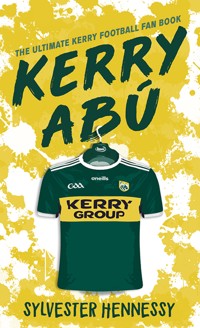
From famous teams who dominated the footballing landscape to players, past and present, who have illuminated the All-Ireland championship with moments of magic, Sylvester Hennessy has left no stone unturned in this ultimate guide to Kerry football. You'll find everything here from significant games involving Kerry, including the 'Civil War' game; comprehensive lists of teams, titles and scorers throughout the decades; full coverage of all the personal accolades won along the way, such as the All Stars; an explanation for the county's crest; and details on the county grounds.
Sie lesen das E-Book in den Legimi-Apps auf:
Seitenzahl: 182
Veröffentlichungsjahr: 2019
Das E-Book (TTS) können Sie hören im Abo „Legimi Premium” in Legimi-Apps auf:
Ähnliche



















MERCIER PRESS
3B Oak House, Bessboro Rd
Blackrock, Cork, Ireland.
www.mercierpress.ie
www.twitter.com/MercierBooks
www.facebook.com/mercier.press
© Sylvester Hennessy, 2019
Foreword © Peter Keane, 2019
Epub ISBN:978 1 78117 666 5
This eBook is copyright material and must not be copied, reproduced, transferred, distributed, leased, licensed or publicly performed or used in any way except as specifically permitted in writing by the publishers, as allowed under the terms and conditions under which it was purchased or as strictly permitted by applicable copyright law. Any unauthorised distribution or use of this text may be a direct infringement of the author’s and publisher’s rights and those responsible may be liable in law accordingly.
Inhalt
Foreword
IntroductionKerry GAA – It’s in our DNA
OVERVIEW
County Grounds
Kerry Jersey
82 All-Ireland Inter-county Titles
THE FOUNDING AND EARLY HISTORY OF KERRY GAA
Humble Beginnings: The Birth of Kerry GAA
All-Ireland Hurling Title
The Fall and Rise of Kerry GAA at the Turn of the 20th Century
A War-torn and Divided Kingdom
Healing the Wounds of the Civil War
All-IRELAND INTER-COUNTY CHAMPIONSHIP
Kerry’s All-Ireland Senior Success
80 Munster Senior Football Titles
Kerry Captains
Captains’ Connections
Top Kerry Goalscorers in Senior Championship Football
Top Senior Championship Appearances for Kerry
All-Time Top Senior Football Championship Scorers
Kerry’s Fortress: A 24-Year Unbeaten Home Run
Kingpins of Junior Inter-County Football
2018 Kerry Senior Inter-county Football Player Records
Kerry’s 37 All-Ireland Senior Football Winning Teams
THE GREATEST KERRY TEAMS
The Original of the Species: Kerry’s 4-in-a-Row Winners 1929–32
Micko’s Bachelors
Ladies’ 9-in-a-Row Side
The Golden Years 2: 2004–09
The Managers: 1975–2019
PANTHEON OF KERRY GREATS
TEAMS OF THE CENTURY/MILLENNIUM
GAA Football Team of the Century
GAA Football Team of the Millennium
Kerry Team of the 20th Century
Millennium Men
OTHER SENIOR TITLES
The National Football League: 20 Titles and Counting
The McGrath Cup
The Railway Cup
MINORS
The History Makers: Minor Football’s Golden Era
30 Steps to History
The Managers
Kerry’s 16 All-Ireland Minor Football Winning Teams
U–21s/U–20s
Kerry at U–21 Level Down Through the Years
Kerry’s 10 All-Ireland U–21 Winning Teams
CLUB & DISTRICT FOOTBALL
All-Ireland Success at Club Level
Kerry Senior County Football Championship
Kerry Intermediate Football Championship
Kerry Junior Football Championship
District Championships
COLLEGES FOOTBALL
Hogan Cup (Senior Colleges All-Ireland Football)
Corn Uí Mhuirí: 48 Senior Football Colleges titles for Kerry Colleges
INTERNATIONAL RULES
Kerry’s Participation in International Rules
ALL STARS
Kerry’s Football All Star Winners
Highest Number of All Stars Won by Kerry Players
Ladies Football All Stars
VOICES OF KERRY GAA
The Men with the Microphone
Epilogue
References
Acknowledgements
About the Author
Foreword
I’ve always felt that, first and foremost, I am a Kerry supporter.
My earliest childhood memories go right back to the great Kerry team under Mick O’Dwyer. They were a marvellous side to watch. Our trips to Dublin to support Kerry in Croke Park as young lads were special. My father and mother instilled in me and my siblings a deep love for the GAA. But I suppose I am not the first person in Kerry to say that the GAA has defined me. After all, in a county like Kerry, football is such a rich part of so many people’s lives.
Even though I was Kerry Minor manager for the past three years, I travelled to the Kerry Senior games like everyone else. Last year, I enjoyed every trip, whether it was the Clare game in Killarney, or the game down in Cork, or even up in Clones. I thought that the turnout by Kerry supporters in Clones last year was great. Equally so, there was something in excess of 20,000 people in Killarney for the Kildare game on an August weekend, despite the fact that, historically, people say this is a bad weekend for Kerry fans to attend games because of our tourist industry.
There was also huge support for every game the Kerry Minors played. Tickets were scarce for the All-Ireland Minor finals over the past three years, as Kerry were not competing in the Senior final, yet there was still massive support in Croke Park. I often wondered how those people got tickets.
I am delighted to get this opportunity to say thank you to the Kerry supporters. We have had some special days in the past, and I am hoping that there will be special days ahead.
I wish Sylvester Hennessy and Mercier Press the very best with this publication. I know Sylvester well, having worked with him for nearly a decade. He played a key role with the Kerry Minor team over the past three years. He is a man who knows his football and I can think of no better man to write a book like this.
I am sure this book will be an enjoyable read for Kerry supporters, not only here in the county, but in the four corners of Ireland and all around the world.
Peter Keane
Kerry Senior Football Manager
IntroductionKerry GAA – It’s in our DNA
What is the secret of Kerry’s football dominance over the years? No other county in Ireland can come anywhere near the footballers of the Kingdom in terms of inter-county success.
The answer is a simple one. Success breeds success, and in a land that is festooned with All-Ireland medals, Kerry footballers are expected to win All-Ireland titles. It is the natural order of things and long may this continue.
When you visit Liverpool, the city is a shrine to The Beatles and their other great passion, soccer. The same can be said of other parts of the world where a place or area is defined by sport or culture.
When you arrive in Kerry there is no mistaking the importance of Gaelic football in the county. As you approach the outskirts of the county town, Tralee, at the Clashlehane roundabout, a wonderful sculpture by Mark Rode of 4 footballers in action is your introduction to the town. Then, as you drive around the town, you come across John Joe Sheehy Road, Austin Stack Park (the headquarters of Kerry GAA), the Joe Keohane roundabout, Dan Spring Road, Bill Kinnerk Road and Bracker O’Regan Road. At one end of Bracker O’Regan Road, the Mounthawk roundabout is dedicated to Joe Barrett, while at the other the Monavalley roundabout is dedicated to John Joe ‘Purty’ Landers. Needless to say, all of these are named after Kerry footballing greats.
A trip around the county offers more examples of the connection between football and Kerry people, with statues of Mick O’Dwyer in Waterville, John Egan in Sneem and Páidí Ó Sé in Ventry just further illustrations of Kerry’s obsession with the game.
As the Romans and the Greeks had their gods, we in the Kingdom of Kerry have our own pantheon of greats. In the Kingdom we worship our former football heroes. Football is our religion. What’s more, to most Kerry people at this point, it feels like Gaelic football is part of our very DNA.
County Grounds
Fitzgerald Stadium
Fitzgerald Stadium is the main county ground in Kerry. The stadium is renowned for its stunning natural vistas of Killarney’s mountains and is the home championship venue for the Kerry Senior football team.
The Killarney venue was named in honour of former Kerry and Dr Crokes great, Dick Fitzgerald. Fitzgerald Stadium was officially opened on 31 May 1936 by Dr Michael O’Brien, the then Bishop of Kerry, and J. M. Harty, Archbishop of Cashel.
In 1937 the new Killarney stadium played host to the All-Ireland hurling final between Tipperary and Kilkenny, due to the unavailability of Croke Park. This was at the time of the construction of the first Cusack Stand in the Dublin ground and Fitzgerald Stadium was seen as the most suitable replacement.
Further developments took place at Fitzgerald Stadium in the 1970s, with the erection of the Dr O’Sullivan Stand and a pavilion. All of this raised the capacity to 39,120.
Renovations have been ongoing ever since and the ground has had many facelifts. The laying of the current ‘Prunty pitch’ proved to be hugely popular and Fitzgerald Stadium now boasts one of the best playing surfaces in the GAA.
In the winter of 2008–09, the first phase in the planned redevelopment of the terraces at both ends of the pitch was finished. Among the changes was an extension of terracing at the Lewis Road end as far as the stand. The terracing is designed in such a way as to allow its continuation along the stand side if and when the stand is upgraded. The new terracing has added an additional 4,000 capacity, bringing the overall stadium capacity to 43,000. Further development is planned, which will raise this to 50,000 in the future.
There are 4 large dressing rooms underneath the new terrace with individual showering and toilet facilities. The dressing rooms are state-of-the-art and on a par with Croke Park.
There is also an area for medical and physio staff, as well as a separate area for mentors. Players exit the dressing rooms via a tunnel on the Lewis Road end of the pitch.
There are 3 levels in all underneath the new terrace. Level 1 has the dressing rooms and shops at the rear of the terrace. Level 2 has very spacious meeting rooms for stewards, gardaí, drug testing and a press room for post-match interviews, with a stairway direct to the dressing-room area. The top level, accessed by lift or stairs, is made up of a control tower for crowd control and monitoring, and there is also a spacious room overlooking the pitch for TV match analysis.
The main entrance area from Lewis Road has been extended with facilities for selling tickets on match day. On the stand side, there are new entrance/exit stairs at the scoreboard end of the stand. New wheelchair facilities are located in the stand, with lift access. There is a new seating area for substitutes/mentors in the stand adjacent to the VIP area in the middle.
On 15 November 2016, Fitzgerald Stadium was announced as one of 12 possible venues in Ireland’s bid to host the 2023 Rugby World Cup – a bid which unfortunately failed.
Fitzgerald Stadium has also been nicknamed ‘Fortress Killarney’, as Kerry’s last loss in a Senior inter-county championship game in the stadium came back in 1995.
Austin Stack Park
Austin Stack Park is Kerry’s second county ground and is in Tralee. The ground was named after Austin Stack, an Irish revolutionary and captain of the All-Ireland-winning Kerry Gaelic football team of 1904. It is situated on John Joe Sheehy Road, named after another former Kerry great.
The venue has played host to many Kerry inter-county home games at all levels, while the county championship football and hurling finals are also normally held here.
The presence of floodlights at the ground means that the venue is widely used for National League games that are played during winter and spring months, as well as for other important matches outside of the summer season.
The headquarters of Kerry GAA, the Kerry County Board has also been based in the ground since 1985. Their office is in the premises known as the ‘Pavilion’, which first opened back in 1967.
Both ends of the pitch have their own commonly used names. The end at the west side of the pitch used to be known as ‘the Mitchels end’, as it backed onto the former site of the John Mitchels GAA club. It is now often referred to as the ‘Aldi end’ of the field, given that an Aldi store is now situated where the Mitchels pitch used to be. It is also sometimes referred to as the ‘town end’. The east side of the field is called either the ‘Killarney end’ or the ‘Horan’s end’, referring to the shopping centre situated behind it.
Austin Stack Park has been used as a venue for games since the 19th century. Back then it was generally known as ‘The Sportsfield’ and was owned by the County Kerry Athletic and Cricket Club. At that time the pitch was oval shaped.
In 1903 the trustees of the stadium rented the ground to a committee consisting of all GAA members. The Kerry County Board then purchased the ground in 1929. In 1934 ‘The Sportsfield’ was converted into a rectangular pitch to host the 1934 All-Ireland semi-final. It was in 1944 that the county board renamed the ground in honour of Austin Stack.
In 1994 a new development was completed, including a new stand, terracing and the redeveloped county board offices. The first Kerry GAA game played under floodlights took place there in November 2001.
In 2007 plans were approved for a replacement stadium on a site outside the town that is currently occupied by Ballybeggan Racecourse. In December 2009, however, due to the downturn in the economy, it was announced that plans for the new stadium and development had been put on hold indefinitely.
Instead, in 2014, a committee was put in place by the county board to look into the gradual refurbishment of the existing ground. The playing surface was upgraded, a new electronic scoreboard was erected and the floodlighting system was upgraded. The terracing at the old ‘Mitchels end’ of the ground was also upgraded. There are plans to upgrade the press facilities and other areas of the ground in the immediate future.
Austin Stack Park remains a very popular venue with Kerry football supporters and is renowned for its match-day atmosphere, which is evident especially on county hurling final day. When Dublin visited Tralee recently for an Allianz League game, 12,000 patrons filled the stadium to capacity, its cauldron-like atmosphere very much in effect that night.
Kerry Jersey
The Green and Gold
Kerry’s traditional colours are green and gold, and the county team kits are composed of a green shirt with a single golden hoop, white shorts and green and gold socks. This hasn’t always been the case, however.
In the early days of the inter-county All-Ireland Senior Football Championship, counties were represented by the club county champions. Kerry’s first representatives were Laune Rangers, and so the blue of Laune Rangers was worn in Kerry’s first championship outing in 1889. In fact, blue was the only colour in use between 1889 and 1895 inclusive, as the teams that went forward to represent Kerry were Laune Rangers and Ballymacelligott, who both wore the colour.
In the early 20th century, selection committees were put in place by the Kerry County Board. Tralee Mitchels were the dominant force in the county championship at the time; accordingly, they had an influential voice in the selection of the team. Given the Mitchels’ success and influence, the county footballers ended up wearing the Mitchels’ colours of green and gold.
Things did not always go to plan, however. There are conflicting accounts of the jersey that Kerry wore in the first of the three games of the infamous 1903 All-Ireland Senior Football Championship Final series with Kildare, but the predominant colour of the jersey was undoubtedly red according to most accounts that exist of the game. One source says that it was a red jersey with green neck and cuffs, which were the colours of the Tralee Mitchels junior football team. Another says that it was an entirely red jersey with no green in it. The reason that Kerry wore this red or mainly red jersey was that a new set of green and gold jerseys that they had ordered was not delivered in time for the game.
For the later games in the 1903 series of finals, however, Kerry wore green jerseys with gold on the cuffs and over the shoulders. And green and gold have been Kerry’s traditional colours from this 1903 triumph onward.
The ‘classic’ style is green with a gold hoop. The colours have rarely changed. In the 1939 All-Ireland Senior Football Championship Final, however, Kerry played Meath, who also wear green and gold. To avoid a colour clash, Kerry wore the red and white of Dingle, the county champions at the time. This was also done in the 1980s finals against Offaly to avoid colour clashes.
Nowadays, the Kerry Seniors change kit is usually blue, reflecting the Munster GAA colours. However, we have seen other changed strips throughout the years. Former Kerry player and fashion designer Paul Galvin, for example, designed a new ‘back to gold’ away strip in 2018.
Kerry’s inter-county teams are sponsored by the Kerry Group, and this is one of the longest-standing sponsorship arrangements in the GAA, the teams having been connected with Kerry Group since sponsorship became more open in the GAA in the early 1990s.
Kerry GAA Crest
Kerry inter-county teams first wore a crest on their jerseys in the Centenary All-Ireland final win over Dublin back in 1984.
The crest was originally shaped like a shield with a green background and gold trimming. Ciarraí was positioned on top of the crest and then the main body had 3 designs: crossed hurleys and 2 sliotars to represent hurling; a football illustrated in dot style to represent football, and a hand and ball to represent handball. This was used until 1988 when a new Kerry crest was designed.
The new crest was used from 1988 to 2011 and was based more on Irish and Celtic symbolism, featuring a round tower, an Irish wolfhound and a harp, with the sea, mountains and a map of Kerry in the background.
The current Kerry crest came into use in 2012. Initially there was a mixed reaction to it, but as time has gone by the new-look crest has proven to be very popular. It features design elements that represent Kerry’s people, landscape, flora, fauna and artistry. These include:
– A bold Celtic-style Ciarraí brand, featuring a crowned C, which pays homage to the county’s moniker: ‘The Kingdom’.
– The naomhóg (a craft associated with the coastal communities around Kerry), propelled by a sail featuring a Celtic cross, which is the symbol of the GAA. This image also calls to mind one of Kerry’s most famous sons, St Brendan, and his epic voyage.
– A red deer (Fia Rua). This is Ireland’s largest wild animal, whose only remaining native herd is found on the slopes of Torc and Mangerton in Killarney National Park. These animals are believed to have had a continuous presence in Ireland since the end of the last Ice Age (c. 10,000 bc) and are steeped in folklore. It is said that ‘Tuan’, the King of the Deer, was given rights of free passage by Fionn MacCumhail to the mountains of Kerry and that his bloodline lives on in the present herd.
– Skellig Michael’s iconic silhouette rising out of the Atlantic Ocean. This is a designated UNESCO World Heritage site and is famous around the globe.
– A Killarney woodland fern, which thrives in wild places. It is an evocation of the county’s majestic mountains, valleys and hills.
– A storm petrel (An Guairdeall). Kerry plays host to the largest numbers of this species anywhere in the world.
– A background pattern of concentric circles, inspired by the gilding on the Ballinclemisig ‘gold box’ (part of the ‘Kerry gold hoard’ in the National Museum) and by the Bronze Age stone carvings found all over Kerry.
The new Kerry crest now takes pride of place on all Kerry GAA merchandise. And while the round tower and wolfhound motif found in the previous crest were hugely popular, the new design has become part and parcel of Kerry GAA life and is universally accepted.
82 All-Ireland Inter-county Titles
Before delving into the history of the Kerry GAA, let’s look at the hard facts behind the Kingdom’s footballing success. If we look at the 4 grades in inter-county football – Senior, Junior, U–21/U–20, and Minor, Kerry have won a phenomenal 82 All-Ireland football titles. That’s 37 Senior, 19 Junior, 10 U–21 and 16 Minor.
That is 32 football titles more than Dublin, who play second fiddle to Kerry in the overall table. Dublin have won 28 Senior, 6 Junior, 5 U–21 and 11 Minor, which totals 50 All-Ireland football titles.
Cork are third in the overall table with 7 Senior, 17 Junior, 11 U–21 and 10 Minor, which totals 45 All-Ireland football titles.
Facts are facts. Kerry are the most successful county in the history of Gaelic football. Footballers from the ‘Kingdom’ top nearly all the all-time-winners lists across the various age groups and grades.
Specifically in the All-Ireland Senior Football Championship, Kerry’s record of 37 titles puts them 9 ahead of Dublin, who have won 28. So it’s clear that, despite Dublin’s recent success, they are still some distance behind Kerry’s record at Senior level.
Kerry have also contested 59 All-Ireland Senior Football Championship finals, with Dublin once again being the next highest participator with 41 appearances.
Kerry are also top of the Junior and Minor all-time winners list. It is only at U–21/U–20 level that Kerry lie one behind another county, with Cork on 11 titles to the Kingdom’s 10.
In Ladies football, Kerry also hold the all-time All-Ireland Senior winners record, with 11 titles alongside neighbours Cork.
It is clear that, across all codes, Kerry football is undoubtedly to the fore in terms of success and pedigree. It is surprising, therefore, to learn that Kerry’s proud Gaelic football tradition actually grew out of quite humble beginnings.
Humble Beginnings:The Birth of Kerry GAA
Most people will be aware that the GAA was formed in 1884. Research suggests that the GAA was introduced to Kerry in 1885. The first big event was the Tralee GAA sports meeting on 17 June 1885, organised by Michael Cusack. A major success, this helped establish the GAA’s control over athletics across Ireland.




