


3,49 €
Mehr erfahren.
- Herausgeber: Georgia Bolton
- Kategorie: Ratgeber
- Sprache: Englisch
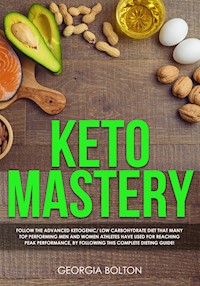
Do you want to learn the best diet strategy for losing weight and for healing your body? If so then keep reading…
Do you have problems getting started with keto? Having issues making keto work for your daily life? Reaching ketosis whilst being vegan? Or exercising whilst following the ketogenic diet? If you do, within this book many of the top leaders in the field have shared their knowledge on hot overcome these problems and more, most of which have 10+ years' worth of experience.
In Keto Mastery, you will discover:
- A simple trick you can do for getting started with the ketogenic diet!
- The best strategies for reaching optimal ketosis!
- The one method you should follow for making keto work for your day to day life!
- Why following a keto lifestyle can be beneficial for preventing dangerous diseases!
- Understanding why some people will fail to stick to the ketogenic diet!
- And much, much more.
The proven methods and pieces of knowledge are so easy to follow. Even if you’ve never heard of the ketogenic diet before, you will still be able to get to lose weight in 30 days or less.
So, if you don’t just want to transform your body but instead revolutionize your health and life, then start reading NOW!
Das E-Book können Sie in Legimi-Apps oder einer beliebigen App lesen, die das folgende Format unterstützen:
Veröffentlichungsjahr: 2020
Ähnliche


















Georgia Bolton
Keto Mastery
Table of contents
Introduction
Chapter 1: The Problems with the Modern Diet
Chapter 2: The Good Parts of Keto
Chapter 3: The Bad Parts of Keto
Chapter 4: Getting Started with Ketosis
Chapter 5: Ketosis and How to Reach It
Chapter 6: Making Keto Work for Everybody
Chapter 7: Is Keto a Good Fit for You?
Chapter 8: Exercise and Keto
Chapter 9: Keto While Vegan
Chapter 10: Keto Myths
Chapter 11: Good Foods
Conclusion
Introduction
The public consciousness is bubbling with all manner of diets and weight loss strategies - from intermittent fasting to the Atkins diet to the Paleo diet.The one that seems to be continuously mysterious to a lot of people is the ketogenic diet, or keto, for short. Is it a high protein, high fat diet? Low carb diet? Neither of these - the keto diet is based on the principle of changing the body from a carbohydrate-powered metabolic engineto a fat-powered one. The name “ketogenic” comes from the compounds that are the end result of the breakdown of fatty acids in the liver when there is not enough sugar in the bloodstream, called ketones. When blood glucose is low, either via fasting or by a particular diet, the body breaks down stored fat into ketones as fuel.
Now how does all this apply to the diet? Essentially, the ketogenic diet is one that revolves around the high-fat intake, moderate protein intake, and very low-carbohydrate intake to keep your body in a state of “ketosis” - burning ketones for fuel instead of sugar.
Interestingly, the genesis of the ketogenic diet lies in the treatment of epilepsy. Treatises from ancient Greece going back as far as 400 BCE prescribe the use of fasting to treat seizures. Obviously, they didn’t know it, but fasting bodies created ketones to fuel themselves.In the early 20th century, Rollin Turner Woodyatt used it to treat epileptic patients with some success. In the 1990s, it received national attention again as a treatment for epilepsy, and from there, the diet gained momentum and other similar diets emerged such as the Atkins diet and Paleo diet.
How do the keto, Atkins, and the paleo diet differ from each other, you may ask? If you look into a nutrition magazine, you’ll be up to your eyeballs with those three and a thousand more strategies.
To keep it concise, keto and Atkins are fairly similar. The primary difference is that the goal of Keto is to put you in ketosis, a metabolic state of burning ketones for fuel, while Atkins is centered around strictly weight loss. Atkins also is more structured in its approach, classically containing four different “stages” and which are based around time and amount of weight lost. Finally, and most notably, the Atkins diet is more generous in its carbohydrate consumption.
The paleo diet revolves around trying to recreate a hypothetical “caveman” diet of unprocessed foods, composed primarily of organic protein and vegetables. What’s more important to the paleo diet is the particular food choices, not necessarily a delicate balance of fat, protein, and carbohydrates. The paleo diet has a lot in common with other diets, in that it emphasizes whole food choices over processed ones, and usually ethically-sourced ones at that, but does not really concern itself with macronutrient balance and ketosis.
Ketosis is a big subject, with many facets to consider, from how it fixes the modern diet to what to eat. If you’re interested in changing your energy systems, read on. The knowledge in this book should put you on the path to a more informed and healthier version of yourself.
Chapter 1: The Problems with the Modern Diet
As many people are probably already aware, we are in the midst of something that can be described aptly as a global metabolic crisis. Obesity, heart disease, and type-2 diabetes rates are higher than ever before and still climbing, not only in the developed world but even in burgeoning countries. The reason for this is simply too massive a topic to be covered in this book, but what it comes down is nutritional havoc perpetrated by excessive simple carbohydrate consumption. When you eat simple carbs, they are easily broken down by body into their component sugars, which causes the pancreas to release insulin, which stores some of those component sugars as glycogen in the muscle and liver, to be used as immediate, quick-to-access energy, and the rest to be deposited in our fat cells, making us to balloon up. In addition, they amongst the easiest to acquire and rewarding foods known to man, being cheap, widely available, and versatile. Simple carbohydrates cover a range from the more commonly known choices like candy and doughnuts, typically what someone thinks of when they hear “simple” or “bad” carbs, to daily staples like bread, rice, and pasta.
Theoretically, if one entered a prolonged state of carb withdrawal, a fast or diet composed primarily of fat and protein, your body does what it naturally does - consumes the stored carbohydrates in your body, the glycogen in your muscles and liver, for energy and then starts tapping into the fat cells for sustenance - ketosis. The problem is, our modern world, we never get to this point. Our world is one where food is widely available, and the quickest, cheapest, easiest, and most rewarding things to eat are carbohydrates, forestalling your ketogenic state forever unless one makes the conscious and informed choice to enter it.
One of the problems is in the United States especially, for most of the 20th century, there was a strong backlash against dietary fat based on faulty science that started long, destructive love affair with carbohydrates that we’re still collectively getting over. The term “fat” to refer to lipids was probably one of the worst things PR wise that could have happened to them, as the association was obvious - fat makes you fat. That’s the most natural conclusion in the world to make, right? Well, human metabolism is never that simple, and the maxim of “fat is the enemy” has been simply destructive on our collective health. Carbohydrates are also inherently less filling than fats, meaning one has to consume more of them to attain the same satiety that fat does. It’s true that fat has a higher calorie per gram count, nine per gram, about double carbohydrate’s four per gram, so satiety one feels is much greater, usually leading one to consume fewer calories at the end of the day. That’s another advantage of the keto diet; you’ll be feeling so satisfied from your diet that there’s no longer a need to accidentally consume 400 calories in chips or other snacks.
With that in mind, ever looked at the calorie count on a can of soda or a glass of fruit juice? They’re almost always in excess of 100, all packed it into a neat little can or bottle and does nothing for actual feelings of hunger, and these products are EVERYWHERE.In the case of fruit juice, it’s being marketed as healthy even though almost all the things that keep fruit from being a metabolic insulin bomb have been stripped away.
Despite the huge prevalence of these sorts of foods everywhere, the idea of “fat is the enemy” still has a decent amount of weight behind it (no pun intended); think about how many products you see marketing themselves as healthier and better for you for being low in fat - in reality, if you want to send your body’s fat-burning systems into overdrive, consuming fat and avoiding carbs is the headspace you want to be in.
Unfortunately, today we live in a fast-paced world where convenience is king and the quicker something can be done, the better. This has led to an increase in processed foods, foods artificially preserved with harmful chemicals and stripped of all base nutritional content in the process. In fact, with a lot of foods, including white flour, white rice, and pasta, nutrients have to be added back in to make sure that people don’t suffer from certain deficiencies that would be easy to avoid in a world of whole foods. The other unfortunate reality is that almost every single processed food is packed to the brim with sugar, and in the case of things like pastries, are also made of insulin spiking white flour.
Processed foods high in oil always take the cheapest possible way out, with oil that’s cheap to produce and heavily processed in of itself, usually a saturated fat or, even worse, trans fats. Trans fats are hydrogenated vegetable fats and are easy to store for a long time and melt at temperatures considered desirable, and are commonly used in things like mass-produced pastries and fast food.
What does hydrogenated mean? To properly get ahold of this, one needs to understand the chemical structure of fats. Fats have long chains of bonded hydrogen and carbon when bonded together once, they’re called saturated, and twice, they’re called unsaturated. Hydrogenation is simply the process of changing an unsaturated (liquid at room temperature, canola, peanut, or corn oil) fat to a saturated (Solid at room temperature, think butter, lard, or coconut oil) one by changing the chemical bonds of carbon from double to single. What are the ramifications of all these chemical shenanigans for your body? They end up increasing the amount of “bad” cholesterol, LDLs and drop the amount of “good” cholesterol, HDLs, increase triglycerides in blood, and increase inflammation all around the body. These sorts of oils are found nearly everywhere, in almost every processed and fast food, and, as mentioned before, convenience is king. People are on the run, people are busy, and are more interested in temporarily squashing hunger pangs than the long-term implications of their diet and food choices. Instead of fixing a simple and filling meal at home that is high in protein and healthy fats, people are opting for the simpler choice.
How to Fix It
What can be done to remedy the modern diet? The good thing about today’s world is that healthy food is cheaper than ever, and the internet acts as a veritable infinite library of information for every food under the sun, and the ones still buried. It just takes a trained eye and a mind well trained in proper decisions about “whole” foods.For the sake of this book, take whole foods to mean unprocessed meats, wild seafood, raw dairy, fresh fruit and vegetables, dried beans, and minimally processed, whole grains.
Following the keto diet isn’t a prerequisite for health, but mindfulness about your food choices is, and that’s where everyone should start. To start assessing how badly the modern diet has blown out your body, a mental note should be made of what you eat and be diligent to change what needs to be changed. It’s not a simple process - renovating any part of your life is never easy - but the simplest place to start is possibly in identifying any food choices that stick out to you as bad. We all know the ones that claw at the back of our minds – the guilty pleasures, the “convenience” foods, the elaborate coffees that are basically desserts that we’re all so fond of, things you know it would be best for you to cut out. That’s where this book starts, just trying to get you to be more cognizant of what you eat, to take the first step and eliminate some of the choices that you know are bad for you, the foods that are helping you to pack on an extra layer of fluff for winter, despite the fact that there’s a good chance you won’t be spending it in a cave. Once that first step is taken, the rest can follow suit so much easier.
Setting goals is always a good idea, be it financially, professionally, personally, or fitness wise. Goals give you a sense of illuminating purpose, and, in a way, light a path for you to follow along to your destination. Start small and get bigger – is your goal to eat more fiber, protein, to put on healthy weight, or to lose bad weight? Once you have a goal in mind, more serious planning can occur. You base your food choices around what you want to mold your body into.
Getting Informed
To properly fix the train wreck that is the modern diet, one needs to know how exactly to implement healthier choices. This is a neglected aspect of modern education for many people, despite how absolutely essential to health and happiness it is. We live in an age where there is more information freely circulating about any topic you can imagine, yet for some reason, this information has failed to properly diffuse across the modern consciousness. It’s no wonder that in an age where processed, artificially crafted foods are so common and cheap, people, in their woeful ignorance, are forsaking actual healthy choices, which is causing diabetes, obesity and heart disease to run rampant.
To get a basic gestalt of the different nutrients, a short guide will be provided here:
Carbohydrates: Energy, the most bioavailable fuel source. Made up of sugars; bread, pasta, rice, beans, starchy vegetables, and other grains
Fat/Lipids: Stored energy of plants and animals, made of a glycerin molecule with fatty acids attached. High satiety. Vegetable oils, butter, lard.
Proteins: Structural component of living tissue, helps maintain and build tissues. Composed of amino acids. Meat, fish, eggs, dairy products, and tofu.
Fiber: Indigestible carbohydrate necessary for gut health, keeps hunger and blood sugar in check. Found in unprocessed whole grains (Whole wheat pasta, bread, brown rice) beans, fruits, and vegetables
Vitamins and Minerals: Two distinct micronutrients, meaning they’re needed in small amounts, for various body functions such as muscle action, digestion, eye health, and dozens of other roles.




