


4,99 €
Mehr erfahren.
- Herausgeber: A.J.Kingston
- Kategorie: Geisteswissenschaft
- Sprache: Englisch
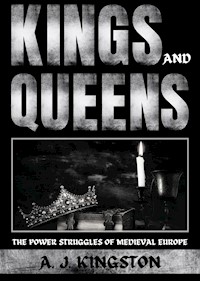
Kings and Queens: The Power Struggles of Medieval Europe is a comprehensive and engaging exploration of the power struggles of medieval Europe. The book provides an in-depth look at the lives and legacies of the kings and queens who ruled during this time, and it examines the ways in which their actions and ambitions helped to shape the course of European history.
With a focus on major events and developments of the medieval period, including the Crusades, the Black Death, and the Reformation, this book provides a unique and fascinating look at the power struggles of the time. It explores the complex web of political, religious, and military factors that shaped the medieval period, and it provides a comprehensive and engaging exploration of the actions and ambitions of the kings and queens who ruled during this time.
Kings and Queens: The Power Struggles of Medieval Europe is written in an accessible and engaging style, making it suitable for students of history, lovers of medieval literature, or anyone who is interested in the power struggles of the past. With its rich and detailed exploration of the medieval period, this book provides a comprehensive and engaging look at one of the most fascinating and important periods in European history.
Whether you are a student of history, a lover of medieval literature, or simply someone who is interested in the power struggles of the past, Kings and Queens: The Power Struggles of Medieval Europe is a must-read book that provides a rich and engaging look at the lives and legacies of the kings and queens who ruled during this time.
Das E-Book können Sie in Legimi-Apps oder einer beliebigen App lesen, die das folgende Format unterstützen:
Veröffentlichungsjahr: 2023
Ähnliche












Kings and Queens
The Power Struggles of
Medieval Europe
By A.J. Kingston
Copyright © 2023 by A. J. Kingston
All rights reserved. No part of this book may be reproduced or transmitted in any form or by any means, electronic or mechanical, including photocopying, recording, or by any information storage and retrieval system, without permission in writing from the publisher.
Published by A. J. Kingston
Library of Congress Cataloging-in-Publication Data
ISBN 978-1-83938-238-3
Cover design by Rizzo
Disclaimer
The contents of this book are based on extensive research and the best available historical sources. However, the author and publisher make no claims, promises, or guarantees about the accuracy, completeness, or adequacy of the information contained herein. The information in this book is provided on an "as is" basis, and the author and publisher disclaim any and all liability for any errors, omissions, or inaccuracies in the information or for any actions taken in reliance on such information.
The opinions and views expressed in this book are those of the author and do not necessarily reflect the official policy or position of any organization or individual mentioned in this book. Any reference to specific people, places, or events is intended only to provide historical context and is not intended to defame or malign any group, individual, or entity.
The information in this book is intended for educational and entertainment purposes only. It is not intended to be a substitute for professional advice or judgment. Readers are encouraged to conduct their own research and to seek professional advice where appropriate.
Every effort has been made to obtain necessary permissions and acknowledgments for all images and other copyrighted material used in this book. Any errors or omissions in this regard are unintentional, and the author and publisher will correct them in future editions.
Table of Contents
Introduction
Chapter 1 From Rome to the Barbarian Kingdoms: The Story of the Fall of the Roman Empire
Chapter 2 The Carolingian Empire: Charlemagne and His Successors
Chapter 3 The Viking Age: Raiders, Traders, and Conquerors
Chapter 4 The Norman Conquest of England
Chapter 5 The Crusades and the Holy Roman Empire
Chapter 6 The Hundred Years' War: England and France
Chapter 7 The Renaissance: Art, Culture, and Politics in Italy
Chapter 8 The Wars of the Roses: The Struggle for the English Throne
Chapter 9 The Habsburg Empire: From the Holy Roman Empire to Austria-Hungary
Chapter 10 The Age of Exploration: Discoveries and Conquests
Chapter 11 The French Revolution and the Napoleonic Wars
Chapter 12 The Victorian Age: Monarchy, Empire, and Industrialization
Conclusion
About A. J. Kingston
Introduction
The medieval period was a time of great change and transformation in Europe, marked by the rise and fall of powerful kingdoms and the struggles of kings and queens to secure their positions of power. The power struggles of medieval Europe were shaped by a complex web of political, religious, and military factors, and they helped to define the cultural, political, and social landscape of the time.
Kings and queens played a central role in the power struggles of medieval Europe, as they wielded great influence and power over their kingdoms and subjects. Through their military conquests, political alliances, and religious policies, they shaped the course of European history and helped to define the cultural, political, and social landscape of the time.
This book explores the power struggles of medieval Europe, and it examines the actions and ambitions of the kings and queens who ruled during this time. It looks at the major events and developments of the medieval period, including the Crusades, the Black Death, and the Reformation, and it explores the ways in which these events shaped the power struggles of the time.
The book also examines the lives and legacies of some of the most influential kings and queens of medieval Europe, including Richard the Lionheart, Eleanor of Aquitaine, and Henry VIII, and it explores the ways in which their actions and ambitions helped to shape the course of European history.
In conclusion, this book provides a comprehensive and engaging exploration of the power struggles of medieval Europe, and it offers a unique and fascinating look at the lives and legacies of the kings and queens who ruled during this time. Whether you are a student of history, a lover of medieval literature, or simply someone who is interested in the power struggles of the past, this book provides a rich and engaging look at one of the most fascinating and important periods in European history.
Chapter 1 From Rome to the Barbarian Kingdoms: The Story of the Fall of the Roman Empire
The Roman Empire, once a mighty and powerful force, began its decline in the 3rd century AD. The reasons for this decline were many, including economic instability, political turmoil, and military challenges from barbarian tribes. By the 5th century AD, the empire was on the brink of collapse, and a series of barbarian invasions sealed its fate.
The barbarians, who were considered uncivilized by the Romans, were actually a diverse group of tribes with their own languages, cultures, and traditions. Some of the most well-known barbarian tribes include the Visigoths, the Ostrogoths, the Franks, and the Vandals.
The fall of the Roman Empire was a complex process that took place over several centuries. In the 4th century AD, the empire began to split into two halves, with the Western Roman Empire centered in Rome and the Eastern Roman Empire centered in Constantinople. The Western Empire, which was weaker and more vulnerable, was the first to fall.
In 410 AD, the Visigoths, led by their king Alaric, sacked the city of Rome, marking the first time in over 800 years that the city had been captured by an enemy. The fall of Rome was a major turning point in the history of the Western Roman Empire, and many historians consider it to be the beginning of the end.
Over the next few decades, the Western Roman Empire continued to decline, and a series of barbarian tribes carved out their own kingdoms in its former territories. The Visigoths established a kingdom in Spain, the Franks established a kingdom in France, and the Vandals established a kingdom in North Africa.
The Eastern Roman Empire, which became known as the Byzantine Empire, survived for another thousand years, but the fall of the Western Roman Empire marked the end of the Roman Empire as a unified entity.
The rise of the barbarian kingdoms had a profound impact on the history of Europe. The barbarian tribes brought with them new languages, cultures, and traditions, and the kingdoms they established would eventually become the modern nations of Europe.
Overall, the fall of the Roman Empire and the rise of the barbarian kingdoms was a complex and transformative process that changed the course of European history. It marked the end of an era of Roman dominance and the beginning of a new era of cultural and political diversity. Today, we continue to study and learn from this pivotal moment in history, and its impact can still be felt in the modern world.
The Roman Empire: From Humble Beginnings to World Power
The Roman Empire is one of the most significant and influential civilizations in history, and its legacy can still be felt in modern times. The origins of the Roman Empire can be traced back to the 8th century BC, when a small settlement on the Tiber River in central Italy began to grow and expand.
The early Roman Republic was a relatively small and insignificant city-state, but it gradually began to expand its territory and influence. The Roman conquest of Italy was a long and bloody process, but by the 3rd century BC, Rome had become the dominant power on the Italian peninsula.
With the conquest of Italy complete, Rome turned its attention to the Mediterranean world. The Punic Wars against Carthage were a major turning point in the history of Rome, and marked the beginning of its expansion into a world power.
By the 1st century BC, the Roman Empire controlled most of the Mediterranean world, and its influence extended as far north as Britain and as far east as the Euphrates River. The Roman Empire was known for its engineering prowess, its system of law, and its military might, which allowed it to maintain control over such a vast territory.
However, despite its many achievements, the Roman Empire was not immune to decline. Economic instability, political corruption, and military challenges from barbarian tribes all contributed to its eventual collapse.
The decline of the Roman Empire was a long and complex process that took place over several centuries. The Western Roman Empire, which was weaker and more vulnerable, was the first to fall. The fall of Rome in 410 AD marked the beginning of the end for the Western Roman Empire, and a series of barbarian invasions eventually sealed its fate.
The Eastern Roman Empire, which became known as the Byzantine Empire, survived for another thousand years, but the fall of the Western Roman Empire marked the end of the Roman Empire as a unified entity.
Despite its eventual decline, the Roman Empire had a profound impact on the world. Its legacy can still be seen in modern law, language, architecture, and culture, and its influence can be felt in the political and social structures of many modern nations.
Overall, the Roman Empire was a remarkable civilization that achieved great heights of power and influence, and left an enduring legacy that has shaped the course of history. Today, we continue to study and learn from the achievements and challenges of this remarkable empire, and its story remains an important part of our collective human history.
The Crisis of the Third Century: How the Roman Empire Weathered the Storm
The period of the Crisis of the Third Century is one of the most tumultuous periods in the history of the Roman Empire. It was a time of great upheaval, marked by invasions, plagues, and economic turmoil.
The crisis began in the mid-3rd century AD, when the Roman Empire was facing a series of military and economic challenges. The Roman Empire was facing invasion from the Goths, the Franks, and the Persians, while at the same time suffering from a series of devastating plagues and economic downturns.
The period of the Crisis of the Third Century was characterized by weak and unstable leadership, with a series of short-lived and often ineffective emperors. The empire was beset by power struggles, rebellions, and civil wars, as different factions vied for control.
Despite the many challenges it faced, the Roman Empire managed to survive the Crisis of the Third Century. One of the key factors that contributed to its survival was the resilience of its people. The people of the Roman Empire were able to adapt to the changing circumstances, and in many cases, they were able to find ways to thrive in the midst of the crisis.
Another key factor that contributed to the survival of the Roman Empire was the strength of its military. The Roman army, while facing many challenges, was still a formidable force, and it was able to repel many of the invasions that threatened the empire.
Ultimately, the Crisis of the Third Century came to an end in the late 3rd century AD, when the emperor Diocletian took power. Diocletian instituted a series of reforms that helped to stabilize the empire and set it on a path to recovery.
The Crisis of the Third Century was a difficult and tumultuous time for the Roman Empire, but it was also a period of great resilience and adaptability. Despite the many challenges it faced, the Roman Empire was able to weather the storm and emerge from the crisis stronger and more resilient than ever before.
Today, we can still learn from the challenges and triumphs of the Crisis of the Third Century, and its story remains an important part of the history of the Roman Empire.
Diocletian and the Tetrarchy: How the Roman Empire Reformed and Reorganized
Diocletian was one of the most important emperors of the Roman Empire, and his reign marked a period of significant reform and reorganization. He is best known for his establishment of the Tetrarchy, a system of government that divided the empire into four separate administrative regions.
Diocletian came to power in 284 AD, during a period of great crisis for the Roman Empire. The empire was facing invasions from barbarian tribes, economic instability, and political turmoil. In order to address these challenges, Diocletian instituted a series of sweeping reforms.
One of Diocletian's most significant reforms was the establishment of the Tetrarchy. The Tetrarchy divided the empire into four separate regions, each of which was governed by a separate emperor. This system helped to reduce the power of individual emperors and promote greater stability and cooperation across the empire.
Another important reform instituted by Diocletian was the creation of a new administrative structure. He divided the empire into a series of smaller provinces, each of which was governed by a civil governor and a military commander. This system helped to improve the efficiency and effectiveness of the Roman bureaucracy.
Diocletian also introduced a series of economic and social reforms. He established a new system of taxation, which was based on land ownership, and he instituted price controls to combat inflation. He also introduced a system of compulsory military service, which helped to strengthen the Roman army.
Despite his many accomplishments, Diocletian was also a controversial figure. He was known for his harsh persecution of Christians, which led to the deaths of thousands of people. He was also criticized for his tendency to rule with an iron fist, and his legacy is often debated by historians.
Overall, Diocletian and the Tetrarchy marked a period of significant reform and reorganization for the Roman Empire. His accomplishments helped to stabilize the empire and promote greater cooperation and efficiency across its administrative regions. Today, his story continues to be studied and debated by historians, and his impact on the Roman Empire can still be felt in the modern world.
Constantine and the Rise of Christianity: How the Roman Empire Embraced a New Religion
Constantine was one of the most important emperors of the Roman Empire, and his reign marked a period of significant change and transformation. He is perhaps best known for his role in the rise of Christianity, and his conversion to this new religion had a profound impact on the history of the Roman Empire.
Constantine came to power in 312 AD, during a period of great political and religious upheaval. The Roman Empire was facing a series of challenges, both from within and from outside its borders, and many people were turning to new religious beliefs in search of comfort and hope.
Despite being raised in a family of pagans, Constantine was drawn to the teachings of Christianity. In 312 AD, he had a vision of a cross in the sky, accompanied by the words "In this sign, you shall conquer." Inspired by this vision, Constantine embraced Christianity and began to promote its teachings throughout the Roman Empire.
One of Constantine's most significant accomplishments was the Edict of Milan, which he issued in 313 AD. The Edict of Milan granted religious freedom to Christians and allowed them to worship openly without fear of persecution. This was a major turning point in the history of Christianity, and it marked the beginning of the religion's rise to prominence in the Roman Empire.
Constantine's support for Christianity also had a profound impact on the political and social structures of the Roman Empire. He was responsible for the construction of many Christian churches, and he helped to promote the spread of Christian teachings and beliefs throughout the empire. He also convened the Council of Nicaea, which established the basic beliefs and doctrines of the Christian faith.
Despite his support for Christianity, Constantine was not without controversy. He was known for his authoritarian style of government, and he was criticized for his treatment of political rivals and enemies. Nevertheless, his impact on the history of the Roman Empire and the rise of Christianity is undeniable.
Overall, Constantine and the rise of Christianity marked a period of significant change and transformation for the Roman Empire. His support for this new religion helped to promote greater religious tolerance and diversity, and it set the stage for the spread of Christianity throughout Europe and the world. Today, we continue to study and learn from this pivotal moment in history, and its impact can still be felt in the modern world.
The Goths: How a Barbarian Tribe Became Allies of the Roman Empire
The Goths were one of the most significant and influential barbarian tribes of the ancient world. They were known for their warrior culture and their fierce independence, and they played a major role in the history of the Roman Empire.
The Goths were originally a nomadic tribe that lived in what is now Sweden, but they began to migrate southward in the 2nd century AD. They eventually settled in what is now Romania, and they came into contact with the Roman Empire.
The Goths first became known to the Roman Empire as invaders. They were known for their raids on Roman territory, and they were a constant threat to the security and stability of the empire.
Despite their reputation as invaders, the Goths were also known for their skills as warriors. They were renowned for their cavalry and their archers, and they were respected by many in the Roman army.
Over time, the relationship between the Goths and the Roman Empire began to shift. In the 4th century AD, the Roman Empire began to recruit Goths into its army, and the Goths began to fight on behalf of the empire.
The Goths also played a major role in the politics of the Roman Empire. The emperor Theodosius I, who was himself of Gothic descent, made a number of political and military alliances with the Goths, and he helped to promote greater cooperation between the Goths and the Roman Empire.
Despite these alliances, the relationship between the Goths and the Roman Empire was not always smooth. There were periods of conflict and mistrust, and the Goths were not always treated fairly by the Romans.
Nevertheless, the Goths were able to establish themselves as significant allies of the Roman Empire, and their impact on the history of the empire is still felt today. The Goths helped to promote greater diversity and multiculturalism in the Roman Empire, and they helped to strengthen the Roman army through their skills as warriors.
Overall, the story of the Goths is a complex and fascinating one, and it highlights the diversity and complexity of the ancient world. Today, we continue to study and learn from the history of the Goths, and their story remains an important part of the history of the Roman Empire.
The Rise of the Huns: How Attila and his Army Became the Scourge of God
The Huns were one of the most fearsome and powerful barbarian tribes of the ancient world. They were known for their nomadic lifestyle, their ferocity in battle, and their ability to strike fear into the hearts of their enemies.
The Huns first came into contact with the Roman Empire in the 4th century AD. At that time, they were a relatively minor tribe, and they were often used as mercenaries by the Roman army.
Over time, however, the Huns began to grow in power and influence. They were led by a charismatic leader named Attila, who became known as the Scourge of God for his brutal tactics and his ability to defeat much larger armies.
Attila's rise to power was marked by a series of devastating military campaigns. He invaded the Roman Empire multiple times, sacking cities and laying waste to entire regions. He also fought against other barbarian tribes, including the Visigoths and the Ostrogoths.
Despite his reputation as a brutal and ruthless leader, Attila was also known for his strategic skill and his ability to inspire his troops. He was able to maintain the loyalty of his followers through a combination of fear, charisma, and a shared sense of purpose.
Ultimately, the Huns were unable to sustain their power, and their influence began to decline in the 5th century AD. Attila died in 453 AD, and his empire began to disintegrate shortly thereafter.
Despite their relatively short period of dominance, the Huns had a profound impact on the history of the ancient world. They helped to shape the political and military landscape of Europe, and their influence can still be seen in the culture and traditions of many modern nations.
Today, the story of the Huns and their leader Attila continues to fascinate and intrigue people around the world. Their legacy is a testament to the power of charisma, strategy, and leadership, and it remains an important part of the history of the ancient world.
The Fall of the Western Roman Empire: How Odoacer and His Army Brought an End to an Era
The fall of the Western Roman Empire was one of the most significant events in the history of the ancient world. It marked the end of a period of Roman dominance in Europe and the beginning of a new era of political, economic, and social change.
The fall of the Western Roman Empire was a complex and multifaceted event, but it was ultimately brought about by a series of military and political challenges that the Roman Empire was unable to overcome.
One of the most significant challenges to the Western Roman Empire came from the Germanic tribes that had been migrating into the empire for centuries. These tribes were often used as mercenaries by the Roman army, but they were also a constant threat to the security and stability of the empire.
In 476 AD, the Western Roman Empire was dealt a fatal blow by a Germanic leader named Odoacer. Odoacer was a general in the Roman army who had been appointed as governor of Italy, but he soon turned against the Roman Empire and led a rebellion against the emperor.
Odoacer was able to defeat the Roman army and establish himself as the ruler of Italy. He then sent a letter to the emperor in Constantinople, declaring that the Western Roman Empire no longer existed.
The fall of the Western Roman Empire had a profound impact on the history of Europe. It marked the end of the Roman Empire and the beginning of a new era of political and cultural change. The legacy of the Roman Empire can still be seen today in the many languages, cultures, and traditions that are descended from the Roman Empire.
Today, the story of the fall of the Western Roman Empire continues to fascinate and intrigue people around the world. It is a reminder of the fragility of even the most powerful empires, and it serves as a cautionary tale about the importance of political stability, economic prosperity, and social harmony.
The Visigoths and the Kingdom of Toulouse: How a Barbarian Tribe Established a New Power in Europe
The Visigoths were one of the most important and influential barbarian tribes of the ancient world. They were known for their military prowess, their political savvy, and their ability to adapt to new cultures and traditions.




