


Erhalten Sie Zugang zu diesem und mehr als 300000 Büchern ab EUR 5,99 monatlich.
- Herausgeber: John Donald
- Kategorie: Geisteswissenschaft
- Sprache: Englisch
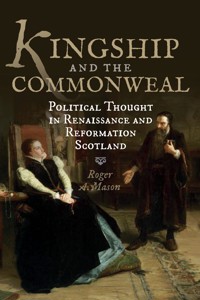
This major collection of essays brings together in readily accessible form the fruits of research into the political thought and culture of Renaissance and Reformation Scotland. As a collection, it ranges from detailed studies of the writings of figures of international standing, such as John Mair, John Knox, George Buchanan and King James VI and I, to more discursive explorations of the changing self-perceptions of the Scottish political community during an era of dramatic political, cultural and religious upheaval. Each essay is self-contained, making its own contribution to a specific area of research. All are variations on the crucial theme of kingship and the commonweal, analysing from a variety of perspectives the way in which the changing nature of the relationship between the Scottish crown and the Scottish people was perceived and articulated by contemporaries. At once focused and ranging, this important collection illuminates in original and innovative ways how a traditionally conservative political community came to terms not only with the cultural influences emanating from Renaissance Europe, but with the revolutionary impact of the Reformation, the constitutional crisis of the reign of Mary Queen of Scots, and the increasing likelihood and eventual reality of union with England.
Sie lesen das E-Book in den Legimi-Apps auf:
Seitenzahl: 659
Veröffentlichungsjahr: 2001
Das E-Book (TTS) können Sie hören im Abo „Legimi Premium” in Legimi-Apps auf:
Ähnliche


















KINGSHIP AND THE COMMONWEAL
Kingship and the Commonweal
Political Thought in Renaissance and Reformation Scotland
ROGER A. MASON
To my Mother and Father
This eBook was published in Great Britain in 2021 by John Donald,
an imprint of Birlinn Ltd
Birlinn Ltd
West Newington House
10 Newington Road
Edinburgh
EH9 1QS
First published in Great Britain in 1998 by Tuckwell Press
Copyright © Roger A. Mason, 1998
eBook ISBN 978 1 78885 397 2
British Library Cataloguing-in-Publication Data
A catalogue record for this book is available on request from the British Library
All rights reserved. No part of this publication may be reproduced, stored, or transmitted in any form, or by any means electronic, mechanical or photocopying, recording or otherwise, without the express written permission of the publisher.
The right of Roger A. Mason to be identified as the author of this book has been asserted by him in accordance with the Copyright, Design and Patent Act 1988
Contents
Preface
List of Abbreviations
Introduction: Kingship and the Commonweal
1 Kingship, Tyranny and the Right to Resist in Fifteenth-Century Scotland
2 Kingship, Nobility and Anglo-Scottish Union: John Mair’s History of Greater Britain (1521)
3 Chivalry and Citizenship: Aspects of National Identity in Renaissance Scotland
4Regnum et Imperium: Humanism and the Political Culture of Early Renaissance Scotland
5 Knox on Rebellion
6 Usable Pasts: History and Identity in Reformation Scotland
7 George Buchanan, James VI and the Presbyterians
8 James VI, George Buchanan, and The True Lawe of Free Monarchies
9 The Scottish Reformation and the Origins of Anglo-British Imperialism
Index
Preface
The purpose of this book is to bring together in readily accessible form some of the fruits of over a decade of research into the political thought and culture of Renaissance and Reformation Scotland. As a collection, it ranges from detailed studies of the writings of figures of international standing such as John Mair, John Knox, George Buchanan and James VI and I to more discursive explorations of the changing self-perceptions of the Scottish political community during an era of dramatic political, cultural and religious upheaval. While each essay is self-contained, making its own contribution to a specific area of research, they are all also variations on the crucial themes of kingship and the commonweal, analysing from a variety of perspectives the ways in which the changing nature of the relationship between the Scottish crown and the Scottish political community was perceived and articulated by contemporaries. It is hoped that such a collection, at once focused and wide-ranging, adds up to something more than simply the sum of its individual parts, illuminating in original and innovative ways how a traditionally conservative political community came to terms not only with the cultural influences emanating from Renaissance Europe, but also with the revolutionary impact of the Reformation, the constitutional crises of the reign of Mary Queen of Scots and the increasing likelihood and eventual reality of dynastic union with England.
Two of the essays (chapters 4 and 8) are printed here for the first time and two others (chapters 5 and 6) are considerably revised and expanded versions of ones previously published elsewhere. The remainder have all likewise appeared in print before, in a variety of academic journals and volumes of essays, but are reissued here with only minor, largely stylistic, corrections. While the notes have been standardised and a certain amount of cross-referencing introduced, no attempt has been made to update either the arguments or the bibliographical information contained in the original versions of these essays. Where new literature has appeared in print which would lead me to refine and modify my ideas as originally presented, I have tried to take account of it in the introduction. The provenance of each of the essays is indicated at the beginning of the chapter concerned, but for permission to include them in this collection I am extremely grateful to Cambridge University Press (chapters 5, 7 and 9), John Donald Publishers Ltd (chapter 3), the Scottish Historical Review Trust (chapters 1 and 6), and the Scottish Catholic Historical Association (chapter 2).
Not surprisingly, in a collection of essays published over a ten year period, I have accumulated an immense numbers of debts to colleagues and friends who have read successive drafts of what were evolving pieces of work. Their helpful comments and advice are acknowledged at the beginning of each chapter. In addition, however, I owe a number of longer term debts which it is a pleasure to be able to acknowledge more fully here. Many of the chapters that follow pursue ideas and arguments which were first broached as part of my doctoral research at Edinburgh University. I am extremely grateful to my then supervisor, Nicholas Phillipson, for introducing me to Scotland’s rich intellectual history and for his continuing encouragement as I have strayed ever further from its assumed highpoint in the Age of Enlightenment. As a research student, I also benefited enormously from a formative year spent at the Johns Hopkins University and I owe a great deal to John Pocock not only for his support and inspiration over many years, but also (and more practically) for inviting me to direct a seminar at the Folger Institute where two of the following chapters were first written and presented. I am also particularly indebted to two other scholars, Jimmy Burns and Arthur Williamson, whose approach to the study of sixteenth-century Scottish political thought could hardly be more different, but whose work in the field I have long admired and from which I have frequently sought guidance and stimulation. To both of them, I am grateful for much friendly criticism and advice as well as the occasional (fruitful) disagreement.
Finally, I owe more general thanks to David Armitage who, while he bears no responsibility for the final outcome, first flattered me by suggesting that a collection such as this might be worthwhile. That the idea has borne fruit is testimony to the good-humoured commitment of the publishers, John and Val Tuckwell, and the patience and fortitude of my wife, Ellen Colingsworth. None of the essays printed here, however, would have been written at all without the continuing support of my parents, and it is to them that this volume is dedicated.
Lathones, Fife August 1997
List of Abbreviations
Aldis
H.G. Aldis (ed.), A List of Books Printed in Scotland Before 1700 (2nd edn, Edinburgh, 1970)
APS
T. Thomson and C. Innes (eds), Acts of the Parliaments of Scotland (Edinburgh, 1814–75)
AUR
Aberdeen University Review
BIHR
Bulletin of the Institute of Historical Research
CSP
Calendar of State Papers
CSP Scot.
J. Bain et al. (eds), Calendar of State Papers relating to Scotland and Mary Queen of Scots 1547–1603 (Edinburgh, 1898–1969)
DNB
Dictionary of National Biography
EETS
Early English Text Society
EHR
English Historical Review
IR
Innes Review
JBS
Journal of British Studies
JEH
Journal of Ecclesiastical History
JR
Juridical Review
P&P
Past & Present
SHR
Scottish Historical Review
SHS
Scottish History Society
SLJ
Scottish Literary Journal
SSL
Studies in Scottish Literature
STS
Scottish Text Society
TRHS
Transactions of the Royal Historical Society
Introduction Kingship and the Commonweal
At no time before the eighteenth-century Age of Enlightenment did Scots contribute so markedly to the history of European political thought as they did during the era of the Renaissance and Reformation. The major upheavals and intellectual challenges of the sixteenth century generated in figures such as John Mair, John Knox, George Buchanan and King James VI and I an outstanding group of political writers whose international significance was immediately recognised by contemporaries and has long been acknowledged by historians. Many of the essays collected in this volume are directly concerned with analysing the writings of these canonical authors. At the same time, however, they attempt to recapture the broader intellectual contours of the political culture which shaped their thinking and on which their writings reflect. While they can make no pretence to constitute a comprehensive history of sixteenth-century Scottish political thought, the chapters that follow do nonetheless broach many of the major themes and issues which such a history would need to address.1
Prominent among those themes is the way in which sixteenth-century Scots perceived and articulated the changing nature of the relationship between the king and the political community over which he presided: that is, in words more akin to contemporary parlance, the nature of the relationship between kingship and the commonweal.2 ‘Woe be to him’, wrote James VI in 1610, ‘that divides the weale of the King from the weale of the Kingdome’.3 If James was not a particularly original thinker, he was often a highly perceptive one, not least when his own power was the issue at stake, and the potential dangers of juxtaposing kingship with the commonweal was a theme which he had raised in much starker and more revealing terms in the course of his The True Lawe of Free Monarchies. First published in 1598, the True Lawe is a remarkably concise and effective defence of the king’s divine right to rule and of his subjects’ duty of unstinting obedience to divinely constituted authority. In the course of it James castigated those who advocated resistance to tyranny for advancing the argument that ‘good Citizens will be forced, for the naturall zeale and duety they owe to their owne native countrey, to put their hand to worke for freeing their common-wealth from such a pesf’.4 Among such apologists, and perhaps prominent in James’s mind as he wrote the True Lawe, was his own former tutor, George Buchanan. For in his De Jure Regni apud Scotos Dialogus Buchanan had argued along precisely the lines criticised by James that the people’s duty to the commonwealth must take precedence over their allegiance to the king.
Buchanan’s Dialogue was probably the most significant – it was certainly the most notorious – political tract to be written in Scotland in the course of the sixteenth century. An elegant defence of elective monarchy and the accountability of kings to their subjects, it imparted a distinctively classical republican spin to an ideal of the commonwealth which was already well-established in Scottish political thinking. At a meeting of the general assembly in 1564, in the course of a famous debate between John Knox and William Maitland of Lethington on the question of resistance to tyranny, the minister John Craig expressed the view ‘that every kingdom is, or at least should be, a commonwealth, albeit that every commonwealth be not a kingdom’.5 Buchanan’s Dialogue is in many respects simply a detailed exploration of this succint formula; moreover, it comes to a broadly similar conclusion as Craig had reached when he told the assembly ‘that princes are not only bound to keep laws and promises to their subjects, but also that in case they fail, they justly may be deposed; for the band betwixt the prince and the people is reciproce’.6 Craig and Buchanan were by no means alone in developing such radical ideas in the Scotland of the 1560s. The events of that decade, culminating in the deposition of Mary Queen of Scots in 1567, generated an unprecedented level of radical political speculation of which Buchanan’s statement of the contractual basis of the relationship between the crown and the community was only the most infamous.
Although not published until 1579, the Dialogue was first written in the immediate aftermath of Mary’s deposition with the express purpose of justifying what was arguably the most significant single political act to occur in sixteenth-century Scotland. That Mary’s overthrow was camouflaged under the fiction of a voluntary abdication may well be testimony to the essential conservatism of a political community which was profoundly ill-at-ease with constitutional revolution. It was a fiction, however, which was unable to contain the development of the radical constitutionalism associated with Buchanan or the increasingly strident assertions of royal absolutism propounded by exiled Catholic supporters of Mary such as Adam Blackwood and William Barclay. Just as the deposition of Mary was an event of European significance, so the debate which it generated was addressed to a European audience.7 Yet the ideological polarisation which is such a feature of post-Reformation Europe is clearly apparent in a domestic Scottish setting. James VI’s development of a divine right theory of royal absolutism must be seen (as it is here in chapters 7 and 8) as a reaction not just to the theories of popular sovereignty associated with Buchanan, but also to their adoption by the radical presbyterian clergy within the Scottish kirk. The issue of sovereignty in late sixteenth-century Scotland was much more than an abstract debate over the nature and limits of royal authority; it was part of an intensely practical struggle to define the character of a reformed Scottish commonwealth and for control of the levers of power within it.
Looking back from the century’s end, James VI had no difficulty in pinpointing the events of the 1560s – the deposition of his mother and the Reformation-Rebellion against his grandmother – as the moment when Scottish kingship and the Scottish commonwealth were forcibly prised apart – with, in his view, consequences equally disastrous for both.8 He was undoubtedly correct in identifying the decade of the Reformation as a critical watershed when the idea of preserving the commonwealth at the expense of a wicked king (or queen) assumed unprecedented significance in the world of practical Scottish politics. In the realm of political theory, however, such an idea was far from new. It was a doctrine espoused, for example, by no less an authority than the great scholastic theologian, John Mair, probably the most intellectually gifted of all the authors considered in this book. The full extent of Mair’s achievement is only now beginning to gain the recognition which it deserves and, primarily a logician, philosopher and theologian, the analysis of his History of Greater Britain to which chapter 2 is devoted is unlikely to take the full measure of the man.9 Nevertheless, it has long been acknowledged that he played a key role in applying the theories of ecclesiastical conciliarism to the temporal realm, and in ensuring that such ideas were transmitted from the medieval to the early modern world. A student and teacher for some twenty-five years in Paris, Mair returned to Scotland in 1518 where he was to spend most of the remaining thirty years of his long and distinguished life and where he numbered among his pupils at St Andrews both George Buchanan and (very probably) John Knox. However, neither Buchanan nor Knox can be considered direct disciples of Mair, and just as it may be doubted whether the bleak analysis of Scottish political culture found in his History of Greater Britain was widely shared by his countrymen, so the extent to which his political ideas were widely known and accepted in Scotland is equally open to question.
If Mair’s influence on Scottish political thought is an issue which still requires thorough investigation, so too does the extent to which his radical politics were informed by a knowledge of native traditions. It is by no means certain that there existed in late medieval Scotland a continuous tradition of ‘libertarian’ thinking which might link Mair with that most famous of all Scottish ‘constitutional’ documents, the Declaration of Arbroath of 1320. Claims for the existence of such a tradition are examined in chapter 1 where it is argued to the contrary that expressions of political radicalism are remarkably rare in late medieval Scotland and that the dominant ideology was one in which kingship and the common good were so closely identified as to render resistance to royal authority all but inconceivable. The arguments developed in chapter 1, however, the earliest written of the essays collected here, need to be considered both in the light of the refinements subsequently introduced in chapters 3 and 4 and in relation to recent advances made on a wider scholarly front. Just as we now know more than we did in 1987 of the career and significance of John Ireland, so it has been argued that there is more evidence for theories of resistance to tyranny in fifteenth-century Scotland than my original article allowed.10 In the light of this research, it is now more appropriate to suppose that, while Scottish political thinking in the late medieval period was dominated by a conservative mainstream, less conventional currents of thought had their place in a political culture which was rather more varied and sophisticated than chapter 1 suggests.
Various aspects of this are pursued in chapters 3 and 4 where some attempt is made to assess the impact of Renaissance thought on Scottish political culture in the late fifteenth and early sixteenth centuries. In chapter 3, for example, it is argued that a heightened awareness of the civic values of the ancient world led contemporaries to invest more heavily than ever before in notions of ‘public profit’ or the ‘common good’. In fact it was during this period that the term ‘the commonweal’ first emerged as a direct vernacular equivalent of the classical res publica and it seems clear enough that a humanist such as Hector Boece, the author of an immensely popular history of Scotland, the Scotorum Historia of 1527, was deeply influenced by the republican values of classical authors like Cicero and Livy. Yet the civic legacy of the classical world did not necessarily issue in the kind of republican politics which Boece appears to have espoused.11 On the contrary, or so at least it is suggested in chapter 4, the early Renaissance period also witnessed the emergence in Scotland of a royalist ideology which saw civility in terms of the law codes of the Roman empire rather than the Stoic ethics of the Roman republic. Speculative though this argument is, it may help to highlight the fact that just as the influence of the Renaissance on Scottish political culture was as multi-faceted as it was profound, so there were a variety of ways in which Scottish kingship and the Scottish commonweal could be reconceptualised on the basis of the vastly increased knowledge of the classical world and its literature made available through the ‘new learning’ of the humanists.
At the same time, chapter 4 also suggests that the cultural history of the century or so before 1560 needs to be viewed and interpreted on its own terms rather than simply as a prelude to the inevitable success of a Protestant Reformation. There are encouraging signs of a revival of interest in the crucial reign of James V which, long neglected by historians, may yet serve to establish the idea of a Scottish Renaissance as firmly in the scholarly consciousness as the idea of the Scottish Reformation.12 Rather than diminishing the significance of the latter, further research on the cultural history of pre-Reformation Scotland can only help to provide a more richly-textured understanding of the ideological roots of Protestant reform and of the impact on Scottish culture and society of the doctrines espoused by John Knox and his fellow reformers. As is argued in chapter 5, Knox’s political ideas were in fact a good deal less radical than is generally assumed. Nevertheless, the intense biblicism which is so characteristic of his thought and which was to become one of the defining features of Scottish Protestantism, effectively transposed traditional concepts of kingship and the commonweal into a ‘godly’ register which derived its authority and legitimacy from the history of Old Testament Israel rather than from the antiquity and continuity of a distinctively Scottish kingship.
The implications of this are explored more fully in chapter 6 where the problem of re-imagining Scotland as a godly Protestant commonwealth is addressed with particular reference to the historical thought of both Knox and Buchanan. Yet the significance of a sense of the past – and the malleability of history – are themes which are common to all the essays that follow. Scottish kingship and the Scottish commonweal were continually defined and redefined with reference to an allegedly common past. Whether imagined primarily as a people, a kingdom or a nation – whether seen as a feudal-baronial community, a classical republic, a godly commonwealth or an imperial realm – a usable past was an essential feature of Scotland’s present (and future) identity. It was an identity, moreover, which was clearly threatened as well as shaped by the pan-Britannic ambitions of a more powerful English neighbour. In the course of the sixteenth century, a potent combination of Protestantism and dynastic politics led to the emergence of a powerful and enduring ideology of Anglo-British imperialism which helped to underwrite the eventual realisation of dynastic union when James VI succeeded to the English throne in 1603. The origins and development of this unionist ideology are the subject of the final chapter in this collection. Yet the prospect of Anglo-Scottish union – and in particular the problem of imagining Scotland as a distinct community within a united Britain – are once again common themes which run through many of the essays that follow. From Mair to Knox to Buchanan to James VI himself, the challenge was ever-present of reconciling British unionism with an awareness of the historic identity of Scottish kingship and the Scottish commonweal.13
The study of the history of political thought has been revolutionised in recent years. While the analysis of canonical texts is still (just about) a permissible activity, it is not one which can be pursued without reference to the contexts in which they were written. The approach adopted here is neither self-consciously fashionable nor deliberately intended to demonstrate the virtues of a particular methodology.14 It is based rather on the instincts of a practising historian who believes that to understand the writings of a John Knox or a George Buchanan one must be acutely sensitive to the whole range of contexts – linguistic, political, social and religious – which shaped them and gave them meaning. Likewise, it is based on the assumption that the study of such writings can in turn shed light on the environment which generated them and the mentalité of those who inhabited it. The political culture of sixteenth-century Scotland – the dynamic nexus of individuals, ideas and institutions which define the politics of any community – is not a subject which has attracted a great deal of attention from historians. It is hoped that the essays that follow may contribute in some small way to our better understanding of the political culture of the Scottish kingdom during an era which was not only the last century of its independent existence but which also witnessed its struggle to come to terms with the convulsive effects of the Renaissance and Reformation.15
1 Studies of the political thought of the period are few and far between, but for pioneering work in the field, see Arthur H. Williamson, Scottish National Consciousness in the Age of James VI (Edinburgh, 1979), and J. H. Burns, The True Law of Kingship: Concepts of Monarchy in Early Modern Scotland (Oxford, 1996).
2 Sixteenth-century Scots tended to use commonweal and commonwealth interchangably: both could mean either the common good or, with increasing frequency as the century wore on, the community whose welfare was at issue. As we shall see, while commonwealth could be used specifically to denote a republic, this was not normally the case. Kingship and the commonweal did not therefore imply incompatible forms of government, but were usually understood as opposite sides of the same monarchical coin.
3 James VI and I, Political Writings, ed. Johann P. Sommerville (Cambridge, 1994), 195.
4Ibid., 78.
5 John Knox, On Rebellion, ed. Roger A. Mason (Cambridge, 1994), 207–8.
6Ibid., 207.
7 For this European context, see J. H. Burns (ed.), The Cambridge History of Political Thought 1450–1700 (Cambridge, 1991), where ‘The Deposition of Mary Stuart’ even merits a sections to itself (pp. 214–18).
8 See in particular his remarks in The Basilicon Doron of James VI, ed. James Craigie (STS, 1944–50), i, 75, discussed further in chapter 7 below.
9 The best brief introduction to his thought is in Alexander Broadie, The Tradition of Scottish Philosophy: A New Perspective on the Enlightenment (Edinburgh, 1990).
10 See J. H. Burns, ‘John Ireland: Theology and Public Affairs in the Late Fifteenth Century’, IR, 41 (1990), 151–81; and M. H. Brown, “I have thus slain a tyrant”: The Dethe of the Kynge of Scotis and the Right to Resist in Early Fifteenth-Century Scotland’, IR, 47 (1996), 24–44.
11 The extent to which Boece’s account of Scotland’s ‘prehistory’ was intended to legitimise the accountability of kings to their subjects remains a matter of some debate, but our understanding of his thinking has been greatly advanced by Nicola Royan, ‘The Scotorum Historia of Hector Boece: A Study’ (DPhil Thesis, University of Oxford, 1996).
12 On the political history of the reign, see James S. Cameron, James V: The Personal Rule 1528–42 (East Linton, 1998), referred to in chapter 4 in its previous incarnation as a St Andrews University PhD Thesis. References to recent work on the cultural history of the reign can also be found in the notes to chapter 4.
13 Three important collections of essays have recently appeared which explore many aspects of the problem of British union particularly in the early modern period: Steven Ellis and Sarah Barber (eds), Conquest and Union: Fashioning a British State 1485–1725 (London and New York, 1995); Brendan Bradshaw and John Morrill (eds), The British Problem c. 1534–1707: State Formation in the Atlantic Archipelago (London, 1996); and Alexander Grant and Keith Stringer (eds), Uniting the Kingdom?: The Making of British History (London, 1995).
14 It is, however, greatly indebted to the methodological writings of Quentin Skinner and particularly John Pocock. See for example James Tully (ed.). Meaning and Context: Quentin Skinner and His Critics (Princeton, 1988), and especially J. G. A. Pocock, Politics, Language and Time: Essays on Political Thought and History (London, 1972).
15 I am currently writing a more synoptic study of sixteenth-century Scottish political culture under the title, Kingship and Tyranny: Scotland in the Age of Reform 1513–1603.
CHAPTER 1
Kingship, Tyranny and the Right to Resist in Fifteenth-Century Scotland
Reprinted with minor revisions from SHR, 66 (1987), 125–51. In writing the original version I benefited enormously from the co-operation of Dr Craig Macdonald in making available his typescript of Book VII of John Ireland’s Meroure of Wyssdome (NLS MS 18.2.8). His STS edition has since appeared in print (see note 11) and I have altered the footnotes accordingly. I am also grateful to J. H. Burns, Norman Macdougall and Sally Mapstone for their helpful comments on draft versions of this essay.
In recent years our understanding of fifteenth-century Scottish kingship has been radically transformed. The traditional picture of a weak crown made weaker and a poor realm poorer by the irresponsible antics of anarchic feudal barons has been thoroughly reappraised. In revisionist hands, Scotland’s allegedly over-mighty magnates have undergone a veritable sea-change and emerged as responsible partners in a generally pacific and constructive relationship with the crown. By the same token, the early Stewart kings are portrayed – at least when of age – as hard-headed realists astute enough to recognise that, given their impoverished circumstances, a powerful nobility was essential to the good governance of the realm. Despite or precisely because of its firm reliance on self-in-terest, this system of laissez-faire monarchy is said to have ensured a measure of security for the new Stewart dynasty and of stability for its ancient Scottish realm which was conspicuously absent from contemporary France and England. In contrast to these other countries, it is argued, crown-magnate relations in fifteenth-century Scotland were characterised by co-operation rather than confrontation.1
Almost certainly this picture of the sweet reasonableness of the Scottish political community will be modified by further research. Already, in fact, elements of robust unreason are re-entering the picture and, in future, kings are likely to be described as rather less rational than ruthless in their policies towards the nobility and magnates as rather more grasping than gracious in their attitudes to the crown.2 Nevertheless, the revisionist exercise has proved far from unrewarding. Among many other things, it has highlighted both the comparatively low level of political violence in fifteenth-century Scotland and the fact that, while two Scottish kings – James I and James III – did suffer at the hands of their subjects, there was no sustained resistance to the Stewart dynasty as such.3 Scotland, in short, never experienced the fratricidal dynastic conflicts which afflicted contemporary France and England.
To an historian of political ideas, this reinterpretation of the nature of crown-magnate relations in fifteenth-century Scotland is of considerable interest. Possibly because of the lack of obvious sources, political thought in later medieval Scotland is not a subject which has attracted much attention from historians. In a recent article, however, Matthew McDiarmid has argued on the evidence of literary sources (particularly the chronicles) that one distinguishing feature of the Scottish tradition was its staunchly libertarian emphasis on the accountability of kings to their subjects. At one point, indeed, he asserts that George Buchanan, among the most radical of sixteenth-century political theorists, says nothing about ihe Scots’ right to resist, depose and even kill their kings which was not said by medieval chroniclers such as John of Fordun and Walter Bower and which was not, at least by implication, fundamental to the outlook of the political community at large.4 As will become clear, this is not a view which is sustainable on the basis of the available evidence. Neither the chronicles nor any other late medieval source provide evidence that theories of resistance, deposition and tyrannicide ever figured more than marginally in the political thought of fifteenth-century Scots. Rather these sources testify to a political ideology as conservative as it was patriotic and one in which the idea of resisting the crown – far less deposing a king – was stated (if at all) in only the most hesitant and ambiguous of terms.
This is a depressingly negative conclusion for an essay which purports to discuss tyranny and the right to resist and, for that reason alone, it seemed worth stating it at the earliest opportunity. Moreover, although it relates to and may well help to explain the Stewart dynasty’s apparently quite remarkable capacity for survival, it is not a conclusion which is so self-evident as to require no further comment. After all, acts of resistance to royal authority clearly did occur in fifteenth-century Scotland: James I was assassinated in 1437, James II was forcibly defied by the house of Douglas in the early 1450s, and James III faced a series of rebellions culminating in his death in arms against his own subjects in 1488. To be sure, this hardly compares with the catalogue of rebellions and depositions which punctuate the history of contemporary England. Nevertheless, it may still be sufficient to cast doubt on the central contention to be advanced in what follows: namely, that fifteenth-century Scots actually shied away – apparently quite deliberately – from espousing those theories of resistance and tyrannicide for which in the sixteenth century, through the writings of John Mair, John Knox and George Buchanan, Scotland was to become notorious. Before examining how late medieval Scots reacted to bad government, however, it is as well to look at their conception of good government. In other words, before considering their attitude to (and remedies for) tyranny, it is important to reconstruct in some detail their understanding of the nature and function of kingship.
*
We may well begin by asking what, in the most general terms, a medieval king was expected to do. The simplest answer is that his principal tasks were to defend the realm and to administer justice within it. These were the responsibilities with which, for example, the Scottish parliament charged the earl of Fife when he was made guardian for Robert II in 1388.5 There was nothing peculiarly Scottish about this: weightily sanctioned by both biblical and classical authorities (e.g., 1 Samuel 8.19–20; Virgil, Aeneid, 6.852–4), defence and justice were seen throughout Europe as the essential functions of the royal office. They had, moreover, the additional imprimatur of the Roman law. Royal responsibility for defence and justice are the leading themes of the proemium to Justinian’s Institutes on which was modelled, perhaps via Bracton or Glanvill, the prologue to Scotland’s own fourteenth-century legal code, Regiam Majestatem.6 Such concerns were singularly appropriate to the later years of Robert I’s reign when Regiam Majestatem was most probably compiled.7 As we shall see, however, defence and justice remained the dominant preoccupations of Scottish political literature throughout the later middle ages.
Of course, in a Scottish context, the conventional belief in the king’s duty to defend the realm was more than usually significant. The English claim to feudal superiority over Scotland, although acted upon only intermittently, was an ever-present threat to the status of Scottish kings and thus to the integrity of the Scottish kingdom. By definition, therefore, the defence of the realm entailed a repudiation of English pretensions and an unqualified insistence that the king of Scots owed allegiance to no superior but God alone. According to the increasingly elaborate historical mythology developed by the chroniclers, the king was the latest representative of a royal line stretching back in unbroken succession to the foundation of the kingdom by Fergus I in the fourth century BC. He was, in short, the most powerful available symbol of the kingdom’s historic and continuing autonomy.8
Important though this clearly was, however, it is not an aspect of Scottish kingship which need detain us here. Rather it is on the king’s responsibility for the administration of justice that we must focus attention. In this context, it is important to stress that justice implies something more than the simple provision of legal remedy through the king’s courts. As the fount of justice the king’s judicial role was obviously of the first importance; but equally clearly the concept of justice had much wider connotations which in the later middle ages led it to be interpreted as nothing less than the maintenance of a stable social and political order. In this more comprehensive sense, justice may be equated quite simply with good governance.9 Not surprisingly, therefore, late medieval discussions of justice readily spill over into other related fields: most notably, the importance of good counsel to successful royal government and, perhaps above all, the importance of the king possessing Christian virtue in more than princely abundance. Even at one’s most charitable, it is hard to describe this kind of political moralising as anything other than jejune. Nevertheless, so fundamental was it to the political outlook of late medieval Scots that it would be perilous in the extreme to dismiss it out of hand.
The preoccupation of fifteenth-century Scottish poets with justice, good counsel and the virtues of the king has not gone unnoticed by literary critics and historians.10 But prose writers no less than poets shared the same concerns. Before looking at their works more closely, however, it is worth pondering the contention that most fifteenth-century social and political criticism is of a highly conventional nature and that attempts to read into the political literature of the period detailed commentaries on specific events may reveal more about the critic’s ingenuity than about either the text or the incident which he is seeking to illuminate. This is not to say that fifteenth-century authors were politically unaware, but merely to warn that the limited political vocabulary available to them led topical allusions to be couched and often wholly submerged in nebulous typological generalisations. Even where a text may be fairly precisely dated, therefore, its value as a source of specific information rather than conventional political wisdom must remain suspect. An interesting case in point, a vernacular prose work, is John Ireland’s Meroure of Wyssdome. Although largely concerned with theological matters – Ireland refers to it as an ‘A.B.C. of cristianite’ – the seventh and last book of the Meroure deals at considerable length with what Ireland considered the essentials of political wisdom and is, as we shall see, an incomparable source for the study of political ideas in fifteenth-century Scotland.11
For the moment, however, what is important is not so much the content of the Meroure as the circumstances of its composition. Fortunately, more is known about John Ireland than about most fifteenth-century Scottish writers, many of whom remain stubbornly anonymous.12 Born around 1440, Ireland was a theologian by profession and spent the middle years of a not undistinguished academic career scaling the scholastic ladder of success at the University of Paris. From an early date, however, he had connections at both the French and the Scottish courts and in 1483 he was persuaded to return to Scotland and enter James III’s service as the king’s chaplain and confessor. If Ireland is to be believed, the Meroure was a book ‘desirit richt gretlie’ by James III.13 Certainly, there is no reason to doubt that it was begun soon after his return to Scotland in 1483. It was not completed, however, until 1490 when it was dedicated to the late king’s son and successor, James IV.14 In other words, the Meroure was written during and immediately after the series of events which led ultimately to James III’s overthrow at the battle of Sauchieburn in 1488. Moreover, as a member of the king’s household, its author was particularly well-placed to witness at close quarters the decline and fall of this so-called tyrant-king. It is, therefore, extremely tempting to construe Ireland’s elaborate advice on such matters as the administration of justice, the importance of good counsel and the personal conduct of the king as the unique personal reflections of an intimate royal servant on James III’s error-prone path to perdition. After all, if the myth of James III’s corruption by low-born favourites and inexorable slide into vicious tyranny has been exploded, the king has at the same time been expertly exposed as a thoroughly unwholesome character whose maladministration of justice and failure to heed the advice of his council and parliament made a signal contribution to his eventual downfall and demise.15 Is it legitimate, then, to read the Meroure as a commentary on the troubled decade in which it was written?
On the face of it, this may seem a perfectly sensible approach. There is no reason to doubt that Ireland was influenced by what had happened to James III and wished to forewarn the youthful James IV of the pitfalls awaiting an unwary king. Furthermore, a great deal of what he says is certainly apposite to the Scotland of the 1480s and some of it might well allude, admittedly in somewhat veiled terms, to particular aspects of James III’s personality and policies. The cautious reader, however, is bound to observe that Ireland’s reflections are for the most part couched in very general terms and that they conform to a conventional pattern of advice to princes which knows neither temporal nor national bounds. Were the same cautious reader then moved to consult the writings of Jean Gerson, chancellor of Paris University a generation or so before Ireland was himself resident there, he would discover that the Meroure’s apparently apposite reflections on Scottish affairs in the 1480s are in reality Gerson’s reflections on the state of France around 1400. In fact, at a rough calculation, some two-thirds of Book VII of the Meroure consists of material drawn unacknowledged and frequently verbatim from a series of sermons which Gerson preached before Charles VI and the French court between 1391 and 1413.16 Although this probably does not exhaust the list of Ireland’s plagiarisms – additional material is, for example, reminiscent of Chaucer’s Tale of Melibee – it is enough to reinforce the point that this type of political literature is highly suspect as a source of information on specific events and to suggest further that Ireland himself is hardly the most accurate guide to Scottish politics in the 1480s.
That this does not preclude the possibility that, in the very selectivity of his plagiarism, Ireland may yet provide useful insights into the political mentality of fifteenth-century Scots, is a matter to which we shall return shortly. Meanwhile, it is worth emphasising the obvious ease with which the political thought of an early fifteenth-century Frenchman could be appropriated by a late fifteenth-century Scotsman. This is indicative of both the stability and the European currency of the conceptual vocabulary in terms of which late medieval Scots described and analysed their political world. Furthermore, it suggests that, whatever activities a king such as James III indulged in, his subjects were liable to construe them in terms of this same small and highly conventional vocabulary of kingship. While these are once again important points to which we must return, it is essential first of all to take a closer look at the nature and sources of the core concepts of this political vocabulary.
*
Undoubtedly the most important of these concepts was justice itself. Not insignificantly, the opening chapter of Book VII of Ireland’s Meroure is based on Gerson’s sermon Diligite justiciam, which, as its title suggests, takes as its text the first verse of the apocryphal Book of the Wisdom of Solomon: ‘Love righteousness (justicia), ye that be judges of the earth’. Largely thanks to Gerson, Ireland’s discussion is rather more sophisticated than was usual in fifteenth-century Scotland. Nevertheless, it is founded on assumptions and pursues themes which his Scottish contemporaries would have immediately recognised and endorsed. Namely, that justice is a virtue which accords with the divine will and reason, that kings and princes are established by God to exercise justice for the good of all their subjects, and that the judges they appoint ought to love God, the king and the common good in equal measure.17
It is precisely these concerns which run through the political poetry of the period. They lie, for example, at the heart of the vernacular poem known as ‘The Harp’ which, probably written about the mid-fifteenth century, was published by Chepman and Millar in 1508 as Ane Buke of Gud Counsale to the King. Justice, asserts its anonymous author, is the ‘souerane flour of vertu’ and on it depends not just the well-being and prosperity of the realm, but even the salvation of souls. It is recommended, therefore, that the king establish an auditor of complaints to minister justice to the poor, that judges be carefully chosen to avoid corruption and partiality, and that their judgements be strictly enforced.18 In the same vein, variations on the latter practical themes occur even in the fifteenth-century verse romance, Lancelot of the Laik, which follows its French prose original in incorporating in its text a lengthy and highly conventional disquisition on kingship. Here the king is advised to appoint discreet and learned judges, personally to travel the realm to dispense his justice, and to do so impartially to rich and poor alike.19 Such sentiments – and many more examples could be quoted – were the commonplaces of the age: to punish vice and nourish virtue was seen as the first object of justice and the primary duty of the king. As the allegory of the harp itself implies, it was the means by which a divine harmony was first established and then maintained in the body politic.20 In its absence, unnatural discord was a constant and menacing threat. Clearly, to the fifteenth-century mind, kingship without justice was not just a contradiction in terms, but an affront to the will of God.
Hence, at least in part, the importance attached to good counsel, without which even the best of kings might be tempted to stray from the straight and narrow path of justice. Thus, apparently abandoning Gerson in favour of Chaucer’s Tale of Melibee, Ireland warns the king not to let ‘crabitnes na cuuatis na hastines’ mar his judgement and goes on to recommend (perhaps unnecessarily) that the advice of loyal, wise and experienced counsellors is preferable to that of fools, drunkards and ‘euill lyffaris’.21 This may or may not have been intended as an oblique reference to James III; but what can be said with certainty is that the advice is conventional to the point of banality. ‘Nothing in government is more fitting for a king than to have good counsellors’, wrote one fifteenth-century chronicler, ‘… in good counsellors consists to the highest extent the honour, welfare and advantage of the king and the realm.’ Consequently, the same chronicler goes on to advise that counsellors who are ‘ambitious and avaricious’ or ‘crafty and deceitful’ should be removed from the king’s presence and replaced by honest men who would not ‘sell justice for money’ and who would ‘blush at lies and flattery’. This too might be applied to James III. In fact, the chronicler in question is Walter Bower, commenting in the 1440s on the council chosen to govern on behalf of the young Alexander III in the 1250s.22
That counsellors should be wise and incorruptible was an assumption as unoriginal as it was universal. To it, moreover, was added the belief that such qualities were much more common in mature old age. Certainly, the dangers to a king who ‘luifit ouer weill zong counsel’ were dwelt upon by the anonymous author of The Thre Prestis of Peblis, one of the very few poems which possibly does contain specific criticism of James III.23 Yet that the frivolities of youth were a dangerous distraction to kings, and that flattering sycophants who encouraged such levity with wicked words and example were evil parasites, were hardly original sentiments. Flattery in particular was a conventional and oft-condemned threat to the sombre virtues looked for in a king. Bower advised that kings should flee from a flatterer ‘as from a scorpion’, while in Lancelot of the Laik the flatterer is condemned as worse than the plague ‘and more the realme anoyith,/For he the law and puple boith distroyith’.24 Flattery, sycophantic courtiers, evil counsellors – these were all stereotypical diagnoses of the corruption of royal virtue in the later middle ages.
Moreover, by the same token, they were highly significant explanations of the breakdown of good kingship. It was, after all, universally assumed that a corrupt and vicious king inevitably presided over a corrupt and vicious kingdom. The prince not only set the example for his court but was emulated by all his subjects. Hence the fixation of political moralists on the personality and moral proclivities – the virtues – of individual princes. ‘A prince’, asserted the chronicler John of Fordun, ‘is doubly a wrong-doer if he strays from the path of virtue. For first he entangles himself in vice, and next he affords the humbler classes an example of wrong-doing. For [to quote the classical poet Claudian] “the fickle rabble changes with the prince” ’.25 The longevity of this belief in the king’s role as a moral exemplar and dynamic is well illustrated by the fact that this same quotation from Claudian is used in such diverse sixteenth-century works as Lindsay’s Satyre of the Thrie Estaitis, Buchanan’s De Jure Regni and James VI’s Basilikon Doron. Meanwhile, in the fifteenth century, poets and chroniclers reiterated ad nauseam and with little variation the virtues deemed essential to a king and the vices which he must at all costs eschew.
One example, slightly more interesting than most if only because it eventually found its way into Shakespeare’s Macbeth, is Fordun’s account of how Malcolm Canmore dissembled villainous corruption in order to test the loyalty of Macduff. Malcolm tells Macduff that he is afflicted with three ‘monstrous besetting sins’ – lust, avarice and unfaithfulness – which vices necessarily incapacitate him as a candidate for the Scottish throne. After a long debate during which it transpires that lust and avarice are vices which, if hardly becoming in a king, might at least be controlled or covered-up by his counsellors, Macduff finally baulks at the prospect of a prince who cannot keep faith with his subjects and in whose heart treachery evidently lurks.26 Of course, aided by his godly wife Margaret, Malcolm later turns out to possess all those virtues generally seen as the essence of good kingship: the same virtues as underlie the ten characteristics of a good king enumerated in Walter Bower’s chronicle and the twelve into which these are expanded in its derivative, The Book of Pluscarden.27 The moral propensities of the prince – his manners and even his mannerisms – were clearly perceived as crucial to the good governance of the realm. As a result, they were adumbrated at great length and in interminable detail.
As R. J. Lyall has pointed out, an important model and possible source for this kind of political moralising was the work known in the middle ages as the Secretum Secretorum.28 Attributed to Aristotle and believed to be a letter of advice from that sage philosopher to his pupil Alexander the Great, the Secretum was in fact an Arabic work which was introduced to Europe in the twelfth century and which subsequently enjoyed such popularity and influence that it survives in some five hundred Latin and vernacular manuscripts.29 One of these was produced in Scotland in the fifteenth century. About 1456, at the request of the earl of Orkney, Gilbert Haye translated a French version of the work into Scots under the title The Buke of the Gouernaunce of Princis.30
Not unexpectedly, we find in Haye’s work the same characteristics of good kingship as we have encountered elsewhere. Thus justice is lauded as the highest virtue, ‘the fourme and foundement that God the glorious has sett to governe all his creatouris’, without which ‘soverane virtue … he [the king] is nocht king na prince, bot he is contrarious to kingis and princis’.31 Likewise, the importance of good counsel, ‘for thy prouffit and the commoun prouffit of thy realme’, is impressed upon the king at length and no less than sixteen moral and practical qualities of a good counsellor or judge are enumerated.32 Above all, however, throughout the work the prince is warned to avoid excess, to eschew the debilitating effects of such vices as lust, avarice, lechery and gluttony and to conduct himself and the affairs of the realm with temperance, discretion and prudence.33 In effect, drawing on a well-established combination of classical and Christian strands of thought, the cardinal virtues – justice, temperance, fortitude and wisdom – glossed by their theological counterparts – faith, hope and charity – are invoked as the essence of royal government. In this respect, the Buke of the Gouernaunce of Princis is echoed by Ireland’s Meroure of Wyssdome which, particularly in the chapters which lean heavily on Gerson’s sermon Vivat rex, reads like a theological commentary on the cardinal virtues.34 There is, however, no need to posit any direct relationship between Ireland and Gerson and the Secretum Secretorum. The Secretum, after all, was only one example – though a particularly influential one – of a genre of political literature known as the speculum principis, the mirror of the prince, in which this taxonomy of royal vice and virtue played a critically important role.
Before the publication in 1599 of James VI’s Basilikon Doron, Scotland can boast of no work which fits very precisely into the mould of the speculum principis genre – a work, that is, specifically designed to educate a particular prince in the duties of his onerous office. Nevertheless, there is no mistaking the didactic intent of the political literature produced in fifteenth-century Scotland. It is perhaps most obvious in Ireland’s Meroure, Book VII of which is the closest approximation we have to a true speculum in that, at least in its final form, it was avowedly intended as a book of advice for James IV. But the didactic strain is no less evident in the poets and chroniclers who clearly saw their works as serving a pedagogic function and who often addressed them directly to the king himself. If such writers did not employ the formal structure of the mirror genre, they were certainly inspired by a similar educative impulse. Moreover, they all shared a common perception of the ideal prince and common (largely ethical) assumptions about the nature and function of kingship which are wholly consonant with – if not directly derived from – the speculum tradition as reformulated in the late thirteenth and early fourteenth centuries in such seminal works as Thomas Aquinas’ De Regno ad Regem Cypri and Giles of Rome’s De Regimine Principum. In itself, however, this points to yet another and perhaps still more authoritative source for the late medieval vocabulary of kingship: namely, Aristotle’s Politics and in particular his Nicomachean Ethics. Both Aquinas and Giles of Rome made extensive use of Aristotle in their works on kingship and subsequently the speculum tradition did much to popularise and in the process to vulgarise Aristotelian political thought.35 Although medieval writers were nothing if not eclectic, Aristotle has some claim to being the single most influential thinker of the later middle ages.36
Of course, by the fifteenth century, both the Politics and the Ethics were in general use in university arts courses and it was no longer necessary to rely on second-hand accounts of Aristotle’s doctrines such as were transmitted through the specula. It is not surprising, therefore, to find the author of The Book of Pluscarden citing the Ethics in his work and referring approvingly to Aristotle as ‘the prince of philosophers’.37 Nor is it surprising to find that Ireland’s Meroure is peppered with Aristotelian tags, references and paraphrases – not all of them attributable to Gerson’s breadth of reading. In fact, although it is rarely made as explicit as in the Meroure, Aristotelianism informs the political literature of fifteenth-century Scotland just as it does that of most Western European countries. Almost all discussions of justice, including incidentally that in the pseudo-Aristotelian Secretum, find their original in Book V of the Ethics, while the rest of that work provided the inspiration for countless descriptions and analyses of the remaining cardinal virtues as well as the source of the influential doctrine of the ‘mean’. In the same way, the Politics gave access to Aristotle’s celebrated classification of the various forms of constitution and, in Book V in particular, to a contrasting picture of kingship and tyranny whose appeal in late medieval Europe was profound and long-lasting.
Influential though he was, however, Aristotle had one very obvious defect: he was a pagan philosopher. Consequently, his thoroughly naturalistic view of man as a political animal and the civil life as an end in itself had to be modified for Christian consumption. If Ireland could rejoice in the fact that ‘man of his natur is ciuile and poletic’, and make explicit reference to Aristotle’s zoon politikon to support his point, he could do so only after arguing that government and political dominion were the product of the Fall: ‘the transgressioun and inobediens that the man committit againe God his creator’.38 Nor was this merely a perfunctory gesture in the direction of Christian orthodoxy. Like so many of his contemporaries, Ireland is best described, not as a political theorist, but as a political theologian.39
*
This is in fact a point of some importance and one well worth pausing to consider in more detail. After all, not only was Ireland himself a distinguished theologian, but all the fifteenth-century Scottish authors discussed in this essay were clerics by profession. It has recently been argued that lay literacy was relatively late in spreading beyond the Scottish mercantile and upper landowning classes in the middle ages. Whereas in England the phenomenal growth of the royal administration and the importance of the common law had encouraged the rapid spread of literacy among the gentry, in fifteenth-century Scotland neither government nor the law had developed to the extent that they demanded a wholly literate political community. As a result in late medieval Scotland the clerical monopoly of the higher reaches of learning remained virtually complete.40
This was a situation of which the clerics were themselves aware and sometimes even critical. For instance, the author of the Book of Pluscarden complained that ‘the nobles of Scotland will not stoop to acquire knowledge’ and went on to remark that ‘justice is weak and lukewarm in the kingdom of Scotland through the defect of youthful kings and unwise barons’. These comments occur in a passage intended as an introduction to the poem ‘The Harp’ which is pointedly appended to the chronicle ‘as a lesson for ignorant judges’.41 ‘The Harp’ itself, in a striking anticipation of the so-called Education Act of 1496, advises the king to make ‘yung lordis study in the lawis,/And in thar youthede tak sum techment’. Only thus, argues the poet, will the nobility gain the wisdom necessary to counsel the king in parliament and administer his justice throughout the land.42 Such criticism, however, was slow to take effect and, although the situation was changing by the late fifteenth century, the literate laird and in particular the lay lawyer were essentially sixteenth-century phenomena. There was no Scottish Fortescue and, by extension, no Scottish equivalent to the rich corpus of legal material (particularly the Year Books) on which S. B. Chrimes based his seminal study of constitutional ideas in fifteenth-century England.43 In Scotland, where the legal profession remained almost exclusively clerical in training and personnel – there was no Scottish counterpart to the English Inns of Court – and where there was no substantial body of common law on which to draw, a political vocabulary founded on indigenous legal sources had little or no chance to develop. As a result, although legal terminology is certainly present in the political literature of the period, it never threatens the predominance of a conventional Aristotelian vocabulary which had acquired a heavy theological accent in the schools of late medieval Europe.44
A good illustration of the use of this vocabulary is provided by the discussion of the twelve characteristics of a ‘good and righteous king’ in the Book of Pluscarden.45 One passage in particular is worth quoting at length, for not only does it exemplify the characteristic tone of Aristotelian political theology, but it also indicates in the most general terms the limitations to which royal power was believed to be subject. Significantly, these limitations stem, not from positive law, but from a combination of a classically inspired conception of the king’s responsibility for the bonum commune and a theologically sanctioned belief in his primary duty to God. Thus, according to the Pluscarden chronicler, the twelfth characteristic of a good king is that
… he introduce not new and evil customs into the realm to the detriment and prejudice of his people and the state (res publica), but love the common good above all things, and guard it, else he will never be beloved by his subjects, nor by God; for God is the soul of the state, and the more one leans to the public good the nearer one is to God and the more beloved by Him; for the king is only the state’s vicegerent (procurator) in the name of the Lord his God, and unless he governs it well he is not worthy of the name of king. This is gathered chiefly from three points which are touched upon by Aristotle, the prince of philosophers, in his Ethics: namely that, firstly, he ought to govern his own self virtuously …; secondly, that he ought to govern his house well …; and thirdly, that he ought to govern his province or country well, or his kingdom if he be a king, as regards the common good and the state (res publico), and the whole people subject unto him. If he shall do these three things he shall deserve to be called king; and then shall the Lord say unto him, Well done, good and faithful servant, because thou hast been faithful over a few things, I will set thee over many; enter thou into the joy of thy Lord.46
The conflation of Aristotle and the Bible could hardly be more pronounced, while the resultant belief in the king’s dual obligation towards both God and his subjects is neatly focused on the idea (to be discussed more fully later) of the common good.
Predictably enough, a similar conflation is evident in many passages of Ireland’s




