


Erhalten Sie Zugang zu diesem und mehr als 300000 Büchern ab EUR 5,99 monatlich.
- Herausgeber: The History Press
- Kategorie: Geisteswissenschaft
- Sprache: Englisch
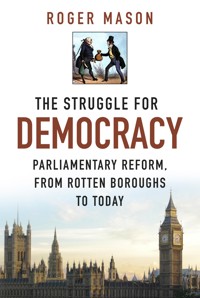
Prior to the 1832 Reform Act the electoral system was rife with corruption and in desperate need of reform. In England and Wales only about 12 per cent of adult men had the vote and the proportion was even less in Scotland and Ireland. Women did not vote at all. A single person controlled a rotten borough that returned two Members of Parliament, and for a number of years one of them was the prime minister. Furthermore, not only did voting take place in public, so landlords could and did evict tenants who voted against their wishes, but voting qualifications also differed from place to place. With the use of many fascinating anecdotes, Roger Mason tells how we got from then to now. All the major reforms are covered: Catholic Emancipation, further Reform Acts, the end of the House of Lords veto and, of course, votes for women. This fascinating history offers a complete insight into the way we have voted from the beginnings of Parliament through to the present day.
Sie lesen das E-Book in den Legimi-Apps auf:
Seitenzahl: 445
Veröffentlichungsjahr: 2015
Das E-Book (TTS) können Sie hören im Abo „Legimi Premium” in Legimi-Apps auf:
Ähnliche


















Contents
Title
Preface
1 The Unreformed Parliament
2 Catholic Emancipation
3 The Clamour for Reform
4 The First Reform Bill and Its Failure
5 The Second Reform Bill and Its Failure
6 Success at Last: The Third Reform Bill
7 An Assessment of the ‘Great Reform Act’
8 The Rise and Fall of Chartism
9 1848–1866: A Developing Head of Steam
10 Disraeli’s Triumph: The Second Reform Act
11 An Assessment of the Second Reform Act
12 The Secret Ballot and the Reining-in of Corruption
13 The Twin Acts of 1884 and 1885
14 Enter Mr Bradlaugh: The Oaths Act 1888
15 The 1911 Parliament Act and What Came Before
16 Votes for Women
17 Representation of the People Act 1918
18 Developments Since 1918
Appendix A
List of Parliamentary Constituencies at the Time of the 1830 General Election
Appendix B
List of Parliamentary Constituencies Immediately after the 1832 Reform Act
Appendix C
Redistribution of Seats Provided by the Reform Act (England and Wales) 1867 and the Reform Act (Scotland) 1868
Appendix D
Full Details of the Redistribution of Seats Act 1885
Appendix E
Dates and Events in the Journey to Parliamentary Reform
Copyright
Preface
This is my nineteenth book. Most of the others have been on the subjects of finance and company law, and I have enjoyed writing them all, but this one is special. It has been a new challenge and writing it has given me the most pleasure. I hope that you enjoy reading it.
Many years ago I acquired a love of history whilst a pupil at Aylesbury Grammar School, and it has remained with me. My two history teachers were Mr Byford and Mr Dalby Ball, and I have much to thank them for. I recall Mr Byford teaching us about Parliamentary Reform, and in particular an inspired lesson on the 1867 Reform Act, which is covered in Chapter 10. It has remained in my mind and it is perhaps not fanciful to think that it provided the germ of the idea for this book.
I have attempted to tell the story faithfully, but at the same time to make the book interesting and enjoyable. It is something that Roy Jenkins and Antonia Fraser have managed so well, and I have tried to do the same. I hope that you will think that I have succeeded.
Finally I would like to express my thanks to Geoff Wright, my wife’s cousin. He read through the manuscript and made a number of very helpful suggestions. He has a special insight because he is a former publisher, and twice stood as a candidate for Parliament.
Roger Mason
1
The Unreformed Parliament
In The Sound of Music Julie Andrews memorably sang, ‘Let’s start at the very beginning, a very good place to start’. It is sound advice for this book. The first two landmarks in the story of Parliamentary Reform are Catholic Emancipation, which was achieved in 1829 and is the subject of Chapter 2, and the Great Reform Act of 1832. This first chapter briefly describes the development of Parliament from the very beginning, and then moves on to the state of the unreformed Parliament prior to 1832.
The English Parliament is often, and with some justification, said to be the mother of parliaments, and it is certainly one of the oldest. It was not invented and did not have a clearly defined starting date, or even an unclearly defined starting date. It evolved, and of course continues to do so. At times the evolution was rapid, but for long periods there were very few changes.
The different parts of England and later England itself were originally governed by absolute rulers, the chief or monarch. He (with due respect to Boudica the personal pronoun is carefully chosen) was a virtual dictator, and if necessary got his way by the exercise of force. He could only be thwarted by greater force or by assassination.
The earliest assembly worth mentioning is the Saxon Witan, which was summoned at the discretion of the king. He called whom he liked and he did so when he liked. The Witan could inform the king and perhaps influence the king, but it could not overrule the king. After the Norman Conquest there was a small but permanent inner council of advisers and from time to time the king would also call additional earls, barons and churchmen. This council formed the basis of what in time would become the House of Lords. For many years county moots had included a representative element. After the Conquest these became known as county courts and incorporated the tentative concept of representative local government. Representatives of the county courts formed the early basis of what in time would become the House of Commons.
Of course, as all schoolchildren should know but perhaps don’t, in 1215 King John sealed Magna Carta, which required him to listen to the barons and at least up to a point accept their advice. The use of the word ‘parliament’ commenced in England in 1236. It is significant that the word is derived from the French word ‘parler’, which means to talk or discuss. It is not derived from a word meaning to legislate or decide.
The forerunner of the modern Parliament was set up in 1265 by Simon de Montfort, the nobleman who was leading a rebellion against Henry III. As well as the barons this included representatives from each county, and also from the cities and towns. De Montfort was killed in battle soon afterwards, but Henry’s son Edward I developed the institution when he became king in 1272. Edward summoned Parliament forty-six times during his thirty-five-year reign. As well as nobles and churchmen there were elections for two representatives from each county (the knights of the shires) and for two representatives from selected cities and towns (the burgesses).
An essential part of the Parliament’s work was to agree taxes. After this had been accomplished the work of the knights of the shires, the burgesses and the clergy was usually done. The king would then discuss laws and other matters with the earls, barons, bishops and abbots.
The representatives of the counties were publicly elected at county court meetings. The process for electing burgesses, who represented the boroughs, varied from town to town. These arrangements did not substantially alter until the 1832 Reform Act. After the early seventeenth century there were very few changes in which cities and towns sent representatives to Parliament, and after the fifteenth century there were not many changes concerning who was allowed to vote.
The power of Parliament relative to that of the monarch progressively increased after the death of Edward I in 1307. Apart from anything else a civil war was won by Parliament, and Charles I was executed. Furthermore, in 1688 Parliament removed James II and invited the Protestant couple William and Mary to be joint sovereigns. In the following year passage of the Bill of Rights was secured. This laid down the limits on the power of the Crown and the rights of Parliament. Subsequently the power of the monarch relative to Parliament waxed and waned. In 1780 a disgruntled House of Commons passed the motion ‘that the power of the Crown has increased, is increasing, and ought to be diminished’.
The English Parliament became the Parliament of Great Britain in 1707 upon the union of England and Wales with Scotland. This in turn became the Parliament of the United Kingdom upon the admission of Irish constituencies and members in 1801. Appendix A shows the full list of parliamentary constituencies at the time of the 1830 general election. The breakdown by type of seat and by country is as follows:
Borough
County
University
Total
England
202
40
2
244
Wales
12
12
0
24
Scotland
15
30
0
45
Ireland
33
32
1
66
Total
262
114
3
379
This does not mean that there were 379 MPs and it does not mean that the distribution between the four countries was in these proportions. The total number of MPs was 658, the main reason for the discrepancy being that most constituencies returned two members. The distribution of the MPs was as follows:
Borough
County
University
Total
England
402
82
4
488
Wales
12
12
0
24
Scotland
15
31
0
46
Ireland
34
64
2
100
Total
463
189
6
658
England appears to have been the winner at the expense of the other three countries, and some cynics will say that it was ever thus. Within England the south did better than the north and cynics will probably make the same comment. The county of Cornwall had no fewer than twenty-one boroughs, each returning two members. This meant that, with the two county members, Cornwall sent no fewer than forty-four MPs to Westminster. This was 6.7 per cent of the total for the UK. Lancashire, including Manchester, Liverpool and other large towns, sent fourteen MPs. Accurate population figures for the time are hard to obtain (especially for Ireland) but the following is typical of several estimates for 1831, the year of a primitive census in Great Britain.
Population
Population Percentage
MPs Percentage
England and Wales
14.0m
57.9%
77.9%
Scotland
2.4m
9.9%
7.0%
Ireland
7.8m
32.2%
15.1%
Total
24.2m
100.0%
100.0%
The Irish figures are for the whole of Ireland and are at a time approximately fifteen years before the potato famine and emigration significantly reduced the island’s population.
It is true that 658 MPs seems an awful lot. The United Kingdom, then as now, had one of the world’s largest legislatures. The House of Commons currently has 650 MPs and many people think that the number should be reduced. For comparison purposes it should be remembered that the whole of Ireland was included in 1831, but that the Republic of Ireland is now an independent country. Only Northern Ireland is within the United Kingdom. The United States, with a population in excess of 320 million, manages with 100 senators and 435 members of the House of Representatives.
All but eight of the English boroughs returned two members, six returned one member and two boroughs returned four. All the Scottish boroughs (or burghs) returned one and so did all the Irish ones except Dublin.
All the Irish and English counties returned two members, with the exception of Yorkshire which after 1826 returned four. All the Welsh and Scottish counties returned just one. However, in an extraordinary exception, three pairs of Scottish counties voted at alternate elections and were disenfranchised at the other.
Apart from Yorkshire, after 1826 the counties were treated equally, regardless of their populations. In Wales, Anglesey had the same weighting as Glamorganshire. In England tiny Rutland had no more than 600 electors, whereas Yorkshire had more than 20,000. The average for English counties was around 4,000. Interestingly the United States Senate operates on the same principle. Alaska (population less than 750,000) and California (population more than 38 million) each send two senators to Washington. Districts represented in the House of Representatives are though of roughly equal size.
The voting qualifications differed between the counties and the boroughs, and they differed enormously from borough to borough. In the counties it was simple: all forty-shilling freeholders had the vote. A forty-shilling freeholder was a person who owned the freehold of land that was capable of bringing in rent of at least forty shillings per year. Since the fifteenth century the expanding population and inflation had meant that an increasing number of adult males had the vote. Exercising this right caused some of them considerable trouble and perhaps expense. There was usually only one voting point in each county, and the forty-shilling freeholders may have had to make a long and difficult journey over difficult terrain. It could take a couple of days or more to get from one part of a large county to another part.
The qualifications for voting in the boroughs were very different from the counties, and they varied from borough to borough. Looking back from the comfort of the twenty-first century one can only say that the variations were ludicrous. The voting arrangements were sometimes derived from a borough’s charter and sometimes from custom lost in the mists of time. In a few cases they were fixed by the House of Commons following determination of a disputed election. In some boroughs the franchise was so extensive that the 1832 Reform Act reduced the electorate. In others the qualifications were very restrictive and there were many variations in between.
Preston, at least for a time, was the borough with the widest franchise. By a determination of the House of Commons in 1661 the right to vote was invested in the inhabitants, which had been interpreted as meaning the resident freemen. The poll in the 1768 election was conducted on this basis and the mayor declared that Sir Peter Leicester and Sir Frank Standish had been elected. The other two candidates, John Burgoyne and Sir Henry Hoghton, petitioned, basing their case on a literal interpretation of the 1661 determination. The petition succeeded and on a poll of all the inhabitants they were elected. This was universal male suffrage in the borough of Preston. What is more, ‘inhabitant’ was interpreted as anyone who had slept the previous night in the borough.
Apart from Preston, the widest franchise was in the so-called scot and lot boroughs and also in the so-called potwalloper boroughs. After 1768 Preston was restricted to being a scot and lot borough. In such boroughs the vote was given to everyone who had resided there for six months, was not a pauper and who had paid scot and lot. Definitions varied and pauper was sometimes taken to mean a person who had received parish relief in the qualifying period. The phrase ‘scot and lot’ refers to taxes paid to the borough for local or national purposes. ‘Scot’ was derived from the old French word escot meaning a payment, and ‘lot’ was derived from the old English word sceot meaning portion or share. So the phrase meant payment of a share. Those who avoided paying their taxes got off scot free. A potwalloper was a person who had control of a separate doorway to his dwelling, could provide his own sustenance and had a fireplace at which to cook his meals.1 He had to be a resident and not a pauper.
Another class of borough was the so-called freedom borough, of which there were sixty-two.2 The freedom of a borough could be acquired by right in certain ways. Examples were by inheritance, marriage to the daughter of a freeman and completion of an apprenticeship. It was also possible for the corporation to elect freemen, a practice which was open to abuse. If it seemed likely that an election would be decided against the wishes of the majority of the corporation, they could elect the required number of freemen known to be willing to vote in the required way.
That seems bad enough, but even worse were the so-called burbage-boroughs. In these the vote attached to a property rather than a person. In many cases it was not necessary for a voter to occupy the property, and in some cases it was not possible to do so. To take just one extreme example, at Droitwich some of the burbages were shares in a dried-up salt pit.3 Burbages could be bought and sold, and could be conveyed for just the period of an election. This allowed a nominee to cast the vote. Non-residence was common in many areas and, for example, 44 per cent of the electors for Cambridge did not reside in the constituency.4
Another extremely unsatisfactory form of constituency was one where a close corporation elected the members. The freemen and other residents had no say at all. The three university seats complete the picture; the voters in these had the potential to cast two votes – once in the university election and once in their county or borough. Voting in more than one constituency was not confined to the university seats and some enterprising citizens arranged to be able to vote in several. This was possible because the polls were normally open for two weeks. It could be to their advantage to travel round and participate in the hospitality and inducements.
In many boroughs the electorate was low or very low. As well as making them unrepresentative this greatly increased the scope for corruption. Figures are unreliable but shortly before the 1832 Reform Act the adult male population of England and Wales was around 3½ million. At the same time the total electorate was around 365,000, or just over 10 per cent. However, the fifty-two counties provided 200,000 of these and the 212 boroughs provided just 165,000. There were of course very big differences between the boroughs, but some of them had tiny electorates. This and the fact that so many were under very close control justified the descriptions ‘pocket boroughs’ and ‘rotten boroughs’. A pocket borough was under the control of one person, one family or a very small group of like-minded persons. The borough was said to be in their pocket.
The distribution of the boroughs and the size of their electorates never was logical, but the passage of time progressively worsened the anomalies. The boroughs did not reflect the consequences of the Industrial Revolution and the migration to the cities, particularly in the north of England. Mighty cities did not have separate representation while rotten boroughs had just a handful of voters.
Perhaps the greatest injustice was Manchester, which did not have separate representation. In the early eighteenth century its population was around 10,000, but according to local censuses it had grown to 182,016 in 1831. ‘Cottonopolis’, as the city was sometimes called, had good reason to feel aggrieved. Birmingham too did not have separate representation. Its population grew from around 74,000 in 1800 to around 150,000 in 1830. The citizens of the so-called ‘workshop of the world’ had good reason to feel under-represented. Representation of these two great cities was only via their contribution to the elections in the counties of Lancashire and Warwickshire respectively. Sheffield was another major city that did not have separate representation.
Many of the boroughs were under the control of families or individuals, and very often they were aristocratic families and individuals. Furthermore, some aristocratic grandees controlled not just one but several of the boroughs. This aristocratic influence is well illustrated by Lord Chesterfield’s words to Philip Stanhope, ‘You will be of the House of Commons as soon as you are of age, and you must first make a figure there if you would make a figure in your country.’5
It is tempting to say that the practice of bribing electors was universal. That would not be correct but it is not too far from the truth. A few high-minded candidates did not do it and some high-minded citizens voted according to their consciences, but the practice was widespread and varied from favours and inducements right up to the blatant purchase of seats. At the minimum many electors expected to enjoy hospitality, often involving copious amounts of alcohol. Elections were popular with tavern keepers; as an example the Duke of Wellington (then Arthur Wellesley) entertained the electors of Rye to a dinner prior to his election for the borough in 1806. Perhaps we should be charitable and assume that it was a reasonable and necessary expense to enable him to explain his policies.
Examples of blatant bribery are numerous but the following extract from the excellent book The Genesis of Parliamentary Reform by G.S. Veitch, first published in 1913 and reprinted in 1965, well illustrates some of the extreme practices:
A pretence of ignorance was, indeed, idle when seats were openly advertised for sale in the newspapers; when £5,000 had been left by will for the purchase of a seat in Parliament, when a seat had been reckoned amongst the saleable assets of a bankrupt, and when a defaulting debtor had paid the market price for a seat in order that, under the protection of parliamentary privilege, he might evade his creditors by escaping from England without arrest. The capital value of a seat can be estimated from the fact that in 1812 the Duke of Bedford sold his ‘property’ in the borough of Camelford for £32,000.
Winning candidates often showed their appreciation after the election, and not always to just the electors. They often rewarded the citizens in general. After his success at Andover in 1754 Francis Delaval arranged for 500 guineas to be fired into the crowd.6 Bribery did not end with the passing of the 1832 Reform Act. At Hertford in 1832 the electors accepted bribes from the Tory and then elected the Whig. This caused outrage, not with the candidate who gave the bribes, but with the perfidious electors who could not be trusted to do the honourable thing.7
An account of the rotten boroughs is almost bound to include Old Sarum and Dunwich, details of which are given below, but there were many others, far too many to detail in this chapter. Gatton, though, deserves a mention. This borough was in Surrey and returned two members. In 1831 there were only six houses within the borough and they provided seven qualified voters. Elections were almost always uncontested, and in an 1803 by-election the successful candidate was returned by a vote of one to nil. Over a long period control of the borough was bought and sold, often for very large sums of money.
Old Sarum was the original site of Salisbury and in 1295 it was given the right to return two members. Shortly afterwards most of the inhabitants moved to New Sarum, which is now Salisbury. The number of remaining residents dwindled and the houses were progressively abandoned. It was a burbage-borough, which meant that votes attached to properties, in this case abandoned properties. It was not necessary that the burbage-holders lived in the properties or even in the constituency. There were seven burbage-holders who were all under the control of one person, so in practice one man selected two Members of Parliament. For many years the borough was under the control of the Pitt family, and a future prime minister, William Pitt the Elder, sat for the constituency from 1735 to 1747.
Dunwich returned two members from 1298 until 1832. It originally consisted of eight parishes and encompassed a flourishing market town and a port, but the encroaching sea swallowed up all but half a parish. This contained forty-four houses and half a church. In 1709 voting was restricted to resident freemen who were not receiving alms, the maximum number of which was set at thirty-two. Two people each controlled eight votes, so acting together they only needed one other vote to have control.
The words of Philip Francis, shortly after his election for Appleby in 1802, illustrate an extreme example of the working of a pocket borough in practice:8
The Fact is that yesterday morning, between 11 & 12 I was unanimously elected by one Elector, to represent this Ancient Borough in Parliament, and I believe I am the very first Member returned in the whole Kingdom. There was no other Candidate, no Opposition, no Poll demanded, Scrutiny, or petition. So I had nothing to do but to thank the said Elector for the Unanimous Voice by which I was chosen. Then we had a great Dinner at the Castle, and a famous Ball in the evening for that part of the Community which mylady calls the Raggamuffins. On Friday Morning I shall quit this Triumphant Scene with flying Colours, and a noble Determination not to see it again in less than seven years.
In the twenty-first century we are accustomed to a variety of candidates contesting each seat at an election. They typically include representatives of the main parties and a range of independents and single issue campaigners. We can be forgiven for not taking some of them too seriously, though we should gratefully acknowledge that it was the Monster Raving Loony Party that pointed out that it was an anomaly to have only one Monopolies Commission. It was not like that before the 1832 Reform Act and to a lesser extent it was not like it afterwards either. Of the seats, 70 per cent were regularly uncontested. The main reason for this was that in tightly controlled seats an election was pointless as it was known in advance who would win. Another reason was that Whigs and Tories sometimes agreed to each put forward only one candidate in a two-seat constituency. They would each get a representative and the cost of a contested election would be avoided. The number of seats contested at the 1761 general election was particularly low – just three English counties and forty-one out of 204 boroughs.9
In 1694 the Triennial Act fixed the maximum length of a parliament at three years, but the Septennial Act 1716 changed it to seven years. This remained the position until 1911, but in practice parliaments were usually dissolved more quickly. There were twenty-nine general elections in the years 1701–1831. MPs were not paid and this too lasted until 1911. Voting was conducted in public and this continued until 1872. There were no votes for women and women could not be MPs. This injustice was partially remedied in 1918 and totally remedied in 1928. The Roman Catholic Relief Act 1829 allowed Catholics to be MPs, but only a person willing to swear a Christian oath was able to take his seat in the House of Commons. This did not change until passage of the Oaths Act in 1888. Male suffrage increased progressively and by 1918 almost all men had the vote. Universal suffrage (both men and women) was achieved in 1928.
Party politics as we know it today was absent from the unreformed House of Commons prior to the 1832 Reform Act. There were two very broad groupings, the Whigs and the Tories, but party discipline was nothing like it is now. Many members adopted an independent attitude and were willing to move from grouping to grouping within the ‘parties’ and occasionally from party to party. They generally did not oppose for the sake of opposing and felt, to some extent at least, an obligation to support an administration that had the confidence of the monarch. The majority of members did not expect or want office, and were content to support the interests that they represented.
We can clearly see, or at least we think we can, that prior to 1832 the unreformed House of Commons was a dreadfully undemocratic institution, ludicrous at times, riddled with corruption and crying out for reform. This was of course true, but before reading further please consider two things. The first is that, like other writing on the subject, this chapter states the facts in bald terms and selects extreme and sometimes entertaining examples. It is rather like some television programmes; everything in them may be true, but the impression that they give is influenced by the editing and what is left out. Secondly, please ponder the implications of the first sentence of The Go-Between by L.P. Hartley, ‘The past is a foreign country: they do things differently there.’ It is a much-quoted sentence and contains a great deal of wisdom.
As detailed in Chapter 3, the clamour for reform grew deafening in the approach to 1832, but for a long time previously, most of the British people were generally satisfied with the mother of parliaments. How could this be? One reason was that many educated people knew that, despite its manifest faults, it compared favourably with the arrangements in numerous other countries. Even the constitution of the democratic United States had significant failings. Many of the men who drafted it in 1787 owned slaves, as did George Washington, the first president. The constitution did not do a lot for Native Americans either.
It can be argued that, in the eighteenth century at least, the House of Commons did to some considerable extent reflect the society of the time. Land was extremely important and the source of much wealth, and it is certainly true that landowners were very well represented. This was one reason why a little later the Corn Laws, introduced in 1815 and repealed in 1846, aroused so much passion in Parliament. There is more about the Corn Laws in Chapter 3. The aristocracy and a relatively small number of powerful families had great power and they were certainly well represented, by themselves and by their nominees. Other interests were also represented, one example being Caribbean plantation owners who opposed the abolition of the slave trade. This was known as the ‘sugar interest’. Another was those with investments in the East India Company. This was known as the ‘Indian interest’. The changes sparked by the Industrial Revolution and the migration to the cities, especially in the north, progressively made these arguments less true, but it was a valid point for a long time.
It sounds strange today, but in the eighteenth century many accepted that it was not necessary to have the vote in order to be adequately represented, not necessarily by the member for your constituency. We now take the view that MPs have a duty to (and generally do) adequately represent children, persons of unsound mind and prisoners, none of whom have the vote. In the eighteenth century this duty was extended to the representation of all women and the majority of men who also did not have the vote.
In the view of many, a depressing aspect of our modern Parliament is that young men and women often have to spend a considerable period toiling for a party before being elected to the House of Commons. They believe that this may suppress the development of independence and is not the best preparation for life as an MP. Of course not everyone would agree, and the observation may be unfair. Regardless, despite all its faults and because of some of them, this was not the case with the unreformed Parliament. Some talented young men who would give great service to the nation were able to secure election at an early age.
As already noted the future prime minister, William Pitt the Elder, was elected for Old Sarum, the rottenest of rotten boroughs. He was 25 at the time. His son, William Pitt the Younger, was elected for the rotten borough of Appleby at the age of 22. He was Chancellor of the Exchequer at 23 and prime minister at 24, a position he was to occupy for twenty-one of the following twenty-three years. Lord Palmerston (Henry John Temple) entered Parliament as the member for the pocket borough of Newport, Isle of Wight, at the age of 22. He joined the government at the age of 24 and held office for most of the next fifty-six years. He died in office one day short of his 81st birthday, having (with a short break) spent the previous ten years as prime minister. Most remarkable of all was the Whig statesman Charles James Fox. His father bought him the constituency of Midhurst and he entered Parliament before his 21st birthday. Despite all this, Parliament in the early nineteenth century was desperately in need of reform. The clamour for it is described in Chapter 3.
NOTES
1. G.S. Veitch, The Genesis of Parliamentary Reform, p.5.
2. Ibid., p.6.
3. Ibid., p.6.
4. Papillon Graphics’ Virtual Encyclopaedia & Guide to Greater Manchester.
5. John W. Derry, Parliamentary Reform, p.7.
6. Recounted by John W. Derry in Parliamentary Reform, p.9.
7. Sean Lang, Parliamentary Reform 1785–1928, p.10.
8. G.S. Veitch, The Genesis of Parliamentary Reform, p.9.
9. John W. Derry, Parliamentary Reform, p.10.
2
Catholic Emancipation
Prior to Catholic Emancipation Ireland was controlled by the so-called Protestant Ascendancy – the Protestants being the descendants of English and Scottish colonists. Roman Catholics were excluded from power and land ownership by the Penal Laws. Prior to union with Great Britain in 1801 the country was governed by the Lord Lieutenant of Ireland and by the Irish Parliament. The Parliament (from which Catholics were excluded) had the ability to pass or change laws, but not outside the framework of laws already passed by the English Parliament. The Lord Lieutenant ran the country on a day-to-day basis. Catholics suffered a host of restrictions, such as not being permitted to participate in certain professions, the law being just one example. In England, Wales and Scotland Catholics could not vote and could not sit in the House of Commons or the House of Lords.
It is interesting to note that the Duke of Wellington (then Arthur Wellesley) was elected a member of the Irish Parliament at the age of 21. He was an Irish Protestant, born in Dublin in 1769, just 106 days before Napoleon Bonaparte was born in Ajaccio, Corsica, an island that was conquered by France in the year of his birth.
By the middle of the eighteenth century freedom of religious worship had been effectively secured, though the Catholic clergy were still obliged to officiate unobtrusively in private houses or in miserable chapels, both in England and in Ireland.1 Nevertheless, there was legislative discrimination against Catholics in England and much more so in Ireland. In England it was enforced with a light touch and sometimes not at all, but in Ireland the harsher laws were rigorously enforced. Not surprisingly, there was considerable discontent in Ireland, but the resentment was muted in England. It may have been a factor that the number of Catholics in England was small – much smaller than now – both in absolute terms and relative to the size of the population.
The Catholic Relief Act 1793 considerably advanced the Catholic cause in Ireland, including allowing them to vote. Catholics had high hopes that further measures would follow, including the right to sit in the Irish Parliament. They appeared to have good reason for their optimism because the prime minister, William Pitt, was in favour. Irish Catholics supported Britain in the war against France and provided troops, so it was expected that this loyalty would be rewarded.
Then it all went very sour. The Protestant Irish Parliament and the Protestant Irish Civil Service adopted a hostile attitude and pursued a policy of repression. Pitt changed tack and withdrew his support for full emancipation in Ireland. Some Catholics turned their eyes towards France2 and there was growing lawlessness and civil strife. This developed into a rebellion in 1798 – a rebellion that was supported by France and put down with the aid of British troops.
Faced with persecution in Ireland, many Catholics became convinced that full union with Great Britain was their best hope. Pitt and leading members of his government also wanted this, not least because it would secure Irish participation and support in the war with France. Indeed full union had almost certainly been Pitt’s aim all along.
Two Acts of Union were passed in 1800, one in Great Britain and one in Ireland. The United Kingdom of Great Britain and Ireland came into being on 1 January 1801. Widespread bribery was used, including the promise of honours, to induce the Protestant Irish Parliament to vote itself out of existence. Ireland gained 100 seats (out of a total of 658) in the House of Commons. It also gained thirty-two seats in the House of Lords, twenty-eight representative peers elected for life, and four clergymen of the (Anglican) Church of Ireland, chosen for each session. To encourage Catholic support Pitt let it be known that full Catholic Emancipation, including the right to sit in the House of Commons and the House of Lords at Westminster, would follow shortly after the Union. This would be for both Irish and British Catholics. It was not a public pledge, but it was a definite understanding.
Pitt’s assurances to the Irish Catholics had been conveyed by the Lord Lieutenant, Marquess Cornwallis, and by Lord Castlereagh, the Irish chief secretary. Both men were sincere, but they knew that the cabinet was divided on the issue. Pitt, of course, knew this too, and he knew that George III was opposed, but he believed that his position as a seemingly indispensable war leader would ensure that he could honour his promise. His confidence was, though, mistaken.
The lord chancellor, Lord Loughborough, led the cabinet opposition, and he enlisted the support of, among others, the archbishops of Canterbury, Armagh and London. The king wrote to Pitt in the following terms,3 ‘Lord Cornwallis must clearly understand that no indulgence can be granted to the Catholics further than has been, I am afraid unadvisedly, done in former sessions.’ Later the king was heard to say,4 ‘What’s this the young Lord (Castlereagh) has brought over from Ireland! It’s the most Jacobinical thing I have ever heard of.’ He went on to say5 that he would regard as his personal enemy any man who proposed anything of the kind. Pitt applied to the king, saying that he had majority cabinet support. The king replied that his coronation oath made it impossible for him to even discuss the matter. After seventeen years as prime minister Pitt resigned on 16 February 1801.
Catholics were bitterly disappointed and the succeeding years were exceedingly frustrating for the cause of emancipation. They had learned the lesson that it is not always wise to rely on the promises of politicians. Pitt recommended Henry Addington to the king as his successor. Addington was the Speaker of the House of Commons and had been a childhood friend of his. He led a ministry opposed to the conciliation of Catholics. During his period in office he was overshadowed by Pitt, a state of affairs evidenced by a contemporary rhyme:
Pitt is to Addington,
As London is to Paddington
In 1804 the war with France was going badly and Addington’s support in Parliament withered. Pitt returned to office as prime minister, having promised the king that he would introduce no measure in support of Catholic Emancipation. The exhausted Pitt died in 1806. He was 46 years old and had been prime minister for nineteen of them.
Another twenty-three years and six more prime ministers were to pass before emancipation was achieved during the tenure of the seventh, the Duke of Wellington. Most of the prime ministers (including Wellington) were hostile, but two were at least cautiously in favour. Part of the reason for the delay was the antipathy of George III and George IV. The older monarch’s long reign lasted until 1820, but his final descent into madness resulted in his son being appointed prince regent in 1811. George IV’s opposition was perhaps surprising. At the age of 23 he had secretly married Maria Fitzherbert, six years his senior and a devout, twice-widowed Catholic. The marriage was canonical but illegal. It was followed by a disastrous legal marriage resulting in a legitimate child, several mistresses and several illegitimate children, but he never forgot his Catholic love. Her miniature portrait was hanging round his neck when he died.6
Three of the six prime ministers after Pitt opposed Catholic Emancipation. They were the Duke of Portland (1807–09), Spencer Perceval (1809–12) and Lord Liverpool (1812–27). A fourth, Viscount Goderich (1827–28), was completely ineffective and only served for 144 days. The two who supported it were George Grenville (1806–07) and George Canning (1827). For different reasons, their periods in office were short.
George Grenville led what became known as the ‘Ministry of All the Talents’. He was Pitt’s cousin and succeeded him in office. His support for Catholic Emancipation was the reason that the king called him ‘Popish’7 and demanded his resignation after just fourteen months in office. Canning had been a strong supporter of Catholic Emancipation and it was therefore rather surprising that the king asked him to form a government. In fact it was doubly surprising because he had been a friend and supporter of Caroline, George’s estranged queen. There had even been unsubstantiated rumours of a sexual relationship between them. This, if true, was a treasonable offence punishable, in theory at least, by the death penalty. In fact, to the great disappointment of the Catholics, emancipation was not an issue. Canning had the shortest tenure of any British prime minister. He was in bad health when appointed and died after less than four months in the position. Prior to taking office he had promised the king that he would not raise the subject of emancipation.8
The ultimate achievement of emancipation had a lot to do with Daniel O’Connell, often known in Ireland as ‘The Liberator’ or ‘The Emancipator’. He was a lively and effective campaigner but, unlike some of his contemporaries, he was always opposed to violence. After practising as a barrister he returned to politics and in 1811 he established the ‘Catholic Board’. This campaigned on the single issue of Catholics having the right to take seats at Westminster. In 1823 he set up the ‘Catholic Association’. This wanted other reforms as well as the right of Catholics to take seats at Westminster. A decisive event was O’Connell’s victory at the County Clare by-election held in June/July 1828. No law prevented him standing as a candidate and being elected, but he could not in conscience take the Oath of Supremacy and take his seat. This was because the wording was a clear rejection of his Catholic faith. There were clear similarities with the position of the atheist, Charles Bradlaugh, who was unable to take his seat in 1880. The circumstances and consequences are recounted in Chapter 14.
The by-election result had come at a time of growing support in England for emancipation, and it placed the government of the Duke of Wellington in a terribly difficult position. If it could happen in County Clare, it could happen in other constituencies too. There was the very real possibility that a general election would see scores of Irish Catholics elected, but unable to take their seats. Ireland was on the brink of disorder and an uprising; the peaceful Catholic Association was in control, but that might change. It was felt necessary to have a large standing army in Ireland, but many of the troops were Catholics and there were worries about how they would act if put to the test.
Both Wellington and Sir Robert Peel, Leader of the House of Commons, opposed Catholic Emancipation. Indeed, Peel’s hostility was so great that he had acquired the nickname ‘Orange Peel’, a reference to the Protestant organisation. Nevertheless, Wellington had been a great general and great generals know when it is wise to retreat. He and Peel reluctantly decided that the very real prospect of civil disorder in Ireland was the greater evil. Emancipation there would have to be.
O’Connell was declared elected on 5 July and Wellington wrote to the king four weeks later. He met the king two months after that and he corresponded with him in November, the delays being caused by the king’s ill health. As a result of this activity the following passage was included in the King’s Speech, delivered to Parliament on 5 February 1829:
His Majesty laments that in that part of the United Kingdom (Ireland), an association still exists which is dangerous to the public peace, and inconsistent with the spirit of the constitution; which keeps alive discord and ill-will among His Majesty’s subjects, and which must, if permitted to continue, effectually obstruct every effort permanently to improve the condition of Ireland. His Majesty confidently relies on the wisdom and on the support of his Parliament; and he feels assured that you will commit to him such powers as may enable His Majesty to maintain his just authority. His Majesty recommends that when this essential object shall have been accomplished you should take into your deliberate consideration the condition of Ireland, and that you should review the laws which impose disabilities on His Majesty’s Roman Catholic subjects. You will consider whether the removal of these disabilities can be effected consistently with the full and permanent security of our establishments in Church and State, with the maintenance of the reformed religion established by law, and of the rights and privileges of the bishops and of the clergy of this nation, and of the churches committed to their charge.
To Wellington’s irritation the conscience of Sir Robert Peel delayed the next step. He was one of the members for Oxford University and had been elected on the policy of no emancipation. He thought it right to resign and offer himself as a candidate at the by-election. The Oxford electors were intransigent and by 755 votes to 609 they elected an anti-Catholic candidate in his place. The rotten borough of Westbury was then vacated for him and he returned to Parliament unopposed. On 3 March he resumed his position as leader of the Commons.
On 4 March Wellington and Peel met the king at Windsor. Also present were the king’s brother, the Duke of Cumberland, Lord Eldon and Lord Chancellor Lyndhurst. Cumberland had previously said, ‘If the King gives his consent to the Catholic Emancipation Bill I will leave the kingdom and never return.’9 Needless to say the threat was not carried out. For five hours the tearful king berated Wellington and Peel, and eventually withdrew the consent that he had previously promised. The two men then resigned and rode back to London. Shortly afterwards Wellington received a letter from the king.10 It began ‘My dear friend’ and read:
As I have found the country would be left without an Administration, I have decided to yield my opinions to that which is considered by the Cabinet to be for the immediate interests of the country. Let them proceed as proposed with their measure. God knows what pain it costs me to write these words.
G.R.
In recommending the Catholic Emancipation Bill to the Commons, Peel very generously said:
The credit belongs to others and not to me. It belongs to Mr Fox, to Mr Grattan, to Mr Plunkett, to gentlemen opposite and to an illustrious and right honourable friend of mine who is no more, Mr Canning. By his efforts, and in spite of mine, it has proved successful.11
Peel’s generosity did not extend to Daniel O’Connell, who had not taken his seat in Parliament. More than any other, he was the man responsible for securing emancipation. Perhaps O’Connell did not mind. He was very capable of speaking for himself. On a different occasion he said of the Duke of Wellington, ‘The poor old Duke. What shall I say of him?: To be sure he was born in Ireland, but being born in a stable does not make a man a horse.’12 It was a splendid joke, capable of infinite adaptation and consequently much used since.
On 30 March the bill passed the Commons by a majority of 320 votes to 142, and on 10 April it passed the Lords by a majority of 213 votes to 109. A distraught George IV gave his Royal Assent on 13 April. He would not look at the parchment, but just scribbled the necessary letters and flung his pen upon the floor. He afterwards said, ‘Wellington is King of England, O’Connell is King of Ireland, and I suppose I’m only considered Dean of Windsor.’13
Daniel O’Connell, who had done so much to get the measure, did not have the honour of being the first person to take advantage of it. The law was not retrospective and only applied to future elections, so he had to submit to a further by-election. He was returned unopposed. The first Catholics to take their seats did so in the House of Lords. They were the Duke of Norfolk, Lord Dormer and Lord Clifford, followed shortly by Lord Petre, Lord Stafford and Lord Stourton. The Earl of Arundel, the Duke of Norfolk’s son, was the first Catholic to take his seat in the House of Commons.
It is almost universally stated that Catholic Emancipation was achieved in 1829. There are obvious reasons for this, but it is not entirely the case. The Catholic Emancipation Act was one of a number of liberating measures. In particular, the Catholic Relief Act 1793 was very important. The 1829 Act still left Catholics with some disadvantages. No Catholic could be lord chancellor of England, lord chancellor of Ireland, viceroy of Ireland or commander-in-chief of the forces. A few niggling, and often ignored, restrictions were in place. For example, priests were not allowed to wear their vestments outside the precincts of the churches.
The year of 1829 did, though, in one important way mark a backward step for the Irish, and in practice for Irish Catholics in particular. In Ireland, the county voting franchise was increased from the 40 shilling freeholder to the ten pound freeholder. As a result county voters in Ireland were reduced from about 216,000 to about 37,000. In some constituencies the electorate was reduced to derisory numbers. This was intended to stop, as the Tories and some others saw it, the prospect of Irish peasants flooding the House of Commons with Catholic MPs. In the short term it did achieve its objective and only a small number of Irish Catholic MPs were elected at the 1830 general election.
The subject of Catholic Emancipation should not be left without mention of its consequences for the Tory Party. Wellington and Peel did not promote emancipation because they wanted to. They did so because they felt that they had to, and it left them feeling resentful. A considerable part of the party felt the same way, and many Tory MPs and peers felt that their leaders should not have conceded. The issue divided the party and weakened the position of its leaders. Wellington and Peel, backed by part of their party, were resolved not to concede on the principle of parliamentary reform. This stance features in the following chapters.
NOTES
1. Denis Gwynn, The Struggle for Catholic Emancipation, pxxiii.
2. Ibid., p.105.
3. Ibid., p.128.
4. Ibid., p.129.
5. Ibid., p.129.
6. Elizabeth Longford, Wellington: Pillar of State, p.209.
7. George Malcolm Thomson, The Prime Ministers, p.76.
8. Denis Gwynn, The Struggle for Catholic Emancipation, p.239.
9. Ibid., p.266.
10. Elizabeth Longford, Wellington: Pillar of State, p.184.
11. Denis Gwynn, The Struggle for Catholic Emancipation, p.275.
12. Shaw’s Authenticated Report of the Irish State Trials (1844), p.93.
13. Denis Gwynn, The Struggle for Catholic Emancipation, p.274.
3
The Clamour for Reform
‘Clamour’ is a strong word, and its use is really only appropriate in the run-up to the introduction of the Reform Bill in 1831. As detailed in Chapter 1, it is arguable that for a long time the unreformed Parliament, despite its enormous deficiencies and absurdities, had produced at least tolerable results. For whatever reasons, pressure for reform was for a long time muted. This chapter picks up the story with the efforts of Pitt the Younger, and takes it through to the resignation as prime minister of the vehemently anti-reform Duke of Wellington on 16 November 1830.
In 1782 a number of like-minded people who favoured reform persuaded Pitt, soon to be prime minister, to raise the matter in the House of Commons. He was clearly a coming man, though it is tempting to say that, not yet 23 years old, he was a coming boy. It is ironic that less than eighteen months previously he had been the beneficiary of the unreformed system, and had taken his seat as the member for a very rotten borough. Pitt moved that ‘a Committee be appointed to enquire into the present State of the Representation of the Commons of Great Britain in Parliament, to report the same to the House, and likewise what Steps in their opinion it may be proper for Parliament to take concerning the same’. This resolution was defeated by a majority of twenty.
The advocates of reform were disappointed but not too dismayed. They persevered and their actions included the encouragement of numerous petitions to Parliament. In 1783 Pitt tried again and his proposals included more MPs for the counties with larger populations and also more MPs for the more populous towns.1 This was rejected by a majority of 150.
Pitt’s final attempt, introduced as an individual rather than as a government measure, was made in 1785. He wanted to remove the franchise from thirty-six of the most notorious boroughs and redistribute their seventy-two seats to the more populous counties and to London. He envisaged that this would be done gradually and with the consent of the electors in the thirty-six boroughs, and he planned that a fund of a million pounds would be established to enable this to be done.2




