


18,49 €
Mehr erfahren.
- Herausgeber: The History Press
- Kategorie: Geisteswissenschaft
- Sprache: Englisch
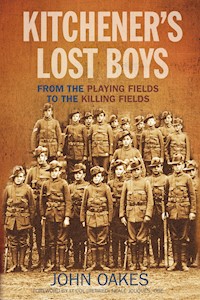
In the early days of the First World War, Lord Kitchener made his famous appeal for volunteers to join the New Army. Men flocked to recruiting offices to enlist, and on some days tens of thousands of potential soldiers responded to his call. Men had to be at least eighteen years old to join up, and nineteen to serve overseas, but in the flurry of activity many younger boys came to enlist: some were only thirteen or fourteen. Many were turned away, but a lot were illegally conscripted, and as many as 250,000 underage boys found themselves fighting for King and Country in the First World War. Over half would never return home. In this groundbreaking new book, John Oakes - whose own father-in-law walked out of the Welsh valleys to join the Royal Navy at the age of fourteen - delves into the complex history of Britain's youngest Great War recruits. Focusing on the recruitment crisis of 1914, he reveals why boys joined up, what their experiences were and how they survived to endure a lifetime of memories. For those who didn't, an unknown grave awaited, and in some cases their mothers never knew what had become of their children.
Das E-Book können Sie in Legimi-Apps oder einer beliebigen App lesen, die das folgende Format unterstützen:
Veröffentlichungsjahr: 2011
Ähnliche



















KITCHENER’S LOST BOYS
KITCHENER’S LOST BOYS
FROM THE PLAYING FIELDS TO THE KILLING FIELDS
JOHN OAKES
First published 2009
The History Press
The Mill, Brimscombe Port
Stroud, Gloucestershire, GL5 2QG
www.thehistorypress.co.uk
This ebook edition first published in 2011
All rights reserved
© John Oakes, 2009, 2011
The right of John Oakes, to be identified as the Author of this work has been asserted in accordance with the Copyrights, Designs and Patents Act 1988.
This ebook is copyright material and must not be copied, reproduced, transferred, distributed, leased, licensed or publicly performed or used in any way except as specifically permitted in writing by the publishers, as allowed under the terms and conditions under which it was purchased or as strictly permitted by applicable copyright law. Any unauthorised distribution or use of this text may be a direct infringement of the author’s and publisher’s rights, and those responsible may be liable in law accordingly.
EPUB ISBN 978 0 7524 7576 9
MOBI ISBN 978 0 7524 7575 2
Original typesetting by The History Press
CONTENTS
Acknowledgements
Foreword
Introduction
1 The Sacrificial Schoolboy
2 Why They Chose to Fight
3 One Hell of a Lesson
4 Recruiting Fever
5 Training for Armageddon
6 School for Sacrifice
7 Outstanding Debts of Courage
8 A Land Unfit for Heroes
Appendix: A Time Line of the Main British Engagements on the Western Front (1914–1918)
Endnotes
Select Bibliography
ACKNOWLEDGEMENTS
Without my wife’s close and detailed scrutiny, my work would be totally unreadable. That she may have been able to rescue something of value is a tribute to her patience. To those of The History Press who have done their best to rescue the rest, including Robin Harries and Abbie Wood, I offer apologies and thanks in equal measure.
In 2002, Dr Martin Parsons and I became interested in the motivation of young officers in combat regiments during the Great War. With the enthusiastic support of Paul Holness, we gathered evidence and published the results in 2003. The work we did then has provided the basic research for this book and my debt to Martin and Paul is, I hope, repaid herein.
Chris Widdows of the Old Redingensians, and late of the Honourable Artillery Company, has been patient and generous with his time, especially in the search for illustrations. Ken Brown, the archivist of the Old Redingensians Association, is also due many thanks.
The Principal and his staff at Reading School have generously allowed me free access to the school library and archives. It will be obvious that my debt to The Times archive is enormous. These two sources have provided much of the primary evidence on which this book is based. Lt. Colonel Leslie Wilson of the Queen’s Royal Surrey Regiment Association has given me permission to publish the valuable letter written by Edward Dwyer VC.
I have benefited from the kind advice of a number of people. Amongst them are the historians Ned Holt and Peter Hurst, and the horseman, Peter Cox. It was Sophie Bradshaw’s idea which has evolved into this book.
FOREWORD
by Lt Col (Retired) Neale Jouques, OBE
The British Joint Services Command and Staff College is housed in a striking purpose-built building at Watchfield, near Swindon. It has combined the higher command and staff training schools of the three military Services with training for MoD civil servants and foreign students from military forces across the Globe. I was privileged to attend as one of the first students of the new college in 2001. The modern construction is based around a vast circular atrium and stretching out east and west of this core is a long, spine-like corridor, some three storeys high, from which the various lecture theatres, syndicate rooms and accommodation are found. The many inspiring and traditional military paintings inherited from the individual Service colleges would have been lost in such a cavernous space and so the decision was taken to fill the blank walls with a dozen vast prints taken from military photographs of the last one hundred years.
The scale and setting of these images rendered them even more striking and even those views that I had seen before gained a new impact, but one image always drew my eye as I walked past it every day and has remained indelibly etched in my mind since then. It was of a group of soldiers from a Scottish regiment, huddled together against the backdrop of the battlefield of the Western Front. Their demeanour, equipment, shrouded kilts and the grim setting exuded a resolute weariness but somehow the image and emotion captured in each magnified face tells more; a tableau of hope, humour, humanity, comradeship and determination. As a modern soldier I have always been fascinated by the First World War, not for the tales of dramatic battles but in admiration of the individuals who endured the trials of the trenches. Unlike any other episode in Britain’s military past, cinema, literature and historical study have focused on the human tragedy of the ‘war to end all wars.’ It is embodied in the annual Poppy Appeal, albeit that over time pathos has seemed to subsume the important element of learning from what has gone before, and the populist view of ‘lions led by donkeys.’ I have always been somewhat sceptical of such absolute assertions. Certainly there were some poor commanders – just as there have been in many conflicts before and after the First World War – but equally there were many brave and effective ones. I also look to the attrition inflicted on Allied Forces in the journey from Normandy and Kursk to Berlin as evidence that this was not the only example in history of total war and its human cost.
But what has intrigued me the most about the 1914–18 war are the motivations and qualities of the soldiers who participated – personified by those twenty or so faces on the wall of the Staff College. The suggestion that so many thousands were collectively duped or had somehow sleep-walked into Armageddon has always struck me as an insult to the memory of our forbears. Certainly, they were living in a society that had become accustomed to British Forces being engaged in conflicts across the World and the realities associated with participation. These were people with hopes like any of us, who were prepared to forsake their livelihoods and aspirations for a greater good.
Perhaps in the modern age of the individual, such a concept might appear somewhat alien, and the passage of time means that the survivors of the First World War are sadly dwindling. Their firsthand accounts have always been modest and matter-of-fact, which has only served to stimulate my interest. How could such men steel themselves for the rigours of trench life, to be placed in harm’s way time and again and cope with the loss of so many comrades?
I have served in every conflict area the British Army has been engaged in over the last twenty years, most of which have been policing-type roles with only fleeting and abstract threats and experiences. It was not really until 2006 in Helmand Province, Afghanistan, that I came even close to the insight that had eluded me previously of what drove those troops in Flanders. As we now witness in the media, the British Army is engaged in a challenging and protracted counter-insurgency warfare of an intensity not experienced since the Korean War. Daily, servicemen and women play a cat-and-mouse game with the Taleban, witness the loss of comrades, enter areas in the knowledge from electronic chatter that the enemy is preparing to attack, and return to areas where friends have fallen. Their efforts have drawn support and admiration from a public unused to the hardships of war, yet what sustains them is not the knowledge of what is going on back at home or some false bravado that, if it exists at all, is extinguished in the first contact. It is a sense of duty, comradeship and the stoicism that has prevailed on many a foreign field throughout history. In that sense, I believe we have a new-found affinity with those faces from the trenches and can relate to them as individuals. Equally, I have come to believe that we are not so far removed from them as we might think or be led to believe; those values and qualities displayed by past and present soldiers alike, however publicly unfashionable, still course through our culture.
I first met John Oakes when he taught me Biology in my second year at Reading School. The initial impression he gave was of a somewhat severe and distant soul but over time it was evident that he was passionate about his subject, the development of the boys he taught and the school itself. He was fiercely loyal, rightly proud of his Service past and tempered that initial impression with humility and good humour. In a sense he was the absolute embodiment of a school that for 800 years had championed education, character and principles in anyone fortunate to become a pupil. It was the late 1970s and grammar schools – and I suspect many of the teachers working within them – were regarded as something of an anachronism. Yet he, and the School, remained true to its values and do so still today. This is why it seems so entirely apt that John should have prepared a book on pupils past and their experiences in the First World War. In so doing he has brought them alive as individuals, as team members, added colour to the images of those times and paid homage to their motivations and selflessness. His painstaking research and accounts of real people serves as a telling reminder of the human aspect of the First World War, even as it fades further into history, and a reference point for the corresponding attributes illustrated by members of our Armed Forces today.
INTRODUCTION
They send some funny people over here nowadays.
I hope we are lucky and get a youngster straight from school.
They’re the kind that do the best.
Osborne, speculating about a new officer in March 1918 (quoted in R.C. Sherriff, Journey’s End.)
There were well over 250,000 underage soldiers in Kitchener’s new armies during the First World War. In the early stages of the war, numerous young men left their public schools and were granted commissions in the army. Required to lead their men from the front, a disproportionate number of these young officers were killed or wounded. Thousands of them suffered from shell-shock. Many fought brilliantly and gained gallantry awards. Some of their stories are recounted in this book.
Why were they there? As usual, the simple question produces numerous answers which pose more questions. These lead into the special nature of male adolescence, the prevailing state of public opinion, the pay rates of recruiting sergeants, the efficiency of examining medical officers, the overwhelming rush of volunteers during the first months of the war and the confusion surrounding the first efforts to accommodate and train them.
In the course of investigating these matters, it became clear that there was a long history of recruiting very young men into the British Army. What is more, there had been a similar recruitment of adolescent men into the Imperial Yeomanry during the Boer War. This was an uncanny precursor to the recruiting shambles which occurred during the opening months of the First World War. As far as I am aware, no one has yet examined this connection.
Why were the underage recruits not found and sent home? Firstly, they had lied about their age and their relative youth may not have been easy to spot. Many young officers were only in their teens anyway. There are other reasons, some of which have to do with the huge bureaucratic machine which supported the army at war.
The British people embarked on the First World War imbued with an imperial vision tempered by Edwardian liberalism. The army was still largely Victorian in outlook. The necessary reforms to its command structure had only been in place for a few years and its most recent combat experience had been gained in the Boer War. In fact, the principal commanders in the early stages of the war – French, Haig and Hamilton, for example – had come to prominence during the great cavalry actions in the South African veldt. The chief of the Imperial General Staff, Lord Robertson – the man charged with converting the government’s will into military action – had himself been an underage recruit. He, too, had practised his staff work in the Boer War.
Mass volunteering for Kitchener’s new armies was possible because there was a set of conditions in Britain, including the presence of Lord Kitchener himself, which had not existed before and will never be repeated. A significant number of the British people, like their prime minister, H.H. Asquith, were under the delusion that they could win the war and carry on with business as usual. Imbued with imperial ideology and not hitherto challenged with any force, the British were shocked by the opposition that their war in South Africa had engendered and resented the German Kaiser’s political and military support for the Boer republics. From this point onwards, the taint of paranoia infected the collective British mindset and it became pronounced in the summer of 1914. A naval arms race, instigated by the Germans to threaten British sea power, had increased the developing ‘Germanophobia’.
There was a general ignorance of the maintenance and management of mass armies and a lack of industrial preparation for the modern war which was to emerge. The British had always won their wars, but against inferior opposition. They looked upon the German Army as laughable. New army recruits were surprised when they received their first induction into trench warfare to be told the Fritz was a good soldier, not a comic opera buffoon.
The bellicose atmosphere at the time of mobilisation in 1914 was palpable. A flush of imperial optimism followed Kitchener’s call for 100,000 volunteers for his New Army. Among many manifestations of patriotic fervour, some of the faded glamour of Queen Victoria’s golden reign was still discernable. Some notable Boer War ‘Dug Outs’ emerged to try to revive one of the most famous irregular corps of the South African conflict. On 13 August 1914 they placed a notice in The Times which read:
Lord Roberts and Lord Ridley have joined the Committee of the revived Imperial Light Horse, and General Sir Bindon Blood will be the selecting officer. Enrolments are being made at 3, St James’s Street, S.W. Old Members of the regiment are asked to communicate with Mr. J. Fergusson at 3 Neville Street, S.W.
The Imperial Light Horse claimed a connection with the infamous Jameson Raid mounted by Cecil Rhodes’ right-hand man, Dr Leander Starr Jameson. This was the quixotic and doomed raid which so spectacularly failed to achieve a coup in the Boer Republic of the Transvaal in January 1896. The idea that a number of ex-colonial mounted infantrymen would dash out to Belgium to face the might of the German Army in 1914 is ludicrous in hindsight, but the advert was serious enough and Lord Roberts was one of Asquith’s early military advisors.
There is a contemporary picture which illustrates the point for us. Each year on the monarch’s official birthday, the ceremony of Trooping the Colour takes place on Horse Guards Parade. The Foot Guards, dressed in uniforms designed in the Victorian era, execute drills evolved to manoeuvre large bodies of disciplined soldiers to deliver volleys of musket balls. The cavalry regiments manoeuvre their horses at the walk and the trot in formations which were appropriate for the Charge of the Light Brigade in the Crimean War. The King’s Troop of the Royal Horse Artillery trots past the monarch on its superb horses towing obselete but much-revered guns. The monarch’s lesser family watches the military pageant from the old commander-in-chief’s room in Horseguards, the antiquated warren of offices which used to be the army’s headquarters in Victorian times.
Officers from foreign armies and diplomats from strange governments are permitted to watch and admire from stands close to the monarch. It is only after the great parade is over and the ordinary people join in the procession up the Mall to Buckingham Palace that the Royal Air Force, formed at the very end of the First World War, flies over The Mall in the hugely expensive aircraft of the modern war which can deliver bombs with pinpoint accuracy. The contrast is enormous.
It was the Victorian army, as exemplified by the ceremony of Trooping the Colour, that the Lost Boys joined. It had always recruited its best soldiers when they were teenagers. It saw no reason to change its ways, until the old army died in the Ypres Salient and the terrors of modern warfare came home to haunt the British people. The Victorian army was left behind and the modern army, more akin to that which takes the field of battle today, was born. It was realised that the trenches were no place for boys to be but it was too late. There were not enough men left and a conscript army was filled up with lads of eighteen who had been fished out of their homes to fight the last battles of the war. It was at this stage that a large number of boys, too young and naive to fight, were dragooned into the trenches.
This book examines reasons why young men volunteered in droves to fight the Germans and how they trained and were transported to the front. By means of their letters, we are able to get into their way of thinking and experience a little of their life in combat – and the aftereffects on their minds. Some of the myths which have grown up around them are examined briefly, as is the tardy way they were demobilised. Finally, the prospects they faced when they got home are given some thought because it was not a land fit for heroes to which they returned.
1
THE SACRIFICIAL SCHOOLBOY
But youth’s fair form, though fallen, is ever fair,
And beautiful in death the boy appears,
The hero boy, that dies in blooming years;
In man’s regrets he lives, and woman’s tears,
More sacred than in life, and lovelier far,
For having perished in the front of war.
Tyrtaeus c. 600 BC.
Translated by Thomas Campbell (1777–1844).
‘Rupert Brooke is dead’ wrote Winston Churchill in a brilliant obituary appearing in The Times on Wednesday 26 April 1915.
A telegram from the Admiral at Lemnos tells us that his life has been closed at the moment when it seemed to have reached its springtime. A voice had become audible, a note had been struck, more true, more thrilling, more able to do justice to the nobility of our youth in arms engaged in the present war than any other – more able to express their thoughts of self surrender, and with a power to carry comfort to those who watch them so intently from afar. The voice has been swiftly stilled. Only the echoes and the memory remain; but they will linger.
During the last few months of his life, months of preparation in gallant comradeship and open air, the poet soldier told with all the simple force of genius, the sorrow of youth about to die, and the sure triumphant consolations of a sincere and valiant spirit. He expected to die: he was willing to die for the dear England whose beauty and majesty he knew; and he advanced towards the brink in perfect serenity, with the absolute conviction of the rightness of his country’s cause and a heart devoid of hate for his fellow men.
The thoughts to which he gave expression in the very few incomparable war sonnets he left behind will be shared by many thousands of young men moving resolutely and blithely forward into this, the hardest, the cruellest, the least-rewarding of all the wars that men have fought.
No doubt Churchill was genuinely saddened by Brooke’s death but there is room to suspect that he had a further motive for writing so movingly about a young officer at the time of the Gallipoli landings. He had led the faction in government which had proposed the attack on the Turks, who had entered the war on the side of Germany and the Central Powers. It was a tremendous gamble. The strategic objective was the Turkish capital of Constantinople, the city which commanded the links between Europe, Asia, the Black Sea and the Mediterranean. The objective was to be achieved by an amphibious landing on the beaches of the Gallipoli Peninsula, which dominated the Dardanelle Straits leading to the Sea of Marmora and the Bosphorus.
Churchill’s eulogy helped to establish the myth of youth, which was growing around Rupert Brooke. It was also, in modern terms, a spin doctor’s coup. It moved the propaganda war forward by glorifying the notion that it was good and right for the young to die for their country. The influence held by novels, boys’ own papers, popular songs, films, posters, cigarette cards, postcards, school books and commercial advertising over adolescent minds in the years preceding the First World War is worth further exploration.
The power of poetry used in the manipulation of public opinion at that time cannot be overlooked. Poetry and fiction had a disproportionate effect, by feeding the imaginative appetites of its readers. It had an emotional and long-lasting impact by becoming incorporated in its reader’s inner personal narrative. It was hard to escape its effect without conscious intellectual effort and most people were not intellectuals and had other things to do anyway. The popular poets and writers of juvenile literature, by validating the imperial warrior hero, helped to mobilise public consent for the declaration of war and for the recruitment of boys into the army.
The government was aware of the power of prominent authors and harnessed it once war had commenced. Kipling was one of several writers who joined the War Propaganda Unit (WPU) set up on 2 September 1914 by the Liberal MP, Charles Masterman, at the behest of David Lloyd George, then chancellor of the exchequer. Kipling wrote a small booklet for the unit entitled The New Army in Training, which will be discussed later. Kipling was just one of a number of prominent authors who lent their services to the war effort. Masterman persuaded Arthur Conan Doyle, John Masefield, G.K. Chesterton, Hilaire Belloc and John Buchan, among others, to write for him. In all, the War Propaganda Unit published 1,160 pamphlets. Though the WPU may have been an effective propaganda arm during the war, no such organisation existed before hostilities commenced. (Many prominent men, not just Kipling and his fellow authors, actively supported the war; they gave money to raise regiments, made speeches at recruiting drives and even gave up their houses as billets.)
Rupert Brooke has been called a war poet. This is a misnomer. He was a before-the-war poet and his influence on the recruitment of public opinion and on the youth culture of the day was significant. His rise to fame is worth charting.
In September 1914 Churchill, then First Lord of the Admiralty, was persuaded to use his influence and obtained a commission for Brooke in the Royal Naval Division, which was to be despatched with the British Expeditionary Force to France. In the event, the RND was diverted to Belgium following an offensive by the Germans, led by General von Bosler, on 28 September 1914. Von Bosler’s force of five divisions, with its 173 guns, began firing upon the outer south-east forts defending the city and port of Antwerp. The British cabinet was greatly concerned; if Antwerp was captured by the Germans, they might be able to take the French channel ports, making it near impossible to land British troops and supplies for the war in France and Belgium. Consequently, the British government decided to send a division of troops to assist in the defence of the city.
On 2 October the Germans penetrated two of Antwerp’s forts, and Churchill was sent to the city to report on the situation in person. Leaving London that night, he spent three days inspecting the fortifications around the city. He reported to Kitchener on 4 October that Belgian resistance was weakening, and Kitchener despatched the British relief force to Belgium. Landing at Ostend on 6 October, it was too late to save Antwerp. The city was evacuated the following day and its Belgian military governor formally surrendered on 10 October. The British intervention prolonged the defence of Antwerp for a few days and Rupert Brooke was a participant in one of the first British engagements of the First World War.
After Antwerp, Brooke wrote of his passion for war in an explicitly youth-oriented sequence of sonnets which he called ‘1914’. They were a call to arms for his generation and they articulated sentiments held by a significant number of young male adolescents. One stanza of his sonnet, ‘The Dead’, glamorised the sacrificial schoolboy and had a disproportionate effect on the mobilisation of consent, a key factor in the manipulation of public opinion:
Blow out, you bugles, over the rich Dead!
There’s none of these so lonely and poor of old,
But, dying, has made us rarer gifts than gold.
These laid the worlds away; poured out the red
Sweet wine of youth; gave up the years to be
Of work and joy, and that unhoped serene,
That man calls age; and those who would have been
Their sons, they gave their immortality.
On St George’s Day, 23 April 1915, Rupert Brooke died of blood poisoning resulting from a mosquito bite while on his way with the Royal Naval Division’s Hood Battalion to take part in the Gallipoli landings. Dean Inge read out one of his sonnets, ‘The Soldier’, from the pulpit of St Paul’s cathedral on Easter Sunday 1915:
If I should die, think only this of me:
That there’s some corner of a foreign field
That is forever England. There shall be
In that rich earth a richer dust concealed;
A dust whom England bore, shaped, made aware,
Gave, once, her flowers of love, her ways to roam,
A body of England’s, breathing English air,
Washed by rivers, blest by suns of home.
And think, this heart, all evil shed away,
A pulse in the eternal mind, no less
Gives somewhere back the thoughts by England given;
Her sights and sounds; dreams happy as her day;
And laughter, learnt of friends; and gentleness,
In hearts at peace, under an English heaven.
This was no new concept arising out of Brooke’s poems and Churchill’s intervention but, like all effective propaganda, it exploited and legitimised a widely-held sentiment. It is easy to find it exhibited in the obituaries of too many boy soldiers. Here are some of those published in the Roll of Honour in The Times.
Second Lieutenant Dudley Hurst-Brown, R.F.A., who died on June 15th from wounds received the same day in Flanders, was 18 years old on June 8, … He was educated at Cardwalles, Maidenhead, and Winchester, where he was in the O.T.C., and it was his intention upon leaving Winchester in the autumn of this year to proceed to Oxford and enter the Army through the University, the same as his elder brother, but, war breaking out, he immediately offered his services and received his commission in the Special Reserve on August 11, 1914. He was at the front for five months, during which time he went through some of the most severe fighting, but escaped injury until receiving his fatal wound. In his letter received the day before his death he stated how glad he was to be at the front, although the fighting was becoming frightful and that he saw little chance as a junior officer of ever getting safely home again, and concluded the letter with the famous Latin epitaph of Horace, ‘Dulce et decorum est pro patria mori’.
Dudley Hurst-Brown had left his schoolroom to fight at the age of seventeen. He knew he would die but was motivated by the prospect of honourable sacrifice.
A further search at random among the obituaries in The Times for July 1916 all too easily reveals boys who went straight from school into the army and thence to the killing fields. In common with Dudley Hurst-Brown, they were often public schoolboys who had been in the Officer Training Corps:
Lieutenant Alexander James Begg, Highland Light Infantry, who died on July 10 of wounds received on July 1 … he was awarded the Military Cross for conspicuous bravery in organising and carrying out a successful raid on the German trenches in April, when he was wounded. Educated at Glasgow Academy and Fettes College, he played in the football team and the fives team, and was a cadet sergeant in the O.T.C. He received his commission on leaving school in September 1915.
Lieutenant James Stanley Lightfoot Welch. Yorkshire Light Infantry … educated at the Preparatory School of Upper Canada College, Toronto and Yardley Court, Tonbridge, and at Rugby where he was a member of the O.T.C., and a scholar. In 1913 he was elected to an open scholarship at King’s College, Cambridge, and would have gone up to Cambridge in October 1914. When war broke out he applied for a commission, and was gazetted in October 1914, being promoted the following May. A letter from his commanding officer says that whilst he was leading his platoon against the enemy he was first wounded by a bullet and fell, but was immediately afterward killed by a shell. His last words to his platoon were Never mind me – carry on.
The Times, 13 July 1916.
A few days later and the following obituary appeared:




