


12,00 €
Mehr erfahren.
- Herausgeber: Icon Books
- Kategorie: Lebensstil
- Sprache: Englisch
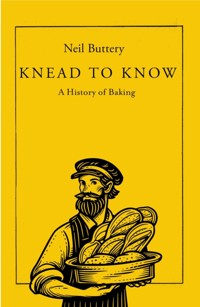
In Knead to Know: A History of Baking, food historian and chef Neil Buttery takes the reader on a journey exploring the creation, evolution and cultural importance of some of our most beloved baked foods, whether they be fit for a monarch's table, or served from the bakestone of a lowly farm labourer. This book charts innovations, happy accidents and some of the most downright bizarre baked foods ever created. Everything has a history, but food history is special because it tells so much about our culture and society, our desires and our weaknesses, from the broad sweep of bread creating human civilisation to the invention of the wedding cake, the creation of the whisk, the purpose of the fish heads in a star-gazy pie, or the fact that mince pies used to be meaty. When we think of the evolution of something, we think every step is an improvement, an incremental elevation toward some peak of perfection as technology improves. This is not always the case. Sometimes things have to become simpler, sometimes knowledge is lost and skills forgotten. As a baker of historical foods, Neil Buttery demonstrates that forgotten recipes and traditional techniques are worth trying out (and mention a few that should perhaps be left in the past). The reader will be inspired by the characters, creations and inventions of the past to be better and more adventurous bakers.
Das E-Book können Sie in Legimi-Apps oder einer beliebigen App lesen, die das folgende Format unterstützen:
Veröffentlichungsjahr: 2024
Ähnliche
















Published in the UK and USA in 2024 by
Icon Books Ltd, Omnibus Business Centre,
39–41 North Road, London N7 9DP
email: [email protected]
www.iconbooks.com
ISBN: 978-183773-121-3
eBook: 978-183773-122-0
Text copyright © 2024 Neil Buttery
The author has asserted his moral rights.
No part of this book may be reproduced in any form, or by any means, without prior permission in writing from the publisher.
Typeset by SJmagic DESIGN SERVICES, India.
Printed and bound in the UK.
CONTENTS
________________________________
INTRODUCTION
GRIDDLECAKES AND PANCAKES
First grains
Hearthstones, bakestones and griddles
Grinding grains
Anatomy of a grain
The oatcakes of Britain
Why so tasty?
Past pancakes
Posh pancakes
Wafers and waffles
King Alfred burns the cakes
Fannie Farmer and the cup system
Crumpets and muffins
A world of flatbreads
BREAD
Bread ovens
Medieval bread
The miracle of yeast
Sourdough starters
The need to knead
What’s your loaf?
Pizza
Italian breads
Shaping and cutting
Cottage loaves
Sticky buns
Hot cross buns
Pumpernickel, rye and ergot
French bread
Bagels and pretzels
Cornbread
Adulteration
Wartime bread
The great bread-roll debate
Christmas breads: stollen and panettone
The rise of soda bread
Doughnuts
Leftover bread
BISCUITS AND CAKES
Gingerbread
Shortbread
Flapjacks
The nation’s favourite biscuits
Teatime
Pound cake
Sponge cakes
Cake chemistry
Tea loaves
Brownies
Icings and glazes
Wedding cake
Simnel cake
The great cream-tea debate
Lemon drizzle cake
Chocolate cake
Red velvet cake
Cake or biscuit?: McVitie’s vs HMRC
PIES AND PUDDINGS
Coffyns and pasties
Types of pastry
Mince pies
Banqueting pies
Yorkshire Christmas pyes
Strange pies
Cornish pasties
Apple pie
Custard tarts
A caudle comeback?
Jam tarts
Treacle tart
Cheesecake
Eccles and Banbury cakes
Filo pastry
American pies
What is a pudding?
Bakewell pudding
Crumbles, cobblers and slumps
Baked custards
Yorkshire pudding
Sticky toffee pudding
Manchester pudding
The Denby Dale pie
PATISSERIE
Choux buns
Galettes and pithiviers
Confectioner’s custard
Let them eat brioche!
Babas and savarins
Croissants
Sugar
Whisks and whisking, mixers and mixing
Meringues
Pavlova
Macarons
Financiers
Chocolate
Chocolate logs
Charlotte Russe
AFTERWORD
ACKNOWLEDGEMENTS
BIBLIOGRAPHY & REFERENCES
NOTES
INTRODUCTION
________________________________
This book is an exploration of baking and its associated terminology, techniques, science and innovation as well as its important place in culture, all viewed through the lens of history. Taking a historical perspective doesn’t just give us an idea of what things were discovered when, it also gives us an idea of how our understanding of the science of baking has evolved. I could have chosen to write an encyclopaedia, but I believe the best way to understand most complex things is to see them evolve: the changes, the improvements, both expected and accidental. I hope, ultimately, that it will build upon your own understanding and intuition so that in the end you will be a better baker.
This brings me to the word evolution: when we think of such a phenomenon, we may think that every step is an improvement, an incremental elevation toward some peak of perfection. This is not always the case. Sometimes things have to become simpler, sometimes knowledge is lost, and skills are forgotten. It depends upon your perspective too, of course: are affordable factory-produced cakes, made of processed ingredients, with their indefinite shelf lives an improvement on a wonky homemade cake or not? The answer depends upon whether you are asking Mary Berry or Mr Kipling.
Names evolve and change as new foods are invented, but sometimes names don’t change as foods veer greatly from their previous forms, causing confusion. For example, if I ask you to imagine a cake, what immediately springs to mind? A nice cream cake, perhaps? A Mississippi mud pie? Or did you think of a fairy cake, or a Scottish oatcake? A Jaffa Cake? A bread cake? Tracing the history of these things helps us explain the similarities and the differences, the steps forwards and the steps back.
Much of this book draws on my own research, writing and cooking. I started writing my blog, Neil Cooks Grigson, where I cooked every recipe in Jane Grigson’s English Food, in 2007 as a hobby. I then moved to America in 2010 for my work as a scientist. There I continued cooking Jane’s recipes but also started a second (and much more popular!) blog, British Food: a History in 2011, so obsessed had I become with food history and traditions. My American friends enjoyed trying all the strange, foreign British food I was cooking, and without realising it, I had built quite a repertoire of skills and recipes. In 2012 I resigned from my job, moved back to Britain and started up my own artisan food stall. I had no special equipment beyond a food mixer, some baking trays, scone cutters and some pie tins. The market became a pop-up restaurant, became a bricks-and-mortar restaurant. The restaurant closed in late 2017 and since then I have concentrated more on research and writing about food and social history.
Baking has been a focus throughout my rather meandering career: baked goods are (as you will soon see) some of the most simple and complex of foodstuffs. They require skill and judgement to make, and they are beloved by all: you’d be hard pushed to find someone willing to turn down a delicious pie or baked pudding. Most importantly, many recipes require very little special equipment or paraphernalia to make.
Knead to Know is not a recipe book, but you will find recipes for many of the delicious baked goods mentioned in this book on my blogs – and many more that are not. At this point I must make clear my other inspirations, because they are the sources I have used to write this book. There are centuries of excellent cookery writing from individuals such as Robert May, Hannah Glasse, Elizabeth Raffald, Eliza Acton and Charles Elmé Francatelli to name but a few. I hope that, after reading this book, you hunt out their books and cook their recipes; in the main, their works are available online to download for free. There is also the great work of other food historians and writers like Alan Davidson, Ivan Day, Annie Gray, Peter Brears, Harold McGee, Regula Ysewijn, Sam Bilton, Laura Mason, Marc Meltonville, Glyn Hughes and Elizabeth David. All of my sources are given in the bibliography at the back of this book.
Tracking the evolution of anything complex inevitably results in the growth of evolutionary trees, with many branches diverging from major limbs to form new groups. As an animal that likes to compartmentalise, humans don’t like it when some things have a foot in more than one camp or when there are grey areas. Just when does pastry become biscuit, bread become cake? For this book to make sense I have had to split it into chapters, and you might not agree with the exact places I have drawn my lines, but we have to start somewhere. To that end, I have split the messy world of baking into the following subjects: griddlecakes and pancakes, bread, scones and cakes, pies and puddings, and patisserie. Each chapter is split into a series of short pieces, connected with the loose narrative of history in a way that is intuitive to me, and I hope will be to you. Each piece stands alone, so you can dip in and out, or read it from cover to cover, it’s entirely up to you.
Now you know my approach, let’s open our first can of worms with this question: What is baking?
It seems like an easy question to answer, doesn’t it? In modern parlance, it’s anything cooked in an oven, and I am sure there are many foods we will agree are baked: pound cakes, brandy snaps, gingerbread, meat pies, pasties, crumbles, macarons. But then there are other things that are baked in ovens but are not found in a bakery or on TheGreat British Bake Off; our Sunday ‘roast’ joint is actually baked, yet it is very obvious (I hope) that roast beef shouldn’t be included in this book. Then there is a long list of foods that are not baked in ovens but would be remiss of me to miss out. I’m talking about crumpets, muffins, drop scones, pancakes, oatcakes and the like. As it happens, all of these foods are cooked upon a bakestone, directly over a fire, the invention of which precedes the oven by centuries. I am confident that you would agree with me that they should be included.
Then there is the most British of foods, the pudding. I am not suggesting for a second that black pudding should be included in the club; that would be ridiculous. But baked puddings like sticky toffee or Bakewell pudding have to be in there. And what about the hundreds of boiled and steamed puddings like Christmas, treacle and jam roly-poly pudding? And let’s not forget their fried cousins: jam doughnuts and yum-yums. There’s ice cream, jellies and all sorts of foods that might be included too. These are not baked but we think of them as all within the same realm. That said, I have largely chosen not to include these foods, simply to help narrow things down a bit; and so, all of the foods described in this book are baked either in an oven or on a griddle. Those are my rules, I just wonder how well I will stick to them.
GRIDDLECAKES AND PANCAKES
________________________________
I have laid out what I have and have not counted as baking in the introduction, so now we can begin our origin story properly, and ask ourselves: ‘What was the first thing to be baked, and how was it achieved?’ I hope I am on fairly solid ground when I say that the stuff – the raw ingredients, as it were – must have been some flour mixture of one or more grains: wheat or barley most likely. Grains had been toasted and cooked in pots of water before someone had the idea of grinding them up first, this we know. Grinding is a natural progression from roasting; if you have ever toasted your own grains or whole spices, you will know just how brittle and easy to break they are, and just how delicious they taste when broken. Combining cooking with grinding was an extremely important notion: cooking breaks down a food and liberates nutrients, making it easier to chew and digest; in science-parlance, the food is more ‘nutritionally available’. Grinding or crushing is like pre-chewing, making the food quicker to cook and easier to ingest. When mixed with water, the starch and gluten inside a cereal grain can mix to form simple batters. These batters could be made into porridges or gruels, or the basis of soups, but how were they baked? It has been long established that from some time in the Mesolithic Age (10,000 to 8,000 BCE) fires were built inside rings of stones, which eventually became hot. However, archaeological evidence from the Black Desert, Jordan, in 2018, moved the date back 2,000 years. Remnants of flatbreads cooked by a hunter-gatherer society on flat stones were unearthed and analysed and were found to contain wild wheat and barley and mashed roots.
Stone is a poor conductor of heat, but once it is hot, it remains hot for a long time, and a blob of dough or a thick batter will cook very well on a flat stone. After this discovery – perhaps by accident – flatter stones were chosen and they were worked to be smoother. The first bakestones were made, and humans got their first taste of hearthcakes, the origin of all baked goods.
Processing and cooking carbohydrate, protein and nutrient-rich wholegrains changed the course of human history: nomadic tribes settled in a single spot in order to grow more of these cereals. The hunter-gatherer had become a farmer and from this point, villages, then towns and cities – civilisations – would form. This meant humans would become more and more dependent upon these grains and better at cooking with them. They also became better at processing and refining them, and at the same time were able to select the plants with the highest yields, domesticating them. Grinding and cooking them maximised the nutrition inside those plants. This could be achieved by making gruels of course, but with baking, you get something extra: toasty crusts, soft and fluffy interiors.
Archaeological digs at and around Stonehenge have revealed that the people who lived and probably celebrated or worshipped here certainly ground wheat, grew a lot of hazelnuts and spent a great deal of time searching for honey. Simple cakes made with ground wheat, ground hazelnuts, honey and probably a little water have been cooked up on hearthstones and found to be not only very ‘nutritionally available’ but also very delicious.
FIRST GRAINS
In recent decades the variety of foods we consume has gone through somewhat of a bottleneck, and this is certainly true for the different types of grains, and flours made from them. There was a time when most British communities grew several different cereals, the precise proportion of wheat, barley, oats and rye dependent upon locale. Cereals were first domesticated in a bow-shaped strip of land sitting across what is today the Middle East, somewhere around the eighth and seventh century BCE. This large strip is known as the Fertile Crescent. Here barley and wheat (and pease*) were the first to be grown, with rye and oats coming later. Two key changes also occurred in the farming and selection of barley and wheat. On the stalk of cereals, each grain is covered by an outer husk which must be removed (shilled); these skilled farmers managed to produce strains that were ‘naked’, i.e. had a husk that easily shilled itself before harvest time. Second, the ‘ears’ of corn and barley were bred to cling more tightly to their stalks and not blow away in the wind as the wild types do; grasses disperse their seeds via wind, so it’s an adaptation they have naturally, one that humans have managed to undo.
Let’s have a look at the four main cereal crops in turn:
1.Barley spread like wildfire out of the Fertile Crescent through communities and countries because of its hardiness and ability to adapt to novel environments, and it has been successfully grown from the Artic Circle to the tropics. It has been ground into flour and made into a variety of cakes and breads in Ancient Babylonia, Egypt, India and the Mediterranean. It was the bread of choice in ancient Rome until it was superseded by wheat. Barley breads and griddlecakes were commonly eaten throughout Britain before the twentieth century, though these days it is grown mainly for the beer and whisk(e)y industries.
2.Rye was originally considered a weed and it followed wherever barley and wheat led, much to the annoyance of farmers. It was only domesticated around 1000 BCE when it was realised that it grew well in poor soils and cold climates, and because of this it became a key crop across northern Europe. Rye was grown across Britain from the early medieval period, though more for its stalks than its grain, because they made for excellent thatching for roofs. Rye is the traditional flour in French pain d’épices and Germanic pumpernickel. Its short-stranded gluten molecules make it suitable for griddlecakes and pancakes. Rye was so popular in Germany that wheat production only overtook it in 1957.
3.Oats were the last of the true cereals to be domesticated, and were, like rye, considered a weed, but their ability to thrive in cold, wet environments made oats a favoured crop in Northern England, Northern Wales, Scotland and Ireland and – again, like rye – was cultivated from the early medieval period. A great variety of griddlecakes emerged from these regions as a result.
4.Wheat is considered the king of cereals – at least in the Western world – and this is because of its gluten: not only does it contain a large amount of it, but the gluten chains are longer than other cereals’, making griddlecakes and bread more bouncy and doughs easier to handle. Its cultivation was comparatively low across medieval Europe because it was difficult to grow in wet conditions. This made wheat rare and therefore gave it status.
The first wheat to be domesticated was called einkorn. It has two sets of chromosomes (this is the DNA we receive from our parents, one set from mum and one from dad), which makes it a diploid (‘two-sets’) organism.* At some point, it hybridised with a wild goosegrass to produce a new species. Hybridisation is common in plants and means that the plant then receives sets of chromosomes from two species, producing a hybrid with four sets of chromosomes (a tetraploid). From these plants, emmer and durum wheat were created. The former preferred arid conditions and was taken to Africa, while the latter was used in Europe for pasta. Then the tetraploid domesticated wheat hybridised again with another species of goosegrass, producing a variety of wheat with six sets of chromosomes (it was now hexaploid). From this new form of wheat, spelt was derived, and all modern wheats are derived from this hexaploid ancestor. Why? The hybridisation is key: there was a huge amount of genetic variation trapped inside, so many different strains could be created. Today 30,000 varieties of wheat are actively grown. Of all wheat grown around the world, 90 per cent of it is hexaploid, and coming in second place, just a smidge under 5 per cent, is tetraploid durum for pasta.
HEARTHSTONES, BAKESTONES AND GRIDDLES
Cooking on a flat piece of stone, as opposed to cooking in a pot, meant that instead of having a liquid gruel or thick porridge, you had a solid cake cooked on a hearthstone that was portable, could be eaten with fingers, passed around and wrapped around other foods. It could soak up the juices from meat, it was brown and toasty. Hearthstone cooking was, simply, more versatile and more delicious, and the products from the bakestone have been enjoyed for millennia. One of the reasons foods cooked on bakestones or griddles have endured is simplicity: a flat, hot surface can be made by just sweeping ash away from a hearth and cooking some dough straight on it. Eventually folk started to make bakestones (or bakstones in Northern England and Scotland) from ‘thin slabs of any locally available stone which could withstand the heat of the fire’.1 However, from the Elizabethan Age, most common were the cast-iron griddles (or girdles in Northern England and Scotland). Curiously, in some regions, they retained the name of bak(e)stone, despite the fact that the material they were made from had changed. The great benefit of iron is that it can be fashioned into a variety of shapes. The standard shape, however, quickly became a round disc with a large, curved handle reaching right over it, perpendicular to the base: this meant that you could move it without burning yourself and that you could hang it over a fire.
Bakestones and griddles are still used today, but they have been taken over by other, perhaps more versatile implements like cast iron skillets. In the UK the making of a good griddlecake or pancake is a skill on the wane – aside from the annual Pancake Day crêpe, how often do we cook some of these up? It seems almost inconceivable that we might knock up a batch of muffins at home. Griddlecakes and pancakes were once the backbone of the country, especially for the working classes; ovens were expensive pieces of kit, and their social rank may not have allowed them to have one installed. Even then, they were only really good for baking large fluffy bloomers of wheaten bread, an expensive cereal compared to the other ones: ‘one of the great points about … all of the tribe of griddlecakes,’ wrote Elizabeth David, ‘was that they provided a means of using meals and flours such as barley, buckwheat, oatmeal, which are not suitable for bread proper.’2 Indeed: low or no gluten-containing flours, if forced into the shape of a large bloomer, would come out of the oven as flat as, well, a pancake. You could have had your loaves baked in a public bakery, but even the more populous towns of Britain didn’t have one: Manchester was without one until well into the nineteenth century. This meant that, for a large proportion of the country, griddlecakes and pancakes were the only way of making baked goods at home and were a key element of the community. Scots baxter (baker) women would bake oatcakes on their hearths for those who worked too many hours to bake them themselves.
There are some rules of thumb when it comes to using bakestones and griddles: they are tricky to use at first, and being made with stoneware or cast iron, they take a while to heat up, and a while to cool down. Scottish food historian F. Marian McNeill helps us out with some tips in her classic book The Scots Kitchen (first published 1929, second edition 1968). To test the heat, sprinkle it with flour: if it takes a few seconds to brown, you are good to go. She also tells us that ‘the girdle is floured for dough and greased for batter’. She emphasises that ‘only the best materials should be used’, and that dough should be handled as little as possible and ‘turned only once’.3 Every stage is important: sifting the flour twice, mixing it correctly and methodically, and – of course – the ingredients must be of excellent quality. As with all ‘simple’ foods, attention to detail is of paramount importance.
They may not be the backbone of the country anymore, but those that have hung on are loved dearly today: Scottish, Derbyshire and Staffordshire oatcakes, wheaten farls, potato cakes, pikelets, crumpets, muffins, drop scones, bannocks, Welsh cakes, crempog las, crêpes. And then let’s not forget those that have been welcomed into our food culture from other countries: chapatis, tortillas, blinis, fluffy American pancakes. What variety! Our lives would certainly be less delicious without them, that’s for sure.
GRINDING GRAINS
In order for us to bake, our ancestors needed to grind their grains into meal, and up until the last 100 years or so, this was achieved by grinding them between stones. When we think of stoneground flour today, we perhaps imagine gently turning windmill sails on balmy autumn days, and we think of the flour produced as wholesome, the real deal.
The first evidence of humans using grinding stones goes back to Southern France, 10,000 BCE, where simple pestles and mortars have been discovered that were used to grind pigments, but we can assume too that similar instruments were used to grind other things such as grains. It wouldn’t have made a fine flour, more a crushed grain for gruels and porridges. The next step in the evolution of the mill is the saddle quern. It is an adapted pestle and mortar made especially for grinding grains, made up of a large, flat stone, with a depression in the middle that slopes down on two opposite sides – the saddle. Grain was strewn on it and was crushed by scraping a large stone rolling pin which was thicker in the middle over it. It was very hard work and was usually done by women. They have been depicted on Egyptian friezes, but they travelled and became popular as far away as neolithic Ireland. This quern spread throughout Europe and was used in many private dwellings in Britain.
Flour, as we think of it today, was first made using the man-powered rotary ‘hourglass’ quern, the origins of which remain obscure, but they were certainly being used in ancient Egypt. It was made up of a fixed, flat, round lower stone, with a second stacked on top, stabilised with an axle. Wooden arms protruded horizontally so that it could be turned (usually by slaves). The stones had grooved channels carved into them, down which good-quality fine flour cascaded. This was very efficient compared to the earlier types of quern, but it was limited by the strength of one’s own workforce. The next major change happened in the second century, when waterpower was harnessed to turn the top stone. These watermills were installed all over the Roman Empire, including England. The Romans left, but their mills remained part of early medieval life: there are 6,000 watermills listed in Domesday Book. The earliest found in the British Isles is in Tamworth and dates from the seventh century. The windmill was invented in Persia around 1000 CE. As trade and people moved westwards, so did ideas and technology, and in the case of the windmill it travelled to Britain via Holland and the Low Countries.
These water- and windmills used large stones, up to 1.5 meters in diameter and very heavy. The stones would often wear and chip, meaning that one’s flour came full of grit. Folk didn’t want to accidentally chip a tooth when eating their bread, so to avoid this, they sifted, or ‘bolted’, it. But this process of bolting also removed a great deal of the bran, so a softer, whiter flour was made. Bolting has been done by the Ancient Egyptians, so whiteness appears to be an ancient desire, not just a modern one.
In medieval Britain, where the majority lived under the thumb of a feudal lord, people had their access to flour highly controlled, and were forced to have their grain milled in a communal mill owned by the lord of the manor. The miller was usually employed by the lord, and for each sack of flour produced, they both took a cut. In many villages, the smaller home querns were banned, making it illegal to grind one’s own flour. It was also a pain to transport their grain across the village. Consequently, the village miller was usually intensely disliked by the community, and he certainly wasn’t the friendly, well-loved Windy Miller we might imagine him to be.
With the dismantling of the feudal system* and then the agricultural revolution of the eighteenth century and the industrial revolution of the nineteenth century, millstones were turned under the power of steam, and for the first time industrial quantities of flour were produced. Now, the limiting factor in flour production was the production of grain itself.
ANATOMY OF A GRAIN
It’s time for a brief biology lesson. There has been, and there will be much more, talk of starch, gluten, germ and bran. Let’s take a small sidestep and look at where all of these things lie within a grain of wheat. A grain is technically a fruit, not in the sense that an apple or a mango is a fruit, but in the botanical sense, because a fruit contains the germ, or embryo, of a plant as well as the nutrients to help that germ develop into a seedling. This may or may not be wrapped in a delicious layer of flesh; in the case of cereals, it is not. The nutritional part of the grain is called the endosperm and it is an elongated oval shape. It makes up the bulk of the grain, around 85 per cent. It is made almost entirely of carbohydrate and protein, and a great deal of that protein, especially in wheat cultivars, is gluten. The endosperm is wrapped in a thin casing just a few cells thick called the aleurone layer. It makes up a small proportion of the whole grain; however, writes Harold McGee, it ‘contain[s] oil, minerals, protein, vitamins, enzymes, and flavour out of proportion to its size’.
Stuck to the bottom of the endosperm is the germ, or embryo. It is very small, making up just 2 per cent of the whole grain, and is difficult to see when looking at a grain of wheat. However, the embryo of a peanut is very easy to spot; when the peanut is split in two, it sits nestled on the inside of the blunt end of one half of the nut. Like the aleurone layer, the embryo is small but packed with nutrients.




