


Erhalten Sie Zugang zu diesem und mehr als 300000 Büchern ab EUR 5,99 monatlich.
- Herausgeber: Old Pond Books
- Kategorie: Lebensstil
- Sprache: Englisch
The fresh waters of the British Isles are diverse, ranging from torrential hill streams to powerful rivers and wide, meandering lowland channels. Canals and drainage channels, ranging in size from ditches to the large Fenland drains of eastern England also hold fish, as do reservoirs, lakes, ponds and other still water bodies. The fish themselves are correspondingly varied. This pocket-sized book provides information about the 54 native, invasive and naturalised species found in the UK today, and includes a photograph of each to allow easy identification
Sie lesen das E-Book in den Legimi-Apps auf:
Seitenzahl: 65
Veröffentlichungsjahr: 2016
Das E-Book (TTS) können Sie hören im Abo „Legimi Premium” in Legimi-Apps auf:
Ähnliche


















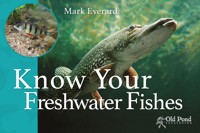
Know Your Freshwater Fishes
Dr Mark Everard
Acknowledgments
The author would like to thank all those who have given permission to use their photographs throughout this book to supplement my own images. Also to my friends at Old Pond Publishing for excellent support and high-quality production of what I hope will be an informative and enjoyable guide.
Contents
Introduction
Often, the eye does not penetrate the surface film of a body of water. This is a shame, as the freshwater flora and fauna of the British Isles is both diverse and spectacular. The freshwater fishes comprise the most charismatic group of organisms living out their lives underwater in Britain, occupying a range of habitats. The fresh waters of the British Isles are diverse, ranging from torrential hill streams to powerful rivers and wide, meandering lowland channels. Canals and drainage channels, varying in size from ditches to the large Fenland drains of eastern England also hold fishes, as do reservoirs, lakes, ponds and other stillwater bodies.
Adaptations and characteristics of freshwater fishes
All of Britain’s freshwater fishes breathe by passing water across gills, swim using fins and lay eggs. However, beyond this common feature, the body form of fishes often betray their preferred habitats and life habits. For example, fishes adapted to stronger flows – such as dace and trout – have streamlined body forms. Others better adapted for more control in sluggish or still waters, such as common bream, tend to have deeper bodies that are also more strongly flattened flank to flank. Fins also betray much of the life habits of fishes. For example, the dorsal (back), anal (rearmost of the fins on the underside) and tail fins of pike are located close together at the rear of the fish, providing it with the propulsive power to accelerate explosively to ambush prey. The pectoral (behind the gills) and ventral (beneath the belly) fins are paired, and are well-developed in fishes like the tench, providing more precise control during slow, gentle swimming as the fishes forage for edible items on the bed of still or slowly flowing waters.
The position, size and other features of the mouth too reveal much about the life habits of the fish. Bleak and rudd, for example, have mouths that are turned upwards, better suiting them to feeding from or near the water’s surface. By contrast, the mouth of barbel, gudgeon and the loaches is angled downwards, equipping them for life on the bed. Other fishes, such as chub and roach, have mouths positioned centrally, enabling them to readily exploit food items across a range of depths. The mouths of predatory fishes, such as pike and zander, are large and armed with teeth to help them hunt fishes and other live prey.
The bodies of most species of British freshwater fishes are covered in scales, bony overlapping plates providing both armour and flexibility. The presence or absence and the number of scales varies between fish families and species, and can be helpful in distinguishing between similar fish species. This is particularly true of the number of scales along the lateral line: a series of sensory pits along the flanks of most groups of fish.
A wide range of books is available for those seeking more detailed information about Britain’s freshwater fishes, including:
• Everard, M. (2013). Britain’s Freshwater Fishes. Princeton University Press/WildGUIDES, Princeton.
• Maitland, P.S. (2004). Keys to the Freshwater Fish of Britain and Ireland, with Notes on their Distribution and Ecology. Freshwater Biological Association Scientific Publication No.62. The Freshwater Biological Association, Ambleside.
British freshwater fish families
The fish fauna of the British Isles comprises not merely a diversity of species – 54 species including a number that are not truly freshwater residents but can be found in estuaries and lower reaches of rivers – but also fishes from 21 different families with quite different characteristics. The fishes in this guide are grouped according to the most common families.
The carp and minnow family(Cyprinidae) is most strongly represented in the British freshwater fish fauna, including 12 native species and seven additional species that have been introduced. The cyprinids have toothless jaws, bodies covered evenly by scales (excepting some scaleless, artificially reared strains), and a single dorsal fin supported by soft rays behind fused spines at the leading edge.
The salmon, trout, charr, freshwater whitefish and grayling family(Salmonidae) is the next best-represented family, including seven native species (one of which is considered extinct) and two introduced species. These salmonids have a slender, streamlined body shape adapted for fast swimming, with a fleshy adipose (or fatty) fin set towards the rear of the back. The jaws are armed with a single row of sharp teeth (except the grayling).
The perch family(Percidae) is represented in the British Isles by three species, two of which are native and one introduced. The percids possess two dorsal fins, the front one supported by strong spines.
The lamprey family(Petromyzontidae) is represented in British waters by three relatively scarce native species. The bodies of lampreys are superficially eel-like with a cartilaginous skeleton, no scales or paired fins, and a mouth without jaws but which comprises a circular disk.
The stickleback and tubesnout family(Gasterosteidae) comprises two native British freshwater species. The bodies of these small fishes are elongated, lacking regular scales though covered by scutes (large bony scales) along the sides, with the front dorsal fin modified into a series of well-developed spines.
The herring, shad, sardine and menhaden family(Clupeidae) includes two British species that live their adult lives in the sea but spawn in freshwater rivers.
A number of families are represented by just one species each in British fresh waters, including the pike family(Esocidae), the sculpin family(Cottidae), the loach family(Cobitidae), the river loach (or hillstream loach) family(Balitoridae), the hake and burbot family(Lotidae), the freshwater eel family(Anguillidae) and the sturgeon family(Acipenseridae).
Other fishes introduced to British fresh waters come from families such as the North American freshwater catfish family(Ictaluridae), the sheatfish catfish family(Siluridae) and the sunfish family(Centrarchidae).
Fishes from some other families are primarily marine, but may move into estuaries and can venture up into the lower reaches of rivers particularly during the summer, so are considered briefly towards the end of the book. These include three species from the mullet family(Mugilidae) and one each from the temperate bass family(Moronidae), the righteye flounder family(Pleuronectidae), the smelt family(Osmeridae) and the silversides family(Atherinidae).




