


11,51 €
Mehr erfahren.
- Herausgeber: Fernhurst Books Limited
- Kategorie: Lebensstil
- Sprache: Englisch
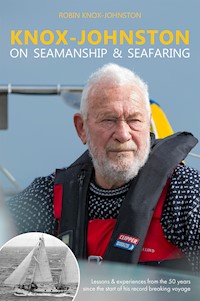
On 14th June 1968 Robin Knox-Johnston set sail from Falmouth to take part in the Sunday Times Golden Globe Race – the first, non-stop, single-handed sailing race around the world. He was an unknown 29-year old Merchant Navy Officer. Ten and a half months later he sailed back into Falmouth, the only finisher in the race and the first man to complete a non-stop solo circumnavigation. Since then he has had an illustrious sailing career, with 3 further circumnavigations, including the fastest circumnavigation and last racing solo round the world in 2007, aged 68. Few people have sailed as many miles as Robin. Now, 50 years since setting out in the Golden Globe Race, you can benefit from Robin's wealth of experience as he shares his thoughts on seamanship and seafaring in this new book, selected from his most provoking, insightful and perceptive writing from the pages of Yachting World magazine. The first half of the book concentrates on seamanship and looks at the skills and gear required. The second half allows Robin to reminisce on memorable boats, races and places he has experienced in his last 50 years of seafaring. The book starts with an original piece by Robin reflecting on the last 50 years. In his Foreword, round-the-world yachtsman, Alex Thomson says of the first half, on seamanship: "Anyone who ventures to sea would be wise to take advantage of the seamanship lessons that Robin has learnt." Of the second half, on seafaring, he describes the pieces as "a joy to read" and says that they "remind us that sailing is primarily a fun activity, to be enjoyed."
Das E-Book können Sie in Legimi-Apps oder einer beliebigen App lesen, die das folgende Format unterstützen:
Veröffentlichungsjahr: 2018
Ähnliche

















CONTENTS
Foreword by Alex Thomson
Introduction by Sir Robin Knox-Johnston
Part One: Seamanship
Skills
Your first ocean passage
Learning from others
Gaining experience is vital
Developing a harmonious crew
Minimising accidents
Making it safe below
Reviewing safety procedures & equipment
Taking heed of the weather forecast
Using waypoints
Obeying the COLREGs
Staying clear
Avoiding a collision
Keeping a lookout
Not over-relying on AIS
Using radar alarms
Throwing a heaving line
The art of anchoring
Unsnagging an anchor
Clearing the propeller
Manoeuvring into a berth
Towing techniques
Sailing safely
Coping with big seas & high winds
Testing MOB procedures
Dealing with medical emergencies
Transferring crew members
Gear
Solent syndrome
The rig
Attachment points
The anchor & its chain
Anchor equipment
Lifejackets
Safety harnesses
The liferaft & sea survival courses
Tool kit
Leadline
Sextant
Sun compass
Logbook
Part Two: Seafaring
Boats
Batavia’s longboat
Cutty Sark
Kate
Whalers
Square riggers
Metre classes
Classic boats
Dunkirk Little Ships
Lady Daphne
Trekka
Loch Foyle punt
Suhaili
MOD70
Races
Changes in single-handed racing
Round the world: Solo or two-up
Velux 5 Oceans Race
Vendée Globe
200th solo circumnavigation
Sydney Hobart Race
China Sea Race
Two-handed Round Britain Race
Round the Island Race
Cowes-Torbay-Cowes Race
Winter race on the Thames
Places
Southern Ocean
Cape Horn
North-West and North-East Passages
Durban
Bombay
Indian Ocean
Greenland
Les Sables-d’Olonne
Lerwick
Central London
FOREWORD
ALEX THOMSON REFLECTS ON SIR ROBIN’S CONTRIBUTION
Sir Robin Knox-Johnston has been my boss, my mentor and a close friend.
He selected me to be a skipper in the 1998 Clipper Race after a 2-month trial sail as his first mate on an expedition to Greenland with Sir Chris Bonnington. Despite being just 24 / 25 years old Robin selected me as a skipper in the Round the World Race when I had yet to even cross the Atlantic, let alone circumnavigate the globe. If I had failed in that race, the responsibility would have landed firmly on Robin’s shoulders. He never shared with me the personal risk he took with that decision and I did not realise until after the event, but if were not for him I would never have embarked on the journey I am now on.
Since then, we have remained close, with both our businesses based in Gosport, and I have even had the fun of sailing and zipping around in ZapCats with him.
I may have sailed faster than him single-handed, non-stop around the world, but such times will always be transitory – someone will always, eventually, go faster. He has the one record which no one else can have – he was the first! None of us professional sailors with our ultra-light and fast craft, now with foils, can ever take that away from him.
To be the first to do something like this takes incredible courage and perseverance. Many doubted it would be possible and, given that he was the only one to complete that first race, it very nearly wasn’t possible at that time. The boat and equipment he had were so primitive compared to what we use today and yet he succeeded when everyone else failed. It is easy to forget that he also built this boat with his own hands – something inconceivable today.
It took immense seamanship to complete that voyage, and he learnt as he went around. He has continued to sail and continued to learn, not least through training hundreds of amateurs to complete a round-the-world voyage. That is what makes this book so exciting – it contains many of the things that Robin has learned in the years since he set off from Falmouth in 1968. Anyone who ventures to sea would be wise to take advantage of the seamanship lessons that Robin has learned.
However, anyone who has met Robin also knows that he is not just a wise old seaman – he is also great fun and lives life to the full. This shows in the pieces on seafaring in this book where he tells of some of his favourite boats, races and places he has visited – always with a twinkle in his eye! They are a joy to read and remind us that sailing is primarily a fun activity, to be enjoyed!
As we approach the 50th anniversary of Robin’s epic first non-stop solo circumnavigation I salute him and urge you to read this book – both to learn and to be entertained.
Alex Thomson
June 2018
INTRODUCTION
SIR ROBIN REMINISCES ON THE PAST 50 YEARS
50 years seem to have passed so quickly, but when I look at my sport I realise that a great deal has happened in that time. It can be compared to the differences in aviation between the time of the Wright Brothers and the arrival of Concorde.
Yachting generally in the 1950’s and 60’s was seeing a large increase, although the number of international trans-oceanic voyages was still small. The introduction of glues used in aircraft production during the previous war for wooden aircraft created a DIY boatbuilding revolution. Dinghies could now be made at home using plywood, and special kits could be bought for dinghies such as the Wayfarer, Cartop, later called the Heron, and the simple, cheap and numerous Mirrors, of which more than 70,000 were built.
Access to cheap boats greatly increased the numbers of people involved in the sport and removed the stigma that yachting was a sport only available to the wealthy. Glass Reinforced Plastic (GRP), invented in the USA in the 1930s, began to have an effect on yacht construction in Britain in the 1950s. A precise female mould, into which glass mat or fibres bonded by resin are put, did not require the skills of a highly trained shipwright. Less skilled labour could be used using the same mould again and again. Soon larger yachts were being built using GRP.
Carbon fibre is almost de rigueur for racing boats these days, a material that was just being tried for aircraft half a century before and its use for spars has had a profound impact, allowing for much less weight in rigs and therefore an increase in stability, or a less heavy keel, which means a lighter and so faster boat. Whilst stainless steel rigging wires are still common, man-made fibres are making a big impact today.
Who could have foreseen foiling yachts? Multi-hulls have been around in Europe from the seventeenth century, although used centuries before in Asia and the Pacific, but they only really began to show their paces when the new materials came in. But now we can lift the hulls clear of the water and the lack of friction has created speeds unthought of just a decade ago. The first time I saw a Moth dinghy foiling I thought I was hallucinating until it whizzed past with hardly a sound. Fascinating for me, exciting for the sailor aboard.
The increase in the numbers of boat ownership has led to a huge change in where we keep our boats. A few marinas existed in the 1960s, but most boats were moored by their anchors or on swinging moorings and a lot of these moorings were controlled by Yacht Clubs. Having never sailed in the UK before, I returned from the Golden Globe Race and automatically assumed that, on arrival at a destination, one tied up to a yacht club and made oneself known, as in India and Africa. I quickly leant that this was only available to members of the club in the UK!
Sailing around the world 50 years ago, the boat was most likely constructed of wood, the sails of Dacron, rigging of plough wire, food in tins and water in tanks or caught in the sails from rainfall. Long voyages were still a rarity. The first of the modern trans-Atlantic races did not take place until 1960 and voyages around the world were cruises until Francis Chichester circumnavigated with one stop in 1966/7.
One problem at the time was that keeping sufficient provisions edible for long periods was not possible. Tins, the only way to store food, had to be protected as the voyage might last months. This meant coding them with paint, then removing their paper labels (which loved blocking bilge pumps) and finally coating them with varnish to keep them from rusting. Eggs needed to be varnished or coated with Vaseline and no vegetables lasted more than a couple of months. Most boats had leaks and, even if they were dry, the damp atmosphere quickly attacked fruit and vegetables and the tin coating, and eventually caused an inevitable hole which ruined the contents. The light-weight freeze-dried foods we can buy today were not even a dream.
Clothing was nothing like the smart sailing gear that is now available. Being permanently damp was the norm, especially in places like the Southern Ocean. One way I found of getting rid of the salt that inevitably built up in one’s clothes was to tow them astern in the sea. This reduced the density of salt at least! The Yellow Wellies had not arrived on the scene: agricultural Wellington boots were more the norm. Towards the end of my ten-and-a-half-month non-stop circumnavigation, my foul weather gear had lost all its waterproofing and was letting in so much water that I cut holes in the bottom of the boots to let the water out! It kept out most of the wind though.
Compass bearings of identifiable objects ashore were the main means of coastal navigation and radio direction bearings offshore if a Direction Finder was carried. In oceanic voyages you relied on Dead Reckoning and using a sextant when the sun, moon or stars could be seen (which meant no position was possible at night when the horizon could not be seen to act as the datum for taking altitudes).
Not many boats carry a proper chronometer these days but they were essential then. The rate of change of a chronometer, whether it was increasing or decreasing its error, was a vital piece of information, occasionally checked by medium frequency transmissions if a single-side band radio was installed. Or a small transistor radio could pick up broadcasts when close to land. A second out can mean a mile of error and after a couple of months across an ocean, if the chronometer drifted, land could arrive unexpectedly!
Communication was by radio, usually low powered, and contacting a shore station to make a call could take hours. If the liner Queen Elizabeth or HMS Ark Royal was trying to contact the shore station at the same time, unless you could get through on a different frequency, you might just as well switch off for a few hours as the power of their radios swamped the yacht’s puny signal. Conversations on the radio tended to be stilted as you knew that all the other ships awaiting their turn were listening in to what you said. VHF radios were almost unknown, but one could use an Aldis signal lamp to ask a ship to report one’s position if one was in sight, as most ships were able to communicate using Morse code.
Without a radio or sighting of a ship, a yacht could go unreported for months. In my case no one knew where I was after I passed New Zealand until I ran into a line of ships near the Azores 4½ months later. The comment from well-meaning people “Weren’t you worried when you were missing?” was countered by the honest answer that I was not missing as I knew where I was, I just had no means of telling anyone! Nor, of course, could I have called for help if I had got into trouble which meant one had to be more self-reliant.
Since then, of course, ocean sailing has been totally changed by the introduction of satellites. These have revolutionised communications and made sailing a lot safer. The tracking devices that are automatically updating the boat’s position via satellite mean that people ashore know exactly where the boat is and, if the boat has an emergency, it can transmit a signal it knows will get through regardless of low power and busy radio shore stations.
In shorter ranges, in place of the trusty Aldis signal light and the necessary knowledge of Morse code, we now have VHF radios which anyone can use since the Government restrictions on radio transmitters have been removed. And a simple addition to the VHF radio allows the connection to the Automatic Identification System (AIS): one of the greatest boons to the modern sailor. It means that not only can a boat see what ships are in range, what course and speed they are making and what type, but also the other vessels will pick up your own boat’s signal, greatly improving the chances of being seen and reducing the risk of being run down. Single Side Band (SSB) radios are now rarely used for long distance communications.
No one could have imagined the Global Positioning System (GPS) which can fix a boat’s position to within a couple of metres every 3 seconds. It has been a huge boon to yachting as it allows people to navigate with great accuracy without the need to learn the use of spherical trigonometry to calculate a sight reduction from sextant readings.
People who would never have considered a long voyage 50 years ago can now navigate oceans with confidence and racing boats do not need a navigator, replacing that position with a meteorologist. And before some traditionalists say “But what happens if the satellites are switched off?”, think about the aircraft flying all over the world without sextants and probably with pilots who would not know how to use them. It might be an idea though, to carry a small battery-operated GPS receiver as a standby in case the main set breaks down!
Tactics and strategy have changed radically as a result of this instant access to information. Whereas 50 years ago the only weather information available was transmitted in Morse code, we have programmes now that bring us up-to-date weather every 6 hours to a relatively simple computerised plotter, and can provide predictions ten days in advance. This allows tactical decisions to be made to place the boat where the winds are likely to be most advantageous. Voyages have become faster as a result of being able to choose the weather, and bad weather can be more easily avoided. This is a huge advance on being reliant upon a Barometer, the wind direction and strength and the cloud formations which was all we had in 1968.
On the negative side, the wonderful Admiral’s Cup series between international teams of three boats was killed off by the arrival of professional crews. The early Whitbread Races went the same way as enthusiastic volunteers were replaced by mercenaries for what became the Volvo. It can be argued that wealthy men who owned boats have been replaced by even wealthier sponsors which has brought money into the sport, and certainly the costs of modern offshore and ocean racing boats mean that they are really only accessible to the wealthy or sponsors. But the Corinthian spirit that provided so much sporting atmosphere and camaraderie has suffered. The pathway to these events, which anyone could have aspired to join 40 years ago, has become almost inaccessible to the ordinary yachtsmen as a result.
One of the positive things that has happened has been the introduction of disabled sailing, an initiative supported by the Royal Yachting Association (RYA). Many of the special inventions that have made this possible have helped those with physical infirmities to compete on a level plain with everyone else. It is growing worldwide.
Another initiative, which has encouraged people to improve their knowledge, and therefore their safety, was in 1973 when the RYA took over the administration from the Board of Trade of the Yachtmaster scheme and management of training and delivery of exams leading to the qualification. It has run ever since and to guarantee the syllabus and integrity of the scheme and its examinations, the Maritime and Coastguard Agency, the successor to the Board of Trade, has a seat on the RYA / MCA Yachtmaster Qualification Panel. This has proved so successful that the RYA Yachtmaster Qualification is now accepted for commercial use in a range of countries outside the UK.
Coming soon we may see unmanned vessels crossing our oceans. Something unthinkable just a few years ago. It used to be that solo sailors were criticised for being unable to comply with Rule 5 of the collision regulations (the requirement to keep a lookout), but how long will it be before we can expect to see Rule 5 changed to suit commercial imperatives?
So much has happened in these past 50 years. One simple statistic really says it all. In fifty years the time for solo sailing around the world has gone from 312 days down to 42 days, an incredible improvement. Before this book has been on the shelves very long will someone fly around on foils even faster? Oh to be 50 years younger but with today’s equipment!
Sir Robin Knox-Johnston
June 2018
PART ONE
SEAMANSHIP
SKILLS
“The sea is an alien environment and is often unpredictable and frightening. It can never be mastered completely, but experience does count.”
Robin Knox-Johnston, June 2009
YOUR FIRST OCEAN PASSAGE
Preparing for your first ocean voyage requires a checklist for everything from sunscreen and underwear to specialist clothing and health products, the latter being the first consideration.
I am often asked for advice on what to look out for and what to take by people planning their first ocean passage. When watching a novice crew prepare for their first ocean crossing, it is very easy to get swept away by the enthusiasm, coupled with a certain amount of apprehension. However experienced a land traveller the crew might be, the first ocean crossing is an adventure, and must be prepared for properly.
The most important point to get across is the sad fact that there are no shops or hospitals in mid ocean. If you have forgotten something you are going to have to do without it until the next port is reached, perhaps two or three weeks away or longer. So try to think of everything that you might usually require over a month and, if unsure, spend a day with a notepad from waking to going to bed that night and note down everything you use, from toothpaste to sunglasses, sun cream to spare socks, towels to underwear.
Health has to be the first consideration. For example a cold is an inconvenience that can be overcome, but any residual disease or injury that might cause a person to have to be confined to their bunk is an imposition on the rest of the crew. It is not just the nursing that may be required, it is the increase in work for everyone else because one person is not available to do their share. With a small crew this will lead to tiredness and frustration and this often happens at the beginning of a voyage when some of the crew may be suffering from sea sickness for a few days.
Obviously the skipper must be told of any special medical issues or allergies that might affect a crew or which require regular medication. Once at sea, although there is a good medical service by radio that can be contacted via the coastguard, unless there is a doctor aboard, most medical treatment is going to be limited to first aid. Many problems that would have made a long voyage an impossibility even 50 years ago can now be controlled by drugs, but it is vital to ensure that a sufficient quantity of the proper drugs are being carried and being stored correctly. Some drugs need to be kept cool, and this can present difficulties on a yacht unless it has a reliable fridge. This applies to what an individual might require on a regular basis just as much as the need for a good supply of appropriate treatments for whatever else might develop. In mid ocean, well out of range of helicopters, evacuation may not be a speedy option and it has to be remembered that only liners and cruise ships carry doctors among merchant vessels.
Clothing is always an issue. The old adage was: ‘if you think you have enough sweaters, pack one more.’ These days we have advanced technically and there are a variety of warm breathable, water dispelling items available. Yachts do not have a lot of dry space and, if the yacht is racing, the skipper will want to keep the weight down so one bag may be all that is allowed. Common sense applies here. If the voyage is to a cold area, make sure that you have good warm weather underclothes; if it is to a hot zone, shorts and sun protection. Remember that the risk of sunburn doubles at sea as, in addition to the direct rays of the sun, there are the reflected rays off the sea’s surface. To avoid burning take the sun in easy stages to build up the tan. While washing facilities are probably limited, do not take too much clothing and keep some clean clothes aside for arrival, preferably sealed in a plastic bag. A good way to avoid creases in items like trousers is to roll them up when stowing them.
Look at the requirements of the countries that will be visited. Some demand visas, the US does if you arrive by yacht for example. Others may require vaccinations.
Finally, if you are the first volunteer to do the hard or dirty jobs before being asked, you will be a popular crew member and invited again.
LEARNING FROM OTHERS
Improving your seamanship, and building your confidence, should be a shared learning experience.
I wonder how many families are put off cruising because of a lack of confidence in their ability to handle their boat and sail it safely? Buying the boat is the easy part of sailing, anyone can do it if they have the money or can obtain a mortgage. But taking a family out into coastal waters can be a frightening responsibility for someone who may have the relevant RYA qualification but lacks a lot of experience. This can lead to stress, which often shows up as irritability. It creates a far from enjoyable outing for everyone as a result.
Of course an experienced friend could always help. Going out with an experienced skipper can help to fill in the areas of insecurity and build confidence. The Liverpool Yacht Club are asking experienced sailors to help the less experienced for this purpose. Sailing with someone who knows what they are doing is an opportunity to learn quietly and free from embarrassment. Of course there will be mistakes, but it is these that we remember far better than something we have learned theoretically. The more mistakes made in the early days, the fewer we are likely to make thereafter, but hopefully an experienced companion will limit them.
Seamanship has always been a hands-on discipline. We learn it far better practically, by doing things. And repetition, although it can be boring, ensures that we automatically do the right thing in an emergency. Just think about bringing a boat alongside a berth or onto a mooring. You can read how to do it, but that is rather like learning to swim from a book. It is practice that teaches you what to look out for, like the wind and the tide effects and the transverse thrust of the propeller.
To reach the stage where we feel confident enough to handle a boat, and the unexpected situations that will arise, requires experience, and that means time afloat, the more the better. Remove the nervousness and provide encouragement and our sport will expand. When the skipper feels confident to sail around the coast they might want to go further afield, but an ocean crossing is a far greater challenge than cruising to the continent. But it is not out of reach. Here the ARC has shown us the way in many respects. This organised cruise in company across the Atlantic provides boats and crews with the feeling of security they seek because they know they are part of a fleet where the members communicate with each other, and provide mutual support. In the event of an emergency they know that help is likely to be available quite quickly. An Atlantic crossing may seem an ambitious undertaking for the weekend sailor, but the ARC has shown that it can be achieved.
This excellent example can be followed on a smaller scale. There must be thousands of boat owners who would use their boats more often if more shared events were organised. We call them rallies and they are usually organised by clubs. Perhaps clubs who do not organise them should consider this. It’s not just the sail in company and the assurance that brings, or the anchoring safely, or the use of dinghies, it’s the exchange of information, the comparisons of how well the boats sail on different points, even learning the proper use of the VHF radio (fines for anyone who says “over and OUT”!). Perhaps rowing races for the youngsters to develop their skills, or other activities, like another much neglected skill, how to throw a heaving line. And of course there is the socialising, which is why one joins a club in the first place. Confidence comes from learning and one of the best ways to learn is by sharing an experience and swapping notes.
So to encourage more people to use their boats with confidence first we have to get people to join a club and participate in rallies. A lot of clubs have seen a decline in their membership in recent years so it is time to come up with new initiatives. This year the Little Ship Club has decided to invite people to join in one of their several rallies as a non-member. Hopefully this will be taken up by non-members as an opportunity to sail further afield, and, perhaps, encourage them to join the club.
GAINING EXPERIENCE IS VITAL
Forget the chit of paper which makes its holder a Yachtmaster after 16 weeks in a sailing school; long hours of sea-time and the school of hard knocks are the makings of a good sailor.
Recent articles in this magazine about fast-track yachting qualifications worry me for two reasons: first is that people will think the holder of the qualification is experienced; second that the holder themselves will think they are ready to take charge of a boat.
You can gain the piece of paper which accredits you with 2,500 miles of sailing on a course where you are never unsupervised. However, if we want the Yachtmaster (Ocean) to really mean something we have to make it more demanding.
I have been selecting skippers for the Clipper race around the world for the last few months. All have to hold an RYA Yachtmaster Certificate with Commercial endorsements, as required by the authorities, in this case the MCA, and without holding this qualification skippers cannot take charge of a boat used for commercial activities. But achieving this qualification in a few months, which will satisfy government requirements, is no way to measure a candidate’s ability to take charge of a yacht and sail it around the world.
I have reached the point where I take the written qualifications for granted and then try to find out just how experienced the candidate really is. I want to know how many miles of ocean sailing they have actually done and in what capacity they have done it. Have they experience of dealing with a crew far from land, where people may develop all sorts of worries or even change character?
I am reassured if they have spent plenty of time at sea. After that you just have to go on your gut feeling for people and there is no better way of making this judgement than by taking them to sea and spending a few days sailing; it is very hard to keep up an act for three or four days, especially when the working hours are unsocial.
A captain I sailed with in the Navy who had worked as an instructor in Dartmouth told me that the best test of a cadet he was unsure of was to take them to sea in a yacht. The same theory ought to be applied when selecting crew. Do you want to take them on spec, untested, or are you going to take them out for a few days just to make sure they are capable and can fit in?
We gain experience by watching someone, understudying them and working with them. Mistakes will be made, but as Napoleon once said: “A man who never makes a mistake never makes anything.” We learn from our mistakes and the longer we spend at sea, the more mistakes we will make (or see being made), therefore if we apply what we have learned, the better and safer sailors we become. Time on the job is what matters – in this case time at sea.




