


9,49 €
Mehr erfahren.
- Herausgeber: Sonicbond Publishing
- Kategorie: Geisteswissenschaft
- Serie: On Track
- Sprache: Englisch
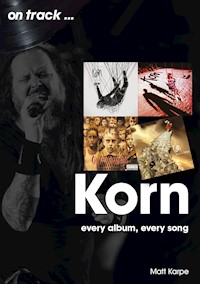
Rising to prominence in 1994 on the back of their eponymous debut album, Korn ushered in a new sound within heavy metal which many would try and imitate in the years that followed. Earning themselves the title of ‘The Godfathers of Nu Metal’, the Bakersfield quintet has sold well over 40 million records, they have topped charts all around the world, and they have also won multiple awards which include two prestigious Grammys. Still firing on all cylinders after three decades, Korn continues to produce powerful and accessible anthems in the present day.
Korn On Track covers all the band’s studio releases thus far - from their 1993 demo tape, Neidermayer’s Mind, to their thirteenth studio album, The Nothing, released in 2018. Reviewing every track and delving into the stories behind many of them, also discussed is Korn’s largely unheralded unreleased material, and their B-sides. The book also includes songs exclusively featured on movie soundtracks, making this an essential guide to this groundbreaking nu metal band.
An avid music fan, author, and journalist, Matt Karpe has written for multiple print and online magazines over the last decade, including Powerplay Rock & Metal Magazine and Down For Life (Punk & Hardcore). As well as releasing four books (We Own the Night: The Underground of the Modern American Hard Rock Scene, two volumes of Nu Metal: Resurgence, and Nu Metal: A Definitive Guide), he is also the creator of the nu metal dedicated zine, The Nu Zine, and the owner of the independent record label, TNZ Records. He lives in March, Cambridgeshire, UK.
Das E-Book können Sie in Legimi-Apps oder einer beliebigen App lesen, die das folgende Format unterstützen:
Seitenzahl: 261
Veröffentlichungsjahr: 2022
Ähnliche



















Sonicbond Publishing Limited
www.sonicbondpublishing.co.uk
Email: [email protected]
First Published in the United Kingdom 2021
First Published in the United States 2021
This digital edition 2023
British Library Cataloguing in Publication Data:
A Catalogue record for this book is available from the British Library
Copyright Matt Karpe 2021
ISBN 978-1-78952-153-5
The right of Matt Karpe to be identified as the author of this work has been asserted by him in accordance with the Copyright, Designs and Patents Act 1988.
All rights reserved. No part of this publication may be reproduced, stored in a retrieval system or transmitted in any form or by any means, electronic, mechanical, photocopying, recording or otherwise, without prior permission in writing from Sonicbond Publishing Limited
Printed and bound in England
Graphic design and typesetting: Full Moon Media
Acknowledgements
Thank you to Stephen Lambe for the trust and taking on this book.
Thank you to my parents for their continued support.
Thank you to my fiancée, Carly, for believing in me and always encouraging me to follow my dreams.
Most importantly – thank you to Jonathan Davis, Brian Welch, James Shaffer, Regi Arvizu, David Silveria and Ray Luzier for creating such incredible music over the last three decades.
Contents
Introduction
Neidermayer’s Mind (1993)
Korn (1994)
Life Is Peachy (1996)
Follow the Leader (1998)
Issues (1999)
Untouchables (2002)
Take a Look in the Mirror (2003)
See You on the Other Side (2005)
Untitled (2007)
Korn III: Remember Who You Are (2010)
The Path of Totality (2011)
The Paradigm Shift (2013)
The Serenity of Suffering (2016)
The Nothing (2019)
B-sides/Covers/Unreleased Material
Further Releases
Other Projects
Woodstock 1999
Monumental
Korn’s Legacy
Bibliography
Introduction
Bakersfield, a charter city in Kern County, California, is some three hours from Los Angeles. Yet in itself, it is a thriving location known for its music culture covering a variety of styles and genres.
The Bakersfield Symphony Orchestra has been performing classical music for well over 80 years; the city’s very own Merle Haggard produced his own form of country music, which would later earn the term ‘The Bakersfield Sound’, while Doo-wop rhythm and blues from the 1950s and 1960s also put the city on the music map. And then there is heavy metal and Bakersfield’s favourite sons, a band who many years later would have 24 February officially declared ‘Korn Day’ by their hometown mayor, and even have their own road named after them (Korn Row).
In the late 1980s, a funk metal band by the name of L.A.P.D. was hitting its stride with three parts of the line-up featuring the then-unknown Reginald ‘Fieldy’ Arvizu on bass (his nickname shortened from the original Garfield – because he had big cheeks), who, although he was left-handed, played bass with his right, James ‘Munky’ Shaffer on guitar (his nickname given by Arvizu as his feet supposedly looked like monkey hands), who only started to learn the guitar as a form of rehabilitation after severing the tip of his left index finger on a bike chain, and David (just David) Silveria on drums. Feeling that the bright lights of Los Angeles would give themselves a better chance of succeeding, where the likes of Mötley Crüe and Guns N’ Roses were proving the city’s music value was just as important as its Hollywood movie empire, L.A.P.D. relocated to Huntington Beach. Just a stone’s throw from downtown L.A., the band released their debut EP, LoveandPeaceDude, in 1989 via Triple X Records, and then a first full-length album in 1991 titled Who’sLaughingNow. At this time, a friend of theirs by the name of Brian ‘Head’ Welch (his nickname coming from the fact he thought he had a big head), was filling in as a second guitarist and also acting as the band’s roadie during live shows, but when the band upped sticks, he decided to remain in Bakersfield and travel to L.A. when he was needed.
Back in Bakersfield, a band called SexArt was starting to earn a name for themselves with their brash form of alternative metal, and amongst their ranks was a weedy new romantic by the name of Jonathan Davis. Working in a mortuary by day and trying to figure out how to be a heavy metal frontman by night, Davis battled self-doubt in the beginning. ‘I had no clue what I was doing’, he was quoted as saying in Leah Furman’s 2000 book, Korn: LifeinthePit, ‘I didn’t even know what the hell to do with my voice.’
Over in Huntington Beach, L.A.P.D. had left Triple X after being given an ultimatum to clean up their act. Despite selling enough copies of their Who’sLaughingNow album to be able to tour the US and Europe, and having earned a strong following through two years of relentless gigging, the band had become notorious for their mischievous behaviour, which included causing damage to backstage areas, throwing food, and urinating in the dip. Making it hard for Triple X to keep throwing money their way and having been banned from many venues in Los Angeles, L.A.P.D. felt it unfair to be called out by their record label, so the two decided to go their separate ways. Later calling it quits altogether after their vocalist Richard Morral up and left, Shaffer, Arvizu and Silveria formed a new band called Creep. Hiring Welch as an official second guitarist, all Creep required now was a larger-than-life frontman to give them an edge over their contemporaries. While Shaffer and Welch visited family in Bakersfield, they went to a show which included SexArt on the bill, and upon witnessing Jonathan Davis in action, Creep attempted to take him back to Huntington Beach to complete the missing piece of their puzzle.
Appreciative of the offer but initially hesitant to accept, Davis reportedly visited a psychic who advised the singer it would be beneficial to move to L.A. and join Creep. Seeing that as the sign he needed to take a risk, Davis went and auditioned for the band, got the gig, and within two weeks, Korn was born. Interviewed years later by Rolling Stone, Davis looked back on his decision to leave Bakersfield: ‘I had to fucking quit my day job where I was making great money as a mortician, I had my own house, to fucking having nothing and working at a pizza place as a shift manager living under some stairs.’
Deciding on their band name after Davis had heard a disgusting story told by some of his gay friends (we’ll leave it at that), the five-piece chose to spell their name with a ‘K’ instead of a ‘C’ and use a backwards ‘R’- the idea of that coming from the Toys R Us logo which, incidentally, was a store where various members of the band had worked previously. Renting the Underground Chicken Sound studio in Huntington Beach, the band would create weird and whacky heavy music, unlike anything that was around at the time and, before long, crowds of people would congregate outside of the studio to try to fuel their intrigue by seeing and hearing what was going on. ‘It’d be us doing odd jobs, just trying to hustle money to scrape beer money together and still have rehearsal money,’ said Shaffer in a 2016 interview with Metal Hammer. ‘We tried to get money in whatever ways we could- washing cars, moving furniture- and then maybe we’d go to the beach and surf a little, and party all night.’
By the summer of 1993, Korn had started playing shows and building a fanbase, and it is there that we join the band’s road to superstardom – with a hell of a lot of brilliant music, chaos and self-destruction along the way. Fasten your seatbelts.
Neidermayer’s Mind (1993)
Personnel:Jonathan Davis: vocalsBrian ‘Head’ Welch: guitarJames ‘Munky’ Shaffer: guitarReginald ‘Fieldy’ Arvizu: bass guitarDavid Silveria: drumsRecord label: self-releasedRecorded at: Underground Chicken Sound Studios, 1993Produced by: Ross RobinsonRelease date: 17 October 1993Highest chart positions: N/ARunning time: 17:55
Joining up with then-unknown producer Ross Robinson, Korn created their first demo tape and released it in limited quantities in October 1993. Sent out to record labels and also to people who filled out a flyer the band gave out at Biohazard and House of Pain shows, where Korn played for free – Neidermayer’sMind wasn’t particularly well-received by the public nor music critics. It is also worth noting that the tape was released without an official title, but it became known through the correlation with the artist who designed its cover art, and so the Neidermayer’sMind moniker was adopted by fans.
Perhaps due to the band themselves rather than their demo, Korn did manage to catch the attention of someone, and that someone was Paul Pontius – an Immortal Records A&R who would describe the band’s sound as ‘the new genre of rock’; and he wasn’t wrong. More for purists, Neidermayer’sMind is still worth a listen from time to time. While Korn was still figuring out their path to global domination, there are still moments across the four tracks which hint at their musical capabilities even at such a green age. Unsurprisingly, it is raw and rough around the edges – but what demo tapes aren’t?
Original pressings remain highly sought after, and if you want one, you are going to have to search far and wide. Every so often, one pops up online, but you will need to make sure you have plenty of money to entice someone into selling it. Bootlegs have also been released over the years, but they are just as hard to come by, and there is always YouTube, where the original recordings are readily available to investigate at the click of a button.
‘Pradictable’(Korn)
People’s first experience of hearing Korn came on this grungy number, and before you shout ‘typo!’, ‘Pradictable’ is exactly how the band spelt it and released it. Jonathan Davis is yet to find his true voice as he sings with a Scott Weiland/Axl Rose snarl on these recordings, but there are moments where the listener sits up and takes notice of a different type of frontman. Instrumentally, the band sounds extremely cohesive, and although a reworked version would feature on Korn’s debut album (and spelt correctly too), this raw and groovy rendition is arguably better the first time around.
‘Blind’(Korn, Dennis Shinn)
A year from now, it would become one of the most ground-breaking songs of the 1990s, but this version of ‘Blind’ also has a certain magic to it. Generally following the formula of that which was penned by Dennis Shinn from the SexArt days, a quicker intro full of extended thick instrumentation really shows Korn’s vision for the first time. Riff-heavy and with a more urgent tempo, ‘Blind’ reeks of star quality long before anyone would truly take notice of the quintet.
‘Daddy’(Korn, Dennis Shinn)
Another song that would be turned into a whole new monster in twelve month’s time, the demo version of ‘Daddy’ is shorter in length and contains a different chorus to that which would close out Korn’s debut album. Regi Arvizu’s bass riff opens proceedings, and while Davis sings with shaky commitment, you get the feeling that he is still singing someone else’s song as, once again, Dennis Shinn wrote the original version before Korn would make it into their own. Different and appealing, this ‘Daddy’ demo doesn’t have the same impact and shock value of what it would soon spawn into, but perhaps that is a good thing as Korn’s main aim in 1993 was to lay down some early foundations.
‘Alive’(Korn)
It would be over a decade before a polished version of ‘Alive’ would be made available to hear, featuring on Korn’s sixth studio album, TakeaLookintheMirror. Containing a Pantera-like metal thump with crunching riffs and fast and frantic drum sections, Davis lets Welch take on the lead vocal role on this one and his feisty snarl fits with the brash soundscape on show. Korn originally scrapped ‘Alive’ and worked some of its sections into their 1994 track, ‘Need To’; however, this is another song that showed small glimpses of the potential Korn had at their very early disposal.
Korn (1994)
Personnel:Jonathan Davis: vocals, bagpipesBrian ‘Head’ Welch: guitarJames ‘Munky’ Shaffer: guitarReginald ‘Fieldy’ Arvizu: bass guitarDavid Silveria: drumsRecord label: Immortal, EpicRecorded at: Indigo Ranch Studios, Malibu, California, USA, May-June 1994Produced by: Ross RobinsonRelease date: 11 October 1994Highest chart positions: US: 72, UK: 181Running time: 65:45
Honestly, when we were labelled the band that invented the style of … what do they call it, ‘Nu rock’? I guess people say we invented this nu metal sound or whatever. I never really thought of it like that. I just thought we were doing our thing. That’s just what came natural from all our influences as musicians. I never really thought, ‘Hey, we’ve invented this new kind of music, this is going to be huge’. (The) Thought never even crossed my mind. David Silveria quote from an interview with RollingStone
Heavy metal looked to be in a healthy state in 1994, after riding the wave of grunge’s short burst in the spotlight, which seemingly ended upon Kurt Cobain’s suicide in the first quarter of the year. Pantera, Nine Inch Nails, Machine Head and Testament all released critically acclaimed albums throughout 1994; however, the whole heavy metal spectrum would change forever on 11 October, when Korn announced themselves to an unsuspecting world.
Sporting Adidas tracksuits, baggy jeans and unkempt dreadlocks, playing seven-string guitars, primordial in their down-tuned settings, and accompanied by an assortment of effects pedals, not to mention the funky rattle of the bass which added to heavy instrumentation more in-keeping with hip-hop than metal – Korn emerged with a sound unlike anything heard before on their self-titled debut album.
By now, they had already secured a deal with Immortal Records and a distribution deal with Epic Records, all thanks to Paul Pontius, who stumbled across the band and quickly noticed there was something different about them compared to the rest of the metal bands floating around at the time. Content with Ross Robinson’s production work on the Neidermayer’sMind demo, Korn once again enlisted his expertise for their first full-length, and as well as transferring the band’s sound to tape, Robinson was able to add the raw and stark reality of the sub-plots which Korn used as influences to write twelve unnerving and deeply unsettling songs. Bringing out the darkest pieces of Jonathan Davis’ history in order to obtain the most real and honest performances out of the frontman, Robinson pushed and prodded with unrelenting prowess, which, in the end, would leave Davis a broken shell of a man.
Featuring subject matters of trauma, bullying, addiction and abuse, all relayed through the tortured howls and almost confessional refrains of Davis, Korn’s debut album reinvigorated heavy metal whilst also ushering in a new movement which would later go on to be labelled ‘Nu Metal’.
Having spent much of their early days experimenting and crafting their sound in the small Huntington Beach house the five band members shared together, as well as holing themselves up in the Underground Chicken Sound studio, evenings saw both locations become the settings for big parties where those in attendance were considered Korn’s primary fan base. An abundance of cheap booze and vast quantities of meth were heavily consumed, as Korn acted like rock stars long before they would ever be considered as such.
With the album ready to record, Indigo Ranch in Malibu was the studio of choice, hand-picked by Ross Robinson who later told RollingStone, ‘The reason I picked Indigo Ranch was because Neil Young was there, Neil Diamond, all these really killer old-schoolers. I think Lenny Kravitz was there, and Nick Cave. I knew that recording raw and vintage, the album wouldn’t sound dated, ever.’ Recorded in a little over a month at a reported cost of no more than $14,000, Korn wouldn’t necessarily earn its creators any overnight success, instead a slow-burning ascension ensued where touring proved pivotal in bringing the band to people’s national (and latterly international) attention.
After a less than successful start to touring life with shows alongside Biohazard and House of Pain, and the death of the band’s very first tour bus, which had been paid for by their record label, Korn resumed their expansive promotional campaign at the beginning of 1995 by supporting punk rockers Sick of It All, the goth rocking Danzig (and Marilyn Manson), and thrash metal legends, Megadeth. A first trek over to Europe followed later in the year, the first show of which took place in Nottingham, England, and by this time, four singles had already been released from the album. ‘Blind’, ‘Need To’, ‘Shoots and Ladders’ and ‘Clown’ were four of the standout songs on Korn, but only ‘Blind’ charted anywhere (15 on Canada’s RPM Alternative 30), while the album itself peaked at 72 on the Billboard 200 in America – which, all things considered, wasn’t to be sniffed at.
Having played over 200 shows in 1995 where Korn also shared stages with Ozzy Osbourne, Metallica and Life of Agony, the Bakersfield five had greatly enhanced their standing within the heavy metal community, gripping their young adult target audience who were looking for a new kind of music to call their own. With subject matters perhaps relatable to what they were dealing with in their own lives, the songs on Korn acted as a kind of remedy to some, who were able to realise that they were not alone in what issues they were dealing with and the emotions that they were feeling.
To further underline Korn’s intention to shock and stun, the album’s artwork perfectly accompanied the music’s dark and atmospheric nature. Depicting a young girl on a swing, shielding the sun from her eyes whilst trying to make out a spooky and shadowy figure standing over her with what looked like claws for hands, the vivid imagery unsurprisingly caused a stir upon its unveiling. The girl – eight-year-old Justine Ferrara – was the niece of Paul Pontius, the man who first discovered Korn. Paid $300 for the photoshoot, the images taken by Stephen Stickler, Justine would not see the finished articles until she was in eighth grade, as her parents were horrified at their daughter’s portrayal. Positioning the Korn logo, so the girl’s shadow looked like it was hanging from it, the connotations of the cover were further enhanced by the rear artwork, which simply showed an empty swing and no one in sight. Pontius himself may have caused some family division at the time, but it was just another vital aspect in helping Korn – both the band and the album, enter the fray with a complete package to give to anyone who dared check out this intriguing new metal band.
In January 1996, Korn was certified gold in America, a year later, it had gone platinum, and by November 1999, it had reached double-platinum status; and with it, five unwitting dudes from Bakersfield had become the pioneers of a new form of heavy metal music.
‘Blind’(Korn, Dennis Shinn)
Originally written by Davis’ bandmate in SexArt, Dennis Shinn’s version was generally what people heard on the Neidermayer’sMind demo before Korn took on ‘Blind’ and turned it into the anthem everyone knows today. ‘It was Korn’s professionalism that brought the song to life’, Shinn was later quoted as saying, and the results were there for all to see in 1994.
Opening with Silveria’s ride cymbal being repeatedly struck in double time, Welch and Shaffer then debut with a single chord progression and distorted counter-riff, which builds tension to almost unbearable limits, and then ‘Blind’ explodes into life with Davis’ now-legendary call to arms cry of ‘Are you readyyy?!’. Written about the singer’s already forceful drug problems (primarily with methamphetamines), ‘Blind’ contains references to Davis’ chaotic life experiences as he explores ways to cope with the effects of his drug use brought on by the trauma he suffered in his younger years. Blistering power and abrasive discipline from the seven-string guitars roar the song forward, while Davis switches between tender and vigorous vocal deliveries to give most people their first experience of hearing him sing. Moody, intense and completely different to what else was coming out back in 1994, a glorious and groove-laden crescendo finds Korn setting their stall out from the get-go with a song now firmly etched in heavy metal folklore.
For many, the promo video for ‘Blind’ was the first time people had the chance to see the band behind the music, and while the video is a relatively simple affair, the small venue in which Korn perform perfectly captures their raw intensity. Largely shot in black and white and also offering some footage of the band members hanging out in California, it is the performance of ‘Blind’ which deserves the viewer’s full attention. With a large banner hosting Korn’s soon-to-be trademark logo, on full show behind David Silveria and his drum kit, a small crowd show their frenzied energy with mosh pits and crowd surfing galore, while Jonathan Davis goes batshit crazy in his Adidas tracksuit and Shaffer and Welch rock some less than trendy boiler suits.
Even watching the video today gives you a feeling of just how important a moment Korn’s debut was back in 1994, and YouTube perfectly summed it up in a 2020 article when George Garner called the video an ‘Epiphanic moment in the history of heavy metal’. With over 66 million views on Korn’s YouTube channel, the Joseph ‘McG’ McGinty Nichol-directed promo remains a ground-breaking moment in nu metal’s early inception.
‘Ball Tongue’(Korn)
Led by Arvizu’s bouncing bass slaps, ‘Ball Tongue’ continued Korn’s early assault with one of the more aggressive and multi-layered songs on the album. Again, musically taking inspiration from 1990s hip-hop, ‘Ball Tongue’ was written about a friend of the band who liked his meth and helped some of the band members get hooked on it too. In his SaveMefromMyself memoir released in 2007, Welch had this to say about the man behind the song’s story, ‘Sometimes he would get so geeked out on speed that he couldn’t talk, no matter how hard he tried. He would just sit there with his mouth open, tongue sticking out, and his tongue looked like it had a little ball on the end of it.’
Featuring Davis’ schizophrenic vocal stylings, his frenzied barking and belligerent growls were in part due to being high on meth at the time of recording. Offering an early glimpse of his scat vocal, which would become famous on later tracks of future albums, ‘Ball Tongue’ proved the band wasn’t a one-trick pony as a colossal bout of instrumentation plays out with the inclusion of beer kegs being repeatedly whacked. For those still catching their breath after ‘Blind’, ‘Ball Tongue’ offered very little respite.
‘Need To’(Korn)
Featuring elements of the ‘Alive’ demo from Neidermayer’sMind, ‘Need To’ is dominated by Arvizu’s bass work and Silveria’s pounding drum sections. Murky and with a hint of grunge filtering through, one of the more accessible and catchy choruses finds a delicate Davis howling in anguish at daring not to get too close to a lover for fear that they may stop loving him. Unsurprisingly chosen as a single, perhaps due to its radio-friendly nature (not that it earned Korn any significant exposure), ‘Need To’ provides a bit of calm to proceedings while still capturing abrasive heaviness in all its glory.
‘Clown’(Korn)
The first track to really create an atmosphere within a song, Davis’ pent-up angst explodes on the scathing ‘Clown’, which was written about a set-to during one of Korn’s early live shows. While playing in San Diego, the band was heckled by a member of the audience who took a swing at Davis after previously shouting obscenities at the band and telling them to go back to Bakersfield. The issue was quickly dealt with when Korn’s manager, Larry Weintraub, knocked the man out, allowing the show to continue.
Providing a little bit of early comedy, as he did on many an occasion, Ross Robinson kept the tapes rolling to capture moments of discussion – whether friendly or otherwise. Before ‘Clown’ starts up, the band can be heard arguing with Silveria, who wasn’t sure whether the song was starting after four clicks or no clicks, to which Davis can be heard saying with some slight agitation in his voice, ‘Just fucking do it, dammit!’ Once things get underway, the distorted guitars create an eerie feel as Davis delivers another vocal performance born out of anger. ‘Hit me clown, because I’m not from your town’, he spits, having the last laugh on the night of the incident, as well as having the last laugh overall, as ‘Clown’ became one of the most popular songs on the album, as well as in Korn’s whole back catalogue in the years to come.
Despite the heckling incident providing the song’s central meaning, the paralleled lyrical similarities with bullying provided the main focus for the music video. Set in a high school, Korn spend much of the video performing in a changing room while Davis gets soaked through from sitting on the floor in the showers, as a handful of jocks poke fun at him from above a wall. Cheerleaders are also featured, signifying the second of the two core groups widely known to commit bullying in school, and their inclusions can provide an all too real bout of stomach-churning anxiety for many a sufferer of such acts in the past.
A further performance shot finds the band surrounded by a wall of unkempt toy dolls, and a life-size clown, similar in look to the evil Pennywise from Stephen King’s It also makes regular appearances. Once again, directed by ‘McG’, the high school focus on Korn’s third music video was perhaps the first to really reel in fans through the harsh and hospitable song lyrics that Jonathan Davis wrote for a generation begging to find their own forms of salvation.
‘Divine’(Korn)
Containing thick and meaty verses, ‘Divine’ also has one of the catchier singalong choruses, but overall, it lacks the power and effect of those which came before and after it. Somewhat of a filler track, had Korn used the guidance given them by Suicidal Tendencies (and latterly Metallica) bassist Robert Trujillo, a little better, perhaps ‘Divine’ could have been what the title suggests. Still, most bands would kill to have a song like this within the track listing of their very best album, so it perhaps shows just how much quality Korn possessed from their humble beginnings.
‘Faget’(Korn)
Written not long after Davis joined the band, Welch came up with the lead riff while sitting around in Korn’s shared Huntington Beach house, and the rest, as they say, is history.
The most impressive song on the album and arguably just as important as ‘Blind’, ‘Faget’, really separated Korn from the rest of the pack with a rallying cry unleashed at bullies and tormentors. Revisiting his time in high school where he was teased and harassed for using eyeliner, listening to new wave music such as Duran Duran, and dressing a little more in-keeping with the New Romantic scene, Davis fights back at all those who accused him of being gay in an emotional tour-de-force which features some of Korn’s most memorable vocal lines. Evil guitar rhythms and earth-shattering bouts of instrumentation make the song more of a colossus, as Welch and Shaffer show off what they called the ‘Mr. Bungle chord’- playing two notes three steps away, in an ode to the experimental Mr. Bungle which was fronted by Faith No More’s Mike Patton.
Acting as a voice for the voiceless, Davis fires through line after line of pent-up frustration, which includes ‘I’m just a pretty boy, I’m not supposed to fuck a girl’, and the fractious cries of ‘I’m just a faggot!’. Robinson’s raw production emphasises the true power ‘Faget’ possesses, helping create an everlasting legacy for a song that held more meaning than any other song on Korn, or at least until ‘Daddy’ came along.
While a music video was filmed for ‘Faget’, it never received an official release. The ‘McG’ directed short featured the full near six-minute song, and despite there being a lot of Adidas promotion once again, the video is a simple band performance in a bright room. Not as bold as the videos to come before it, it still showed Korn’s progression and comfort at being in front of cameras, putting on an authentic presentation that best shows David Silveria’s incredible drum prowess.
‘Shoots and Ladders’(Korn)
Proving divisive between fans and critics – some calling it lazy, containing a lack of depth and being poorly executed, it is perhaps a testament to Korn that as young musicians still finding their way in 1994, ‘Shoots and Ladders’ would quickly become somewhat of a cult classic.
A heavy metal song that opens with some bagpipes was a first, and it was another instance of Ross Robinson’s knack for catching the band off guard by keeping the tapes rolling. Picking up Davis walking past the studio door while playing the bagpipes as the mic remained stationary, what we hear gives the impression of Davis being farther away than he was before he does indeed move off into the distance. Interestingly, Davis first learned to play the bagpipes when he was in high school, where he has previously said he would play them for up to six hours a day. When Korn were hanging out during band practice one day, David Silveria told Davis to start playing the bagpipes in front of everyone, and only then did they decide to integrate them into a song, and ‘Shoots and Ladders’ made for their perfect debut.
Another revolutionary moment in metal and featuring lyrical renditions of children’s nursery rhymes, Korn chose those with hidden and negative meanings behind them. ‘All these little kids sing these nursery rhymes, and they don’t know what they originally meant,’ said Davis in a later interview. ‘Everyone is so happy when singing ‘Ring Around the Rosie’, but it is about the Black Plague. All of them have these evil stories behind them.’
Also including parts of ‘One, Two, Buckle My Shoe’, ‘London Bridge is Falling Down’, ‘This Old Man’, ‘Baa, Baa Black Sheep’, and ‘Mary Had a Little Lamb’, ‘Shoots and Ladders’ is performed with a nightmarish sentiment which eradicates any small lingering moments of innocence. Leading to a final blast of violent instrumentation while Davis delivers more chaotic vocal refrains, ‘Shoots and Ladders’ earned the band their first Grammy Award nomination in 1997 for Best Metal Performance – despite its original mixed reaction. Pitted against prime cuts from Pantera, White Zombie, Rob Zombie and Alice Cooper, and the winning Rage Against the Machine, it was still an impressive feat when you consider Korn was already standing alongside such distinguished acts with many more years of experience under their collective belts.
Korn’s second music video was again directed by ‘McG’ and partly using live show footage in which the band can be seen growing ever more comfortable on big stages they were playing during some vital support slots in their early days. In keeping with the song’s meaning, though, it is the fairy-tale set containing a castle, waterfalls, trees, plants and colourful doll-like houses, which gives ‘Shoots and Ladders’ a visually spectacular music video. A radio edit sees the song reduced from 5:22 to 3:39 and thus removes much of the bagpipe intro, but the tension matched against the overly dream-like and innocent setting makes this very much a video not to be viewed by children. Another colourful and poignant moment in Korn’s breakout, the band’s music videos were already hinting at having a life of their own, where budgets were not going to be a problem in helping create a visual aspect to stand side by side with the power of their music and lyrics.
‘Predictable’(Korn)




