


9,49 €
Mehr erfahren.
- Herausgeber: Sonicbond Publishing
- Kategorie: Geisteswissenschaft
- Serie: On Track
- Sprache: Englisch
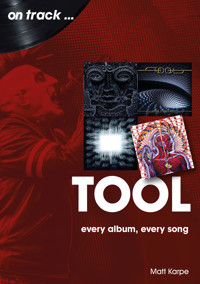
Music may not have been the designated career path for the members of Tool when they each relocated to Los Angeles in the 1980s, but the quartet would soon find one another and join forces to become one of the most distinctive acts in the history of rock and metal. Tool On Track documents all of the band’s studio releases, from their raw and unapologetic 1991 demo tape to their 2019 epic, Fear Inoculum, a record thirteen years in the making and an album that would solidify Tool as one of the greatest progressive rock bands of all time.
Something of an enigma but an extremely complex and intelligent band, this book goes into considerable depth as it uncovers the stories behind Tool’s engrossing back catalogue. The formulations of pivotal songs such as ‘Sober’, ‘Ænema’, Schism’, ‘Lateralus’ and ‘Rosetta Stoned’ have become stories of legend, and this book has been extensively researched in order to create a valuable reference book that all Tool fans can delve into at their leisure,
Also focusing on the band members’ various side-projects and selected guest appearances, as well as acting as a detailed biography, this is the most comprehensive book on the band yet written.
An avid music fan, author, and journalist, Matt Karpe has written for multiple print and online magazines over the last decade, including Powerplay and the punk and hardcore publication, Down For Life. Tool On Track is Matt’s sixth book overall, his previous releases being We Own the Night: The Underground of the Modern American Hard Rock Scene; two volumes of Nu Metal: Resurgence, Nu Metal: A Definitive Guide, and Korn On Track. He lives in March, Cambridgeshire, UK.
Das E-Book können Sie in Legimi-Apps oder einer beliebigen App lesen, die das folgende Format unterstützen:
Seitenzahl: 258
Veröffentlichungsjahr: 2024
Ähnliche



















Tool
Every Album, Every Song
On Track
Matt Karpe
Sonicbond Publishing Limited www.sonicbondpublishing.co.uk
Email: [email protected]
First Published in the United Kingdom 2022
First Published in the United States 2022
British Library Cataloguing in Publication Data:
A Catalogue record for this book is available from the British Library Copyright Matt Karpe 2022
ISBN 978-1-78952-234-1
The right of Matt Karpe to be identified
as the author of this work has been asserted by him
in accordance with the Copyright, Designs and Patents Act 1988.
All rights reserved. No part of this publication may be reproduced, stored in a retrieval system or transmitted in any form or by any means, electronic, mechanical, photocopying, recording or otherwise, without prior permission in writing from Sonicbond Publishing Limited
Graphic design and typesetting: Full Moon Media
Contents
Social Media
Acknowledgments
Introduction
1. 72826 (1991)
2. Opiate (1992)
3. Undertow (1993)
4. Ænima (1996)
5. Satival (Box Set) (2000)
6. Lateralus (2001)
7. The Holy Gift
8. 10, 000 Days (2006)
9. Fear Inoculum (2019)
10. Collaborations
11. Associated Artists
12. Influencing Others
13. April Tool’s Day
14. Classic Setlists
Bibliography
Social Media
Follow us on social media:
Twitter: https://twitter.com/SonicbondP
Instagram: www.instagram.com/sonicbondpublishing_/
Facebook: www.facebook.com/SonicbondPublishing/
Acknowledgments
Thank you to Stephen Lambe for commissioning this book.
Thank you to my fiancée Carly, for her unconditional encouragement. I love you more!
Thank you to Maynard James Keenan, Adam Jones, Danny Carey, Justin Chancellor and Paul D’Amour, for their artistic talents and years of incredible music.
Introduction
They call Los Angeles ‘The City of Angels’, ‘The land of hope and opportunity’, and plenty of other nicknames have been given to the second-largest city in the United States. Most of these names are aimed in the direction of the glamourous West Hollywood district, where budding actors and musicians flock to try to earn some kind of fame and fortune. Whether or not they could’ve foreseen their future successes, Maynard James Keenan, Adam Jones, Paul D’Amour and Danny Carey all moved to L.A. in a bid to make their own singular dreams come true. While music may not have been the designated career path for all of them in the beginning, the four would soon find one another and join forces to become one of the most unique acts in the history of hard rock and heavy metal.
Having had his intelligence and creative expression stifled since his younger years, James Herbert Keenan – born 17 April 1964 and later taking on the first name of Maynard (from a fictional character he created whilst in high school) – delved into everything from wrestling and cross-country to art and design, and even did a stint in the US Army. His desire to enrol stemmed from the Bill Murray movie Stripes, and Keenan initially served as a forward observer before studying at West Point Prep School. Becoming distinguished in basic and advanced training, he then declined an appointment at West Point, in favour of joining the Kendall College of Art and Design. Later he relocated to Boston, where he worked as an interior designer for pet stores, and then was sent to Los Angeles with music in his mind. Putting his goals to one side, to begin with, Keenan continued on the interior design path which had initially earned his transfer to Tinseltown. Having done such a good job in the Somerville, Massachusetts pet store he worked in, the chain’s owners were eager for Maynard to give their L.A. store a much-needed facelift. But it wouldn’t be long before he moved on and entered film set construction work.
From a very young age, Adam Jones had a great interest in animation, so much so that he was quickly able to turn his ideas into three-dimensional sculptures. Also becoming a keen musician, first he played the violin, the double bass as part of an orchestra, and then the bass guitar. One of Jones’ early bands – Electric Sheep – in his home state of Illinois, found him playing alongside a then-unknown (and later Rage Against the Machine and Audioslave guitarist) Tom Morello. Turning down the offer of a film scholarship, Jones decided to move to Los Angeles where he studied art and sculpture, and then became an effects designer. Learning stop-motion camera techniques – which would become extremely handy in the years to come– Jones saw his sculpture and makeup work included in the Ghostbusters II movie in 1989, the 1990 science fiction sequel Predator 2, and later Terminator 2: Judgement Day and Jurassic Park, amongst others. Although his artistic talent was giving him a strong platform to move on to bigger and better things, it would be his self-taught guitar skills that would ultimately earn Adam Jones his greatest calling.
Kansas native Danny Carey was destined to be a professional drummer. By the age of ten he’d already joined his high school band and was also taking private lessons on the snare drum. Within two years he was playing a proper drum set. Fast-forward to him enrolling at the University of Missouri in Kansas City, Carey expanded his percussion studies with theory into the principles of geometry, science, and metaphysics. Later moving to Portland, Oregon, Carey picked up some musical experience playing in a handful of short-lived bands. But his career really began to take shape upon his arrival in Los Angeles, where he somehow landed a gig working as a studio drummer for the acclaimed singer-songwriter Carole King, and some of his contributions were included on her 1993 album, Colour of Your Dreams. Also, around this time, Carey was playing live sets around LA with the punk-tinged hard rock band, Pigmy Love Circus.
Floating from one act to another, Carey was also jamming with a young Jeff Buckley around that same period, for a potential country rock project. Buckley had built up a following on the East Coast through playing cover songs, before deciding to focus on his own music and forming his own band. Buckley then signed to Columbia Records and released his debut album Grace in 1994.
Sadly, Buckley died from accidental drowning in 1997, and his work was only given the respect it deserved sometime later, when the album went platinum in America and seven times platinum in Australia: courtesy of his popular cover of the Leonard Cohen classic ‘Hallelujah’. During their brief friendship, Buckley would send Carey demo tapes featuring early versions of songs that would form Buckley’s one and only album to be released in his all-too-short lifetime.
Like Adam Jones, Paul D’Amour headed to L.A. to work in the film industry. Originally from Spokane, Washington, little is known of his early years, but after relocating, D’Amour helped build movie sets, and worked on music videos and TV commercials. Despite having a decent job that many people would kill for, a music career was of higher importance for the already accomplished guitarist.
In a city so big, it seemed like poetic destiny that these four lone wolves should find one another. Keenan and Jones met through a mutual friend whom the future frontman Keenan was dating, and both were friends with Tom Morello, who by now had also upped sticks to Hollywood and was putting together the early pieces of Rage Against the Machine. A long way from becoming revolutionary political-rap metal masters – which is a success story worthy of a whole other book – it was actually Keenan who introduced Morello to drop-D tuning, as well as coming up with the now-infamous riff that Morello helped lead Rage’s biggest statement song- ‘Killing in the Name’.
After listening to a demo tape of Keenan’s old band Children of the Anachronistic Dynasty (or C.A.D. for short), Jones was so impressed by the vocals that he suggested the two should form a band together just for fun, and nothing too serious. Hesitant to begin with – due to the bad experiences he had suffered from C.A.D. and the earlier Tex A.N.S. (Tex And The Anti Nazi Squad) brought on by a lack of commitment from members unable to match the hunger and drive that Keenan possessed – the born-to-be frontman eventually agreed, having seen Jones’ competent guitar-playing. Jones also brought D’Amour into the band, even though he grudgingly traded six strings for four after being told there was no room for a second guitarist.
At the time, Hollywood was awash with wannabe singers and hopeful guitar heroes. Bass players floated around from time to time but to a much lesser extent, while drummers proved even harder to come by. Keenan and Jones would invite a handful of drummers they knew of to come and play with them in their Jellö Loft rehearsal space (the same place where Green Jellö cut their teeth in the early days), but rarely would these drummers show up. Living in the same building and witnessing all who came, went and ultimately failed to show up, Danny Carey felt bad for his acquaintances, and as his kit was already set up, he started to play with his friends as a temporary fill-in.
Carey and Keenan had become known to each other through Green Jellö – a band more commonly known today as Green Jellÿ after the Jell-O brand owners Kraft Foods Inc. put them under legal pressure to change their name. Alongside the other gigs he had going on with Carole King and Pigmy Love Circus, Carey played drums in the consistently revolving and ever-escalating Jellö lineup for three years. Keenan s one and only official appearance on a Jellö track can be heard on the band s minor hit Three Little Pigs , where his falsetto cameo finds him supplying the ‘Not by the hairs of my chinny chin chin’ line. In addition, Primus hero Les Claypool and comedian Pauly Shore can also be heard singing on the popular song. On the accompanying Cereal Killer album, Carey earned himself a credit under the nickname Danny Longlegs. But once he became the final piece of L.A.’s latest rock band, magic was instantly uncovered, and the quartet’s chemistry could not be denied.
Digging deep into their own discontent – a collective feeling of being stuck in dead-end jobs and suffering from less-than-ideal living arrangements in a not- so-flamboyant area of Los Angeles – the four musicians constantly practised as they honed their raw-but-promising craft.
Keenan was spurred on to form his own band after constantly ridiculing the Los Angeles music scene and being challenged by his friends to form a band if he thought he could do better. He looked back on the first steps he took in turning his musical dream into reality, in his 2016 memoir A Perfect Union of Contrary Things:
The frustration I felt at the time was definitely what got this project off the ground then. I’d had good friends in Boston, and I’d been successful at the pet store, and I believed I was on the right path. Then I lose everything and I’m living on $400 a month. I needed to destroy. I needed to be primal scream and I needed to be loud enough to make people go, ‘What the fuck is that?!’. I needed to get it out. It was that tipping point where you either become a serial killer or a rock star.
During a brainstorming session for a potential band name, Toolshed became the sole frontrunner. Giving some relevance to the lyrical themes Keenan would cover in the quartet’s early songs, the singer used his merchandising experience to contemplate the full impact a band name could provide. While Toolshed seemed apt, it was soon decided that Tool had a simpler but more impactful ring to it: thus confirming the old adage that sometimes less is more. A double entendre which appealed to their darkly humorous side, wanting their music to be a tool to help others understand an alternative way of thinking but also leave artistic room for mass interpretation, the name also implied the mystery and unease of interweaving themes soon to be discussed in their songs.
By now, the grunge movement was set to explode into action, and mainstream exposure would instantly follow. Nirvana were about to release their sophomore album Nevermind, Pearl Jam were putting the finishing touches on their debut opus Ten, and Alice in Chains and Stone Temple Pilots were also set to unveil themselves to much greater audiences. Hair metal was out and grunge was in, but Tool’s early brand of alternative metal appeared to have very little mainstream appeal at all. With that said, there was something different about this band who incorporated additional sounds and textures into their music: which instantly set them apart from their contemporaries. No one knew what the future had in store for Tool, but for now, their only focus was to lay some solid foundations to build upon for if and when their big chance may come.
72826 (1991)
Personnel:
Maynard James Keenan: vocals
Adam Jones: guitar
Paul D’Amour: bass
Danny Carey: drums
Recorded at the Jellö Loft, Los Angeles, California, August-September 1991
Producer: Tool, Steve Hansgen
Label: self-released
Release date: September 1991
Chart positions: N/A
Running time: 22:49
Although not many were there to witness it, Tool’s debut live performance has become a legend. Their friends in Green Jellö had signed a record deal with Zoo Entertainment in the second half of 1991, and the ensuing celebratory party gave Tool their first stage and crowd to unleash their cerebral and visceral alternative metal on. Meticulously rehearsing five days a week since their formation had allowed Tool to hit the ground running, rising in a cascade of offbeat rhythms and fluctuating quiet minimalism. Those in attendance at the Jellö Loft that night were quickly drawn to a band led by a confident and provocative frontman – one who contorted his body and menacingly stalked the stage, all the while brandishing a controlled and hypnotic vocal tone, with agonisingly guttural screams thrown in for good measure. Keenan, Jones, D’Amour and Carey may have cut placid demeanours offstage, but onstage they were completely different monsters – releasing a wall of sound and emotion with an energy so contagious that the crowd was unable to focus on anything other than the band playing in front of their eyes. Debut shows were not supposed to go as well as this.
Word quickly spread across Los Angeles of this riveting new act, and next came shows in some of the city’s less-than-glamorous clubs – a conscious understanding that starting from the bottom of the ladder was the only way for Tool to eventually get to where they wanted to be. Taking the early and ridiculously late slots meant sparser crowds. The shows were infrequent and often unpaid, yet Tool performed as if they were on the grandest of stages in front of stadium-sized audiences. They were also still getting to know each
other, their playing styles and their onstage personalities. But from the outside, they already appeared to be a well-oiled machine.
Eager to record some of their material – some of which was less than two months old – the quartet invited Minor Threat bassist Steve Hansgen to the Jellö Loft. Having been friends with Adam Jones for some time, Hansgen brought along his Fostex 280 4-Track, and used the band’s DAT recorder to put six songs to tape. The finishing touches to Tool’s first demo were added in his North Hollywood home studio in next to no time. Known amongst fans as The Toolshed Demo and simply Tool, the tape has the more commonly referenced title of 72826, which Keenan chose when a label number was required at the tape’s pressing stage. When the set of numbers were typed into a telephone keypad, the word ‘Satan’ corresponded with the numerical sequence, and while Tool was certainly not a Satanic band, their darkened edge and humourous personalities were quick to reveal themselves.
Boasting furious aggression, cryptic lyrics, solid musicianship and unexpected tempos, Tool were so happy with the demo that they released it to fans at the end of September 1991. Charging as little as $5, and with the demo available in limited quantities, the band refused to hand out any freebies, even to those who claimed to work for record companies. For Tool, the music was far more important than obtaining a record deal, and Maynard James Keenan’s vision was finally being brought to fruition with a bunch of friends who were also dedicated in working towards a common goal. Taking an organic path where if and when the opportunity of a record deal arose, Tool would be able to reap the rewards, knowing they’d done things their own way from the very beginning.
Artist Cam de Leon sketched the tape’s simple but striking cover art of an open-end and double-box wrench, which displayed a rather obvious priapic innuendo (much like the band name), as comedy attempted to balance the intensity and authority of the six tracks on show.
72826 offered the first look into Tool’s expansive thought processes and songwriting skills, which were far more adept than a lot of bands after such a short period of existence.
‘Cold and Ugly’ (Tool)
Opening with a grating Adam Jones riff before Paul D’Amour’s bass work becomes the driving force, ‘Cold and Ugly’ finds Tool introducing themselves in the grandest of fashions – or as ostentatious as they could on a demo tape which varies in sound quality from one track to the next. Whether it was how the song was recorded, or a conscious decision to put an echo effect on Maynard Keenan’s vocal, the live feel of his vast repertoire of styles quickly puts the singer on the map – his impassioned moments of screaming all the more pronounced and confident as the demo progresses.
Danny Carey’s animated drumming unearths future star quality, and while ‘Cold and Ugly’ reeks of the early-1990s – even feeling a little grunge-orientated in places – Tool’s brand of alternative metal was already worlds away from the other heavy hitters of that time. This demo version is also the only studio recording of the song to ever be released.
‘Hush’ (Tool)
Suffering from a production flaw where Keenan’s vocal greatly overpowers the much quieter instrumentation, ‘Hush’ is a riff-heavy but simple hard rocker which makes its impact and ducks out in less than three minutes. Thankfully, a more polished re-recorded effort found its way onto Tool’s next release, so there is more on ‘Hush’ to come in a few pages’ time.
‘Part of Me’ (Tool)
‘I know you better than I know myself’ says Keenan on a song which many believe was written about the singer’s penis, and masturbation. Confirming Tool’s intention to let the listener form their own opinions on the meanings of the songs – regularly refusing to print lyrics in their album booklets and relying on the music to be the more powerful source – those willing to dig deeper have also considered false ideals and tapping into our own consciences as potential subject matter that is covered on ‘Part of Me’. A move that has often infuriated their fans, Tool followed the likes of Pink Floyd and R.E.M. in keeping their album booklets lyricless, sharing the view that people are likely to listen more intently when trying to figure out the stories to the songs, and thus ultimately leading to the listener paying as much attention to the musical side as they would to the words. Adam Jones confirmed his band’s outlook in a later interview:
We don’t print our lyrics, because we want people to really sit closer to the speaker and try and hear what Maynard’s saying versus what’s going on in the music. We treat everything with as much importance as the lyrics.
Angry and forcefully delivered while erring on the side of safety once again, Carey’s pummelling drum sections stand tallest as the listener continues to acquaint themselves with this obscure but exciting new act.
‘Crawl Away’ (Tool)
Later to be included on the band’s first full-length album, the debut of ‘Crawl Away’ cemented Tool’s early potential, with a dazzling opening riff, before quieter verses allow D’Amour to lead with a meaty bass line. Despite still finding his way as a vocalist, Keenan provides another potent performance, showing experience way beyond his years. Written about a controlling narcissist who loses someone important to him because of his own misdeeds, the fiendish line of ‘I can see your back is turning/If I could I’d stick a knife in’ are more than a tad unsettling, to say the least. However, it does highlight an intriguing mindset and how Keenan is able to translate his thoughts into words.
‘Sober’ (Tool)
Instantly a cut above the rest and adding to what appeared to be Tool’s alternative metal formula at the time, ‘Sober’ hints at the progressive route they would take in the near future. Slow and methodical verses feature a flurry of guitar styles from Jones, who has never been the kind of guy to stick to one particular playing technique. Sinister and shrouded in darkness, Keenan’s thought-provoking lyric – written about a friend of the band whose most creative moments came when he was high – leads the charge on this early Tool classic-in-the-making. Two years later, a much more advanced version of ‘Sober’ would become the quartet’s breakthrough song, and also arguably one of the best metal songs of the whole decade.
‘Jerk-Off’ (Tool)
As with ‘Cold And Ugly’, the only studio version of ‘Jerk-Off ’ ever to be released is on this demo tape. Jones and D’Amour work well together with scratch riffing and combustible bass work respectively, while Keenan’s rage spills over with scathing lyrics that again can be interpreted in various ways. Generally, there appears to be contempt towards people who avoid repercussions from their negative actions – the line ‘Doesn’t matter what’s right/It’s only wrong if you get caught’ appears to highlight the singer’s intense frustration with living in Los Angeles. ‘I should play God and shoot you myself’ he follows up with, as he releases his pent-up anger in an unapologetic fashion. His highest scream ever put to tape bolsters one final swarm of crass instrumentation, concluding a demo tape unlike any other, and leaving those who were fortunate enough to hear it, begging for more.
Opiate (1992)
Personnel:
Maynard James Keenan: vocals
Adam Jones: guitar
Paul D’Amour: bass
Danny Carey: drums
Recorded at Sound City, Van Nuys, California, January 1992
Producers: Sylvia Massy, Steve Hansgen, Tool
Label: Zoo Entertainment Release date: 10 March 1992
Chart positions: N/A Running time: 26:52
You’re never sure what a major label is going to do with an album – whether they’re going to exploit every possible aspect and throw you out there and try to make you this big, hyped thing. So you kind of cripple them by giving them an EP they can’t work with.
Paul D’Amour
Kevin Coogan had witnessed Tool’s first performance at the Jellö Loft, and the Zoo Entertainment A&R had also heard their self-released demo. He could tell there was something different about the four-piece: an enigmatic and wholly intriguing metal act who sounded unlike anything else at the time. Along with Nirvana and Pearl Jam, Smashing Pumpkins and Soundgarden were leading the grunge charge, and while Tool wasn’t considered a threat in bringing heavy metal back into the spotlight, there was an apparent edge to their music which was begging for further attention. Coogan shared his findings with a fellow Zoo Entertainment colleague, and they gave the label’s president, Lou Maglia, the lowdown on Tool.
On the night of the band’s first show at the Coconut Teaszer, Maglia was just around the corner, scoping out Dumpster: another band who were firmly on his radar. But after their less-than-inspiring performance was cut short, Maglia decided to head to the Teaszer instead of going straight home. Word is that Tool knew of Maglia’s possible attendance that evening, and while their live execution instantly drew in Zoo’s boss, their set was no more elaborate nor different than on any other night: it was just business as usual. Before heading home, Maglia demanded his team invite Tool to his office the next day, and when Keenan, Jones, D’Amour and Carey arrived, they were instantly offered a record deal.
Being the dog-eat-dog music business, it wasn’t long before reps from major labels such as Atlantic, Epic and Interscope tried to sink their claws into Tool with mouth-watering offers easily eclipsing those of little old Zoo Entertainment. ‘I got a glimpse of what power was and how quickly it can be abused’, said Keenan in his 2016 memoir: ‘So you play with it. If you can pretend they’re wearing bunny ears while you’re eating their expensive food, it’s the most exciting time in your life’.
Offering the most money generally wins a band’s signature, but Tool was not your typical band, and their intentions of earning a record deal were not based around gaining fame and fortune. In Lou Maglia, the band felt they’d found someone who had a good understanding of the message they wanted to share with the world. He also understood and embraced their artistic nature, and perhaps most importantly, he was willing to let them remain in full creative control. Offering Tool further monetary focus on live performances, and his undivided attention if and when they required it, was enough for Zoo to secure Tool’s signatures on 27 November 1991.
Professionally pressing enhanced copies of the 72826 demo, Maglia then sent Tool straight into the studio at the beginning of 1992, to work on their first official release. While the label presumed a full-length album would be on the cards, Tool had other ideas, as Keenan in particular understood the power that an EP had in providing a small taster of what else was to come. Reminding their record label that they had creative control of their output, the band were perhaps a little surprised when Zoo was more than happy to sign off on an EP. Using a loophole in the three-album contract, Zoo was therefore able to obtain a bonus release from their latest signing, as a slightly angsty Tool were told that an EP would not count as one of the three albums included in their deal.
Moving from an engineering role to becoming a fully-fledged record producer, Sylvia Massy was brought in to yield Tool’s EP, having recently completed work on Green Jellö’s Cereal Killer album. Recorded in four days to avoid further expenses, the band would have to pay out of their own pockets if they stayed any longer, so Opiate was quickly created at the legendary Sound City Studios in Van Nuys, California. Since opening in 1969, a who’s-who of rock and pop royalty has recorded there. In the year before Tool’s visit, Nirvana recorded their magnum opus Nevermind, at Sound City. Ronnie James Dio recorded Holy Diver there in 1983, and Elton John, Tom Petty, Cheap Trick and Fleetwood Mac are just a handful of illustrious artists to also walk through the studio’s hallowed doors and lay down some timeless music.
Even though Tool had already written most of what would become their first album, they were advised to put their most aggressive material on Opiate so they would be taken more seriously and thus create a convincing first impression.
Deciding to re-record four songs from their demo tape, they also added two live recordings in the middle of the tracklist, further breaking convention and shattering the traditional flow of how a studio record usually went.
Upon the release of Opiate on 10 March 1992, critics were unable to
categorise Tool’s music, due to the harmonic complexity and youthful aggression and contempt that drove the six songs. Not wanting to be associated with the glam metal bands who were still around in 1992 (or hair metal bands, if you prefer, who Tool perceived offered less-than-serious messages in their hedonistic music: the complete opposite to Tool’s own mood and intentions), the quartet asked Zoo to not push them on metal radio stations. Unfortunately, due to its raucous nature, Opiate forced the band into a category they desperately wanted to avoid, and also because their record label could see heavy metal as the only suitable market to promote such material. The results showed the songs to be too layered to become instant hits, and they were certainly too heavy to appeal to mainstream radio listeners – thus Tool had succeeded in their intention of being renegades from the outset.
Cam de Leon created the artwork, the arresting cover depicting an alien- looking priest with his hands in the prayer position. Cloned to show three pairs of praying hands, the image appears to touch on the Illuminati idea – an ambiguous religious faction that many conspiracy theorists believe to be involved in world finance. The priest also hints towards the Karl Marx opium of the masses theory, which is deeply prominent in the lyric theme of the EP’s title track.
Perhaps best considered as alternative metal – which makes it understandable that Zoo would push the release on heavy metal radio stations – Opiate provided many with an explosive introduction to Tool, and listeners across America soon became engrossed with an incredibly unique up-and-coming band who already had bags of momentum behind them.
In 2013, the EP was reissued to mark its 21st anniversary. Supposedly, Tool wanted to celebrate its release at the 20-year mark, but they missed the boat and released it when it was legally old enough to drink. While no extra tracks were added to the reissue, special attention was given to the artwork and the album packaging. Releasing five different variations in five different colours, two of the printing methods used were old machine and hand pressed. The modernised cover art showed a priest with face paint and flames wrapped around his body, in a prayer-like motion. At the end of the flames, seven miniature priest figures can be seen in various poses. Only 5,000 copies were pressed – 1,000 of each variation – and it wasn’t a surprise when every single copy sold out within days of the reissue’s pre-order announcement.
‘Sweat’ (Tool)
Spearheading the EP and Tool’s first official release, ‘Sweat’ is led by antagonistic double-kick drumming and blunt guitar blasts. Influenced by early- 1990s metal and certainly finding the four-piece at their heaviest, the intense nature of ‘Sweat’ underlines Tool’s intention of announcing themselves with their most aggressive songwriting possible.
Lyrically poetic, a suggestion of being on a drug trip finds Keenan reminiscing with the line ‘Seems I’m slipping into a dream within a dream’. However, as found in the theme of the EP’s title track, Karl Marx’s book The German Ideology




