


Erhalten Sie Zugang zu diesem und mehr als 300000 Büchern ab EUR 5,99 monatlich.
- Herausgeber: Books on Demand
- Kategorie: Lebensstil
- Sprache: Englisch
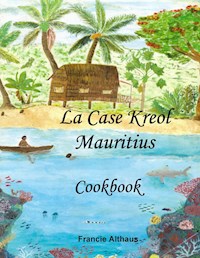
"Creole cuisine for me personally is, when Orient and Occident are melting in my cooking pot and the result has its own character". Mauritian people inherited their delicious culinary from three continents. The various cultures have enriched their kitchen and eating habits. The roots of Mauritian Creole kitchen reach up to Europe, India, Africa and China.
Sie lesen das E-Book in den Legimi-Apps auf:
Seitenzahl: 54
Veröffentlichungsjahr: 2014
Das E-Book (TTS) können Sie hören im Abo „Legimi Premium” in Legimi-Apps auf:
Ähnliche



















Contents
Introduction
Preface
Basics and sauces
Creole sauce
Paste for Creole curry
Creole curry
Green curry paste
Red curry sauce
Chilli sauce
Mazawaru sauce
Tropical fruit sauce
Coriander sauce
Pumpkin seeds sauce
Spice mixture for Briani
Kalia sauce
Vindaloo paste
Gadjacks and finger food
Aubergine fritters
Split pea patties
Taro balls
Rissoles
Marinated champignons
Brown eggs
Cassava croquettes
Yellow split-peas pancake
Samosas
Rolls of Eggplant with feta cheese
Soups
Green soup
Vegetable soup à la Ti-N-Gol
Chicken Muluktawni
Pumpkin soup
Pumpkin leaves soup
Red lentils soup
Main courses
Meatballs in sweet and sour sauce
Chicken rolls with nut cream
Chicken breast filets in Kalia sauce
Spicy meat patties
Sausage in Creole sauce
Chilli lamb
Duck breast filets in mango-curry sauce
Lamb in Tandoori-whisky sauce
King prawns in red sauce
Pork neck in rum and brown sugar
Tuna Vindail
Pork filets with palm heart in Vindaloo Sauce
Cuttlefish eggplants curry
Mauritian fish stew
Cuttlefish in turmeric and brown mustard Seeds
Cuttlefish à la Creole
Faratas
Chinese noodles
Chutneys and salads
Turnips salad
Red Cabbage with grapes
Mango and cucumber
Kokoda
Eggplant chutney
Avocado chutney
Tomato chutney
Coconut chutney
Mango chutney (one way)
Mango chutney (another way)
Mango Kutscha (pickled)
Pawpaw chutney
Mauritian turnip leaves
Desserts
Banana fritters
Sweet potato coconut crescents
Poached guavas
Guava compote
Pinacolada mousse
Some notes to some ingredients
I want to express my heartfelt thanks to all these people, who gave me help and support during many evenings of work for this book. Thanks to Harm, Runa, Harry, Lyn and Matthias. Special thanks to Jan and Tina.
Thanks to Frederik for the cover picture.
I wish to extend these thanks to Christoph and also to all my guests who have been most encouraging to me.
Yours Francie Althaus
Introduction
It was a gift to be born with international genes. In one word, so I am blessed.
My ancestors came from different part of this world, which are India, Pakistan, Madagascar, France and England.
I was born and brought up on the island Mauritius, pearl and key of the Indian Ocean.
I married a German and came to Germany. I was lucky to travel and work in Ethiopia and the Solomon Islands together with my husband and through our visits between South Africa, Australia, New Zealand, Zambia and other countries, I got the opportunity to make acquaintance with new culinary which I gratefully learned and prepared myself.
I was 9 years old when I started cooking and my first experience together with my younger sister, who is today living in South-Africa and who is also a superb cook, left scars.
The stove was too high, both of us balancing on a small and narrow stool, discussing what comes first in the hot pan with oil. The rest you can imagine...
Neither injuries nor disappointment stopped me through new trials. Today, I`m a passionate cook.
Hindus, Moslems, Chinese, Creoles, Africans, Franco-Mauritians and Anglo-Mauritians live on Mauritius.
These multicultural aspects of my country woke up my immutable interest to learn and try the different cuisines and later I acquired more knowledge and understanding.
Whenever it was not clear to me how to prepare something, I could ask my grandma, my mother or my neighbours; very often it was just observing them.
To go through my trial and error period, I made a deal with my mom. She had to sew some new garments for me and I in turn did her cooking. These were the opportunities to create and prepare real menus for the family.
At the age of 22, I came to Germany and very often I was longing for food I had eaten at home. Many dishes were easy to prepare and sometimes improvisation from materials/ingredients available brought me close to a very good result.
In the meantime my kitchen turned into a laboratory, it did not matter where I was, I tried and created new recipes but I did not think to write them down.
20 years ago I got the idea to write everything down that I cooked and part of it is in this book. It`s a great pleasure for me to share it with you.
Cooking is for me creativity, fantasy and an art; and a recipe book gives new ideas and possibilities to try something new.
Though exotic spices found their way to Germany, it was not always easy to find the right ingredients everywhere.
I still can remember the most expensive mangoes of my life 30 years ago, 7DM (German Marks) for one mango which came from Mauritius by airmail.
Ingredients featured are widely available in general stores, Supermarkets and Asia-shops; for some of the others you might need to find a specialist supplier, or make it suitable with what is available.
It`s a pleasure for me to help you with these different recipes to create delicious exotic meals either for yourself, or for your guests.
Enjoy yourself!
Francie Althaus
Preface
Mauritius! “Oh yes! The Blue Mauritius, the stamp”, was the reaction of most people I met in Germany 30 years ago.
Today for many people Mauritius is not only the famous stamp, but it is also known to be a fabulous Island for vacation.
“Where is Mauritius? “ I was asked very often.
Mauritius lies north of the tropic of Capricorn in the Indian Ocean, between Africa, India and Australia and south of the Equator.
Mauritius is about 1865 square kilometres in size and has no indigenous inhabitants.
Without a doubt the “Dronte“, also called “Dodos“, had been the real indigenous dwellers of the island. Unfortunately they finished devoured on the menu of famished sailors and imported predators.
After 1681 there were no Dodos found anymore on Mauritius.
Arab, Portuguese and Dutch traders called in Mauritius, but they didn`t stay there for long. The Island was called “Mauritius” after the Prince Moritz of Nassau. The Dutch brought sugarcane and the Batavia deer; in return they took the tropical timber.




