


12,99 €
Mehr erfahren.
- Herausgeber: Grove Press UK
- Kategorie: Geisteswissenschaft
- Sprache: Englisch
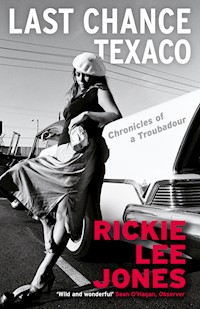
A Book of the Year in Rolling Stone, Uncut, Mojo, The Telegraph and the Glasgow Herald This troubadour life is only for the fiercest hearts, only for those vessels that can be broken to smithereens and still keep beating out the rhythm for a new song. Last Chance Texaco is the first-ever no-holds-barred account of the life of two-time Grammy Award-winner Rickie Lee Jones, in her own words. It is a tale of desperate chances and impossible triumphs, an adventure story of a girl who beat the odds and grew up to become one of the most legendary artists of her time, turning adversity and hopelessness into timeless music. With candour and lyricism, the 'Duchess of Coolsville' (Time) takes us on a singular journey through her nomadic childhood, to her years as a teenage runaway, through her legendary love affair with Tom Waits, and ultimately her longevity as the hardest working woman in rock and roll. Rickie Lee's stories are rich with the infamous characters of her early songs - 'Chuck E's in Love,' 'Weasel and the White Boys Cool,' 'Danny's All-Star Joint' and 'Easy Money' - but long before her notoriety in show business, there was a vaudevillian cast of hitchhikers, bank robbers, jail breaks, drug mules, a pimp with a heart of gold, and tales of her fabled ancestors. In this electrifying and intimate memoir by one of the most remarkable, trailblazing and tenacious women in music are never-before-told stories of the girl in the raspberry beret, a singer-songwriter whose music defied categorization and inspired pop culture for decades.
Das E-Book können Sie in Legimi-Apps oder einer beliebigen App lesen, die das folgende Format unterstützen:
Veröffentlichungsjahr: 2021
Ähnliche




















Praise for Last Chance Texaco
“[A] gripping, lovely memoir . . . Thrilling, funny, scary, sad, packed full of life and extraordinary characters. I loved this as much as I loved Dylan’s Chronicles and Patti Smith’s Just Kids.”
—Nick Hornby, Believer Mag
“A testament to the joys and the chaos of a life of travelling.”
—New Yorker
“A classically American picaresque tale.”
—New York Times
“I’m reading Rickie Lee Jones’ Last Chance Texaco right now . . . and I’m really enjoying it . . . I have a weakness for books by hard, radically honest women with an unusual antenna for magic, language and scenery.”
—Maggie Nelson, New York Times, “By The Book”
“In this raw and roving life story, Jones depicts a child who recognized her humanity and worth even when others wouldn’t, and a woman whose confidence helped her rise above heroin addiction, music industry sexism and the traumas of her youth . . . In a book about the past, Jones has no problem moving on. It’s a neat trick.”
—Jake Cline, Washington Post
“An impassioned and cinematic trip through Jones’s eventful life. I shouldn’t be surprised that Jones manages to carry her originality, intimacy, and volcanic expressiveness into book form.”
—Boston Globe
“The prose is rich and rhythmic, filled with lines that are pithy (‘Rickie Lee is a Frank Capra movie that had been overtaken by Stanley Kubrick’) and poetic (‘childhood traumas leave their dirty footprints on the fresh white snow of our happy-ever-afters’). ”
—Minneapolis Star-Tribune
“[Rickie Lee Jones] opened every door and she never flinched . . . She’s a storyteller.”
—San Francisco Chronicle
“Jones has lived a life as brave . . . and rich as her music—with love, heartbreak, addiction, and magic sprinkled throughout.”
—O, the Oprah Magazine
“Well-crafted and intensely candid.”
—San Diego Union-Tribune
“Vividly cinematic . . . Sexy and moving and sad.”
—Bookforum
“Last Chance Texaco chimes with the bittersweet experiences of many of her peers who have written about their lives over the past few years. But there are elements here that set it apart: Jones’s refreshing gift at improvisation, her eye for vivid detail, and her rhythmic, poetic writing style.”
—The Arts Fuse
“Good news: Rickie Lee Jones’ prose is very much like her lyrics—poetic, symbolic, penetrating. She writes like she sings. There is a free-flowing, jazzy, impish honesty delicately balanced between confessor and voyeur . . . and this is before you ever get to the music . . . This may well be the finest rock memoir I have reviewed here. A unique entrance in a disquieted creative mind that finds its solace in experience.”
—The Aquarian
“[A] riveting, often harrowing, memoir . . . With the free-flowing sonic patterns of jazz, Jones’ memoir swirls across time, moving backward and forward with reckless abandon, hardly pausing as the breathlessness of her journey overtakes us (and her). In staccato prose that echoes her scat singing, Jones holds nothing back as she chronicles her adventures on the road and the ragged ups and downs of her family life and fame.”
—No Depression
“One of the most compelling memoirs I’ve ever read . . . What really sucks you in, and lifts you up, is the dazzling magic of her prose.”
—Please Kill Me
“She can’t help it: Rickie Lee Jones creates poetry wherever she goes. Last Chance Texaco was written in the same rich, entrancing, dusty language as her songs. From all of her beginnings to endings, there’s a Rickie Lee Jones romance to it all.”
—SPIN
“What makes this a most inspiring memoir is her absorbing storytelling, facility with language (no surprise there) and her fealty to integrity—commerce be damned.”
—Michael Simmons, Mojo
“Men leave, fame fizzles, family breaks your heart . . . but Jones knows a good story and how to tell it.”
—Kirkus (starred review)
“Lyrical . . . With gorgeous prose . . . interspersed with her lyrics, this is as distinctive as she is, a rich, bracing, and candid memoir dancing with the love of language.”
—Booklist
“Like her music, Jones’s anecdotes bop with immediacy and are filled with unsavory—but somehow sweet—characters such as bank robbers, pimps, and drug dealers. Fans will enjoy this buoyant coming-of-age narrative by one of music’s most idiosyncratic performers.”
—Library Journal
First published in the United States of America in 2021 by Grove Atlantic
This paperback edition first published in Great Britain in 2022 by Grove Press UK, an imprint of Grove Atlantic
Copyright © Rickie Lee Jones, 2021
The moral right of Rickie Lee Jones to be identified as the author of this work has been asserted by her in accordance with the Copyright, Designs and Patents Act of 1988.
All rights reserved. No part of this publication may be reproduced, stored in a retrieval system, or transmitted in any form or by any means, electronic, mechanical, photocopying, recording, or otherwise, without the prior permission of both the copyright owner and the above publisher of the book.
Every effort has been made to trace or contact all copyright-holders. The publishers will be pleased to make good any omissions or rectify any mistakes brought to their attention at the earliest opportunity.
1 3 5 7 9 8 6 4 2
A CIP record for this book is available from the British Library.
Paperback ISBN 978 1 61185 445 9
E-book ISBN 978 1 61185 888 4
Printed in Great Britain
Grove Press UK
Ormond House
26–27 Boswell Street
London
WC1N 3JZ
www.groveatlantic.com
This book is dedicated to my familyOn whatever stage they call their own
CONTENTS
Prologue
Introduction: A Prelude to Gravity
THE BACK SEAT
Chapter 1: What Were the Skies like When You Were Little?
Chapter 2: Juke Box Fury
Chapter 3: On Saturday Afternoons in 1963
Chapter 4: A Summer Song
Chapter 5: The Winston Lips of September
RIDING SHOTGUN
Chapter 6: The Moon Is Made of Gold
Chapter 7: Gravity
Chapter 8: You Never Know When You’re Making a Memory
Chapter 9: The Summer of 1969
Chapter 10: Walk on Guilded Splinters
Chapter 11: Olympia
Chapter 12: Surfer Girl on the Waterbed
Chapter 13: Turn Her Over and Go . . .
Chapter 14: Doyt-Doyt—Venice Beach
DRIVER’S SEAT
Chapter 15: Easy Money
Chapter 16: Young Blood
Chapter 17: The Man with the Star
Chapter 18: Rickie Lee Jones
THE WAY BACK SEAT
Chapter 19: Saturday Night Live
Chapter 20: The Bus Stop Blues
Chapter 21: Jazz Side of Life
Chapter 22: It Must Be Love
Epilogue
Acknowledgments
Glossary of Songs
PROLOGUE
Frank “Peg Leg” Jones
Here are the histories of my parents and siblings whose often tragically shaped lives feed my music and personality. Here are the stories of my friends and lovers, co-writers and producers, and those demons and angels who wage a constant battle for my soul. There were cave dwellers, Southern hoodoo, urban jails, and some of the most opulent hotels in the world. I’ve traveled to these places via my thumb and VW bug and a few times, the Concorde supersonic jet. I’ve lived volumes as a young girl long before I was famous and here I share the largeness of events I experienced through my younger eyes.
I sense a natural language being whispered that is shared by all of us. In dreams I sometimes understand the symbols, but then I wake up and they’re gone. A puff of ink that will not stick to this reality. What was I hearing? What were they saying? Was it music? Surely I heard something. After all these decades, life remains stubbornly mysterious.
Music shapes us and fundamentally changes us. Once we have listened we do not stop. We do not ever recover from music. We will return again and again to the radio, the record store, the bedroom where girls listen to records all day.
Performing is a religious experience for me. You can never know what I feel, only what you feel. My secret courage is my magic. You are doused with my strange water of emotion as you witness this courage, and that is my true performance. It sounds like music but something is being passed between us. Something personal.
I have come to believe that I am moving in the right direction, following a path more than forging the way. My performances center around that belief. I am propelled forward by seemingly random events linked together by the fact that eventually I end up in better circumstances than when I began. Sure, bad things happen but if I keep pushing to become my best self, I am brought from the pain into a brighter passage. That instinct—to believe in my heart—always delivers me. I go where she is going. I’m with Her.
INTRODUCTIONA PRELUDE TO GRAVITY
I named this book “Last Chance Texaco” because I spent most of my life in cars, vans, and buses. Back seats, shotgun, and driving myself. From these vantage points I watched life approach and recede. As time went by I was always running away from and moving to new life, but once I finally got there I could never lay down roots. For me, it seems, life is the vehicle and not the destination.
The meaning of “Last Chance Texaco” is simple. It is the light in the distance that never goes out, refuge for the tired traveler on a dark road. “You can trust your car to the man who wears the star” sang the old commercial—an important backstory people today may not know—“The big bright Texaco star!” I used the familiar signposts and lingo of my generation to build the lyrics of “Texaco,” and in fact most of my early songs make reference to obscure Americana nearly forgotten today. When my young life seemed to be nose-diving into the desert sands of Hollywood, going nowhere fast, I raised that Texaco star like a pirate flag and overtook my future against all odds. The man with the star is as much Christ as he is a lover or a stranger in a gas station, whomever it is you need to put your trust in tonight. “Last Chance Texaco” remains a kind of living spirit to me. A whisper of belief in impossibilities.
When I was twenty-three years old I drove around L.A. with Tom Waits. We’d cruise along Highway 1 in his new 1963 Thunderbird. With my blonde hair flying out the window and both of us sweating in the summer sun, the alcohol seeped from our pores and the sex smell still soaked our clothes and our hair. We liked our smell. We did not bathe as often as we might have. We were in love and I for one was not interested in washing any of that off. By the end of summer we were exchanging song ideas. We were also exchanging something deeper. Each other.
Tom had two tattoos on his bicep. He liked to don the vintage accoutrements of masculinity: sailor hats and Bernardo’s pointed shoes. The more he tried to conceal his tenderness, the more he revealed a chafed and childlike nature. I adored him. He was my king. In bed he was the greatest performing lion in the world. I mean to say that Tom was never not performing.
Then quite suddenly, in November we were no longer seeing each other.
I spent the fall driving around with Lowell George, the charismatic guitarist from Little Feat, a local hero who kept his little feet “in the street” as it were. He found me there in my squalid basement encampment and we went drivin’ around in his Range Rover, seated high above the street studying various motels and apartments where he had spent time with Linda and Valerie and Bonnie too. He showed me the hotel I would live in one day—the Chateau Marmont—and we sat in the living rooms of managers who would load him up with drugs for the chance to put his signature on paper. He flirted with them all like a child flirts with the devil, toying with their furious drugged-up machinations and escaping, like a child called home by his mother, just before he signed his soul away. Lowell seemed unconcerned about his own mortality. The play was the thing, and that boy could play the guitar.
In bed Lowell was a fat man in a bathtub. I mean to say that something about him was in another room, laughing, singing to himself. He was a handsome man, unhealthy, kind to a fault.
By June we did not speak much anymore. He’d tried to obtain the publishing rights to “Easy Money” and Warner Brothers intervened. It left a very bad taste on both our tongues. I learned that lesson out of the gate; when push comes to shove, money trumps friendship.
The next summer I drove around with Dr. John. It was a very different car, a station wagon used to take his kids to school and bring groceries home to his wife, Libby. He had been married a couple times and had a number of “sprouts.” He also had a ghost he kept with him, a thing that followed him, watched from behind the curtains in the hotel rooms and the plastic-backed chairs in the diners we visited. I mean to say it was his addiction.
By the end of summer, he left his companion with me and I drove alone for the rest of the year.
Then Sal Bernardi picked me up in a car with broken windows and cardboard to keep the cold out. He drove like Mr. Magoo. “Road hog,” cried the New York City cabbies as he careened his “vehicle” down Fifth Avenue toward the Village one snowy December evening in 1978. He was wearing his pajamas and a stocking cap. Sal was always so punk rock. He wrote a melody too tender and too complex to be understood by the alley cats he was inclined to throw his songs at.
The apex of my love life corresponds to my career success, and unfortunately my success corresponded with my drug use. My drug career was short-lived—three years from 1980 to 1983. I quit and headed to France. But the damage was done.
I did drugs like I did everything else. On fire, with no back door. I escaped, of course, and I carried my heart out in a birdcage. But she was burned, and she cried so loud, casting wild notes over water and cloud. Freed of such beauty, she waited to be freed of her sorrow. Maybe that is the picture I see. I turned it into poetry, what else could I do?
By the following spring, Waits and I were back together. I remember driving down La Brea Avenue from the airport. Tom and Chuck liked to pick me up at the airport. There was plenty of traffic so when “Chuck E’s in Love” came on the car radios it echoed across the stoplights and the exhaust pipes. Tectonic plates of culture and music were colliding around us. The three of us, me riding in the middle, were the last Neanderthals, the holdouts of the Tropicana Motel. Once Tom and I moved in together, a way of life ended. Eskimos began migrating south and all the mammoths died away.
* * *
My 1957 Lincoln got mangled that summer by Chuck E. and Mark Vaughan who went joyriding while I was on tour. When Tom and I broke up, Tom ditched his Cadillac in self-storage and I left my roughed-up Lincoln with a nurse up north. She worked at the hospital where I nearly died from a heart infection.
I quit driving around with people then. I rented cars and lived in hotels. For a long time I looked over my shoulder thinking there was someone behind me. Just the shade of the demon. I was sober but something was following me.
A collage of images from my Chicago infancy is forever glued to my music. I see rickety wooden fire escapes and recall holding my sister’s hand in an alleyway. I know the smell of dime store lunch counters where Mother and I ate pie in thick coats of cigarette smoke. The carbon monoxide fumes and air brake screech of the city buses we took. Most of all, I remember Riverview Park where terrifying rides and bright lights and loud calliopes enchanted me. Speeding carousels with huge wooden horses I was too small to mount, a perpetual state of fear and longing that became the backdrop for so many songs.
I must have been lost more than once on that fairway, as Mom stood in line for tickets. Outside the bright spotlight I wandered toward the dark sea of an unlit backstage where monsters slept. I was drawn to the darkness and terror. No matter how much a ride frightened me, I begged to go on it again and again.
We left Chicago in 1959 when I was four years old. I grew up in the Arizona of the 1960s. Phoenix was a quiet place in the endless desert, and the radio was our only means of touching the larger world. The Phoenix I knew, ancient and unchanged, is gone now.
My family took such a long trip across America that I felt as if I had always lived in the back seat of our 1959 Pontiac. My big brother Danny and I kicked, poked, and tickled each other in a blender of games that turned the long minutes into long hours. Once I kicked my brother right in the balls and he tore into me like a tornado. I didn’t really know what was down there. He kicked me too. It hurt, but catching the attention of the front-seat referee was not allowed. If Mom said Danny was too rough he might not play with me, so I had to pretend I was not hurt. We were shaping rules not only for hurting each other, but for whom we might be as adults.
On that magical tour into the U.S.A., we saw stalactites in New Mexico, and in Yellowstone National Park we encountered bears rummaging through the garbage like homeless Russian astronauts in fur coats. They were as alien to me as if they had dropped from the sky. I knew them as the cartoon Yogi (“smarter than the average bear”), but in person they were hungry as hell. They came up to our car and demanded food and suddenly I was terrified. “Hurry, roll up the window,” with Mom and Danny laughing. They were always laughing at danger. I couldn’t understand why they didn’t take these things seriously. Finally, our road trip ended in Pomona on my uncle Bob’s doorstep.
America was succumbing to an expanding postwar pressure of social symmetry: be alike, fall in line. In California my family became the idealized version of itself. We had a collie dog just like Lassie and my brother had a raccoon cap like Davy Crockett. We were Walt Disney’s America. Mother wore gloves and Father had a crew cut.
Trying to fit into the Protestant world around them and win the good graces of my Protestant grandmother, my parents baptized me Presbyterian and we attended Presbyterian services. All the rest of my family remained Catholic. It was a terrible source of friction and in spite of everything we tried, the Joneses remained unwelcome in Grandmother’s Temple City. There was an argument and we hit the road, coming to a stop in our new home in the Arizona desert.
The shy desert, a chalky remainder of countless millions of years of other living things. Animals who raised their young on these unforgiving rocks, only to lay down their burden and wait. The skeletons of their lives are the dirt of our cactus gardens. We too will become fossilized pages in some unimaginable future. Well, maybe imaginable: “Look, can you see my fossilized arm—under the Xazzcandra Prelapse? I think it is turning pink again.”
There is a little girl down there we need to talk to. Can you see her? I wonder, do you think she can hear me singing? What’s she doing with that frog?
THE BACK SEAT
Chapter 1
What Were the Skies like When You Were Little?
“Oh the skies were beautiful, pink and yellow and blue . . .”
Three-year-old Rickie and big sister Janet
Down along the end of the street was a well, a concrete circle about five feet in diameter. There you could find all manner of water-loving creatures, drawn from the desert to the shade. Tadpoles swam with tiny mosquito larvae. I was carrying a frog I found in the mud.
In the desert, shade means the difference between life and death. Wherever there is shade there are fairies. I knew this instinctively but my father told me all about fairies: “Watch for them out of the corner of your eye. In the dappled light fairies can be seen as they take form, and if you are very still you may see them darting across the limb of a tree.”
Studying the drop down to the bottom of the well, I saw that it was only about ten feet. I let the frog slip from my hands into the well and said:
“Water there.”
“You can swim down there.”
“Be out of the sun.”
When I returned later and saw the frog dead, I looked up from that well and I was sore inside. I had killed a thing. I was inconsolable. There was nowhere to run away from this feeling.
That experiment was nothing like what I expected. Now I knew. People could cause terrible harm, and even I could hurt an innocent thing. That it was an accident made no difference to me or the frog. “I’m sorry, I wish I had not put you down there. I wish I could take it back.” It was here by the well I made up my first song. The song made its home in me and I kept it there. I sang:
I wish, I wish,
That wishes would come true,
And then, I know,
That it would be alright.
God’s little scientists want to know how things work, and sometimes quite by accident, they find out the hard way. I was forging roads between my imagination and the world before me. The real frog died but I saved it in my first song. Out here, in fairy kingdoms, anything seemed possible.
I wandered the neighborhood with my invisible friends, inspecting everything I came across. I was often frozen in some daydream when an invisible horse galloped down the street in a storm of wild fury, only to find me waiting and fearless. A trembling velvet muzzle pressed against my hand, the horse’s gesture of acceptance and trust. Only I understood and could tame its wild heart.
I hollered out loud to my invisible horse to the consternation of my sister and brother who watched me in bewilderment.
The garbage men often ate their lunch in the shade at the edge of our backyard, parking on the dirt road that ran along the farmer’s field next to our house. One morning my mother sent me out with a pitcher of water for the men. Standing some feet away, I began to sing, pretending not to notice they were watching. A couple of the guys clapped their hands, the oleander bush cheered. I bowed, and Mother called me into the house.
My very first performance I was three years old, a snowflake in a ballet recital of “Bambi.” Bowing low at the end of our dance I heard the audience’s applause and took it personally. I remained bowing long after the other snowflakes had melted and left the stage. The dance teacher had to escort me off but the audience was delighted and the die was cast. I liked it up there.
What I really wanted most was to play the piano. Pidgey Muncie lived three doors down and she had a piano.
Pidgey was my age, shy and sweet, plump like her mother. Pidgey could not have visitors once her father came home from work but I would stay until the very last moment to play that little spinet piano. I sounded out the notes to the Doublemint commercial and Pidgey and her mom taught me “Heart and Soul.” They were terrified that I’d still be there when Mr. Muncie came home so they unceremoniously escorted me out the back door.
Mr. Muncie was the most terrifying man I’d ever met. He was short and stocky with a crew cut. An ex-Marine and currently a very angry man. Then one morning I was playing in the backyard when I saw Mr. Muncie digging a hole in the farmer’s field. He had a bag in his hand that he put into the hole and buried. I ran in and told my mother. “Mr. Muncie buried something in the field!”
She was doubtful of what I had seen, but she called Mrs. Muncie, who said:
“Yes, the dog had puppies today. He just took them out there and buried them alive.”
Buried them? What? Alive?
“We have to go dig them up.”
“They are dead now, Rickie. We cannot go get them.”
I felt panicked. How could we sit there as little innocent babies were dying? We must bring them back to life.
Pidgey’s dog died a few days later. I felt she died of a broken heart from watching her babies taken from her. My mother told me she died because there were no puppies to drink her milk. I quit going to poor Pidgey Muncie’s house. I now knew that there were terrible people in the world, people who hurt innocent things, people who were also daddies, or uncles, or neighbors.
My brother had gotten a red bicycle for his eleventh birthday. I was allowed to ride his bike, if I was able to do so. Unable to reach the seat, I balanced on the ungainly apparatus and rode the five houses to the end of our street, then navigated the wide turn and returned to Mother and Danny. I had passed the test and was admitted to the grown-up world of bicycle riders. It wasn’t that hard, really.
One morning I asked my mother if I could ride Danny’s bike.
“Yes, but only to the corner and make sure I can see you.”
I rode round and round in circles at the end of our street. A car came suddenly and stopped right in front of me. It was followed by a second car that screeched to a stop. A redheaded boy jumped out of the first car but then a bigger man in the second car caught up to him. He was swearing as he moved toward the redheaded boy, who seemed to be crying, “I’m sorry, I’m sorry.”
“Son of a bitch, you son of a bitch, goddamn.”
“I’m sorry,” the boy was crying.
I felt bad for the redheaded boy because he was so afraid, he seemed so sad.
The seat was too high for me to stop the bike without falling, so I rode around in circles watching the men until I could place the pedal in just the right position and gently fall over. I set the bike on the sidewalk and moved carefully toward the cars and the yelling.
The big man looked into the back seat, right over the shoulder of the redheaded boy he had pushed up against the window. Now tears of rage as the man’s fist caught the boy in his jaw, and he threw him down by his shirt as he wept. I was frightened but I approached the car to look into the back-seat window. There was a little girl lying there, a very little girl, maybe two or three. She was lying down on her back.
I cannot remember anything else. My mind—or fairies maybe—lifted that picture and flew it away on the wings of mourning doves. I don’t remember what I saw. Did I see blood? The child seemed languid, stunned. Did I make that up? I petted her, I spoke to her, but I don’t know what I saw in the back seat.
Pidgey and I had met this redheaded boy before. He was the little girl’s babysitter and seventeen-year-old cousin. We’d been to her yard to play. I remembered that he was very protective and would not let us play with her. It was noticeable, so we spoke of it as we left the house.
To leave that little girl’s house we had to cross a fairy ditch. A shaded patch behind her house that filled me with dread. Something told me there was danger there, and it shaped the warning into a pulse, a feeling, a thrill. Perhaps something had already happened there. Or perhaps I felt echoes of time to come, calling to time happening now. Or maybe it was what I now know, that pedophiles are all around lining up to claim the innocent.
Back on the street, people were drawn by the furious shouting of the father. They broke up the fight and pulled him off the redheaded rapist. The father went looking for the babysitter after he discovered his little girl missing but he found them too late. He pursued the boy in a dangerous car chase through town right up to the dead end where I was riding my brother’s bike around in circles on a warm and sunny Phoenix morning.
A lady asked me what was happening. “I saw it all,” I said. She told a policeman and he said, “We will come to interview you later on.” Oh, I felt so important, so grown-up.
The sun had set by the time the officer came. I was safe in my old footie pajamas, wiggling my toes as I watched my mother talk with the policeman. He was standing on the other side of the screen door.
“Yes, Rickie Lee is here, but she doesn’t know what rape is. She’s only five years old.”
“Yes I do!” I called from behind.
The officer veered around my mother to address me. “Tell me what it is.” I stepped up to the screen. “It’s when someone beats someone up really bad.” The officer nodded and said, “We will be in touch if we need your testimony.” He said to my mother, “I don’t think they’ll ask her to testify. She’s innocent, no reason for her to know anything like this.”
My mother closed the door and we all sat down to watch television. Daddy was home that night. He passed out Eskimo Pies. My dad loved Eskimo Pies. I was safe that night, and in spite of the obvious, all that was cruel and ugly seemed far away from our doorstep.
The very first week of school, I was excited and engaged. Then the art teacher said I did not need the special apron my mom bought with pockets for pencils and paintbrushes. She embarrassed me in front of the other kids and she didn’t seem to like me. Perhaps that was enough to change my mind, sow a seed of self-doubt. Starting school was too much for me. I started getting boils and headaches. I was very young to start school, that first year they had to drag me screaming down the corridor. Yet I loved playing horses on the playground, and I loved Stevie Barnes.
I was always pretending I was a horse, no matter where I was. At school I spent my recess minutes galloping past all the other children. One day another little girl started running with me. Soon I transformed all the girls in my grade into a herd of horses, and we ran around whinnying and galloping. By the end of that week of roundups, I couldn’t wait to get to school.
That’s when I met Stevie Barnes. Stevie and the other boys chased those wild horses like rodeo cowboys. Stevie would catch my braids and I would gallop away, making a three-beat sound of hooves, my hands hitting my hips and my feet running in a two-beat ba-dump. In my childhood I never ran without making that sound. Pa ba-dump, Pa ba-dump, Pa ba-dump.
If Stevie Barnes ever kissed me, and I hope he did, I wiped it off like spit even though I was very pleased and proud to be Stevie’s horse.
If there were another book of my life, a different version of myself, it would be one where I grow up with Stevie Barnes and he marries Rickie Lee, his green-eyed mare and childhood sweetheart. I would grow up a good girl and a confident child, pleasing my parents and balancing everything so as not to be too much of anything—too much trouble, too much joy, too much body, too much soul. I would be contained, and all of Rickie Lee and Stevie’s children would be happy grazing in the valley of the sun.
My first and second grade at Ocotillo School were the only years I was a confident and happy child. My mother led the Singin’ Swingin’ Blue Birds troop (Camp Fire Girls) to a triumphant live performance at the father-daughter banquet. One meeting we crafted wooden bluebirds. I still have most of mine. By the end of the second grade those halcyon days ended with a haircut and a move to a new school district. I don’t know which was harder, the loss of my friends or the spectacle of my braids lying on the salon floor. Either way, childhood was abruptly and forever altered, and not for the better.
Chapter 2
Juke Box Fury
My mother, Bettye, and my nieces
My mother was raised in orphanages around Mansfield, Ohio. Her parents, James and Rhelda, were unable to care for her. The Glens were a clan who ran full on at life and just kept going.
My maternal grandfather, James Glen, was the youngest boy in a family of women and a doughboy in World War I. He survived the terrible Battle of Argonne, in France, where mustard gas was used on soldiers. Family lore claims he was badly damaged by the gassing, and for the rest of his brief life he drifted, jobless. I don’t know how he felt about his children. There was only one encounter between James and my mother. There are no pictures of him. He died of tuberculosis while my mother was still a teenager, and I do not know if anyone came to his funeral.
James Glen returned from the blown-up fields of France and against his family’s wishes, married a teenage girl, Rhelda “Peggy” Rudder. Together they made four children in rapid succession: Don, Fritz, Jimmy, and Betty Jane, my mother. Peggy was Dutch and French, her people were poor. Peggy’s mother, Ora Issey Spice, had no hand to lend her wayward daughter, and no husband to bring in money. I recall the story of the great grandfather who bought one of the first automobiles in the county and crashed it trying to avoid a rearing horse and buggy. His Airedale dog, dismayed and confused, would not let anyone get to the dead man in the driver’s seat and had to be shot by the sheriff.
Other than her remarkably musical name, Ora Issey Spice was absent from bedtime stories but she did have a brother named “Hangman” whom mother spoke of from time to time. “Did he hang people, Mama?” Nope. Just a nickname (I hope). Uncle Hangman was a diabetic who had to shoot himself up with an old blunt needle that would hardly penetrate his skin. He was too poor to afford a new needle.
Grandmother Spice’s family were pioneers, turn-of-the-twentiethcentury Americans who “combed their teeth with a wagon wheel.” Born in the late 1800s, my great-relatives worked their way across this young country. They had no running water, no electricity. Funny, it wasn’t much more than a hundred years ago they were all just kids. Now they are weeds in the wind, a trickle down your back.
Life is a locomotive, and as long as you watch it from a distance it takes a long time to go by. Ride that train and you’ll be gone in the blink of an eye, the landscape moving with you.
“Night Train”
By the time Grandma Peggy was twenty years old she had three children and was fending for herself while Grandpa Jim was camping out in the fields of Ohio. He lived as he did back in France, sleeping under trees and building campfires. He never fully returned from the war. In one of those fields near a farm that had just been robbed of some chickens, the sheriff found Grandfather roasting a bird under the stars. The judge sentenced him to a year in prison for stealing chickens, and while Jim was in prison, Peggy gave birth to their fourth child, a blue-eyed girl named Betty Jane. My mama.
With James Glen in jail, Richland County officials took a personal interest in the Glen children. They removed all three sons from Peggy’s custody, but for the next few years Peggy managed to elude the authorities and keep her baby girl. She’d already lost her boys and her husband—she was not letting go of her daughter for anybody.
Baby Betty was sleeping in Peggy’s bedroom when the social worker came to take her away to the orphanage with her brothers. The social worker had official papers and a police officer with her as she pounded on the front door. Peggy hurried to the bedroom and gathered up my mother and climbed out the window. Peggy went a-running as fast as she could through the cornfield with my mother in her arms, leaving the social worker still standing on the porch. The social worker took Peggy’s flight personally and would pursue Peggy as if Betty were her own child.
I heard this story of Peggy running through the cornfield so many times that it became my story, too. I was there—inside of my mother’s skin as her mother ran for our lives. My daughter, too, somewhere inside of me. We all ran across the cornfield with my grandmother.
Peggy lived on the run. She found an apartment and a roommate and worked as a waitress to take care of my mama. She always looked over her shoulder because Richland County and the social worker would not give up. There were close calls as they kept on coming for her.
One evening, Peggy was waiting tables while her roommate was sitting with the baby. Betty-nanny was in the apartment watching the sandman floating by sprinkling baby-light magic on her blue and quiet eyes. There was a knock on the door. Peggy’s roommate answered and came face-to-face with the social worker looking for Peggy and her child. “Peggy is not here. She’s at work. You go on and get outta here now,” and she closed the door. The social worker was employed by the devil himself and would not be deterred by words. This time she went around the back of the house and climbed in through the window, grabbed little Betty, and climbed back out and ran. The social worker kidnapped my mother.
It was a harsh time in America and Peggy had no husband at home to make her “legitimate.” She never had a chance to win her children back. The courts ruled Peggy an unfit mother and all four of her children were permanently separated from their mother’s care. The Glen kids, along with a million other orphans of the Great Depression, were left to fend for themselves among the religious fanatics and pedophiles and sadists that seemed to gravitate toward children’s homes.
At least the Glen children had each other at the orphanage. Their bond was unusually strong, their word true. In a crucifix of rhyme and spit, each one vowed not to be adopted if it meant being separated. By swearing faith to one another they created an extraordinary sense of integrity for their family and future families, although this promise condemned each to a childhood of institutions. “Night Train” belongs to the women of my clan.
Here I’m going
Walking with my baby . . . in my arms
Cuz I am in the wrong end of the eight-ball
And the devil is right behind us
And the worker said
She’s gonna take my little baby, my little angel, back
But they won’t get ya, no
Cuz I’m right here with you
On the Night Train . . .
My mother’s stories are the heart of me, the country from which I come. Escapades of her ghastly childhood in the orphanage were the Grimm’s Fairy Tales of my own. Trolls and dragons could not compete with my mother’s impossibly gothic reminiscences of the 1930s and the orphanages where she grew up.
Many nights, lying there with my mother (Father was always at work) my brother and I would ask Mama to tell us one of her stories. Of course we knew them all by heart, or at least we thought we did, but we’d ask for them like you might ask someone to play a song. Play that one, Mother. Tell us about One-Ball!
One-Ball
Of all the people Betty Jane met—the nice cook who baked her a cake when she was twelve, or the kind, young couple who bought her new clothes and gave her a private room of her own (and then returned her to the orphanage because she refused to live there, separated from her brothers)—Mother recalled the matron, “One-Ball,” with the most chortles and disdain. One-Ball alone received a name from the orphans—one worthy of her half-human heart.
One-Ball was named for the solitary ball of hair, the bun, she pinned up on her uncommonly cruel head. It was speculated among the children that the name more likely referred to the one testicle she hid up there under her skirt, thus, “One-Ball!” My mom would laugh so hard about that. Lying with us, thirty years away from that orphanage, it was finally safe for the little girl inside her to giggle out loud.
One-Ball liked to sneak up on kids, trap them, catch them as she hid in a shadow holding a belt. It was the surprise element that was the sadism. She kept children in a constant state of terror and exhaustion. After years of silent acceptance, my mother finally confronted her tormentor, redeeming a lifetime of torture. Old One-Ball almost ended up No-Ball-At-All. If you get my meaning.
Mother had her own bedroom now, being fifteen years of age; she’d earned her privacy after thirteen years in orphanages. On this particular evening, One-Ball, bored and restless, was scouting for an unguarded child to pounce on, and stealthily she entered my mother’s bedroom. Betty was seated at the vanity, brushing her hair with her back to the room. One-Ball hoped to grab her by the hair—the element of surprise brought the terror that was so satisfying. Mom spotted One-Ball in the mirror and she kept her cool, waiting until the old witch was nearly upon her and then she rose suddenly, with her hairbrush raised in the air. This time it was One-Ball in the hot seat.
Mother faced her tormentor. “If you ever sneak up on me again, try to hurt me, even touch me, I’m gonna ram this hairbrush down your throat and it’s gonna come out your butt.”
Bold move, Mom. One-Ball staggered, her soul shrinking, and retreated like a demon caught in its own reflection. One-Ball did not catch my mother that week or any other, ever again. She was a bully and bullies can only eat the fearful.
One-Ball went into the shadows from which she came, just a page or two in a chapter about the cruel adults who abuse little children. Gentle Betty, it seemed, had been waiting for a chance to strike a blow for the little guy. Literally. Mother’s years as a slave were coming to an end. She would be gone by her sixteenth birthday.
Even though her nickname was “Sarge,” my mother’s demeanor was unconfrontational, and something way inside—the little girl she was once—was exceptionally kind. It was there till the very end. Like an iceberg, I suspect most of my mother remained frozen under the surface. She would often demand:
“What’s the use of bringing all that up?”
And she was right. All that hand-wringing and chanting of unfortunate memories, what’s the point of it? Cry your tears and be done with it. My mother—and my mother’s past—is always with me.
Rhubarb Pie
Mama had the most secrets and the best poker face. It was forty years before I even knew she played the piano! One evening near Christmas Mom sat down and played “O Holy Night.” My mouth fell open, and my little sister and I sat silently in awe. Who knew what else she kept in that caldron of cakes and pies and blood and tears?
For Mother, the lesson of orphanage life was simple: control yourself. Mom started the rhubarb pie story with a different twist on this lesson every night: never let them know you like it or they’ll take it from you. Which was another way of saying never let them see who you really are. Tom Waits used to say that, too. I never listened to either of them.
The rhubarb pie story is a testament to that one truth, and the reason behind my mother keeping so many secrets so well.
“We hardly ever got to have dessert, and rhubarb pie, they only made it for the kids once or twice a year. It was my favorite. We were lined up to go into lunch and as we entered I saw the pie on the table. I was so excited that I gasped, like this”—she sucked in air—“One-Ball heard me and pulled me out of line. They sent me to my room without any lunch.”
“No pie?” I asked.
“No dinner, either.”
She explained, “It is hard for little kids to stand still, especially when they’re excited about dessert. Jim just couldn’t seem to stand still. The male guards were much crueler than the women—they liked to flick Uncle Jim’s ear, they knew it hurt him so bad. He always had ear infections. They hit his ear to make him cry. They said it was to teach him to stand still but it was really because they just liked to hurt the children.”
As with the flicking of Uncle Jim’s infected ear, the staff customized punishment to uniquely hurt little children and leave a mark on them into adulthood. The little girl who loved rhubarb pie was still in my mother’s voice as she relived the despair of inexplicable cruelty.
For Mother’s seventieth birthday, I bought her a giant rhubarb pie. It was big enough to feed all the children in the orphanage: Jim, Don, and Fritz, and all the rest of them. They are ghost orphans now. I could not reach them with my pie. I thought to shine a kindness so bright that it would shine into her past, but we can never undo what was done.
Ninety years ago, my mother’s entire generation was tricked into the dust bowl of desperate poverty called the Great Depression, due to the greed and narrow interests of wealthy men. Betty’s sad childhood as an orphan was so common that Little Orphan Annie, a syndicated comic strip character, became a national sensation. Child actor Shirley Temple, one of the biggest box-office stars of the time, usually played a singing, dancing orphan of some sort. In 1932, my mother’s image became iconic. She got her first job as a model at three years of age, in a print ad for cake flour. She was the image of a happy child, her Dutch-boy haircut neatly framing her sweet face, her tiny fingers almost touching a yellow cake that would always remain beyond her fingertips.
My song “Juke Box Fury” opens with a little introduction, a melody my mother often hummed around the house. It was the only song I remember her singing regularly. She said it was already old when she learned it as a little girl. Dorothy herself probably sang this tune on her way home from Oz:
Polly and I went to the circus,
Polly got hit with a rolling pin,
We got even with the circus,
We bought tickets but we didn’t go in.
This melody made a powerful impression on me. It told me everything I needed to know about my mother’s America. “Ain’t got nothin’ to prove to nobody.” Perhaps, then, this song is the proper title for the last and saddest of her stories—though not the most violent or most tragic. Just . . . another ticket unused.
A Bum on the Bench
My mother’s father, James Glen Sr., was a “red-haired-blue-eyed-Irishman.” She liked to rush through to make that collection of syllables into one word. When Jim got out of prison, he was sick with the same tuberculosis that would kill both my grandfathers and a generation of Americans. Had the media reported my grandfather’s death they might have said, “A veteran of a war long forgotten died before his time in a VA hospital somewhere near a chestnut tree and a wishing well.”
He was an old man by the time my mother was fourteen years old, but very, very shy Betty agreed to meet him. She was an excellent student, and so serious about her gymnastics that she wrapped her bosom to flatten her profile. She wasn’t totally sure she wanted to meet the old man. What if she didn’t like him? What if he didn’t like her?
Betty’s brother Jim Jr. arranged for them to meet in a park. “Walk through the gate and to the left, there is a statue and a fountain. Dad will be sitting on the bench by the fountain.” She arrived after school with her books in her arm, something to hold onto or place between her and him. She sat down on the bench to wait.
When she bent down to tie her shoe she noticed an old man, a bum, sitting to her left. Had he been there all along? She let her eyes meet the man’s. He was looking at her. Then he grinned, a mostly toothless smile. Why was he smiling at her? She shuffled, tried to look away. It was hard to breathe, she was such a shy girl. Then the old man took off his hat. It was the red hair, the famous red hair.
She realized, Oh God, it was him.
Her father rose slowly and sat down next to his daughter. “Betty Jane?” And he smiled, so big, so happy. “I’m your daddy.” He had no front teeth and he looked like a poor bum in old clothes and worn-out shoes. Betty Jane stood up and ran away, crying. Her father watched her go. He put his hat on and walked back to wherever he came from. Her brothers chastised her. What was she afraid of? An old man? She would never again see her father. He died of TB shortly afterwards.
The Orphanages of Richland County
This orphanage relied on the work of children to turn a profit, but the children didn’t get much of the food they harvested. The four Glen kids, my mother and her brothers, were behind the main house, shucking corn. There was a big pile of it, and six-year-old Betty pulled the sleeves off, then removed the silky golden “hair” and put each ear of corn in a tin pot. Her older brothers were nearby, gathering up old stalks of corn; the eldest, Don, standing by, pretending to help. Mother said the kids got the parsnips and turnips and only rarely (on Sundays), chicken (necks) and dumplings.
The Glen kids had decided to run away, again. The eldest boys, Don and Fritz, whispered to seven-year-old Jimmy, “We’re gonna run today. Be ready.”
“What, run? Now?”
“You’ll know.”
When old Mr. Brown or Miss Smith went into the smokehouse, the kids took their shot. Don and Fritz lit out across the cornfield.
“Come on!”
Jimmy grabbed ahold of Betty’s left hand and ran after them. Don looked back to see Jimmy losing ground. Mr. Brown was already out the back door and running across the field, so Don slowed down and reached for Betty’s right hand. Now Fritz picked up the slack and took his sister’s hand from little Jimmy, the two bigger boys pulling her behind them. Betty was lifted off the ground and she flew between her brothers like a kite. In my child’s mind I would see her up there, the wind lifting her body, floating heavenward and away as the Glen family, racing for their lives, showed my mama how to fly.
Everyone was a-runnin’ as fast as they could but Don could see they were still losing ground. The old man Mr. Brown called for help (“Goddamn Glen kids”) and now there were a number of adults trying to head off the Glens. Wisely, Don and Fritz dropped Betty’s hands and she tumbled to the ground. The two of them ran like horse thieves. If Mr. Brown caught him this time, Don knew he was gonna regret ever having been born.
Betty raised her head, calling to her brothers, “Wait for me!” but she would soon learn to accept defeat wordlessly. Never let them see you cry. Jimmy was still running but he was only a year older than his little sister, and he couldn’t get far. He cried out as the men yanked him up. One of them slapped Jimmy on his sore ear. Jimmy and Betty were taken back to the big house and sent straight to bed without supper. Jimmy was small but since he was a boy, he was whipped. Betty was not hit, not because she was too little to beat but because she really had nothing to do with what had happened. Well, maybe a swat or two just for being in the fray.
Sacrificing Jimmy and Betty to the chase allowed Fritz and Don to escape. They were hiding in a ditch making profound social calculations that no child should ever face. Don said, “Hell, they won’t hurt Betty because she’s just a baby. They might spank Jimmy but if they catch me they’re gonna beat me to death. I ain’t a-gonna be beat no more.”
Years later, as I asked about the orphanage punishments, I remember my uncle Don grinning:
“The way they beat me, they like-ta killt me,” and his smile hesitated as if he recalled something that was not smiling back. A flicker of pain. Then he was back to his charming, polyester-leisure-suit self.
Uncle Don, trying to jump-start a ranch of his own, once stole a semi-truck filled with cattle heading for Bob’s Big Boy restaurant. He got caught and went to prison. I confess I enjoyed the dichotomy of twentieth-century-style cattle rustlers in semi-trucks. A certain family pride.
Don and Fritz finally made their way to Chicago where their mama lived. They were outside the State of Ohio’s budget, and “Just let ’em go” finally echoed down a government hall. Don eventually returned to Ohio and bought a house near Wooster. He married a nice Italian lady and they offered their home to kids who needed foster placement. Fritz married a stripper and ended up in Waco, Texas.
When Mother finally left the orphanage in 1944, she headed for Chicago and was reunited with her mother at last. She moved to the North Side, went to secretarial school, got a job, and started spelling her name with an “e” at the end. Bettye. It was the first inkling of her determination to make herself into a new person. Released from the region, she would eventually free herself of that southern Ohio/Kentucky accent that might forever brand her as “un”—untrustworthy, unworthy, and unsophisticated.
Bettye was full of life and energy, the world laid out before her. She planned to stay single until she was at least twenty-eight years old. She wanted to see the world, to be somebody. She would be anybody except what the orphanage had confined her to.
My parents met at a lunch counter where Mother and her roommate often stopped for a quick bite before going to work. My father, the waiter, was classy. He was dark and brooding, back from the war, and handsome like a movie star. Like most World War II veterans, he drank and fought and laughed about drinking and fighting. They took a trip to Florida together before we were born. I only know this because I once asked where a photograph of Mother was taken. She was private, even secretive, so most of her pre-Rickie life went with her to the Invisible World of the Great Beyond.
Bettye was twenty years old when she got pregnant. She wasn’t married. I had suspected this as a child but had been rebuffed with great condemnation—how dare I imply such a thing. One day she accidentally revealed it during a conversation when I was at least forty-five years old.
“Oh, didn’t I ever tell you that?”
“No! Motheeeer! I asked you when I was a kid about that and you scolded me for asking!”
“Close your mouth, you’re catching flies. It was none of your business. I guess you’re old enough now to hear.”
Mother’s life with my father, who also bore the scars of a life without a home, was premised on a vow that they would make themselves into better people than their ancestors. They were determined to jettison their past lives and join a better stratum of society.
My parents married and lived in Chicago for the first four years of my life. My sister Janet (eight years older) was attending school in a Catholic convent and my brother, a little soldier, attended a Catholic military school. Janet had some trouble on her vacation back home, and my father decided we had had enough of Chicago. Shortly after my fourth birthday celebration at kindergarten, we said goodbye to the Windy City and hello to the road. It was the siren call of the West.
Mom and Dad thought that together they could do anything because anything was possible with money and they had a strong work ethic. Together they worked two jobs each and double shifts as often as they could. They saved their money. Their son Danny would go to college, study law, maybe become the president of the United States. Anything was possible with hard work.
But my parents had learned as kids to avoid government, big institutions, and authority. They used cash to avoid declaring income and they avoided obligations beyond next month’s rent. Their mistrust extended even to census takers, so banks and mortgages were out of the question. They pushed themselves hard but never accumulated wealth.
Once they left Chicago they never stopped moving. What were they running from? Well, they ran from cities, houses, and eventually themselves, but they never got away from their difficult childhoods or their love for each other. Long after their lives together ended, my mother would stare at the window tapping her foot as if she longed for the music Father brought to our house. My father missed Bettye’s jitterbug dancing. She was a very good dancer. I oughtta know, she taught me to jitterbug one rainy afternoon in my brother’s log cabin out in Lacey, Washington. We were listening to Van Morrison’s “Jackie Wilson Said.” Mama swung me around like a redheaded stepchild. She knew how to lead alright, because she’d grown up following.
Childhood traumas leave their dirty footprints in the fresh white snow of our happy-ever-afters. No matter what my mom did—or her brothers, for that matter—she found traces of her past obstructing her future. She built a better life but didn’t escape her past. Orphanage children received clothes and schooling, but not love and affection. They had food where others in the Depression did not, but even this privilege came at great cost, for it could be withheld on the whim of an employee. In this torment, my mother learned not to hold onto the things she loved because then no one could take them away from her. Our violent past will also find our children. It echoes. Recovering takes generations.
Betty Jane poses with cake




