


22,99 €
Mehr erfahren.
- Herausgeber: John Wiley & Sons
- Kategorie: Fachliteratur
- Sprache: Englisch
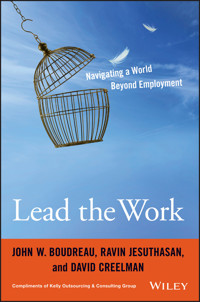
A detailed look at the evolution of employment and its far-reaching implications Lead the Work takes an incisive look at the evolving nature of work, and how it's affecting management and productivity at the organizational level. Where getting things done once meant assigning it to an employee, today's leaders are increasingly at risk if they fail to recognize that talent can float into and out of an organization. Long-term employment has given way to medium- or short-term employment, marking the first step in severing the bond that once fixed an individual inside an organization. Getting work done by means other than an employee was once considered a fringe event, but now leading organizations are accepting and taking advantage of the notion that talent has shown itself to be mutable. This book explores this phenomenon in detail and provides a new roadmap to help managers navigate this new environment. The workplace has undergone many changes over the years, but the emerging trend away from traditional employment represents a massive shift that has profound implications for the business model of every organization, large or small. This book describes how management is changing, and how managers must adapt to survive. * Examine the dispersed organization and the changing nature of employment * Learn how work is becoming impermanent and individualized * Find new strategies for managing and leading * Get up to speed on the decision science for the new era Workplaces evolve like biological beings; only the strong survive, and it's the competitive edge that ensures continued success. Lead the Work describes the new landscape, and shows you how to adapt and thrive.
Sie lesen das E-Book in den Legimi-Apps auf:
Seitenzahl: 493
Veröffentlichungsjahr: 2015
Ähnliche


















Table of Contents
Title Page
Copyright
Dedication
Foreword
Acknowledgments
Part One: The Background
Chapter 1: Leading Work—Not Managing Employees
Work: Escaping Traditional Regular Full-Time Employment
Work Is Leaving Organizations
Talent Platforms Optimize Freelancing
Seeing a Pattern in the Pieces
Notes
Chapter 2: Free Agent World
Why Employment Evolved, and What's Evolving Next
Problems in Job Land
The Less “Regular” Full-Time Job
The Starbucks Office and the Social Acceptability of Free Agency
From Free Agent Nation to Free Agent World
The Implications of Free Agent World
The Remaining Barriers to World Domination
Notes
Chapter 3: Outsourcing and Alliances
The Rise of Outsourcing
The Rise of Alliances
Notes
Chapter 4: The Talent Platforms
Upwork
Tongal
Topcoder
The Less “Regular” Full-Time Job
MTurk
Notes
Part Two: The Model
Chapter 5: Leading the Work Beyond Employment: A Decision Framework
How the Framework Deciphers the Work beyond Employment: The Case of Upwork
Chapter 6: How IBM Leads the Work
IBM's Open Talent Marketplace
The Assignment Agency: Optimizing Work in a Single Unit
The Lesson of IBM
Notes
Chapter 7: The Assignment: How Much to Deconstruct, Disperse, and Detach?
How Small to Deconstruct?
How Widely to Disperse?
How Far from Employment to Detach?
Unlocking the Code: Applying the Three Dimensions of the Assignment
Conclusion
Notes
Chapter 8: The New Organization: Permeable, Interlinked, Collaborative, and Flexible
Organizational Form
How Easily to Permeate?
How Strongly to Interlink?
How Deeply to Collaborate?
How Extensively to Flex?
Making Decisions about the Organization: Permeate, Interlink, Collaborate, and Flex
PICF Pictured
How PICF Makes Leading the Work Easier
Notes
Chapter 9: The Reward: Short-Term, Individualized, and Imaginative
Navigating Rewards beyond Employment
How Short the Time Frame?
How Specifically to Individualize?
How Creatively to Imagine the Reward?
The Value of the New Rewards for Leaders, Clients, and Workers
Optimizing the Reward Dials to Lead the Work: Netflix, Foldit, and SAS
Notes
Part Three: Implications
Chapter 10: Future HR Practices in Leading the Work
HR Beyond Employment: Work Engineering
The Talent Lifecycle
Planning
Attracting/Sourcing
Selecting
Deploying and Developing
Rewarding
Separating
Leading the Work by “Rewiring” HR
Notes
Chapter 11: Future HR Outcomes in Leading the Work
Engagement and Culture
Leadership
Diversity and Inclusion
Performance
The New HR Professional: Leader, Architect, Engineer, and Orchestrator of a Boundaryless Global Workplace
Notes
Chapter 12: Governance and Stakeholders
A Perspective on the Future of Unions
Some Closing Thoughts on Governance and Stakeholders
Notes
Chapter 13: Nations, Citizens, and Children
The Bright Side of a World Beyond Employment
The Dark Side of a World Beyond Employment
Who Is Right, the Optimists or the Pessimists?
What Should We Do?
Conclusion
Notes
About the Authors
Index
End User License Agreement
Pages
i
ii
iii
iv
v
vi
vii
xiii
xvii
xviii
xix
xxi
1
3
4
5
6
7
8
9
10
11
12
13
14
15
16
17
18
19
20
21
22
23
24
25
26
27
28
29
30
31
32
33
34
35
36
37
38
39
40
41
42
43
44
45
46
47
48
49
50
51
52
53
54
55
56
57
58
59
60
61
62
63
64
65
66
67
68
69
70
71
72
73
74
75
76
77
78
79
81
83
84
85
86
87
88
89
90
91
92
93
94
95
96
97
98
99
100
101
102
103
104
105
106
107
108
109
110
111
112
113
114
115
116
117
118
119
120
121
122
123
124
125
126
127
128
129
130
131
132
133
134
153
154
155
156
157
158
159
160
161
162
163
164
165
166
167
168
169
170
171
172
173
174
175
177
178
179
180
181
182
183
184
185
186
187
188
189
190
191
192
193
194
195
196
197
198
199
200
201
202
203
204
205
206
207
208
209
210
211
212
213
214
215
216
217
218
219
220
221
222
223
224
225
226
227
228
229
230
231
232
233
234
235
236
237
238
239
240
241
242
243
244
245
246
247
248
249
250
251
252
253
255
256
257
258
259
260
261
262
263
264
265
266
267
268
269
270
271
272
273
274
275
276
277
Guide
Cover
Table of Contents
Foreword
Part One: The Background
Begin Reading
List of Illustrations
Chapter 1: Leading Work—Not Managing Employees
Figure 1.1 The Casual Look: United States, Percentage of Employed
Figure 1.2 Alternative Models For Leading the Work
Chapter 2: Free Agent World
Figure 2.1 Increasing Payroll and Benefits Costs
Chapter 5: Leading the Work Beyond Employment: A Decision Framework
Figure 5.1 “Lead the Work” Map
Figure 5.2 Unlocking the “Lead the Work” Code
Chapter 6: How IBM Leads the Work
Figure 6.1 Unlocking the “Lead the Work” Code (Reprise)
Figure 6.2 IBM's Open Talent Marketplace Process
Chapter 8: The New Organization: Permeable, Interlinked, Collaborative, and Flexible
Figure 8.1 PICF in Pictures
Figure 8.2 Organization Chart Including External Relationships
Figure 8.3 An Interlinked and Collaborative Value Chain
Chapter 9: The Reward: Short-Term, Individualized, and Imaginative
Figure 9.1 Traditional Individualization Is Optimum
Figure 9.2 Individualizing for Top Performers Is Not Optimal
Figure 9.3 Value of Higher Performance Is Much More Than the Value of Moderate Performance
Chapter 10: Future HR Practices in Leading the Work
Figure 10.1 HR and the Lead the Work Framework
Chapter 11: Future HR Outcomes in Leading the Work
Figure 11.1 HR and the Lead the Work Framework
Chapter 12: Governance and Stakeholders
Figure 12.1 Longer Exchanges Have Greater Impact
Praise for Lead the Work
“The new world of work has new ways of working. Boudreau, Jesuthasan, and Creelman brilliantly capture the increasingly granular and customized work world where more employees will be free agents. This forward-thinking book offers creative and relevant insights for managing employees as agents. It has implications for leaders, human resources, rewards, and employees.”
—Dave Ulrich, Rensis Likert Professor of Business, University of Michigan, and Partner, The RBL Group
“Anyone leading an organization through the rapidly changing and challenging landscape of today's workplace will find Lead the Work tremendously valuable. Boudreau, Jesuthasan, and Creelman expertly chronicle how work has evolved into multiple methods of employment, focused less on managing employees and more on providing work-based leadership. They give concrete advice on how organizations can thrive in this environment. The concept of ‘beyond employment’ will soon be commonplace to business leaders.”
—Henry G. Jackson, President and Chief Executive Officer, Society for Human Resource Management
“Lead the Work invites business leaders to free their minds from the shackles of traditional regular full-time employment. The book provides a framework that enables us to embrace examples like Elance-oDesk, Tongal, and Khazanah not as anomalies but as potential solutions to getting the work done and sourcing the best talent. Lead the Work pushes the boundaries of flexibility in work arrangements to a future where we not only just build or buy talent but also borrow and share talent.”
—Johan Mahmood Merican, Chief Executive Officer, TalentCorp
“How leaders and organizations assemble the right teams of talent today is rapidly evolving to utilize teams of much more than just permanent employees, temporary help, and outsourcers. I have seen this to be true across the globe…a globe that has fewer and fewer borders when it comes to customers and talent. The focus on the ‘workers,’ the ‘client,’ and the ‘work’ in Lead the Work brings all the pieces together of how organizations need to deliver value to their customers, both today and tomorrow. Innovation of how to find and utilize talent is going to be a differentiator, both in professional services organizations and beyond. Lead the Work does an excellent job of describing what the trends are, brings them to life by showcasing real examples that expand your thinking, and helps to alleviate any fears about this new talent marketplace.”
—Jill Smart, President, National Academy of Human Resources, and retired Chief Human Resources Officer, Accenture
“The world of work is changing fast—creating more complexity and breeding disengagement. Boudreau, Jesuthasan, and Creelman take a comprehensive look at the changes happening outside our companies that are affecting how we get work done together inside our companies. After exploring the diverse ways in which we now connect people with the work we need done, they offer us a convincing framework for designing our enterprises, organizing work, and constructing deals to offer workers. Fortunately, this framework clearly shows leaders the few critical levers to pull to create new work arrangements that deliver on the value agenda. Wisely, the authors also engage with tough questions about the impact this new framework will have on society and the roles of leaders, HR departments, and government. Lead the Work enlightens us all—as leaders, workers, and citizens—about how we can still accomplish great things together in the midst of this turbulence.”
—Sandy Ogg, Operating Partner, Private Equity Group, Blackstone
“Lead the Work explores a seismic shift in the very concept of work. For anyone looking for a fresh way to think about competing, innovating and leading, Lead the Work will stimulate your creativity and give you new ideas on how to tap into an emerging “free agent world.” This new virtual workplace being built by a diverse, multi generation workforce hinges on individuals leveraging their skills to build portfolios of work that seamlessly integrate into the lives they want to lead.
The new book by Boudreau, Jesuthasan and Creelman makes an intriguing argument that traditional employment approaches are migrating to innovative and agile ways of tapping into new talent pools. The authors paint a compelling picture of workplace innovations that challenge convention to compete in an open, global and virtual talent marketplace. The challenge lies in how to lead in this new world.
The best managers in this new paradigm bring together flexible teams and distribute work to those best skilled to deliver, more quickly and cost effectively than traditional approaches. Convening and motivating a network of “followers” who you may never physically meet, requires new ways of leading, orchestrating and collaborating, along with new rules of engagement.
Lead the Work is a fresh, insightful way to think about work, how it is done and who does it. It challenges us to make potentially radical shifts in the way we need to lead and compete. The authors deliver a wake-up call with numerous real world business examples that make the case this is not a temporary trend, but rather a pivotal inflection point. The highest impact insight is that the basic concepts of work, employee and leader must be reinvented in a world where individuals seek to be the “CEO of me.”
As a former Chief HR Officer and alum of five global fast paced consumer and technology companies, Lead the Work challenged my thinking about new ways to lead and innovate with the talent of today and tomorrow.”
—Eva Sage-Gavin, Vice Chair, Aspen Institute's Skills for America's Future Advisory Board, formerly Executive Vice President, Human Resources and Corporate Affairs, Gap, Inc.
“Knowing how to manage the multitude of contractors, vendors, and temps who now work side by side with our regular employees is a crucial skill, and Lead the Work shows us how to do it right.”
—Peter Cappelli, George W. Taylor Professor of Management and Director of the Center for Human Resources, Wharton School of Business, University of Pennsylvania
“The traditional employment relationship has evolved to a place of free agency where employees are the CEOs of ‘self, incorporated’ in a flat, interconnected, dynamic, and creative world. John, Ravin, and David take a new and refreshing look at how the relationship has evolved to better enable organizations and their leaders to achieve business objectives through employment relationships some may view as fickle, but which others appreciate as the new normal.”
—Scott Sherman, Executive Vice President, Human Resources, Ingram Micro
“The way in which work gets done, by whom, and how, is changing quickly and dramatically. Everything it seems is being “disrupted”, including the process of workforce planning. The models of employment and organization that have evolved slowly and predictably, are soon to be extinct or irrelevant in whole or in part. Lead the Work is a must read for business leaders, particularly Human Resources executives, who must adapt or wither, even if they don't yet realize it. This book, greatly advances our understanding of what these changes are, what they will be, and most importantly, provides great insight into how to move your enterprise into this new world. This is an orientation to what is to become of HR and the management of human capital. A total “Aha” experience. I have seen no research which comes close to this.”
—James J. Duffy, Chief Human Resources Officer, Ally Financial Inc.
“Changing demographics, changing worker values and preferences, changing technologies…these all drive leaders to consider changing approaches to how work gets done in and through organizations. In Lead the Work, Boudreau, Jesuthasan, and Creelman detail how these trends have transformed work and caused many to question the traditional employment model. They provide examples of companies that have successfully leveraged innovative approaches to work arrangements to provide quicker, more efficient, and—more importantly—more effective means of competing. This book will give leaders strategies, tools, and ideas for how to do the same in their organization.”
—Patrick M. Wright, Director, Center for Executive Succession, and Thomas C. Vandiver Bicentennial Chair in Business, Darla Moore School of Business, University of South Carolina
“Lead the Work delivers revolutionary thinking about the emerging transformation in how work will be done in the future, as well as when, where, why, and by whom it will be done. This book contemplates a world beyond traditional employment models. It asks and answers the crucial yet frightening question—what would happen if the traditional employment model gave way to more bite-sized, freelanced, project-based, shorter-term gigs? It not only addresses this question, but also challenges us to rethink the implications of blowing up and refashioning long-held assumptions about leadership, organizational operating models, workforce engagement, culture and purpose, and the future of the human resources profession, to name a few.
“Imagine a world of work where most (or a significant percentage) of the people doing the work are not our employees, but rather freelancers who have complete control over what work they choose to do, when they choose to do it, where they choose to do it, with whom they choose to do it, and why they choose to do it. Imagine the implications of leading the work rather than the employees doing the work.
“Boudreau, Jesuthasan, and Creelman get our attention, question our assumptions, capture our imaginations, shake us up, and help us see all will be all right—but not before they teach us what we have to do to reshape the role of leaders and organizations. After reading Lead the Work, you will never think about leadership, work, or the workforce in quite the same way again.”
—Ian Ziskin, President, EXec EXcel Group LLC, and former Chief Human Resources Officer of Northrop Grumman and Qwest Communications
“Finally a book that takes us into the rapidly evolving nature of work and how workers and organizations will respond! The authors have provided the first book to enable HR leaders and organizations to better understand where work is going and to create tools and methods to respond to these changes.”
—Libby Sartain, former CHRO, Yahoo! and Southwest Airlines, and Director, Manpower Group and AARP
“As a board member of the Institute for the Future and a former CHRO in Silicon Valley, I have become very aware that we are moving from a world of hierarchical organizational structures toward a world where human resources can be digitally activated, deactivated, and reconfigured to come together as needed and where needed. In its best form, workers from all over the globe will be empowered to choose when, where, and how they work. Many will choose to be their own employers. Those who continue to align with a specific institution will expect equivalent opportunity and flexibility, and the challenge of building a productive work community in this kind of environment will call upon new forms of leadership. John, Ravin, and David's look at the evolution of work has arrived not a moment too soon. It is time that every person who occupies a position of leadership or aspires to be a leader fully appreciates this new world of work, and this well-grounded research is an important step in that direction.”
—Debra Engel, board member, Institute for the Future, and former Senior Vice President of Corporate Services, 3Com
“The authors have very thoughtfully and clearly described the opportunity for companies to deconstruct work into ‘tangible deliverables,’ and then source the work from new and rapidly evolving labor pools. Those who are tracking the dynamics of these evolving labor pools understand that the ‘free-agent workforce’ is well represented by workers who are described as ‘creatives.’ Shopping in that labor pool is important if you believe creativity is critical to your future business performance. Executing these ideas will be nontrivial, and will require nontraditional thinking and methods. CHROs will have an important role in these transformations, but the success of changes of this scale requires the full alignment of the CEO and the executive team.”
—John S. Bronson, Bronson Consulting LLC; formerly Vice President of HR, Williams Sonoma, and Executive Vice President, Pepsi-Cola Worldwide
“Boudreau, Jesuthasan, and Creelman invite us into the new world of work, where technology disrupts markets and businesses, where the democratization of work empowers the individual employee and drives enhanced employee choice, and where work models emerge from other domains, such as sports or moviemaking, where ‘loaning talent,’ free agency, or assembling project-based production teams is the norm. They introduce this world through a series of contemporary, diverse examples ranging from the established infrastructure of IBM to Topcoder, an online community that ‘gathers the world's experts in design, development, and data science to work on interesting and challenging problems.’ They urge today's leaders to step boldly into this complexity and ambiguity, and provide a framework to guide their journey. That framework is accessible and compelling, whether you are a chief executive officer, a business unit leader, an academic, or a human capital professional. As a former chief human resources officer, I suggest that HR leaders read this book with their CEOs, business unit leaders, and leadership teams. Use it as an organizational diagnosis and to develop a road map for this ‘brave new world of work.’”
—Kaye Foster-Cheek, Senior Advisor, Boston Consulting Group, and former Chief HR Officer for Onyx Pharmaceuticals and Johnson & Johnson
“Future organizational challenges require rethinking fundamental assumptions, and some of the most important assumptions have to do with work and workers. Achieving success through talent is the job of corporate officers, boards, managers, workers, citizens, and governments. Lead the Work offers CEOs a thoughtful framework for navigating the rapidly evolving nature of how work gets done. It is a forward-looking guide to the future, with useful, important, and practical insights for operating in today's environment as well. CEOs should read this book together with their heads of HR, their extended leadership teams, and their boards. This book clearly describes a future that is approaching fast, with an important vision for leadership and human resource management.”
—Laurie Siegel, Director, CenturyLink and Volt Information Sciences, and former CHRO, Tyco International
Lead the Work
Navigating a World beyond Employment
John Boudreau
Ravin Jesuthasan
David Creelman
Copyright © 2015 by John Boudreau, Ravin Jesuthasan, and David Creelman. All rights reserved.
Published by John Wiley & Sons, Inc., Hoboken, New Jersey.
Published simultaneously in Canada.
No part of this publication may be reproduced, stored in a retrieval system, or transmitted in any form or by any means, electronic, mechanical, photocopying, recording, scanning, or otherwise, except as permitted under Section 107 or 108 of the 1976 United States Copyright Act, without either the prior written permission of the Publisher, or authorization through payment of the appropriate per-copy fee to the Copyright Clearance Center, Inc., 222 Rosewood Drive, Danvers, MA 01923, (978) 750-8400, fax (978) 646-8600, or on the Web at www.copyright.com. Requests to the Publisher for permission should be addressed to the Permissions Department, John Wiley & Sons, Inc., 111 River Street, Hoboken, NJ 07030, (201) 748-6011, fax (201) 748-6008, or online at http://www.wiley.com/go/permissions.
Limit of Liability/Disclaimer of Warranty: While the publisher and author have used their best efforts in preparing this book, they make no representations or warranties with respect to the accuracy or completeness of the contents of this book and specifically disclaim any implied warranties of merchantability or fitness for a particular purpose. No warranty may be created or extended by sales representatives or written sales materials. The advice and strategies contained herein may not be suitable for your situation. You should consult with a professional where appropriate. Neither the publisher nor author shall be liable for any loss of profit or any other commercial damages, including but not limited to special, incidental, consequential, or other damages.
For general information on our other products and services or for technical support, please contact our Customer Care Department within the United States at (800) 762-2974, outside the United States at (317) 572-3993 or fax (317) 572-4002.
Wiley publishes in a variety of print and electronic formats and by print-on-demand. Some material included with standard print versions of this book may not be included in e-books or in print-on-demand. If this book refers to media such as a CD or DVD that is not included in the version you purchased, you may download this material at http://booksupport.wiley.com. For more information about Wiley products, visit www.wiley.com.
Library of Congress Cataloging-in-Publication Data
Boudreau, John W.
Lead the work : navigating a world beyond employment / John Boudreau, Ravin Jesuthasan, David Creelman.
pages cm
Includes index.
ISBN 978-1-119-04004-0 (hardback)
ISBN 978-1-119-04006-4 (ePDF)
ISBN 978-1-119-04007-1 (ePub)
1. Contracting out. 2. Consultants. 3. Self-employed. I. Jesuthasan, Ravin, 1968- II. Creelman, David, 1957- III. Title.
HD2365.B665 2015
658.3′01–dc23
2015018223
Cover Design: Wiley
Cover Image: ©iStock.com/george tsartsianidis
To the free agents and free-spirited employees and colleagues, including my daughter and wife, whose stories bring life to a new world of work
—John Boudreau
To my colleagues at Towers Watson and the members of St. Paul and the Redeemer Church in Chicago who continually inspire me with their random acts of kindness and love
—Ravin Jesuthasan
To the free agents of the world who are striving, not without difficulty, to invent a new way of work.
—David Creelman
Lesen Sie weiter in der vollständigen Ausgabe!
Lesen Sie weiter in der vollständigen Ausgabe!
Lesen Sie weiter in der vollständigen Ausgabe!
Lesen Sie weiter in der vollständigen Ausgabe!
Lesen Sie weiter in der vollständigen Ausgabe!
Lesen Sie weiter in der vollständigen Ausgabe!
Lesen Sie weiter in der vollständigen Ausgabe!
Lesen Sie weiter in der vollständigen Ausgabe!
Lesen Sie weiter in der vollständigen Ausgabe!
Lesen Sie weiter in der vollständigen Ausgabe!
Lesen Sie weiter in der vollständigen Ausgabe!
Lesen Sie weiter in der vollständigen Ausgabe!
Lesen Sie weiter in der vollständigen Ausgabe!
Lesen Sie weiter in der vollständigen Ausgabe!
Lesen Sie weiter in der vollständigen Ausgabe!
Lesen Sie weiter in der vollständigen Ausgabe!
Lesen Sie weiter in der vollständigen Ausgabe!
Lesen Sie weiter in der vollständigen Ausgabe!
Lesen Sie weiter in der vollständigen Ausgabe!
Lesen Sie weiter in der vollständigen Ausgabe!
Lesen Sie weiter in der vollständigen Ausgabe!




